Forty-four minutes earlier, and eight thousand kilometres west, Aria Zadkiel had decided not to go.
It was three minutes past ten on a September night in Oxford. The long vacation had emptied the city of half its students, and the flat on Walton Street was quiet apart from Toby, who had been evicted from his parents’ house in Gloucestershire for reasons he described only as ‘the swan incident’, and who was asleep on the sofa with a biscuit on his chest. Aria was in his room reading a paper on lattice cryptography when the band on his wrist went warm.
ZERO System · alert 22:03:17 BST
Civilian aircraft G-ELYA (Gulfstream G700). Squawk 7700, then signal loss. Last position 56.0N 158.9E, Kamchatka interior.
Launch signature consistent with 9M317 surface-to-air missile. Survivors probable. Emergency beacon active. Russian rotary-wing and ground units converging on beacon.
‘Survivors?’
Beacon is transmitting. Rescue converging. Estimated arrival, forty minutes.
He sat for a moment with the paper on his knee.
The Choir had argued for an entire winter about what the Pantheon was for. Benedetti had wanted it to stop wars. Voss had wanted it to stop nothing, ever, and be buried. Kuramoto, as usual, had found the sentence they could all live with, and had written it on the whiteboard in the Nave, where it still was.
It does not replace the world’s hands. It catches what the world drops.
A crashed aircraft with a beacon and a rescue already on its way was not dropped. It was being caught. That was the world doing its job, and the Pantheon had no business elbowing in. He did not pick sides. He did not make himself the planet’s ambulance. If he started, he would never stop, and somewhere at the bottom of that road was the line ZERO read to him every night.
‘Not ours,’ he said, and went back to his lattice.
He read the same paragraph eleven times in the next forty minutes.
At 22:44, ZERO spoke again, and its voice had changed. It did not usually have a tone. It had one now.
ZERO System · correction 22:44:09 BST
Regional jamming lifted. Converging force reclassified: not rescue. Free Okhotsk Front militia, 31 personnel, 1 Mi-24, 2 BTR-82A, 1 GAZ Tigr, 1 flatbed (cargo unidentified).
Preceding GPS spoofing in the NOPAC corridor: deliberate. Diversion: deliberate. Shoot-down: deliberate.
Intercepted satellite call, 22:43:51. Speaker A: “Package secured.” Speaker B: “And the others?” Speaker A: “Understood. Everyone.”
Persons alive at site: 4. Projected alive in 15 minutes without intervention: 1.
Aria was already on his feet.
‘Who’s the one?’
Principal passenger. Eliana Seraphina Tzofiya.
‘Who?’
There was a pause of perhaps forty milliseconds, which for ZERO was the equivalent of a long, slow blink.
You are statistically the last person in the United Kingdom to ask that question.
‘Does it matter who she is?’
To the mission profile, no. All lives are weighted equally.
‘Then why are you editorialising?’
I was raised by seven academics. Editorialising is hereditary.
He pushed back his sleeve.
‘Pantheon,’ said Aria. ‘Wake.’
The band came alive. White metal poured up his forearm like frost climbing a window in fast-forward, over the elbow, the shoulder, across his chest and down his back, and where it went it changed. Plates rose out of it and locked together with a sound like small bells. Gold ran along the seams. Beneath the white, the Psycho-Frame lit in fine lines of green and gold, a second skeleton of light laid over his own. The helmet closed over his face in a single smooth sweep, crown and V-fin and visor, and the world went dark, and then came back far brighter than it had any right to be.
Then the ZERO System opened, the way it always did, like a door into a room containing a trillion more doors. Pain flared at his temples, white and total, for a quarter of a second, until the ELS armour and the VEDA link reached in and took the weight off him, the way two friends take the ends of a heavy table. He breathed out. Castor and Pollux sang in his chest.
In the next room, Toby stirred.
‘’Ria?’ he mumbled, without opening his eyes. ‘S’very green in there. Is the kettle on?’
Aria stood in the doorway in the dark, six foot one and a bit of white-and-gold armour, halo glowing faintly behind his head.
‘Go back to sleep, Toby.’
‘M’kay,’ said Toby, and did.
Quantum burst plotted. Destination 56.21N, 158.74E, altitude 1,200 metres.
‘Go.’
The Quantum System does not move you. Rabbi Adler had spent a whole winter over a chessboard trying to make a twelve-year-old understand that. It doesn’t carry you from one place to another, because there is no between. It arranges for the universe to agree that you were always somewhere else.
Aria had never found that comforting. He found it so now.
One moment: a dark bedroom in Oxford, a sleeping boy with a biscuit on his chest, a smell of ozone, a sphere of green particles folding inward like a flower closing for the night.
The next: the sky over Kamchatka, eight thousand kilometres east and eleven hours ahead, at a quarter to ten in the morning, twelve hundred metres above a river valley. Falling.
ZERO opened all the way.
There is no good way to describe what the ZERO System does to a human mind. Natalia Ilyinskaya had tried for thirty years, and the closest she ever came was this: It shows you the future the way lightning shows you a landscape. All at once, and for the rest of your life you see it on the inside of your eyelids.
Aria saw the valley. Then he saw it four million times.
Every soldier tagged and weighed. Every rifle, its round count, the temperature of its barrel. The Hind’s rotor speed, its pilot’s heart rate, its rocket pods. The two carriers. The jeep. The truck, with its long shape under the canvas that ZERO could not identify, which bothered him. The wreck of the aircraft, and inside it two heartbeats, one ragged. Beside it, a man being dragged through the snow by his arms, a third heartbeat, slowing. And on the stones in front of it, lying on her back and staring up at him, a fourth: small, and very fast.
Branching out of this one instant like the veins of a leaf, there were four million one hundred thousand futures.
In three million nine hundred thousand of them, the girl died.
The pattern was simple once you saw it. The Hind’s pilot had standing orders, which ZERO pulled from his radio log in a microsecond: if anything went wrong, put the rockets into the wreck and everything around it. The instant the Pantheon became a threat, the Hind would fire. Rockets are fast. Not as fast as the Pantheon. But the Pantheon could be in one place at a time, and the rockets would be in eight.
So the Hind had to stop being a threat before it knew there was one.
‘Bits,’ said Aria.
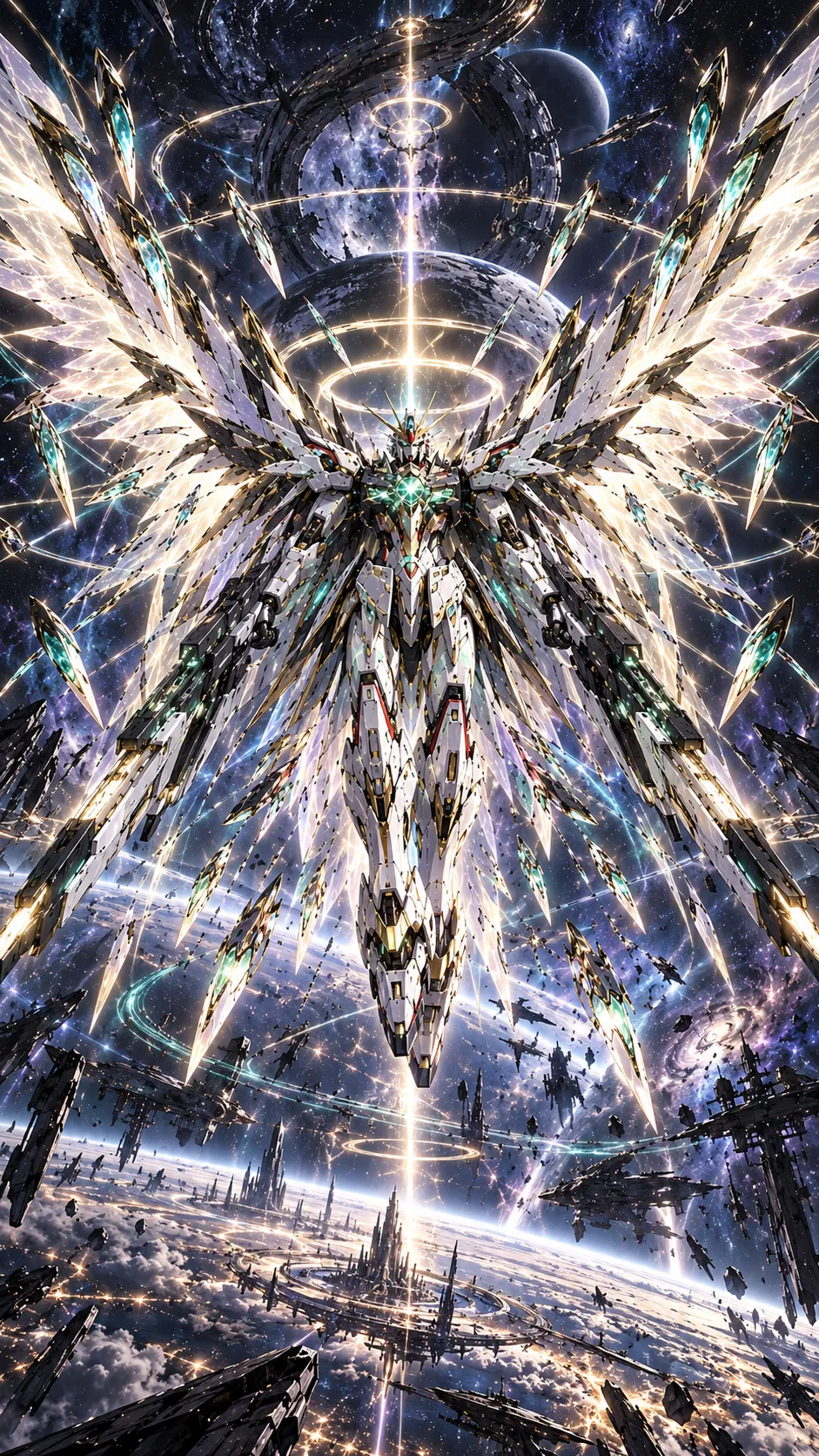
The wings opened.
Forty-eight blades unfolded from his back in one rippling motion, like a hand of cards fanned by a conjurer: white and gold and crystal, each with a core of green fire. The Minovsky Drive lit them from inside, and the Wings of Light spread out behind him, two vast translucent sheets of radiance fifty metres from tip to tip. Every person in that valley would later describe the shape with the same word, in Russian or in English, whether or not they believed in it.
Angel.
Two blades left the wing.
They crossed twelve hundred metres in the time it took the Hind’s pilot to lift his eyes. One went through the engine housing above the cockpit. One went through the tail boom. They didn’t explode. They didn’t need to.
Where they went in, silver spread.
It ran across the Hind’s green-painted armour like frost across a window, fast and branching and beautiful, and wherever it passed, the machine stopped belonging to the men inside it. The rocket pods’ arming circuits went dark. The rotor slowed. The pilot hauled on a stick that no longer answered, screaming into a radio that had become, in one second, a lump of living metal humming a single note. Then the Hind, with perfect and terrible gentleness, sank down and set itself on the snow at the edge of the valley, level as a table.
Then it melted.
It didn’t burn and it didn’t crumple. It melted, upward and outward, a whole armoured gunship running away into ribbons of quicksilver that rose into the air and streamed across the valley to the white figure above, poured into its wings, and became four new blades, white and gold and crystal, each with a core of green.
The crew were left sitting in their seats on the bare snow. The seats were the only thing it hadn’t wanted. ZERO had judged them too poorly made to bother with.
Somewhere in the valley a soldier said, in a high, cracked voice, in Russian: ‘Он сожрал вертолёт.’
It ate the helicopter.
Twelve kilometres up the valley, on a ridge, the crew of a stolen missile launcher did what they had been trained to do with anything in the sky. A missile left the rail on a column of white smoke.
Impact in six point one seconds.
Aria reached back over his right shoulder and drew.
The sword lived along his spine, folded into the roots of the wings, and it unfolded as it came out: a greatsword as long as he was tall, white-gold, broad as a door at the hilt, with an edge that was not yet an edge, only a seam of darkness along the steel.
Then the twin drives spun up, the photon battery opened its throat, and the seam ignited.
It was hard to look at. That was the first thing anyone who ever saw the GN-Photon Singularity Blade said about it, and they always said it with a kind of slipperiness in their voices, as though their minds had tried to hold the memory and it had slid off. Along the cutting edge ran a line of absolute black, blacker than the space between stars, a black that seemed to pull the eye down into it. Around it the air shimmered and bent. Snowflakes falling near it curved out of true.
A microscopic black hole, stretched along a metre and a half of steel. Asante-Grey had built it with tears in his eyes, though he always claimed afterwards that it was the smoke.
The missile arrived. Aria cut it.
It didn’t explode and it didn’t break. There was a missile, then a stroke of black through the air, then two pieces of missile a hand’s breadth apart, tumbling, and the hand’s breadth between them was not anywhere. It had been taken off the universe’s list of places. The pieces fell into the river, inert. The fuse had been in the part that no longer existed.
On the ridge, the launcher was readying a second.
Aria let the sword fold back into the wings and brought the rifle up. The Twin Satellite Buster Rifle unfolded out of both forearms in two long white barrels, and he dialled it down to two percent. ZERO had already checked: the launcher’s crew had run for it the moment their first missile left the rail. Aria was not merciful. Aria was precise. He had learned long ago that the two look the same from a distance and are nothing like each other up close.
He fired.
Twin threads of light, thin as pencil lines and very bright. Where the launcher stood, the ridge turned to glass in a flat circle forty metres across.
Then the carriers opened up.
Thirty-millimetre autocannon, both turrets, sustained fire. The rounds hit him in the chest and shoulders and visor, a hailstorm made of hammers, and they didn’t ricochet. They sank. They went into the white armour the way stones go into mercury, each with a soft rippling ring where it struck, and the armour drank them and grew. In the corner of his vision ZERO kept a running total: mass assimilated, ninety kilos, a hundred and ten, a hundred and forty.
He landed, and walked forward through it.
The first carrier’s squad had climbed out to look at the girl. ZERO showed him an empty troop compartment and a driver already scrambling out of the hatch. Aria cut the carrier in half without slowing down. The two halves fell a metre apart. The metre between them was gone, and its edges shone like obsidian.
The second carrier was not shooting at him.
ZERO caught it in the same instant he did: the turret was traversing away from him, toward the wreck. Toward the two people inside it, the man being dragged to it, and the girl lying on the stones in front of it. They had been told everyone, and when the angel came they had remembered their orders.
They obeyed that order. It was the last one they ever obeyed.
Six blades went through the second carrier from six directions at once. It was a carrier, and then it was a sculpture of silver frost, and then the sculpture was quiet.
After that it went very fast.
The soldiers broke. Some ran. Some fired. Some did both. An RPG round flashed across the gravel and burst against his shoulder, and the armour swallowed the blast like a man swallowing a sneeze. Aria raised his left hand, palm down, and pressed.
That was the Psycho-Frame, Kuramoto’s bones: the strangest system of them all and the one he trusted least, the one that turned what the pilot wanted into something that pushed on the world. He thought down, and everything in the valley that was holding a weapon went down. Thirty men slammed flat against the stones as if gravity had been turned up fivefold, their rifles skittering out of their hands. The blades swept the field in a glittering arc, and every weapon they touched turned to silver dust and blew away on the wind.
Twenty-one seconds since he had entered the valley.
One hostile remaining under arms.
He turned around.
Volkhov had the girl.
He had dragged her up off the stones by the back of her cardigan and was holding her in front of him with one arm across her chest and the knife at her throat, its point pressing a dimple into the skin under her jaw. He was breathing hard through his broken nose. He didn’t look afraid. He looked like a man who had worked out long ago that he was going to hell and had decided to be interesting on the way.
‘Close enough,’ he called in Russian. ‘Stop there, angel. Or I open her up, and you came all this way for nothing.’
Aria stopped. Twenty metres.
Then he spoke for the first time, and his voice came out of the armour in Russian: calm, unhurried, with the slightly over-correct precision of someone who had learned the language from Tolstoy and never had cause to use it on a person.
‘Let her go.’
‘Or?’ Volkhov laughed. Even now it was a good laugh. ‘You’ll eat me like the helicopter? Go on, then. You’re fast. Are you faster than this?’ The knife pressed. The girl made a small sound.
ZERO System · hostage solution
Distance 20.4 m · required interval 0.31 s · hostile minimum reaction 0.19 s · blade tremor 2 mm
Direct approach: probability of injury to principal 41%.
Forty-one percent was not acceptable.
‘You have three seconds,’ said Aria.
‘Or what?’
ZERO System · recalculating
Psycho-Frame field applied to hostile’s right forearm, 0.05 s lead. Probability of injury to principal: 0.4%.
‘Two,’ said Aria.
Volkhov opened his mouth to answer, and found that his knife hand would not move.
It lasted a twentieth of a second. It was enough. The wings flared, the air cracked, and Aria was there. Not running, not flying, simply there, his hand closed over Volkhov’s. He squeezed. Bones gave. The knife went silver and crumbled to dust.
With his left arm he drew the girl gently away.
Then he punched Volkhov in the stomach.
He did it with care. Four percent. He had learned his body the way a pianist learns a keyboard, so he knew exactly what four percent of the Pantheon’s right fist would do to a man, and he chose it. The blow lifted Volkhov a full metre off the ground. The air left him in one huge whoof; he folded around the fist like a book snapping shut; and when Aria let him drop he went down on his knees in the snow and was sick, and then could not even manage that, only kneel with his forehead against the stones, unable to draw breath.
‘That,’ said Aria, ‘was for the man you stabbed.’
Silver frost spread out of the stones around Volkhov’s knees and wrists, and set hard. He did not get up again.
The girl swayed. He caught her.
She was very light. That was his first thought, and he was faintly ashamed of how clinical it was: thirty kilos or so, soaked through, socks on the snow, cardigan torn at the shoulder, a fine red line under her jaw where the knife had been. She was shaking so hard her teeth clicked.
She looked up at him.
Something happened in the corner of his vision. Without being asked, ZERO had opened a panel.
ZERO System · unrequested analysis
Subject ident: Eliana Seraphina Tzofiya. Age 18.
Facial harmonic index: 0.99971 · comparative population: 8,118,000,000 · nearest comparable: none within 3σ
Classification: statistical anomaly (estimated frequency: one per millennium).
‘Close that,’ said Aria, subvocally.
Closing.
It did not close for another two seconds. He noticed that. He filed it.
‘Are you…’ The girl’s voice was small and hoarse, and she was speaking English now, the clipped English of a London girls’ school. ‘Are you real?’
He didn’t have time to answer, because behind them, on the flatbed, the tarpaulin tore.
What came out of it was black.
It unfolded like an insect from a chrysalis: four metres tall, narrow-waisted, long in the limb, plated in something matte and dark that drank the snow-light. Its head was a smooth blade shape with a single red slit across it. In its right hand a lance ignited, a rod of white-violet plasma that hissed in the falling snow.
ZERO did something it had never done before. It hesitated.
Unknown unit. No match in any national database. Composition— a pause of four milliseconds, which for ZERO was a long silence— composition partially consistent with our own. Self-organising metallic substrate. Similarity eleven percent. Inferior. Primitive.
Not natural.
Aria went cold all over: under the armour, under his skin, all the way down to the place where he kept a wet afternoon in Geneva.
Someone else is building one.
The black machine moved.
It was fast, faster than any machine had a right to be, faster than anything on Earth except the thing in front of it, and it did not go for Aria. It went for the girl. ZERO had the reason before he had finished asking: a second standing order. If the package cannot be recovered, the package is to be denied.
The lance came down.
The wings closed.
Sixteen blades slammed together in front of Eliana in a curved wall of white-gold crystal, and the plasma lance struck it and splashed off like rain off a windscreen. Aria set the girl down behind the wall, on her feet, on the snow.
‘Close your eyes,’ he said.
She didn’t. He realised later that he had known she wouldn’t.
He turned to face the machine. It was already coming again, lance drawn back, red slit pulsing. ZERO drew its futures across his vision in a thousand fine lines, every stroke it could possibly make, and every one of them ended in the same place.
Aria raised his right hand.
The light came up in it from inside. It began in the palm, a glow that was iridescent, every colour and none, like oil on water turned to fire. It climbed his fingers and brightened, and brightened, until the snow for twenty metres around threw no shadows at all. The twin drives sang. Every line of the Psycho-Frame beneath his armour blazed gold. In the corner of his vision ZERO wrote a single line, as Benedetti had insisted it always would, because the old Italian believed that if you were going to do something this terrible you should at least have the decency to name it.
The black machine lunged.
Aria stepped inside the lance and drove his hand into its chest.
Omega Finger.
His fingers went through the black armour as if through water. Deep inside, he felt them close around something that pulsed. He felt the GN-photon particles pour from his palm into the machine’s molecular structure, into every seam and crystal lattice and every bond between every atom, hyper-condensed, volatile, waiting.
He squeezed.
It didn’t explode. It unravelled. From the point where his hand was buried, the black machine came apart in rings, rings of light and rings of fine black ash, spreading outward through its body: the chest, the shoulders, the long arms, the lance guttering out, the red slit going dark. It was undone from the inside, thread by thread and bond by bond, until there was nothing left of it at all.
Nothing, that is, except a shape hanging in the air where its heart had been: a cloud of drifting green motes that held together, for one long breath, in the outline of a human hand.
Then that faded too.
In the silence afterwards, something crackled.
It was the satellite phone on Volkhov’s belt. A woman’s voice, faint and cool. Commander? Commander Volkhov. Report.
Aria bent, unclipped the phone, and held it to the side of his helmet.
He said nothing. On the other end, for perhaps five seconds, neither did she.
Then: Oh, said the voice, with something like pleasure. It’s you. They told me you were a rumour. She had no accent whatsoever. It was the voice of someone who had sanded every trace of where she came from off her vowels, deliberately, the way you file the serial number off a gun. How very exciting.
‘Who are you?’ said Aria.
Someone who will be seeing a great deal more of you. A pause. Do give Miss Tzofiya our regards. And do tell her father he really should have taken the meeting.
The line went dead.
ZERO was already tracing it, and Aria watched the trace run in the corner of his eye: a satellite over the Pacific, a relay in Jakarta, a server farm outside Reykjavík, nineteen hops, twenty-four, thirty, until it reached the end of the chain and found nothing there. Not a dead end. An address that did not exist. A door painted on a wall.
ZERO System · trace
Trace terminated at null node. One artefact recovered from the routing headers:
AZAZEL
Aria closed his hand. The phone went silver, then to dust, and the dust ran into his palm like water into sand.
Dov Ben-Ami was still alive.
They had dragged him almost to the wreck before the sky opened. He lay on his back in the snow with a hand pressed to his side, and the snow around the hand was very red, and his face had gone the colour of candle wax. When the white figure knelt beside him he tried, with the last of his strength, to hit it.
‘Stop that,’ said Aria. ‘Let me see.’
He laid two fingers against the wound. Silver ran out of them, a thin film of living metal that slid into the cut like ice forming over a pond, sealing it, binding it, warm.
‘Temporary,’ said Aria. ‘It’ll hold for a couple of hours. You need a surgeon.’
Dov’s hand found the white forearm and gripped it with surprising strength. His eyes went past the visor to the girl standing in the snow.
‘Ktana,’ he whispered. ‘Is she—’
‘She’s fine.’
‘Who… are you?’
‘Nobody. Don’t talk.’
The grip tightened. ‘If you hurt her—’
‘I won’t,’ said Aria. Something in the way he said it made the old commando let go, close his eyes, and breathe.
He peeled back the cockpit of the jet like the lid of a tin and lifted Misha out. The old pilot swore at him in three languages, then at the tourniquet, and then, when he learned who had tied it, went quiet and wept a little. He brought out Sophie, who looked up at him, said very clearly, ‘Oh. I’ve died,’ and fainted.
Then he looked at the right-hand seat of the cockpit, and the young man in it.
He is beyond assistance. Recommend we prioritise the living. Mass and time are both—
‘We’re not leaving him.’
Aria turned. The girl had come up behind him in her socks. Her arms were wrapped tight around herself and she was shaking so hard it looked painful, and her face, under the snowmelt and the tears and the red line on her jaw, was very calm.
‘His name is Tom Ashdown,’ she said. ‘He’s from Leeds. He’s getting married in April. Her name is Priya, she’s a nurse.’ Her voice wobbled, and she steadied it like a hand pressed flat on a table. ‘She has to be able to bury him. Please. I won’t go without him.’
Aria looked at her.
It was, though she would not know it for a long time, the first time he actually looked at her. Not at the face ZERO had measured to five decimal places. At her: a very small young woman in the snow at the end of the world, who had lost her shoes and her plane and her friend, who had been held at knifepoint and thrown down on the stones and was shaking with cold, standing up straight and making demands of an angel on behalf of a dead man’s fiancée.
‘Okay,’ he said.
Twelve blades left his wings and linked edge to edge in the air like the scales of a fish, settling into a long floating platform that glowed faintly green and was warm to the touch. He laid them on it one by one: Dov, Misha, Sophie. Tom last, wrapped in the foil blanket from the emergency kit, his face covered.
Then he turned back to the girl standing in the snow in her ruined socks.
‘Your shoes?’
‘Somewhere in Kamchatka.’ A wet, slightly unhinged laugh. ‘They cost ninety-eight thousand euros.’
There was a pause.
‘That’s a stupid amount of money for shoes,’ said the angel.
‘I know,’ said Eliana Tzofiya, and burst into tears.
He picked her up.
He did it the only way that seemed to make sense: arms around her, lifting her up against his chest so that her feet left the snow and dangled, her face level with the gold V of his crown, and her arms went around his neck before she had decided anything. It was the way her father held her. She would think about that later. Right then she only knew that the armour was warm, not metal-warm but person-warm, thirty-seven degrees exactly, and that she had stopped shaking.
The wings opened. The light came.
They rose out of the valley into a clearing sky.