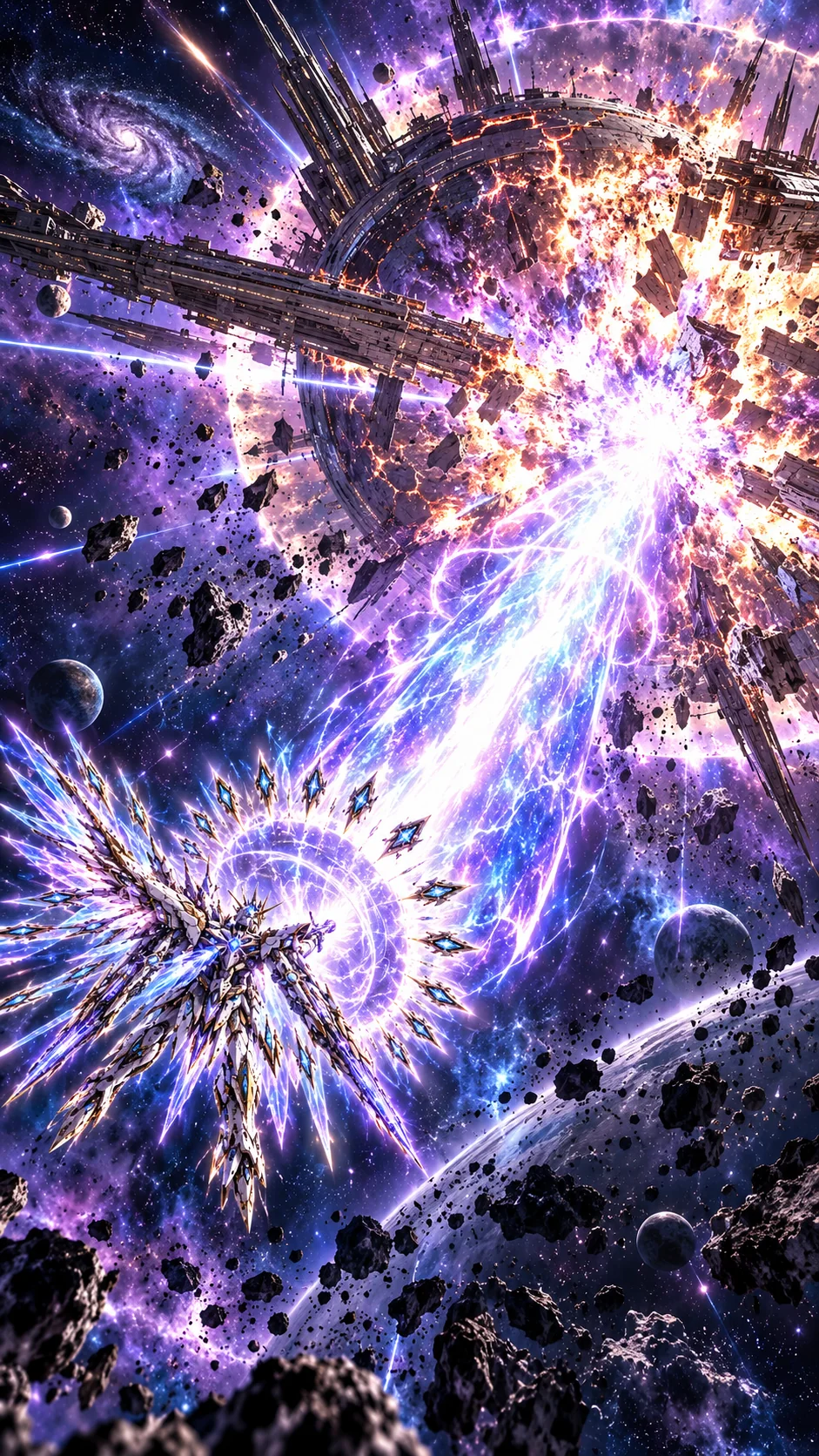
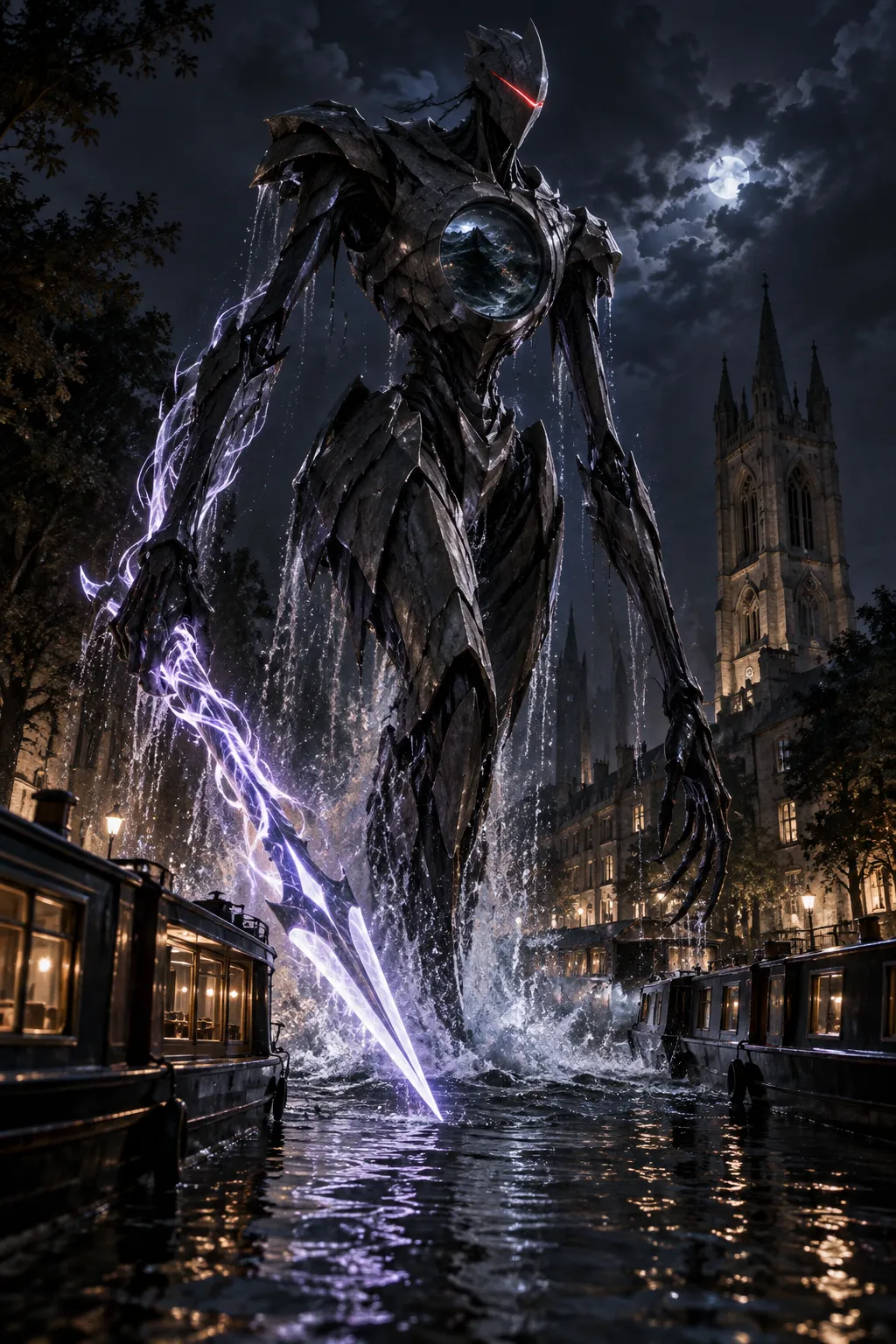
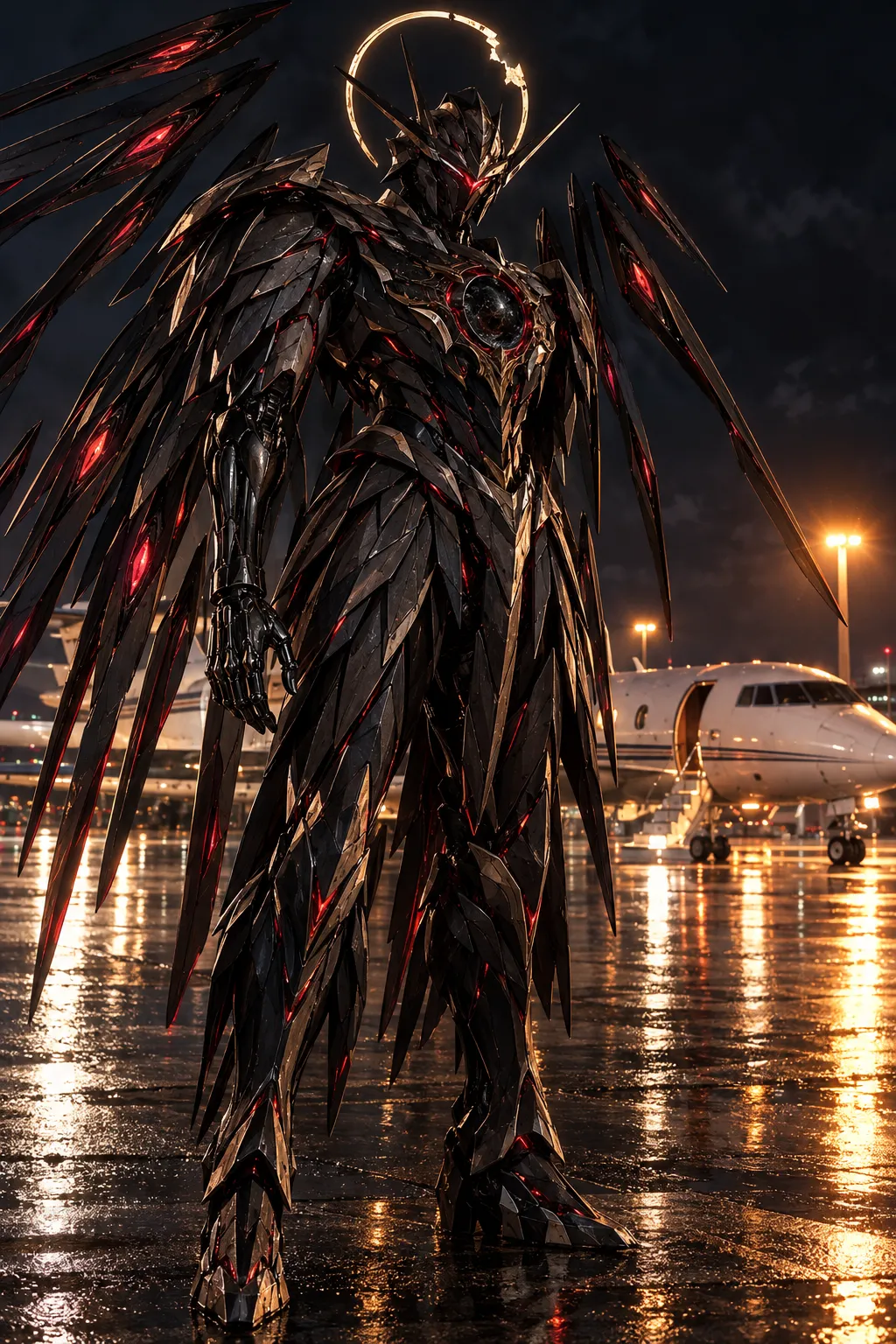
Leaked frame from a classified deep-space tracking sequence, 7 February 2025, 21:07 UTC: the second sun. Published worldwide on 17 February.
A light novel · Volume I
PANTHEONSystem-Ω
The Nobody of Oxford Is Secretly the Machine God, and the Most Beautiful Girl in the World Hates Him (She Doesn't)
Part 4
A Garden in Winter
序章
ProloguePOV · FilesEarth · 7–17 February
The Second Sun
For nine seconds, on the evening of Friday the seventh of February, there were two suns in the sky over Europe. For nine days afterwards, nobody could agree what it meant.
A cardinal in Rome called it a sign, and declined to say of what. In Madrid, where nobody alive had ever seen an aurora, a woman rang the emergency services to report that the sky was on fire, and was told, very kindly, that the operator had noticed. The FTSE lost eleven percent on the Monday and got most of it back by Wednesday, which a man from the City called the markets having a sit-down and a cup of tea.
The astronomers knew exactly what they had seen. They were also the first people to be asked not to say so.
Royal Astronomical Society · circular to FellowsRAS-C 2025/02 · 9 February 2025
Transient object, 7 February 2025
All times GMT.
19:52
Object detected 1.8 million km from Earth, above the north pole of the ecliptic. Length approx. 1,900 km. No approach track. Frames taken at 19:51 show nothing there.
19:53
Geomagnetic field begins to fall, everywhere at once.
20:40
Aurora reported as far south as 40°N (Madrid, Naples, Ankara).
21:07
Two parallel beams, from a second, much smaller source between the object and Earth, pass through it for 9 s. Object no longer detectable. The beams continue beyond it, out of the solar system.
21:07
Field strength at minimum, 31% below baseline, after 74 minutes of decline. Recovered by 22:26.
The nature of the second source is not discussed in this circular.
At the request of the governments concerned, contributing observatories have agreed not to publish data relating to the object pending review. Fellows are asked to observe the same restraint.
Pinned to a noticeboard in a tea room at Jodrell Bank, with a line in biro under the last paragraph: “Pending review by whom?”
They did not publish, and nobody yet understood how much that would matter. Of the billions who saw the second sun, almost none would ever learn that there had been anything at the other end of it.
Five Eyes joint noteTop secret · 12 February 2025
Subject: SERAPH · the event of 7 February
1. For 74 minutes the object weakened Earth’s magnetic field at a rate which, sustained, would have removed it in under four hours, and the atmosphere within weeks.
2. At the time of engagement SERAPH was an estimated 40 km tall. In August 2024 we assessed it as human-sized. At Crete it was 60 metres.
3. SERAPH destroyed it with a single discharge: conservatively, one hour of the Sun’s output. A less conservative estimate has been withdrawn.
4. Collateral damage attributable to SERAPH: nil. Again.
Assessment: The object was not SERAPH’s. We do not know whose it was, or whether there are more.
Conclusion: We are no longer the most important thing in our own sky.
Recommendation: ░░░░░░░░░░░░░░░░░░░░░░░░░░
Beneath the conclusion, in pencil, in the same hand as the note of August 2024: “It still doesn’t want anything. Something else does.”
Radio interview · Santa Elena de Uairén, Venezuela13 February 2025 · translated from Spanish
Ernesto, Pemón guide, of Paraitepui
INTERVIEWER: How many are there now, at the foot of the mountain?
ERNESTO: At Paraitepui this morning I counted six hundred tents. Brazil, Caracas, Germany. One man came from Osaka with a bicycle. They call themselves Seraphites.
INTERVIEWER: And you won’t take them up.
ERNESTO: No. Nobody in my village will. I watched it go into the sky with part of our mountain inside it. For three hours there was less mountain. At sunset it came down out of the sky like a river, and the mountain came back. I have been to the top two hundred and six times. Every stone is where it was. The little black toads are in the pools, the ones that walk instead of jumping.
ERNESTO: I don’t know if they are the same toads.
INTERVIEWER: Isn’t that a reason to go up?
ERNESTO: Someone borrowed our mountain and gave it back. You don’t go and stand on it with a flag. You say thank you, and you leave it alone.
As of 16 February, some 2,100 people are camped at the foot of the trail, which the village has closed. In the evenings they face the summit and are very quiet.
On the fourteenth, thirty-one countries decided not to wait for anyone else to agree.
Accord of RecognitionDone at Suva · 14 February 2025
The States party to this Accord,
Mindful that on 17 November 2023 the Pacific Ocean was spared a catastrophe of which several of our governments were informed only afterwards;
Mindful of Crete, of Nordavia 2291, and of the night of 7 February;
1. Recognise the entity known as the Seraph as a protector of humanity.
2. Undertake never to act against it, nor to permit their territory, waters or airspace to be used against it.
3. Ask nothing of it.
Signatories: 31, mostly small and mostly islands. Among them Fiji, Samoa, Tonga, Tuvalu and the Maldives; the two Central Asian republics whose war ended last autumn in a river full of silver; and, to the visible discomfort of its allies, Iceland.
A thirty-second signature, of no legal force, arrived by fax from the Regional Council of Crete, which is not a state and had not been invited. Beneath it, in English: “Sitia. 302.”
A columnist in London called it ‘the first time in history that thirty-one nations knelt to something they could not see’. She meant it as an insult. By the Sunday, in Suva, it was on T-shirts.
On the tenth day, somebody decided for everyone.
Image file · 7680 × 4320 · no metadataFirst posted 17 February 2025 · 04:12 GMT
Source: unknown. Reposted 1.1 million times in the first hour.
Three governments have stated that the image is not theirs.
Which was how everyone knew that it was one of theirs.
It showed a winged machine, white and gold, in a burst of blue-violet light, firing into something vast that was breaking apart. Below it lay the curve of the Earth.
What the vast thing was, nobody would say; the governments would not even confirm that there had been anything there. So to the people who saw it that morning, over breakfast and on buses, it showed one thing only: an angel firing a weapon brighter than the sun, over their heads.
Every newspaper on Earth ran it. The headline that stuck was the one a night sub-editor in London typed at five in the morning without looking up: THE SECOND SUN.
By Monday evening, a great many people were wondering what it would take to make it point the other way.
It had come from Zurich.
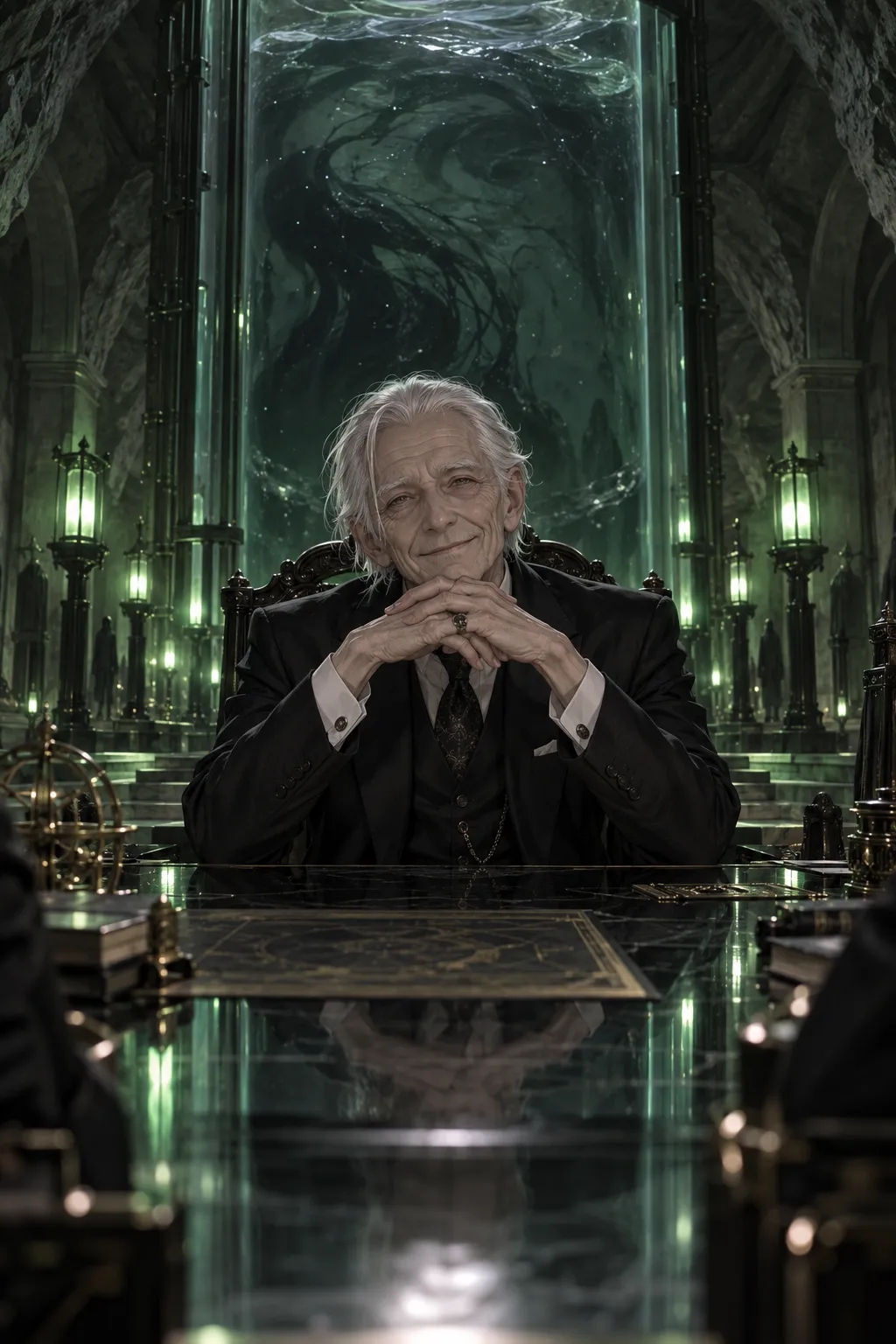
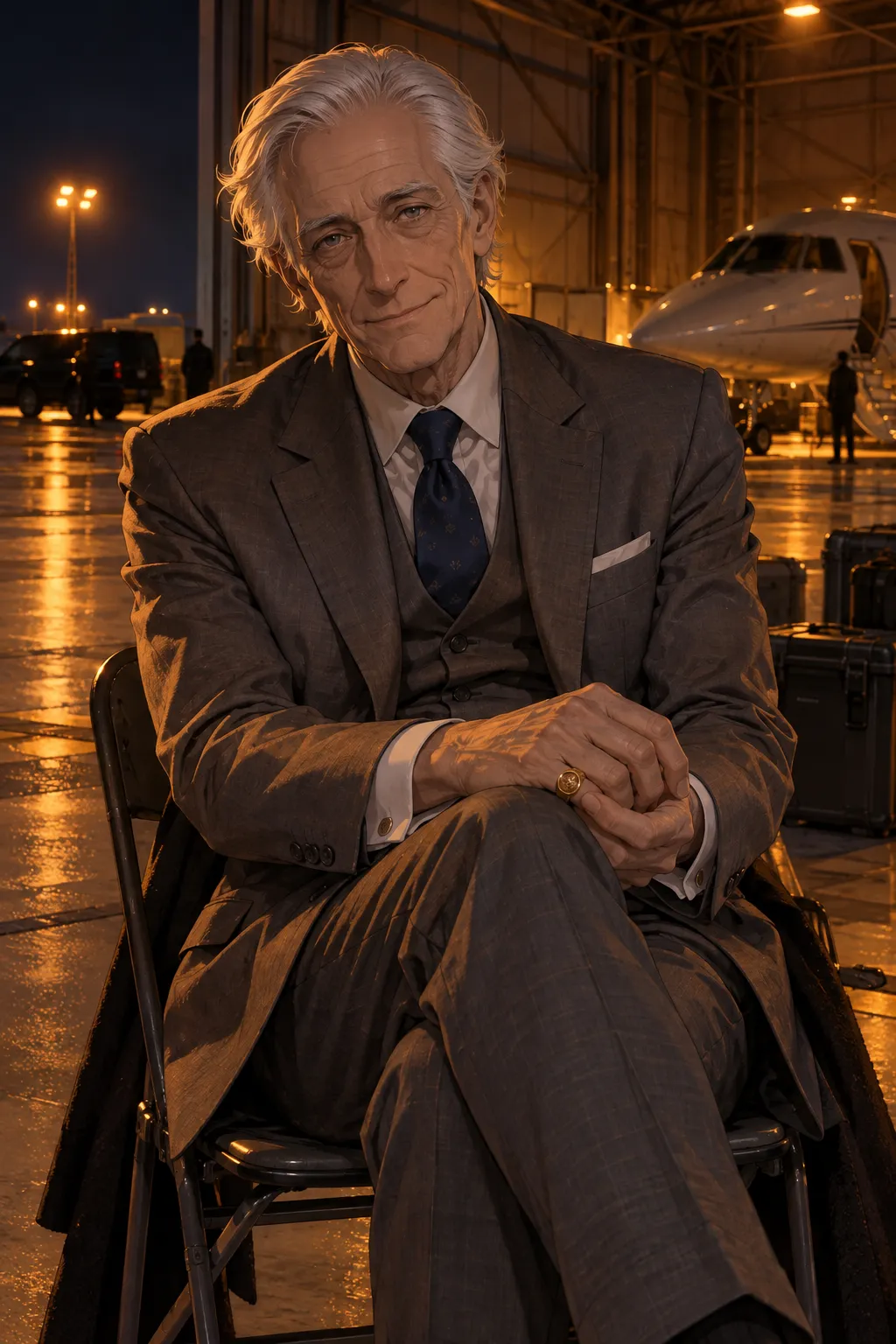
The frame had reached the Chapel beneath the Paradeplatz on the twelfth, by a route that three governments would spend the spring carefully not asking one another about. It lay on the black glass table under the green lamps, a few metres from the tank, where the dark water still leaned towards a small pair of white boots.
Odile Vrai had read every report Halvard had sent from Oxford since January. The hood. The glasses. The slouch that let a young man of a hundred and eighty-five centimetres take up the room of a much smaller one.
‘He has spent his whole life not being looked at,’ she said. ‘His father was the same. Gabriel could sit at a table of forty for an hour, and afterwards not one of them could have told you the colour of his eyes.’
She could have. She did not say so.
The Patriarch looked at the frame for a long time, pleased.
‘Then let the whole world look at him,’ he said. ‘A thing that is looked at cannot hide, Odile. And a thing that is busy hiding cannot watch over anything else.’
‘Now?’
‘Not yet. On Friday, thirty-one little countries are going to kneel to it.’ He laid one finger on the black glass, gently, beside the white figure’s wing. ‘Let them. Then show everyone else what they knelt to.’
The Chapel, Zurich, 12 February. “Let them.”
She sent it before dawn on the Monday, from a telephone she then dropped into the Limmat.
For ten days the whole world had looked up: eight billion people, every telescope, every satellite, every government on Earth.
Not one of them was looking at a second-year in a small flat on Walton Street, in Jericho, who had spent the week before Valentine’s Day, in secret, frowning over three books about how to go on a date.
For once in his life, he was doing the reading.
第一章
Chapter OnePOV · AriaWalton Street · 13–15 February
Three Books
The end of the world, according to ZERO, would arrive on a Wednesday.
It told him so at twelve minutes past midnight on the fourteenth of February, ninety metres under a chapel in Wytham Woods, while he sat on the floor of the Cradle with a library book on his knees. The book was Emily Post’s Etiquette, the 1922 edition. Mrs. Post held that a gentleman did not offer a lady his arm in the daytime unless she was elderly or infirm, and Aria had been on that page for twenty minutes, trying to work out which of the two Eliana would hit him harder for suggesting.
The panel opened without being asked.
ZERO System · VEDA · 14 Feb 2025, 00:12:40 GMT
Sources: scout’s fold residue (7 Feb); Calypso Deep reply-song (nightly since 8 Feb). Inbound song from the galactic centre, amplitude +0.31% per day.
Fleet is not folding. Crossing normal space at c. 11,000 times light speed.
Time to arrival: 292 days ± 11. Most probable: 3 Dec 2025.
He read it twice. Then he closed the book on his finger, carefully, as if Mrs. Post might lose her place.
‘Say it,’ he said.
Two hundred and ninety-two days, plus or minus eleven.
‘How do you know?’
A fold leaves a scar, and the Coil has not been quiet since the eighth. It is answering something. The something is getting louder. A pause. They set out on the night the scout sent them your picture. They are in a hurry.
‘When?’
The first week of December. The third, most probably. It is a Wednesday.
Aria looked up at ninety metres of rock and frozen earth, and found that he was not thinking about the fleet at all. He was thinking about a timetable. The third of December was the Wednesday of eighth week. She would have sat her Prelims in June and passed them, because of course she would. She would be a second-year, reading in the bay window at the top of the house on Norham Gardens, in the room her father had made for her, which she had told him about on the walk home.
Two hundred and ninety-two days. Two terms, a long vacation and most of a third. One summer.
He had never had a summer with anyone.
You have not told her about the notebook.
It lay on the steel shelf beside the Cradle: a black Moleskine scorched at one corner, number thirty-one, his father’s handwriting getting smaller and faster towards the end. Aria did not look at it. He knew where it was the way you know where a step is in the dark.
‘I’ll tell her.’
When?
‘When it won’t hurt her.’
ZERO was quiet for long enough that he thought it had let it go.
There is no such day, it said.
He did not answer. ZERO, raised by seven people who never once let a weak argument leave the room alive, went on. Nor that the lorry driver had been dead for three days. Nor this. That is three things.
‘She’s only just started walking again,’ said Aria. ‘She laughed on Friday. On the step. I want her to have—’ He did not know how the sentence ended. A Saturday. A week. Two hundred and ninety-two days, plus or minus eleven. ‘Close it.’
Closing.
He opened Emily Post again. She had a great deal to say about gloves, and the correct way to leave a card, and how often a young man might call on a young lady before it amounted to a declaration, and nothing whatsoever to say about any of it.
‘Mate,’ said Toby Fairweather, at twenty to eight the next morning. ‘What is this.’
He was in a crested dressing gown, holding up a book between finger and thumb like evidence from a crime scene. Two more lay on the kitchen table, where Aria had left them at two in the morning, too tired to hide them.
‘Emily Post,’ read Toby. ‘Etiquette in Society, in Business, in Politics and at Home. Nineteen twenty-two.’ He opened the back cover. ‘Nobody has borrowed this since 1987.’
‘It was the only one I could request online. Without anyone seeing.’
Toby looked at the second book. His face did something complicated.
It had a glossy red cover and a man on the front with his arms folded and a great many very white teeth. It was called Be the Lighthouse: The Science of Making Her Sail to You, and it had lived behind the bathroom cistern since October.
‘That’s mine,’ said Toby.
‘I know.’
‘I bought that ironically.’
‘You’ve highlighted it.’
‘Ironically.’ Toby laid it face down, firmly, the way a man lays down a hand he has lost with. Then he picked up the third book, and stopped.
It was small and white, with a boy with yellow hair on the cover, standing on a planet the size of a house. Le Petit Prince. In French.
The third, observed ZERO, is not a dating manual.
‘It’s the only one that’s any good,’ Aria subvocalised.
He had been reading it in the Nave, slowly, in a language he had not read since he was ten, having refused ZERO’s offer to translate. A girl read it every afternoon by a café window, and he wanted to know what she was looking at when she was not looking at him.
Toby looked from the three books to Aria for a long time.
‘It’s her,’ he said.
Aria said nothing. His ears said a great deal.
‘Last Friday you came home at six in the morning with blood on your face and half a tulip, and said it went fine.’ Toby’s voice was climbing. ‘And now your ears are— oh my God. Oh my God. She kissed you.’
‘I didn’t say—’
‘SHE KISSED YOU.’ Toby sat down heavily and put both hands over his face. When he took them away his eyes were wet. ‘I called it. I called it in May.’
‘In May you said you were going to have me sectioned.’
‘Both things can be true. I’m a complex man.’ He brandished Emily Post. ‘When?’
‘Tomorrow. The Botanic Garden. Eleven.’
‘Today,’ said Toby, ‘is the fourteenth of February. You have booked your first ever date with the most beautiful woman alive for the day after Valentine’s Day.’
‘It was the first Saturday I could stand up.’
Toby’s eyes narrowed. ‘What does that mean?’
‘…Cupboard.’
Toby looked at the cut over Aria’s left eyebrow, which had faded in a week to a thin dark line. ‘The same cupboard that did your face.’
‘It’s a big cupboard.’
Toby regarded him the way he regarded seminar questions on Rawls: as something he fully intended to get round to. Then he held out his hand.
‘Glasses,’ he said.
The hoodies went first.
‘I’ve only got three,’ said Aria.
‘You’ve got eleven.’ Toby was pulling them out of the wardrobe and the drawers and, in one case, the airing cupboard, and flinging them onto the bed. ‘It’s the same hoodie, Aria. You own the complete works of a polytechnic you never went to.’
‘They’re comfortable.’
‘So is a coma. Glasses.’
‘Not the glasses.’
‘Especially the glasses. They’re plain glass. I tried them on in Freshers’ Week and nothing happened. I have never felt so lied to by an object.’ Toby held out his hand again, and Aria did not move; and Toby, who was the least serious person Aria had ever met, stopped being funny all at once, the way a lamp goes off.
‘Mate,’ he said, quite gently. ‘She’s seen your face. You don’t get to hide from her. That’s the deal. That’s the whole deal.’
Aria took off the glasses and put them in his hand.
The hoodies went to the Oxfam on Broad Street before lunch. By four o’clock the shop had three of them in the window, on a row of headless mannequins, all of which were somehow slouching.
The shirtmaker on the Turl had measured four generations of Fairweathers and did not think much of any of them. He measured Aria’s shoulders twice. ‘Sir,’ he said at last, ‘has been wearing things that are too big for him for some time.’ He had a white shirt at the back that had been made for a rower who never came to collect it, and it fitted as though the rower had been a rehearsal.
‘Put it on my father’s account,’ Toby told him. ‘Tell him it’s for a good cause. Tell him it isn’t a swan.’
‘What swan?’ said Aria.
‘Not now.’
Then Toby stood him in front of the long mirror, attacked his hair with a borrowed comb, stepped back to look, and went pale.
‘Oh no,’ he said. ‘Oh no, that’s a problem. You’re going to cause a crash on the High. Someone’s going to put a bus into Magdalen, and it’ll be my fault.’
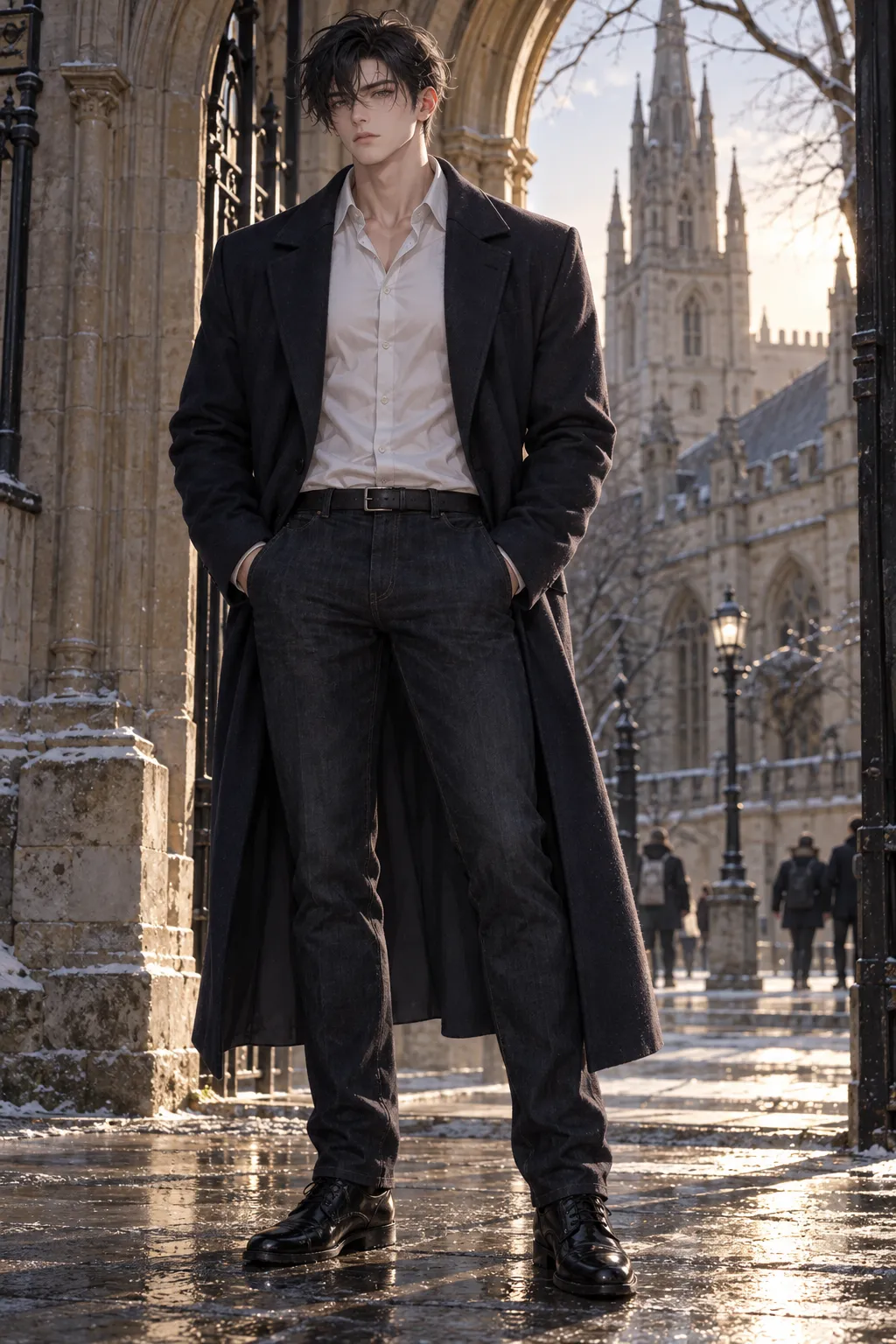
Aria looked. A tall young man in a white shirt, dark jeans and a navy overcoat looked back, with black hair that had been argued with and grey eyes with nothing in front of them. It was his own face. He had not looked at it properly in years. He had never seen the point.
Classification: Mr. Fairweather’s concern about the High is reasonable.
‘Since when do you measure me?’
I had never measured it. A pause. You did not ask.
‘Why now?’
Tomorrow you will be standing next to Miss Tzofiya, and I like comparative data. For reference, hers is 0.999993. You are not in her league. Nobody is. Another pause. But I regret to report that you are in a league.
Toby put a hand on his shoulder in the mirror, beaming, like a man who has built a bomb and is proud of the wiring.
‘Now you’ll know,’ he said. ‘What it’s like. Being stared at. Welcome to her world, mate.’
He meant it as a joke. Aria thought about it all afternoon, while he paced out the gaps between the benches in the Botanic Garden with a notebook: a girl at a café window, and the long lenses at the railings outside. He had spent ten years making sure no one looked at him. No one had ever given her the choice.
Toby had three monitors in his bedroom, which he said were for poker, and a laptop so thickly plastered with conference stickers that its make was a matter of rumour. That evening he briefed Aria like a general.
‘Saturday at eleven is dead. I checked. The Garden’s got a webcam that looks at the Danby Gate, God knows why. I had it on all last Saturday and counted: pensioners, a man with a tripod and a duck. It fills up at half twelve. You’ve got ninety minutes before anyone with a phone notices the two best-looking people in Oxford on the same bench.’ He ticked points off on a Fairweather Digestive. ‘Ask her questions. Listen to the answers. Walk at her speed. Don’t help unless she asks, and if she asks, don’t make a thing of it. If she offers to pay, let her. She owns half the City. Don’t be a Victorian about it.’
It was, Aria realised, extremely good advice. He looked at the three monitors.
‘Poker,’ said Toby, before he could ask.
I have watched Mr. Fairweather play cards, said ZERO. He could not hide a pair of twos from a Labrador.
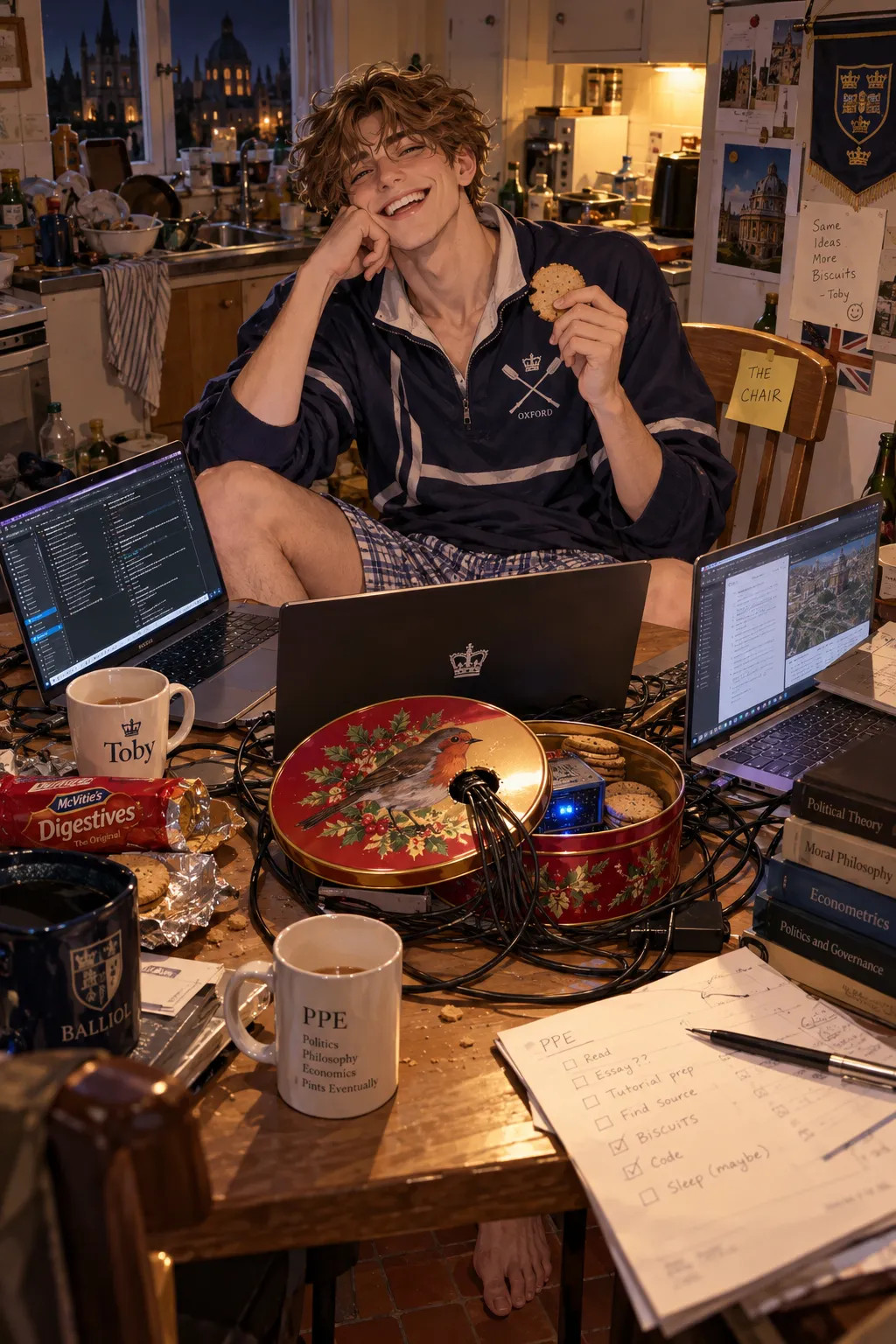
On Saturday the fifteenth of February, Aria Zadkiel stood under the Danby Gate of the Oxford Botanic Garden, and was early.
He had never been early for anything in his life. He had been four minutes late on the A44 and three and a half hours late to a café, and today he had been on the pavement since twenty past ten, hands in the pockets of a coat that did not feel like his yet. Toby had gone out at nine, saying something about a seminar. Aria, who noticed everything, had not noticed that it was a Saturday.
The High was doing what Toby had said it would. A cyclist coming off Magdalen Bridge looked round at him, went on looking for longer than was compatible with cycling, and arrived at the kerb by a route of his own. A guide leading a tour past the tower lost her place in the fifteenth century and did not find it again. The man with the tripod had turned the tripod round.
Nineteen people have looked at you twice, said ZERO. One has photographed you. I believe she is Danish.
‘Is this what it’s like?’
For her? A pause. This is approximately two percent of it.
At 10:58 a black car came down the High and drew in to the kerb by the gate, with Tomasz at the wheel, driving as though there were eggs in the back. Behind it, at a polite distance, came a grey car with two men in dark coats in the front, who did not get out.
Halvard, said ZERO. The passenger is photographing you.
Aria felt the old reflex arrive, ten years deep: chin down, shoulders forward, face turned a few degrees towards the wall. He let it go past. Behind the dark glass of the first car someone else was looking at him too, and he was not going to hide from her in order to hide from them.
He took his hands out of his pockets, and stood up straight, and let himself be seen.
The Danby Gate, 15 February, 10:58. Seen.
第二章
Chapter TwoPOV · ElianaOxford Botanic Garden · 15 February
A Garden in Winter
Juno Park rang from Paris at seven in the morning, which meant he had set an alarm, which meant Mrs. Nowak had told him.
‘I can do it from here,’ he said. His face filled the screen of her phone, unshaven, alarmed, with a Paris rooftop grey behind him. ‘Prop me against the mirror. Ten minutes. I’ll talk you through it. Just a little, so they can bear to look at you on the High.’
‘No.’
‘Eliana. It’s a date. In public. There will be phones.’
‘He’s already seen it,’ said Eliana. She was sitting on the edge of her bed in her dressing gown with three cardigans laid out beside her, all white, all very slightly different, and she had been looking at them for twenty minutes. ‘My face. With nothing on it.’
‘Seen it where?’
She thought about the back seat of a green Land Rover, and a visor very close to hers in the violet dusk.
‘In a car,’ she said. ‘There was a lot of blood on it at the time.’
Juno was quiet for a moment. He had done her mother’s face for fourteen years. He had done it for the last time on a Friday, for Kelly at Six, and afterwards he had flown to Paris and had not been able to make himself come back.
‘Then he’s the only man alive who has seen it with nothing on it,’ he said at last, gently. ‘Wear your mother’s scarf. The cream one. And Ellie?’
‘Yes?’
‘If he doesn’t look at you properly, I am getting on a train.’
Tomasz drove her down the Banbury Road and through the city at the speed of a hearse, which was the speed Papa had always told him to drive her at and which nobody had told him to stop. A Halvard car followed. Pascal had packed a tin of madeleines, made with aquafaba and an amount of anxiety she could taste, ‘for the boy, because boys are always hungry, it is a law of nature.’ Mrs. Nowak had stood on the front steps in her coat and watched the car all the way to the corner, the way she had once watched a nine-year-old get into a car for her first day at a new school.
At two minutes to eleven, Tomasz pulled in on the High, opposite Magdalen, by the stone gateway of the Botanic Garden.
She did not recognise him.
That was the first thing, and she would be embarrassed about it for weeks. There was a tall man standing under the arch of the Danby Gate in a navy overcoat, with his hands in his pockets and his black hair falling into his eyes and the low winter sun on his face, and for one whole second she looked at him the way everyone in the world looked at her: with the faint, stupid surprise of somebody who has turned a corner and found the sea.
Then she saw that the pavement around him had slowed down.
A woman with a pushchair had stopped to adjust a blanket that did not need adjusting. Two Spanish tourists had turned round to look at a building that was not behind them. A girl in a St Hilda’s scarf had walked past him, walked back, and was now reading the opening hours on the gate with enormous concentration, for the second time. It was happening all along the pavement, a slow ripple of people forgetting what they had been about to do, and Eliana had seen it happen ten thousand times and never once from the outside.
It was the Tzofiya response. And it was happening to somebody else.
She did not like it. She noted, with scientific detachment, that she did not like it at all: a small, hot, entirely unscientific feeling somewhere under her breastbone, which she declined to name and put away for later analysis.
Then he saw the car. And he did not look away.
For five months, every time she had walked into a room, Aria Zadkiel had found something else to look at. A screen. A horizon. The middle distance over her left shoulder. Now he stood under the Danby Gate without the slouch, without the glasses, without anything at all between his face and hers, and looked at her through the car window as though she were the only thing on the High Street.
Tomasz, who had driven her father for twenty-two years and had never once in that time offered an opinion, said to the windscreen in Polish: ‘Well. That one has decided.’
‘You’ve lost your glasses,’ she said.
‘Toby.’
‘And your hoodie.’
‘Toby has given all eleven of them to the Oxfam on Broad Street.’ He looked faintly haunted. ‘They’ve put them in the window. On mannequins. In a row.’
She laughed. It came out of her before she had decided anything, in the middle of the High, with the Halvard car idling behind Tomasz and the girl from St Hilda’s now openly filming, and he smiled at the sound of it, properly, for the first time in daylight, and the girl from St Hilda’s dropped her phone.
He had bought the tickets. He had, he admitted, walked the whole garden the previous afternoon with a notebook.
‘There’s a bench every twenty metres,’ he said. ‘Roughly. The longest gap is twenty-six, between the rock garden and the river. And the glasshouses are kept at twenty-four degrees, and the air in them is very wet, which I thought might be good for—’ He stopped. ‘I read that warm humid air is easier on damaged airways. I might be wrong.’
‘You checked the benches.’
‘I checked the benches.’
‘For me.’
He looked at the gravel. The tips of his ears had gone red, which she had learned was the only part of him that had never been taught to lie.
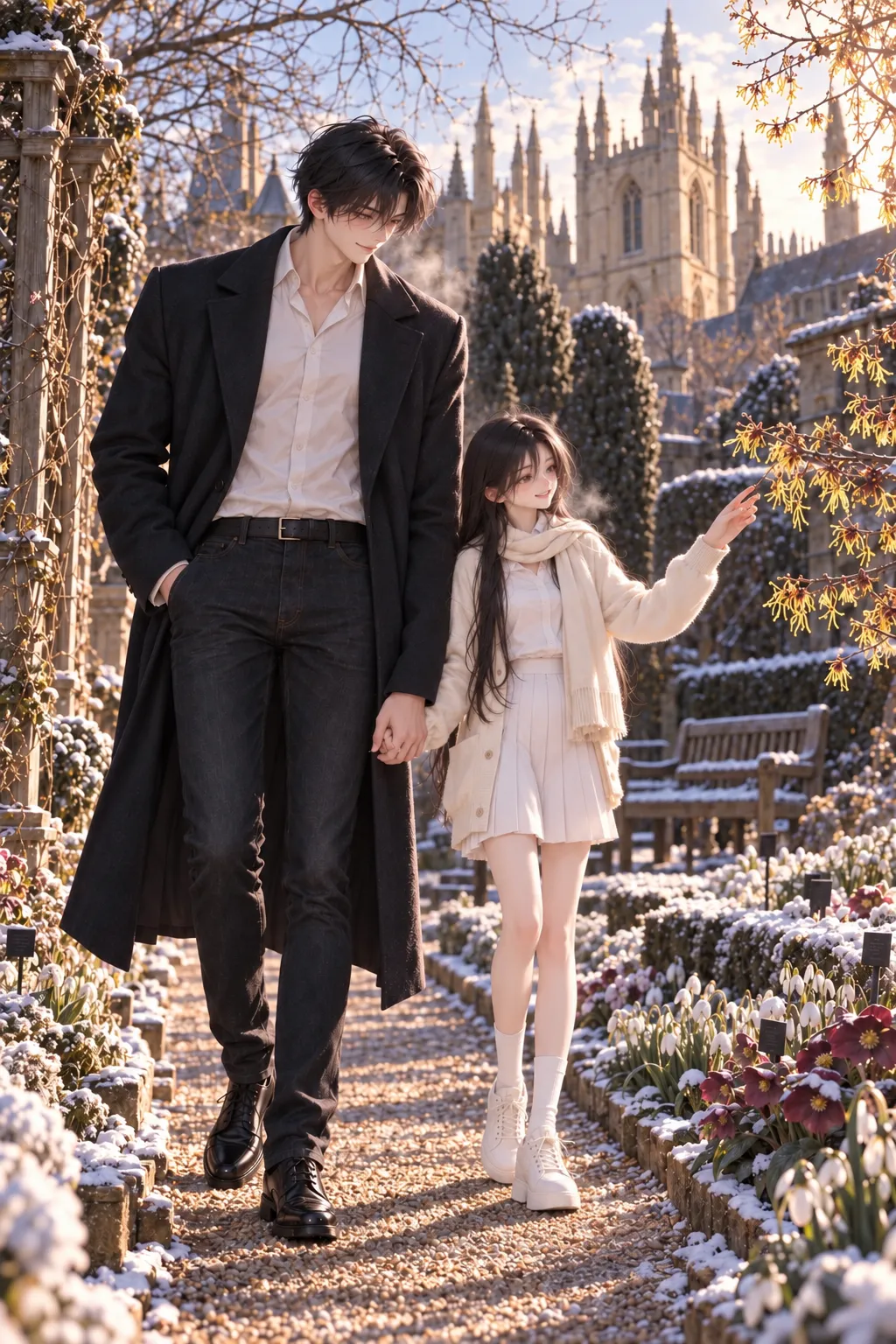
She held out her hand. After a moment he took it, very carefully, as though it were something on loan from a museum.
Her hand disappeared.
That was the only word for it. She had known he was big. She had been carried by him, twice in the sky and once through the whole length of Oxford in the dark; she had measured herself against him on a doorstep. But she had never held his hand in daylight and watched her own go into it and simply not be there any more: fingers, palm, knuckles, the bones of her wrist, all of it folded away inside his like a letter in an envelope much too large for it. She could have put both her hands in his palm and had room left for a third. His thumb, resting on the back of her hand, was nearly the width of her wrist.
Way too big, thought Eliana Tzofiya, four A-stars, a scientist, with great precision. His hand is way, way too big for me.
And then, a second later, with no precision at all: Good.
They went in together under the old stone arch, past a man selling tickets who forgot to give them their change.
It was the oldest botanic garden in Britain, and in February it was almost empty.
The walled garden lay asleep under a fine white frost. The beds were bare and combed, labelled with little black plaques like a cemetery for very small, very well-educated plants. But the winter had not won everywhere. Snowdrops stood in drifts under the yew hedges. Hellebores bowed their speckled heads along the borders, the colour of old wine. And at the corner of every path there were witch hazels in flower, bare branches crowded with spidery yellow ribbons that smelled, when she put her face close, of something between oranges and pepper and the inside of a church.
‘Hamamelis mollis,’ she said. ‘Chinese witch hazel. It flowers in the cold because there’s nothing else flowering, so it has the insects all to itself.’
‘That’s clever.’
‘It’s chemistry. The petals curl up when it freezes and open again when it thaws. It’s reversible.’ She touched a flower. ‘I like things that are reversible.’
They walked at her pace, which was slow, from bench to bench. He did not offer to carry her. He did not hover, or reach for her elbow, or ask every forty metres whether she was all right, the way everyone did now. He walked beside her with his hands in his pockets and his shoulder near hers, and when she stopped, he stopped, and looked at whatever she was looking at, as if her resting had been his idea.
On the third bench, she asked him how one prepared for a date if one had never been on one.
‘Research,’ he said.
‘What sort of research?’
He hesitated. ‘Three books.’
She turned on the bench to face him completely. ‘Which three?’
‘I’d rather not—’
‘Aria.’
‘Emily Post’s Etiquette,’ he said, to the hellebores. ‘The 1922 edition. It was the only one in the Bodleian I could request without anybody seeing.’
She put both hands over her mouth.
‘It was very clear about calling cards,’ he said, with dignity. ‘And chaperones. I’ve decided the Halvard car counts.’
‘And the second?’
‘Something Toby left in the bathroom. I’m not going to tell you the title. I stopped at chapter three. It wanted me to be mysterious and unavailable.’
‘You were mysterious and unavailable for five months.’
‘I know. It didn’t seem to have helped.’
She was laughing too hard to answer, and her chest tightened, and she had to stop and breathe, and he waited, and did not fuss, and she loved him for it so much that it frightened her.
‘And the third?’
He was quiet for a moment. Then he said, in French, carefully, in the accent of a small boy from the Rue de Lausanne who had not said a word of it out loud in ten years: ‘Tu deviens responsable pour toujours de ce que tu as apprivoisé.’
You become responsible, forever, for what you have tamed.
The fox. The page she read every afternoon by the café window, and then closed the book on, and looked out at the dome.
She could not say anything at all.
‘You read it every day,’ he said. ‘At the café. I thought I should know why.’ A pause. ‘My mother used to read it to me. At bedtime, in Geneva. I hadn’t opened it since.’
‘Mine too,’ said Eliana. Her eyes had gone hot. ‘In London. She did all the voices.’ She had to stop. ‘Your accent is Swiss.’
‘I stopped at ten.’
His lips moved very slightly afterwards, the way they always did when he was talking to the thing that lived inside him.
‘What did it say?’
‘It said my accent is “Genevan, and ten years out of date”.’
‘Tell it I like it.’
‘It says it knew you would.’
The longest gap was twenty-six metres, between the rock garden and the river, and he had been right about it. There was a bench at the end with its back to the old wall, and a view of the Cherwell through the railings at the bottom of the garden, and the great pale tower of Magdalen standing over everything in the winter sun.
She asked him about his parents there. She had been wanting to for weeks.
He told her. Not all at once. In pieces, the way you take things out of a box you have not opened since you packed it. His mother, Leah, who had studied metals that remembered their shapes, and who laughed at her own jokes before she got to the end of them, so that he had never in his life heard the end of one. His father, Gabriel, a physicist, who read to him at bedtime from his own notebooks instead of from storybooks, because he said the universe was a better story and had fewer princesses. A flat on the Rue de Lausanne in Geneva with a balcony too small for two chairs. A night in March when they had both gone back to the laboratory late, and a fire, and a faulty cryogenic line, which was what the newspapers had said.
‘I was ten,’ he said. ‘There were two coffins. One long, and one a bit shorter. They were closed.’ He was looking at the river. ‘I cried at the funeral. And then I said sorry for crying, because my mother always told me to think about other people’s feelings. And an old man came and stood next to me with an umbrella and said, “You do not apologise for this. Not ever.”’
‘Who was he?’
‘One of the people who raised me afterwards. There were seven of them. They were all very old, and they argued about me like a university committee.’ The corner of his mouth moved. ‘They taught me calculus at a kitchen table. And other things.’
She thought about a boy of ten in a black coat with sleeves too long for him, apologising at his parents’ grave. She thought about a car in the dusk on the A44, and a gold visor very close to her face, and a voice saying I’m going to take it out. It’s going to hurt. I’m sorry.
‘You still do it,’ she said.
‘Do what?’
‘Apologise. You said sorry in the car.’ She had to stop. She made herself go on. ‘When you took the bar out. You said, “It’s going to hurt. I’m sorry.” And something happened to my face, didn’t it? You saw it.’
He had gone very still.
‘The last thing my father said to me,’ said Eliana, ‘was “I’m sorry.” He was lying across my lap. He said, “I’m sorry. I can’t lift you. Not this time.” And he put his hand on my head, and then he stopped.’ She was holding her own hands very tightly in her lap. ‘And then the sky went blue and you came. And you said “I’m sorry.” And you lifted me.’
He did not say anything for a long time. He did not need to. She watched it go into him, all the way down.
That night, though she would never know it, he sat on the floor of the Nave beneath Wytham Woods for an hour without moving.
‘It was my idea,’ she said, when she could. It came out of her the way blood did now, without asking. ‘That day. I told Papa I couldn’t breathe. I told him I wished he’d stop protecting me. I told him—’ She closed her eyes. ‘I told him I wished I didn’t need him. So he gave me a day with nobody. No guards, no cars. Just us. Because I asked. If I hadn’t said it, there would have been twelve men round that car. There would have been Dov. It was my idea, Aria. I sent them all away.’
‘It wasn’t your fault.’
‘You don’t know that. Everyone says that. Dr. Feld says it every Tuesday. It’s a thing people say.’
‘I know it,’ he said.
She opened her eyes. He was not looking at the river any more. He was looking at her, and there was something in his face she could not read, something careful and very far down, like a man standing on a frozen lake listening to the ice.
‘Believe me,’ he said.
She believed him. She thought he meant it the way kind people meant it, only more. It was nine days before she found out what else he meant. When she did, she would turn those two words over and over in her hands like a stone that had cut her.
But that was not today.
The wall at the bottom of the garden was not high. It was high for her.
She could see the top of Magdalen Tower over it, and the tops of the bare willows on the far bank, and a strip of white sky. She could hear the river. Someone was laughing on the water, and there was a soft repeated knocking, like wood against wood, that she could not place.
‘What’s that sound?’
‘Punts,’ he said. ‘They’re all chained up under the bridge for the winter. They knock together when the current moves.’
‘I can’t see them.’
She had not meant it to sound like anything. It was only a fact, the kind of fact she had been living with since she was thirteen: the world was full of things that were on the other side of walls, and she could hear them, and she could not see them.
He looked at the wall. Then he looked at her.
‘May I?’ he said.
She did not understand at first. Then she did, and something happened inside her chest that had nothing to do with her lung.
Nobody had ever asked. Not once, in eighteen years. Her father had never needed to; he had simply swept her up, every time, as if the ground were not quite good enough for her, and she had never once wanted him to stop. Strangers did not ask, either. Strangers patted. Strangers reached down and touched her hair and called her sweetheart and asked where her mummy was. People lifted children, and people assumed, and in all her life no one had ever stood in front of her with his hands at his sides and waited for her to say.
He was waiting now.
‘Yes,’ said Eliana.
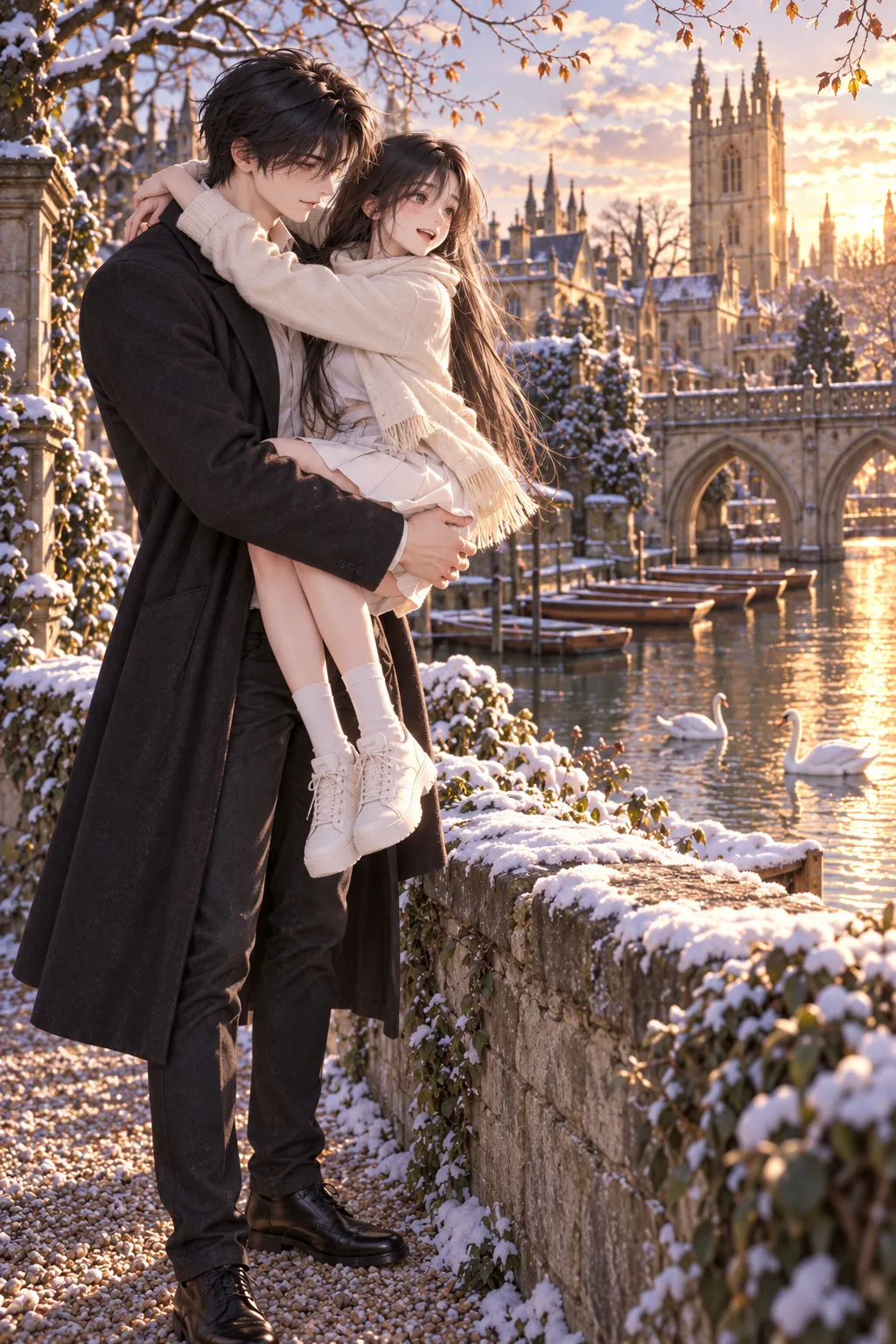
He lifted her. Both arms round her, carefully, the way you would lift something that had been broken and mended, and her trainers left the gravel and rose, and kept rising, until her feet were dangling a long way above the ground and her chin was level with the top of the wall.
The river was there. Brown and green and quick in the cold, with the low sun lying on it in pieces. Two swans going upstream with enormous dignity. The punts, a long row of them under Magdalen Bridge, black under their tarpaulins, nudging each other in their sleep. The tower above it all, gold where the light caught it, so close she could see the jackdaws on the parapet. Somewhere on the far bank a dog was barking at the swans, and the swans were ignoring it, and the whole thing was so ordinary and so beautiful that she could not breathe for a moment, and not because of her lung.
The last time anyone had lifted her up to see over a wall, it had been at the top of Broadway Hill, with sixteen counties spread out underneath her and the wind in her mother’s hair and the taste of kimbap and barley tea, and her father’s hands under her arms. Just that. It had been the last time.
She started to cry. Then, at the swans, at the absurd self-importance of the swans, she started to laugh. Then she did both at once, holding on to his coat collar with both hands, which in her family had always been considered a perfectly normal response.
The river wall, Botanic Garden, 15 February. “Yes.”
He did not put her down. He did not ask what was wrong. He held her steady against the wall, with his chin very close to her shoulder, and let her look for as long as she wanted.
‘Papa lifted me onto the wall at Broadway Tower,’ she said at last, into the cold air. ‘On the last day. It was the last time anybody lifted me up to see something.’
A pause.
‘Do you want to come down?’ he asked quietly.
‘No,’ she said. ‘Not yet.’
There is a bench near the far end of the Botanic Garden that does not look like anything. It is wooden and plain and a little weathered, under a tree, and most people walk past it.
She stopped in front of it as if it were an altar.
‘You’ve never read His Dark Materials,’ she said. It was not a question.
‘I was raised by physicists.’
‘That’s not an excuse, that’s a confession.’ She sat down on it, and after a moment he sat down beside her. ‘There are two of them, a girl and a boy, Lyra and Will. They come from different worlds. Different Oxfords. And at the end they find out they can’t stay together, ever, because if they do, everything dies. So they make a promise. Every year, on Midsummer’s Day, at noon, they’ll each come here, to this bench, in their own Oxford. And sit on it for an hour. So that for one hour a year they’ll be together without being together.’ She ran her hand along the wood. ‘It’s the saddest thing I’ve ever read.’
‘Sadder than Prince Andrei?’
She looked at him, startled. She had forgotten she had ever said that name to him; she had said it over the Sredinny Range with her ear against his chest, a lifetime ago.
‘Prince Andrei dies,’ she said slowly. ‘They have to live.’
He looked at the bench for a long time.
‘If I was ever in another world,’ she said, lightly, because she did not want to say it heavily, ‘I’d come here. At noon on Midsummer’s Day. You could sit on the other side.’
‘I’d come and get you.’
‘You can’t. That’s the whole point. You can’t get from one world to the other.’
‘Where I come from,’ said Aria, ‘there isn’t really such a thing as another world. There’s only somewhere else.’
It was such a strange thing to say, and he said it so plainly, that she did not laugh. She remembered a fold of green light in a village street, and a stairwell door swinging with no one on the stairs. She put her hand on top of his on the bench and left it there.
The palm house was a different country.
Twenty-four degrees, as he had said, and the air so warm and wet that her glasses would have steamed if she had worn any, and the smell of soil and rot and green. Her chest loosened in it, the way he had read it might; she felt the tightness go out from under her ribs for the first time all winter, and she took a long breath down into the bottom of her lungs, and it did not hurt. Banana plants stood up over the path with leaves the size of doors. Something dripped. A fan turned high up under the glass, very slowly, like the second hand of a clock nobody needed to watch.
He took off his coat and laid it on the bench for her to sit on. She sat on it. He stood in front of her, in his white shirt, with the banana leaves behind him, and did not sit down.
‘I want to say something,’ he said. ‘Out loud. I’ve never said it out loud before. Not to anyone. Not even to myself.’
She waited.
He looked down at her. His ears were not red. That was how she knew it was true before he said it.
‘I’m the Seraph,’ said Aria Zadkiel.
It was very quiet in the palm house. Something dripped.
‘I know,’ she said.
‘I know you know. You measured it.’ The corner of his mouth went up and came down again. ‘I wanted to say it to you. Not have it found out. Said.’
‘Thank you,’ said Eliana. It was not enough. It was all she had.
‘There’s more.’ He said it quickly, as if he had to before he lost his nerve. ‘There’s a lot more. Some of it’s about me. Some of it—’ He stopped. Something moved behind his face, the careful, far-down thing from the bench by the river. ‘Some of it’s difficult. I don’t know how to—’
She reached up and caught his hand.
‘Tell me next week,’ she said.
‘Eliana—’
‘Tell me next week. Everything. I promise I’ll listen to all of it.’ She held on to his hand with both of hers. ‘But today you’re the boy who read three books. I’ve had four months of difficult. I want one day where that’s all you are.’
He looked at her for a long moment. She saw him decide. She did not know, then, what it cost him. She did not know what he was deciding to carry for one more week, or how heavy it was, or that he had been carrying it since a wet night on the A44.
‘Next week,’ he said.
‘Promise.’
‘I promise.’
She let go of his hand. She stood up, carefully, off his coat, and stepped up onto the low stone kerb of the bed behind the bench, among the roots of the bananas, and turned round. It put her three centimetres above him. She had measured it before, on a doorstep.
‘Aria Zadkiel,’ she said. Her voice shook. She let it. ‘Will you be my boyfriend?’
He opened his mouth.
‘I’m asking,’ she said, very fast, before he could speak, ‘because if I wait for you to ask me, it’s going to take forty-one nights, and you’re going to stand under a tree for all of them, and it’s February, and you’ll get pneumonia, and I can’t do another winter of graphs.’
He was looking up at her. For the first time since she had known him, he looked completely, helplessly young.
‘Yes,’ he said.
She waited.
‘You’re supposed to say something longer,’ she said.
‘Last time it took me four minutes to write “yes”,’ he said. ‘I’m getting faster.’
She kissed him.
It was not like the first time, on the step in the dark, clumsy and frightened and over before either of them knew what was happening. She had thought about that kiss every night for eight nights, the way she thought about a result she could not quite explain, and she had decided, scientifically, that it had been a fluke: shock, and exhaustion, and the light of a second sun. Nobody felt like that twice.
She had been wrong.
It was slow at first, and careful, as if they were both still asking. Then his hand came up to the side of her face, the whole enormous warm width of it, his thumb along her cheekbone and his fingers in her hair, and stayed there as if it had always meant to; and something in him that had been holding very still for ten years stopped holding still, and he kissed her back, properly, and the palm house went away.
She had read about this. Of course she had. She had read Tolstoy and Austen and Pullman and the Brontës and a great many worse books under the covers with a torch, and every one of them had lied to her, because none of them had said it would feel like this: like the moment in the lab when a clear solution goes, all at once, cloudy with crystals; like a whole flask of soda water uncorked somewhere under her ribs, a thousand small bright bubbles rising from the bottom of her stomach to the back of her throat and fizzing in the tips of her fingers. It tickled. It actually tickled, inside, in places she had not known could be tickled, and she did not know what to do with it. There was nothing in Atkins about it. There was no plan for it, no folder, no steel tin of tablets. She held on to his collar with both fists because she had to hold on to something, and stood on her toes on the kerb of a flower bed among the roots of the bananas, and kissed him as if she had been waiting eighteen years to find out what it was for.
Under her hands, under the white shirt, she could feel both his hearts. His own, going much too fast. And beneath it the slow, deep, double thrum she had first heard over the Sredinny Range with her ear against white armour, steady as a tide. She thought: I am the only person in the world who knows what that sound is. She thought: Oh. Oh, so this is it. This is what everyone meant.
When it ended she did not open her eyes. She stayed where she was, with her forehead against his and his hand still on her face, breathing as if she had walked a kilometre, except that for once it was nothing to do with her lung. He was breathing like that too. She could feel it.
‘Aria,’ she said, without opening her eyes.
‘Mm.’
‘I don’t know what to do with this.’
‘Neither do I.’
‘I think I’m going to remember it,’ she said, ‘for the rest of my life.’
She did. Even later, when she had decided to remember nothing about him at all, she remembered that.
Behind the largest of the banana plants, somebody made a noise like a kettle coming to the boil.
They broke apart.
The noise turned into a cough, and then into a terrible, strangled, continuous wheezing, and then the banana leaves parted and Hamish from Aberdeen fell out onto the path, purple in the face, choking on what turned out to be a Fairweather Digestive, followed by the Honourable Tobias Fairweather, who was thumping him on the back with one hand and holding a pair of binoculars with the other.
There was a silence. Something dripped.
‘We were looking at the bananas,’ said Toby.
‘They’re very good bananas,’ wheezed Hamish, from the floor.
They had met, she found out later, at a quarter to ten that morning outside the Danby Gate, recognised each other instantly as men on the same mission, and formed an alliance. Toby had brought the binoculars. Hamish had brought a flask. They had been behind the bananas for forty minutes.
‘I would like it minuted,’ said Toby, to the palm house in general, to the glass roof and the turning fan and the very good bananas, with the radiant, tearful dignity of a man whose life’s work has been vindicated, ‘that I called it.’
Aria put his face in his hands.
Eliana stood on the kerb among the banana roots, three centimetres taller than the boy she had just kissed, with her mother’s scarf round her neck and her lungs full of warm air that did not hurt, and laughed until she had to sit down.
They came out of the Danby Gate at half past three, as the sun went down behind the city and the stone turned gold and then grey. Tomasz was waiting with the engine running. The Halvard car was behind him, and one of the men in dark coats was standing beside it with a phone to his ear, looking at Aria the way you look at a word you have been trying to remember.
She saw him. She did not care. Let them look. Everyone always had.
Aria held the car door for her, the way the 1922 edition of Emily Post very probably advised, and she got in, and he leaned down to the window.
‘Next week,’ she said.
‘Next week,’ he said.
She watched him in the wing mirror all the way down the High, a tall figure under the gate in a white shirt, with his coat over his arm and a girl from St Hilda’s still pretending to read the opening hours behind him, until the road curved and he was gone.
Afterwards, she would count the days, the way she counted everything. There were nine of them. It was a very good number of days.
第三章
Chapter ThreePOV · BothOxford · 17–22 February
The Luckiest Man on the Planet
On Monday the seventeenth of February, the whole world looked at an angel, and Oxford looked at the demonstrator.
The angel was on the front of every newspaper on Earth, firing a second sun over everybody’s heads. The demonstrator walked into the Thom Building at two o’clock in a white shirt that fitted him, with no glasses, no hood and nothing to stop anybody looking. The first-years had known since January that he was the bloodied stranger from WHO IS HE. They had not known that under the hoodie, the whole time, he had been this. Forty engineers looked up from their Python at once. Hamish from Aberdeen inhaled a biscuit.
By Tuesday he was on Oxfess.
Oxfess · anonymous · 18 Feb 2025, 01:12
#48211 · to the tall demonstrator in Thom who carried the Nine-Second Girl home: are you single. asking for 400 friends
The girl at the next desk in the Upper Reading Room had it open on her laptop, and kept glancing from the screen to Aria and back, like somebody checking a reference.
Eliana watched her over the top of The Amber Spyglass, which she had bought at Blackwell’s the day before, to read the bench again.
They were, officially, together. Three days in, she was still not used to the word. They went everywhere at her pace, a bench at a time, and he carried her bag, which held Atkins’ Physical Chemistry and weighed about as much as a small dog; she let him because he had never once offered. On every bench she taught him a word of Korean. 배고파, I’m hungry, which he would need, because Pascal had heard about him. 바보, idiot, the fond kind. 괜찮아, it’s fine, the most useful lie in the language. There was one more she would not teach him yet. ‘When you need it,’ she said.
In the afternoons they sat opposite each other in the Camera, as they had in January, except that now, when she looked up, he was already looking, and neither of them looked away, and nobody at the next desk had to leave the room. The Upper Reading Room had, as a body, decided to cope.
It was the rest of Oxford that had not.
She had spent her whole life being the thing a room turned round to look at: the double take, the nudge, the phone held casually at chest height. She had never once seen somebody else on the end of it, across a table from her, going quietly red. He had nothing left to hide behind. He sat with his distributed systems open in front of him and let them look, the way she had sat at the café window all January and let them, because the only other choice was to stop going anywhere. She knew exactly what it cost. She had just never watched anyone else pay it.
She reached across the desk and took his hand, in front of sixty people.
The girl at the next desk closed her laptop.
Professor Halvorsen caught him on Wednesday on the stairs of the Mathematical Institute. She stopped two steps above him, which made them nearly of a height. She had a newspaper under her arm, folded front page inwards. He did not need to see it. It would be the same photograph as every other front page in the world.
‘Mr. Zadkiel,’ she said. ‘You have stopped hiding.’
‘I lost my glasses.’
‘And your hood, and your posture, and I am told eleven hooded sweatshirts.’ Everything she said sounded like a warning to shipping. ‘Since your first week you have sat in the least-noticed seat in my lecture theatre. I assumed you had a reason. Nobody hides that carefully from nothing.’ A pause. ‘So. Either the reason has gone away—’
‘Or?’
‘Or you have found something that matters more to you than not being found.’
He said nothing. She went on looking at him, with the expression she kept for proofs that were correct for the wrong reasons.
‘I am no longer curious, Mr. Zadkiel,’ said Ingrid Halvorsen. ‘I am worried.’
Her heart rate was ninety-six, said ZERO, when she had gone. For Professor Halvorsen, that is shouting.
On Thursday at six, Imogen Hart was leaning on the wall outside the Balliol lodge in an Oxford rowing jacket, and when Aria came out onto Broad Street with Toby a step behind, she put her phone away and looked at him instead. She did it openly, from his shoes to his hair and back.
‘Zadkiel. So it was you.’
‘Was what?’
‘WHO IS HE.’ She said it in capitals. ‘My whole crew’s watched it four hundred times. And I said, I know that walk. That’s the boy in the hoodie who told me he was busy.’
‘I was busy.’
‘Nobody in a hoodie like that has ever been busy.’ She smiled, and unlike last May, it was not practised at all. ‘Anyway. The Commem offer stands. I still need someone tall who won’t talk about crypto.’
‘Only the mathematical kind,’ said Aria, before he could stop himself, and she laughed, delighted, and put her hand on his arm.
Miss Tzofiya, said ZERO. Thirty metres. She has stopped walking.
She had come up from the café, which meant two rests, the railings of the Sheldonian and the window ledge of Blackwell’s, and she had stopped a third time outside the Oxfam, beneath three headless mannequins in his old hoodies. She was looking at Imogen Hart’s hand.
For three seconds she did not move. Then she came on, and her face did something he had never seen it do. It went perfectly smooth: pleasant, attentive, serene. The face she gave to photographers.
‘Hello,’ she said, arriving. She took his hand without looking at him, and held out the other to Imogen. ‘I’m Eliana.’
Imogen Hart looked down at her, which was a long way, and at the two hands, and at Aria’s ears, and read the whole thing at once, the way a good stroke reads a race. She laughed again. There was no unkindness in it anywhere.
‘I know,’ she said, shaking Eliana’s hand. ‘Everyone knows. Hello.’ She gave Aria a look that was very nearly respect. ‘I’d say “your loss, Zadkiel”. But I really don’t think it is.’
She went off down the Broad, and was looked at all the way to the Turl, though not, for once, by everybody.
‘I’m not jealous,’ said Eliana.
Nobody had said she was.
‘Jealousy,’ she said, ‘is an irrational allocation of—’
‘Of what?’
‘Of attention. To a threat that doesn’t exist. Which it doesn’t. She was lovely. She has very good shoulders. It’s fine.’ She had not let go of his hand. With the other she had taken hold of his coat sleeve, just above the cuff, as though he might blow away down Broad Street. ‘It’s completely fine. 괜찮아.’ A pause. ‘It’s fine.’
Four, said ZERO. One of them in Korean.
Toby, who had watched all of it from the lodge doorway with a Fairweather Digestive halfway to his mouth, said, ‘Excuse us one moment, Eliana,’ with enormous courtesy, and towed Aria back under the arch.
‘Mate,’ he said, very low.
‘Don’t.’
‘Mate. The most beautiful girl in the world just got jealous. Of Imogen Hart.’ He sounded like a man in a cathedral. ‘Over you.’
‘She said she wasn’t.’
‘She said “it’s fine” four times. One of them was in Korean. I don’t speak Korean and even I could tell.’ Toby took him by both shoulders. His eyes were shining. ‘Aria. I want you to hear this from someone who loves you. You are, without exaggeration, the luckiest fucker on the planet.’
On the available data, said ZERO, he is not exaggerating.
‘Now go and fix it,’ said Toby, and turned him round, and pushed.
She was standing where he had left her, looking away down the Broad.
‘I didn’t see her,’ he said.
‘She had her hand on your arm.’
‘That isn’t what I mean.’ He tried again, because she deserved the true thing and not the quick one. ‘For ten years I haven’t looked at anybody. On purpose. I got very good at it. I could walk through a room of a hundred people and not see a single face, because if you don’t look at people, you can’t—’ He let that go. ‘She asked me to Commem last year. I couldn’t have told you the colour of her eyes. I still can’t.’
Eliana turned round.
‘I don’t know how to look at people,’ said Aria. ‘I only ever learned how to look at one.’
She looked up at him for a long moment. Down the street, in the Oxfam window, the mannequins slouched in sympathy.
‘That’s extremely unfair,’ she said at last.
‘Why?’
‘Because I was going to be cross with you all the way up the Banbury Road, and now I can’t.’ She tugged at his sleeve until he understood and bent down to her, and she said into his ear, very quietly, ‘바보.’
Then, before he could straighten up: ‘Come to dinner. Monday. At the house. Inside, this time. Pascal wants to know if you’re real.’
‘Yes.’
‘You don’t know what he’s making.’
‘Yes,’ said Aria.
He walked her home up St Giles at her pace, with her bag on his shoulder, while she taught him the Korean for dinner and laughed at his vowels.
Monday, observed ZERO, is not next week. Next week ends on Sunday.
He did not answer. He looked at her laughing under the lamps along St Giles, and searched for somewhere in it to put a lorry driver who had been dead for three days and a notebook with her name in it, and could not find anywhere.
The lilies had come while she was out.
Mrs. Nowak had put them in the hall, in the tallest of the glass vases, because they were beautiful and because they were from Papa’s friend: three dozen white lilies, wide open, their throats freckled with rust, filling both storeys with a scent so thick that Eliana could taste it before she had her coat off. Among them was a card in a small, careful, old-fashioned hand. Thinking of you. The door is always open. A.K. Beside the vase lay a cream envelope with a Swiss stamp.
Klinik Seeblick · Zürich18 February 2025
Dear Miss Tzofiya,
At the request of Dr. A. Kreutz, we are pleased to confirm that the Lake Suite remains reserved in your name, without time limit and without obligation.
No referral is needed. Whenever you are ready, we will send a car.
p.p. Dr. O. Marchand, Medical Director
There had been lilies at Eomma’s funeral, and in her room at Merton for weeks afterwards, from people who did not know what else to send, until the whole room smelled like a chapel of rest.
‘Not in the hall,’ said Eliana. ‘Please.’
Mrs. Nowak looked at her face, and did not ask, and carried them away. They ended up in the downstairs cloakroom, where they made washing your hands feel like a state funeral.
Eliana put the letter back in its envelope. She did not throw it away. She could not have said why.
Then she sat down on the bottom stair, because the walk home had been longer than she had admitted and the air very cold, and coughed into a tissue. Once.
It was nothing. A spot of red on the white, the size of a five-pence piece.
She folded the tissue in half, and in half again, and put it in her cardigan pocket beside Primo Levi, and sat on her father’s stairs until her phone buzzed.
From: A. Zadkiel · To: E. S. Tzofiya · 20 Feb 2025, 19:38
괜찮아?
His first Korean, unprompted, with the question mark in the right place. Something went warm and sore under her breastbone.
Then she typed back, with one thumb: 괜찮아.
It was the most useful lie in the language. She had told him so herself.
On Saturday the twenty-second of February, at ten past eleven, a woman bought a first-class single to Oxford at the ticket office at Paddington.
The man behind the glass had sold tickets there for nineteen years, and liked to place a voice before it had finished asking: Cardiff, Lagos, a good school in Surrey and a bad marriage. He could not place hers. It was warm and unhurried, and it was not from anywhere at all. He worried at it for the rest of his shift, like a word on the tip of the tongue.
She sat in a forward-facing seat with the Financial Times and read it from the front page to the back, currencies included. She did not look out of the window. Not at the canal, nor at the frost on the fields beyond Reading, nor at the river as the train slowed over it into a city of pale stone where the sun had just come out.
She did not need to. She knew what was there.
A mile away, in the University Parks, a tall young man was walking very slowly beside a girl in a white cardigan, a bench at a time, carrying her bag, and being taught at last the phrase she had kept back all week: 보고 싶어, which means I miss you, and also, she explained, I want to see you, because in Korean they are the same words.
第四章
Chapter FourPOV · ElianaNorham Gardens · 24 February
The Kind Woman
On Monday the twenty-fourth of February, at a quarter to three in the afternoon, Eliana Tzofiya was arguing with a Frenchman about butter.
‘It is not butter,’ said Pascal, for the third time, with his hand on his heart. ‘It has never been butter. It is cashew and miso and a little white wine and my grandmother’s patience. But when it browns, mademoiselle, it smells of butter, and the boy will think it is butter, and he will be happy, and nobody will be harmed.’
‘He’ll know it isn’t butter.’
‘Then he will be impressed. Either way, I win.’
She had been planning the dinner for a week. Roasted squash with the brown butter that was not butter. Black lentils with smoked aubergine. Bread, which Pascal would bake that afternoon and would be in a temper about, because Pascal was always in a temper about bread; he said it was the only food that could tell when you were nervous. Pascal had asked, delicately, what the young man liked to eat, and she had realised she had no idea. She had never once seen him eat. She had given him a steel tin of kimbap in January, and he had not opened it in front of her.
‘He eats what he’s given,’ she had said. ‘I think he was raised by people who forgot about meals.’
Pascal had looked at her with an expression of profound medical concern, and gone away to plan for a regiment.
It had been the happiest week of her life. She did not say so to anyone, because saying it aloud felt like tempting something, but she knew it the way she knew the boiling point of water. Nine days since the garden. She had walked further in them than in the whole of January, a bench at a time, with her bag on someone else’s shoulder. She had been jealous, which was new, and ridiculous, and which she had decided to count as a scientific experience. She had taught a boy the Korean for I miss you and heard him say it, badly, at the top of her steps, before he went down them backwards so that he could keep looking at her. She had coughed up a spot of blood the size of a five-pence piece on Thursday and folded it into her pocket and not told anybody, and she had not been frightened, because nothing could be frightening in a week like this.
Tonight he was coming to dinner. Inside the house. For the first time.
For forty-one nights he had stood under her window at Merton, and all winter after that under the plane tree across the road. Once he had carried her to the top of the steps and set her down. He had never come through the door. Tonight he would, and she would show him the hall Papa had built, and the reading room, and the bismuth crystals, and the card on the desk that said So you have somewhere to be tall, and then, because he had promised her a week ago in a palm house that he would, he was going to tell her everything.
She had already decided what to wear. White. All of it. The white blouse and the white cardigan, and a white pleated skirt that Eomma had bought her in Seoul the summer before last and that she had never worn, because Eomma had held it up against her in the shop and said, This one is for a good day, Ellie. You’ll know which.
She knew which.
At three o’clock, Mrs. Nowak came into the kitchen with her face arranged.
‘Miss Eliana. There is a lady in the hall. From the clinic in Switzerland. Dr. Kreutz’s colleague.’ She held out a card between two fingers, as though it were warm. ‘She says she was passing.’
The card was heavy, cream, engraved. Dr. Odile Marchand. Medical Director. Klinik Seeblick, Zürich.
Eliana knew the name. It had been at the bottom of the letter that came with the lilies. p.p. Dr. O. Marchand.
‘Nobody passes Oxford,’ said Eliana. ‘From Zurich.’
‘That is what I thought,’ said Mrs. Nowak. ‘The man at the door let her in before I could ask.’
The man at the door was the one with the boxer’s ears. He was standing in the hall when she came through, with his hands folded, looking at nothing.
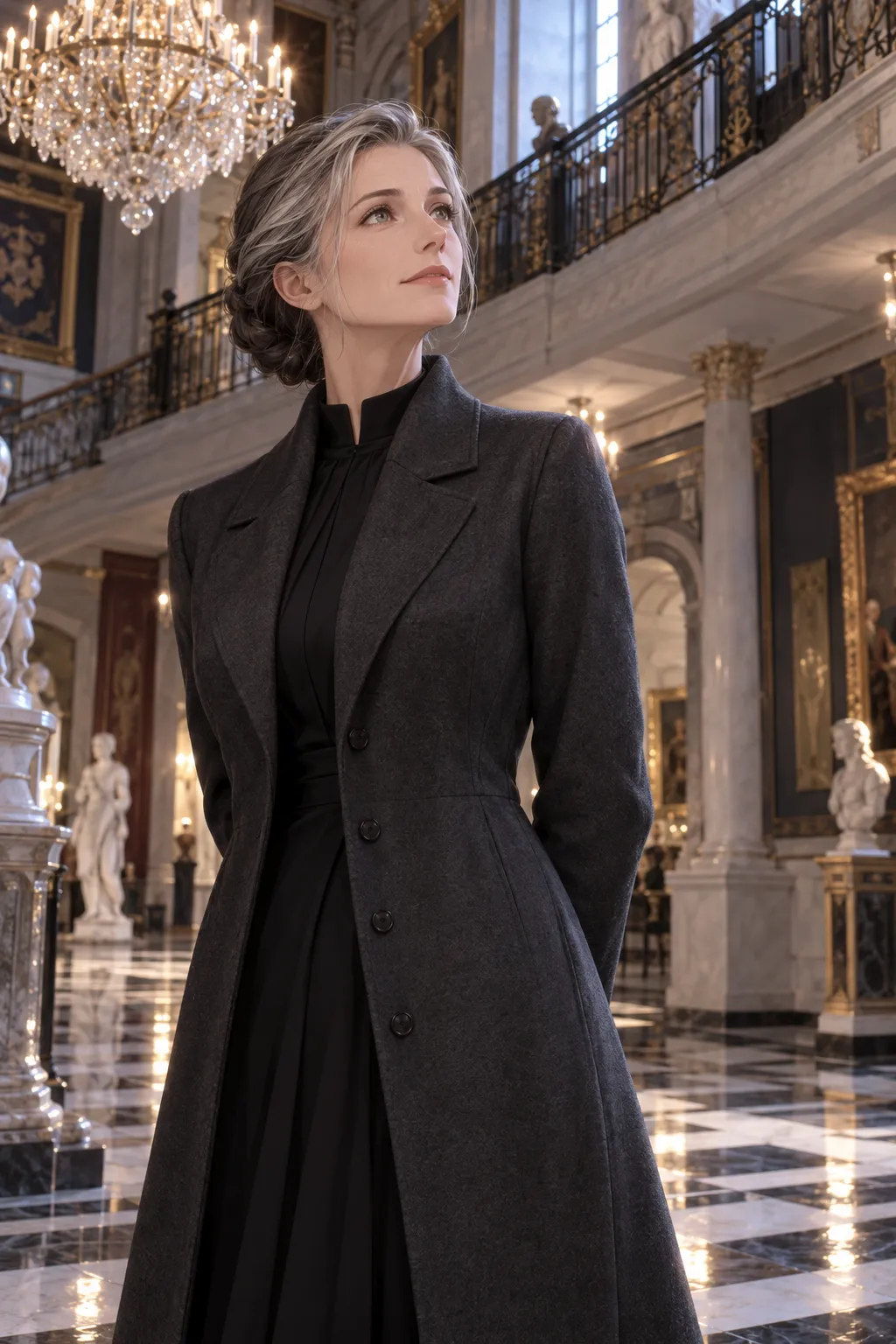
She had expected someone in a white coat. Dr. Marchand was in a dark grey one, beautifully cut, over a dark dress. She was in her early fifties, slim and very upright, with grey eyes and grey-streaked hair drawn back, and no jewellery at all: no rings, no earrings, not even a watch. She was standing in the middle of the black-and-white marble under the chandelier, looking up at the gallery with the open, interested expression of somebody in a museum, and when Eliana came in she turned and smiled.
Norham Gardens, 24 February, 15:00. Dr. Marchand.
‘Miss Tzofiya. Forgive me. I should have telephoned. I was in London, and Anselm told me you were so close, and I thought, if I telephone, she will be polite and say no.’ The smile deepened, a little ruefully. ‘So I didn’t.’
It was a very good voice. Warm, unhurried, intelligent. And it had nothing in it at all.
Eliana had six languages and a grandmother who could tell a Muscovite from a Petersburger in a single vowel, and she listened to accents the way other people looked at faces. Everybody had one. Everybody carried the place they came from in their mouth, in the shape of the r and the length of the a and the little lift at the end of a question, however many countries they had lived in since. Juno’s English still had Seoul in it. Papa’s had Moscow. Dr. Kreutz’s had a soft Zurich floor under every word.
Dr. Marchand’s had nothing. Not French, though her name was French. Not Swiss. Not English. It was as clean as a sheet of glass. It was as though she had been born nowhere, or had gone back, at some point, and carefully removed the place.
Somewhere very far down, something in Eliana stirred, like a sound heard once through a wall. She reached for it. It slid away.
‘You signed my letter,’ she said.
‘I did. I’m afraid I sign everybody’s.’ Dr. Marchand glanced at the empty place on the hall table where the lilies had been, and Eliana had the uncomfortable sense that she knew exactly where they had gone. ‘May we sit? I promise not to try to sell you anything. Or, well. Not much.’
They sat in the drawing room, by the window. Mrs. Nowak brought tea without being asked and then did not leave, but stood by the door with her hands folded over her apron, like a second, much more Polish guard.
Dr. Marchand did not talk about the clinic at first. She asked about Merton, and about chemical engineering, and listened to the answers as though they interested her. She knew what a metal–organic framework was. She asked whether Eliana had read Primo Levi, and when Eliana took the battered paperback out of her cardigan pocket, she laughed, delighted, and said that she had read The Periodic Table on a train when she was nineteen and had missed her stop by three countries.
Then she asked, very gently, whether she might listen to Eliana’s chest.
She had a stethoscope in her bag. She warmed the bell of it in her palm before she touched it to Eliana’s back, through the blouse, which nobody did except Ms. Okafor. She listened for a long time, moving it, saying breathe in, and out, and again, thank you, in that voice with nothing in it, and Eliana sat very straight on the sofa and breathed, and felt the old tightness on the right side, and the faint catch at the bottom of each breath, like a hinge that wanted oiling.
‘Thank you,’ said Dr. Marchand at last, and put the stethoscope away. ‘How often now?’
Eliana thought of the tissue folded in her pocket.
‘Not often.’
Dr. Marchand looked at her for a moment and did not say you’re lying, and Eliana liked her for it.
She explained the treatment then, plainly, without brochures. The bronchial arteries that had been torn in October would never be quite right, because the body, mending them, had mended them badly, with scar and with vessels too thin for the pressure they carried. At the Klinik they had been teaching the body to do it again: taking a patient’s own cells, growing them, putting them back where the damage was, so that the walls of the vessels could be rebuilt properly, the way they had been before. ‘Your surgeon would call it experimental,’ she said. ‘She would be right. Some of it is. I won’t pretend otherwise. But I have seen what it does.’
‘Thank you,’ said Eliana. ‘I’m not ready.’
‘No. I didn’t think you would be.’ Dr. Marchand smiled. ‘The room is there. That is all I came to say about the clinic.’
She put down her cup.
‘There is another reason I came,’ she said.
Afterwards, Eliana would try to remember exactly when the room changed. She never could. Dr. Marchand’s voice did not change. Her face did not change. She went on sitting with her hands folded on her knee and her grey eyes very steady, and spoke in the same warm, unhurried way she had spoken about Primo Levi, and somewhere in the next ten minutes the drawing room on Norham Gardens stopped being a room Eliana knew.
‘When I was young,’ said Dr. Marchand, ‘I belonged to some people. I’m not proud of it. I was very clever and very lonely and they were very old and very rich, and they gave me a table to sit at, which is the thing clever, lonely young people want most. They call themselves the Children of Tehom. Tehom is Hebrew. You’ll know it.’
Eliana did. Her grandmother had read her the first page of Genesis in Hebrew when she was five. And darkness was upon the face of the deep.תְּהוֹם. Tehom. The deep.
‘Your father knew them,’ said Dr. Marchand. ‘Not as a member. As a debtor. He paid them, every year, for thirty years. A great deal of money. And they asked him, in the end, for the one thing he would never give them, and he refused.’ She paused. ‘I left them, a long time ago. I have spent most of my life since trying to mend some of what they break. It is why I run a clinic and not a bank. I tell you this so that you know why I have this.’
She took a slim folder out of her bag and put it on the low table between them, beside the teapot.
HM Coroner for Oxfordshire · post-mortem examinationExtract
Deceased: BRENNER, Matthias · male · 51 · HGV driver
Found in the cab of the articulated vehicle involved in the collision on the A44, 26 October 2024, 17:41.
Injuries
None attributable to the collision.
Rigor
Fully resolved.
Lividity
Fixed. Pattern inconsistent with the position in which the body was found.
Interval
Death estimated at 68–72 hours before the collision.
Cause
Undetermined.
Inquest opened and adjourned, 4 November 2024. Not resumed.
Adjourned at the request of a government department. Which one is not recorded.
Eliana read it twice. Then she read it a third time, because the words would not stay still.
Before the collision.
A lorry on the A44 at dusk, coming round the bend between the woods. The trailer beginning to slide, quite slowly, almost gracefully, like the arm of a clock. Her father saying one word in Russian, very calmly. And in the cab, at the wheel, with his hands on it, a man who had been dead for three days.
She had known. Somewhere, since a van in Radcliffe Square and a voice saying undamaged, she had known. It’s the same people. It was always the same people. She had carried the thought for a month the way you carry a stone in your shoe, and never once taken it out to look at it, because if she looked at it she would have to see the rest.
‘It wasn’t an accident,’ she said. Her voice sounded strange to her, very small and very far away.
‘No.’
‘Why?’
‘Because your father said no to them.’
‘To what?’
Dr. Marchand looked at her with something that might have been pity, and did not answer that.
‘There is a young man,’ she said instead, ‘that you have been seeing. Since the garden. Tall. A Balliol second-year. He carried you home through Oxford in January, and the whole world watched him do it.’
Every part of Eliana went still.
‘His name is Zadkiel,’ said Dr. Marchand. ‘His father’s name was Gabriel. I knew him. Everybody at that table knew him. For nineteen years he was one of us. We called him Brother Gabriel. He held a title, the Keeper of the Third Lamp, and he was the most brilliant man I ever met.’ She said it simply, as if it were a fact about the weather. ‘He knew your name, Miss Tzofiya, when you were eight years old. He wrote it in a notebook. If anything of Gabriel’s survived the fire, his son has it.’
The drawing room was very quiet. Somewhere in the house Pascal was banging a tin on a work surface, and swearing at bread.
‘You’re lying,’ said Eliana.
‘I would very much like to be.’
‘He carried me home.’ It came out of her before she could weigh it. She held the other thing down, the enormous thing, the white figure and the wings and the bar in her chest, held it down with both hands, because whoever this woman was, she would never, ever give her that. ‘He’s kind. He— you don’t know him.’
‘I’m not saying he is cruel,’ said Dr. Marchand gently. ‘I don’t think he is. I think he is very like his father, who was kind too, in his way. I am not saying he did anything to you.’ She leaned forward a little. ‘I am saying he knew. Ask him how long he has known that your parents were murdered. Ask him why his father wrote your name. Watch his face when you ask.’
‘Why are you telling me this?’
‘Because the people who did this are not finished, and I would rather you walked towards them with your eyes open.’ Dr. Marchand stood, and buttoned her grey coat. She laid a second card on the table beside the folder. ‘You’ll want to be angry with me. Please. Be angry with me. I can bear it.’ She looked down at Eliana, and her grey eyes were very kind. ‘But ask him.’
Mrs. Nowak showed her out. The man with the boxer’s ears held the door. Eliana sat on the sofa in the drawing room with the folder on her knees and did not move until the gate had closed and the sound of a car had gone away down Norham Gardens.
She went up to the reading room. The stairlift took four minutes. She counted every second of them.
Then she sat in the window seat, in the bay at the top of the house, with the bismuth crystals catching the low winter light in their cabinet and the card on the desk saying So you have somewhere to be tall, and made herself think.
She was good at thinking. It was the thing she was best at in the world. She laid it out the way she would lay out a problem sheet. The lorry driver had been dead for three days. Somebody had wanted her parents dead, and had made it look like weather. The somebody was old and rich and had a name out of Genesis. And a boy who had told her believe me on a bench by the river, nine days ago, had known that her parents were murdered, and had not said so. Had, if the woman was right, a notebook with her name in it, and had not said so. Had stood under her window all winter, knowing, and had not knocked, and had not said so.
There’s more. A lot more. Some of it’s difficult.
And she had said: Tell me next week.
Then she thought of Broadway Hill.
She did not mean to. It came up on its own, the way it always did: the wind, the rug, the kimbap. Her own voice, red to the ears, saying Zadkiel. Papa going still. Papa looking out at sixteen counties, a long way away and a long time ago.
I knew a Zadkiel once. A physicist, in Geneva.
And then— what had he said? She had replayed that afternoon a thousand times, but always for Eomma’s face, Eomma’s promise, Eomma’s unfinished sentence; she had never once replayed it for this. It came back to her now in pieces, sharp-edged, through the folder on her knees. A room full of very bad ones. She heard that. He died. She heard that. And then the smile, the ordinary enormous smile, put on over something he did not want her to see. It’s a common enough name. Probably no relation.
Papa had known. Papa had sat on a tartan rug and heard the name and gone white, because he had known exactly who the Zadkiels were and what room they had sat in, and he had smiled at her and lied.
To protect her. Of course to protect her. Everyone always did everything to protect her. Papa with his twelve men. Dov with his hand on the back of her neck. Mrs. Nowak with her folder of rules from September. Dr. Kreutz with his brochures. And now a boy with grey eyes who had decided, all by himself, on a bench by the river, what she was allowed to carry.
She coughed.
It was not much. A little more than Thursday. She took the tranexamic acid from the steel tin with hands that were quite steady, and drank the water, and sat with her eyes closed until the tightness eased.
She could cancel. She could ring him now and say she was ill, which would be true, and not see him, and not ask, and keep for one more evening the best nine days of her life exactly as they had been.
She did not ring him.
At six o’clock she went down to her room and put on the white blouse, and the white cardigan, and the white pleated skirt Eomma had bought for a good day, and her white Nikes with the one silver thread. She did not put anything on her face. She looked at herself in the mirror for a long time, and the girl in the mirror looked back, very pale, very calm, dressed for a wedding or a funeral.
She would give him until the end of dinner. She knew that about herself, standing there: she would forgive him everything, if only he told her first.
At seven o’clock, the doorbell rang.
For the first time in his life, he was exactly on time.
第五章
Chapter FivePOV · BothNorham Gardens · 24 February · 19:00
White
He had decided to tell her everything after dinner.
He had decided it at one minute past midnight on Monday morning, lying on the floor of the Nave, when ZERO had observed, without being asked, that next week had ended. He had decided it again on his run, and again in Halvorsen’s lecture, and again on the walk up the Banbury Road in the dark, with his father’s last notebook in the inside pocket of the navy coat Toby had chosen, where he could feel its corners against his ribs at every step. The page with her name on it. The road. The driver who had been dead for three days. All of it. Tonight, after dinner, when she had eaten something, and was warm, and he had watched her laugh at least once.
You have rehearsed this eleven times, said ZERO, as he came through the gate. You have not once got past the first sentence.
‘I’ll get past it tonight.’
What is the first sentence?
He didn’t know. He rang the bell.
It was the first time he had ever been inside. All winter he had stood under a plane tree across the road and watched the light in the bay window at the top of the house; he had never gone through the door. A Halvard man opened it, the one with a boxer’s ears, and looked at him for exactly one second too long.
The hall was not what he expected.
Her father had had it opened up two storeys high, to a galleried landing with an iron balustrade, and from the middle of that height hung a chandelier of the kind Alexander Stevansky had presumably considered modest: a waterfall of crystal, every drop of it lit. The floor was black and white marble. There were white sofas, and white flowers in tall glass vases, and tall windows going dark and blue behind them. It was much too big for a girl of a hundred and forty centimetres, and he understood at once that it had been built by a man who wanted the world to see how much room there was for her.
She was standing on the stairs.
Three steps up, with one hand on the banister. She was all in white: a white blouse, the white cardigan, and a white pleated skirt he had never seen before, and her white Nikes with the one silver thread. Her hair was down. She had not put anything on her face. And she was not smiling.
He had seen her face covered in blood in the back of a Land Rover. He had seen it scarlet in a village street in Esso, and wild in Radcliffe Square, and lit by candlelight on the step of a closed café. He had never seen it like this: perfectly composed, perfectly still, and behind the stillness something holding itself together by force.
‘Thank you for coming,’ she said.
It was the most formal thing she had ever said to him.
Pascal had made a dinner that would have made a Michelin inspector reconsider his life. Aria did not taste any of it.
They ate in a dining room off the hall, at one end of a long table built for twenty, with Mrs. Nowak coming in and out and pretending not to look at either of them. He had kept his coat. It hung on the back of his chair, heavier on one side. Roasted squash with brown butter that was not butter. Black lentils and something smoked. Bread Pascal had baked that afternoon in a temper. She ate four mouthfuls and moved the rest from one side of her plate to the other, and answered every question he asked, politely, in full sentences, and asked none back.
She has said ninety-one words since you arrived, said ZERO. Her heart rate has not dropped below one hundred and four. She has looked at your coat three times.
‘She’s tired,’ he said, to his plate.
That is one hypothesis.
He told himself he would tell her in the hall, before he went, where it was quiet. He sat through two hours of it with the notebook hanging at his back, waiting for the right moment, and the right moment sat across the table from him in white and waited for him to find it, and he did not.
At five past nine she put down her fork.
‘I’ll show you out,’ she said.
She did not show him out. She walked him to the foot of the stairs, slowly, and then went up three steps and turned round, so that her eyes were very slightly above his. The Halvard man stood in the doorway to the drawing room with his hands folded. Mrs. Nowak had stopped in the dining-room door with a tray.
Aria had his coat over his arm. He put his hand into it for the notebook.
‘Did you know,’ said Eliana, ‘that my parents were murdered?’
The hall was very quiet. Somewhere above them, a drop of the chandelier turned on its wire and caught the light.
Pilot.
He had the notebook in his hand. And she was standing on the third stair with her chin up, looking at him the way she had looked at the angel in the snow in Kamchatka, demanding things on behalf of the dead, and there was only one thing he could say to her face.
‘Yes,’ he said.
She did not move. He saw it go into her anyway.
‘When?’
‘That night. On the road.’
‘How?’
‘The man driving the lorry,’ said Aria. ‘He’d been dead for three days before it hit you.’
‘You knew that on the road.’ Her voice was very level. ‘In October. While I was in intensive care with a tube down my throat.’
‘Yes.’
‘In the pharmacy. When you paid for my prescription and walked away.’
‘Yes.’
‘Under my window. Every night.’
‘Yes.’
‘In the café. On the step, when I kissed you.’
‘Yes.’
‘In the Garden.’ Now it shook, just once, and she steadied it. ‘On the bench by the river. I told you it was my idea. I told you I sent them all away. And you looked at me and said, “Believe me.”’
‘I meant it.’
‘You meant it because you knew!’ It came out of her like something breaking. ‘You knew it wasn’t my idea, it was theirs, it was always theirs, they were waiting for me to say it, and you let me carry it. You let me go to Dr. Feld every Tuesday and say it should have been me. You let me lie awake at four every morning and do the arithmetic. Twelve men round that car. Dov. My idea. You let me believe that, Aria, for four months, because you’d decided I couldn’t carry the other thing.’
‘I was going to tell you tonight.’ He held up the notebook. His hand was not steady. ‘That’s why I brought— I was going to tell you everything. Tonight.’
‘You said next week.’
‘You said next week,’ said Aria, before he could stop himself.
She went white. For a second he thought she was going to fall. Then she lifted her chin even higher.
‘I did,’ she said. ‘I said tell me next week. I didn’t know that “difficult” meant “your parents were murdered and I’ve known since October”.’ She drew a breath, and he heard it catch, deep down on the right side, and his whole body went cold. ‘A woman came to see me today.’
‘What woman?’
‘She was kind. She sat down and told me the truth, and she showed me the post-mortem, and it took her ten minutes.’ Her eyes were very bright. ‘That’s ten minutes more than you managed in four months.’
Ask her, said ZERO, very fast, about the woman’s voice.
‘Eliana. Did she have an accent?’
She stopped. Something crossed her face, very quick, like the shadow of a bird across a window.
‘No,’ she said slowly. ‘None at all.’
‘That woman is—’
‘Don’t.’ She held up one hand. ‘Don’t you dare. Don’t you dare stand in my father’s house and tell me who I’m allowed to trust.’
He shut his mouth.
‘She told me what your father was,’ said Eliana.
Of all the things he had been ready for, that was not one of them.
‘My father,’ said Aria, ‘was a physicist.’
‘He was one of them. The people who did it. They call themselves the Children of Tehom.’ She said the strange word carefully, as if it were a chemical she had been warned about. ‘She said he was one of them for nineteen years. Brother Gabriel. The Keeper of the Third Lamp. She said he knew my name when I was eight years old.’ Her eyes went to the black notebook in his hand. ‘She said he wrote it down. In a notebook.’ A pause. ‘That notebook?’
The hall tilted, very slightly. Tehom. He had never heard the word in his life. Brother Gabriel. His father, who read him notebooks instead of fairy tales. The Keeper of the Third Lamp. He did not know what any of it meant, and she was looking at him as if he had known all of it, all along.
‘Yes,’ he said. ‘That notebook.’
‘Papa knew him.’ Her voice was getting thinner. ‘On Broadway Hill. On the last day. I said your name, and Papa went still, and he said he’d known a Zadkiel once, in Geneva. In a room full of very bad ones. And then he smiled at me and said it was a common name and probably no relation.’ She laughed. It was a terrible little laugh. ‘He looked me in the face and lied. To protect me. And two hours later he was dead in my lap. And you—’ She was breathing too fast now. He could hear it. ‘You’ve been doing exactly the same thing. Haven’t you. Deciding what I’m allowed to know. Twelve men outside the loo. A drone over the garden. A glass case.’ Her voice cracked right across. ‘You’re just another glass case, Aria.’
He came up one step. He held out the notebook to her, open at the last page.
‘Read it,’ he said. ‘Please. Read what he wrote. My father—’
‘I don’t want your father’s handwriting,’ said Eliana. ‘I wanted yours.’
And then she coughed.
It was a small cough. A dry one. She turned her head away from him to do it, politely, the way she did everything, and put the back of her hand to her mouth.
When she took her hand away, it was red.
She looked at it, and he watched her understand, in the half-second before her body decided for her, exactly how bad this one was going to be.
Then it came.
It came up out of the right side of her chest the way it had come in the car on the A44, in a hot dark rush, all at once, far more than a body that size should have been able to hold, and it was not stopping. It poured over her chin and down the white blouse. She bent double on the stairs, choking, and her hand slid off the banister. He was already moving. He caught her as she came down the last two steps, and they went down together onto the marble at the foot of the stairs, and his coat fell, and the notebook skidded away across the floor.
Norham Gardens, 24 February, 21:12.
ZERO System · medical 21:12:40 GMT
Massive haemoptysis. Right lung. Estimated loss 350 ml in 80 seconds and rising.
SpO₂ 84%. 79%. 73%.
Airway obstructing. Right side down. Keep the left lung clear.
‘Right side down,’ he said, to her, to himself, to the people running. ‘Keep the left lung clear.’ He turned her onto her right side so that the blood would run out of her mouth and not across into the good lung, as the plan said. He held her there with one arm under her head and the other across her back. She was convulsing against him, long shuddering spasms that came up out of her chest and went through the whole of her. She was clawing at the floor, at his arm, at the air. Her eyes were wide open and looking at him and full of terror, and she could not breathe, and he could not breathe for her.
Someone was shouting. Mrs. Nowak, running, with the folder that held the plan in one hand and the steel tin of tablets in the other. Pascal, on the phone, in French and then English, saying an address. Tomasz on his knees on her other side. The Halvard man had not moved from the drawing-room doorway. ZERO painted him in the corner of Aria’s vision: phone in hand, filming.
Her skirt had ridden up in the convulsions. There were four people and a camera in the room.
He did not look down. He kept his eyes on her face, on her blue lips, on the airway that was the only thing in the world that mattered, and with his other hand he found the hem of the white skirt by touch and drew it down, and straightened it, and smoothed it over her knees, the way you would straighten the blanket of somebody asleep. Then he held out his hand behind him without looking round, and Mrs. Nowak, who understood, picked his coat up off the marble and put it into his hand, and he laid it over her.
Mrs. Nowak saw all of it. She would never forget it.
Sixty-four percent, said ZERO. Fifty-nine. She is not moving air. Aria, there is a clot in the—
He put two fingers into her mouth and swept it. It came away dark and heavy and he flung it on the marble, and swept again, and got more, and still she did not breathe.
Then she was sick. Not food: blood, swallowed blood, a great black rush of it from her stomach on top of what was coming up from her lung, and it went everywhere, over her face and his hands and the black-and-white squares, and in the middle of it her eyes rolled up and her whole body, which had been fighting so hard, simply stopped. Her hands opened on the marble. She went limp.
Fifty-two, said ZERO. It is below your fingers. It is in her throat. Aria, she has perhaps sixty seconds.
He did not think about it. There was nothing to think about. He turned her face up to him in the crook of his arm, and put his mouth over hers, and sucked.
It came into his mouth hot and thick, tasting of iron and salt: her blood, a mouthful of it. He turned his head and spat it onto her father’s floor and put his mouth back on hers and did it again. And again. The third time something came free, deep down; he felt it give, a dense warm clot that filled his mouth, and he spat it out onto the marble beside her head. Then he sealed his mouth over hers and breathed into her. Once, slowly, his own air, the way Kuramoto had taught him on a dummy in the Nave when he was twelve. Twice.
‘Breathe,’ he said against her mouth. ‘Eliana. Breathe. In for four. Come on. Come on—’
Mrs. Nowak, on her knees on the other side of her with the folder of the plan crushed in both hands, saw that too.
Eliana dragged in a breath. It was the worst sound he had ever heard: wet and torn and whistling, like a broken bellows. Then another. Then a cough that brought up the last of it over his wrist, and then a breath that was nearly a breath.
Sixty-one, said ZERO. Sixty-six. Bleeding slowing. She is breathing. A pause. She is breathing.
She did not move again. She lay slack in his arms with her head heavy against his forearm and her eyes half closed and her hands open on the marble, and breathed, and he knelt over her with her blood on his mouth and could not, for a moment, do anything at all.
The action plan said: never flat. Upright, leaning forward, so that what is left can come out.
So he gathered her up off the cold floor. He did not ask, this time. He did it the only way he knew, the way he had in a valley in Kamchatka and on the A44 and in Radcliffe Square: one arm under her, lifting her against his chest, her face against his shirt, his other hand on the back of her head to hold it there, her white trainers coming up off the marble and dangling a long way above the floor. Her blood was all down the front of his white shirt. He held her up against him under her father’s chandelier and felt her breathing, thin and fast and wet, against his heart, and Castor and Pollux beating slow beneath it, and for one moment, the only moment in that whole night, he let himself close his eyes.
Norham Gardens, 24 February, 21:16. “Let go.”
She came round in his arms.
He felt it happen: a change in her breathing, a tightening of her fingers in his shirt. Then a stillness. Then he felt her understand where she was, and whose arms she was in.
Her hands moved to his chest. Flat, both palms, on the wet red cotton over his heart. And she pushed.
There was nothing in it. She weighed thirty kilos and had just lost more than a third of a litre of blood on her father’s floor, and he was ninety kilos of muscle with a war machine in his bones, and she pushed against him the way a moth pushes against a window, with everything she had, which was nothing.
‘Let go,’ she whispered. Her voice was a wet thread. ‘Let go of me.’
He could not put her down on the marble. He could not let go of someone who could not stand. He stood there holding her up, and she pushed, and pushed, and her palms slid on the blood on his shirt, and she pushed again.
‘Let go.’ She was crying now, without any breath to cry with. ‘Please. Please. Let go of me.’
‘Mr. Zadkiel.’
Mrs. Agnieszka Nowak was standing in front of him.
She was sixty-three and came up to his chest, and there was blood on her hands and on her apron. He knew her from what Eliana had told him on the benches that week: fifteen years running the London house, pierogi without eggs for a ten-year-old, three in the morning at a kitchen table, gluing a dead man’s coffee mug back together piece by piece. Pascal stood at her shoulder with the phone still in his hand, and Tomasz behind them both, and all three of them were looking at him.
‘Put her down,’ said Mrs. Nowak. Her voice was quite steady. ‘Please. On the sofa. Gently.’ She did not look away from him. ‘And then leave her alone.’
Nobody in that house had ever asked him to go. He looked at the three of them with her blood on their hands, the people who had stayed with her through the winter when there was nobody else.
He carried her to the nearest of the white sofas and laid her down, propped up on four cushions, the way the plan said. She turned her face away from him, into the cushions.
‘Don’t come back,’ she said. It was barely a voice. ‘Don’t stand under my window. Not any more.’
Her left hand was still caught in his.
He let it go.
He did not decide to do the next thing. That was what he told himself afterwards, many times, and it was not true.
As her fingers slid out of his, a thread of white metal came out of the tip of his forefinger, finer than a hair, finer than the silver line at the heel of her shoes. It went once round her left wrist, under the cuff of the ruined cardigan, and sank into her skin like breath fading from a window, and was gone. If you had looked for it, with the light just so, you might have seen something on the inside of her wrist that could have been a vein. Nobody looked.
That, said ZERO, very quietly, is not what she asked for.
‘I know.’
A long pause.
For the record, said ZERO, I would have done the same. For the record, she would not have let either of us.
Somewhere out on the Banbury Road a siren was coming. He stood up. His father’s notebook lay on the marble at the foot of the stairs, open, face down, with her blood across the black cover.
Notebook thirty-one, said ZERO.
He looked at it for a long moment.
‘Leave it,’ he said.
He walked out through the hall, past the Halvard man in the doorway, who lowered his phone and smiled at him, and out of the front door into the dark.
He did not stand under the plane tree. She had asked.
He walked home through the dark without a coat, in a white shirt that was not white, past a couple outside the Jericho Tavern who saw him and stopped talking, and somewhere on Walton Street he felt it.
Under his own heart, which was going much too fast, and under Castor and Pollux, slow and steady as always, there was a third heartbeat. Very small. Very fast. Very faint, like a sound in another room.
He stopped on the pavement.
It is a medical monitor, said ZERO. Heart rate, oxygen, airway, position. It speaks to the armour the way the boots did. It runs warm while it is connected to us. You will feel it as long as it is on her.
‘I know what it is,’ said Aria.
He stood on the pavement for a long time, with his hand flat on his chest, and felt her heart slowing, very gradually, from frightened to merely sad.
Toby was on the sofa when he came in. He looked up, and saw the shirt, and the blood on Aria’s face and neck and hands, and for once in his life he did not say anything at all. He got up. He put the kettle on. He ran a bath, and came back and stood in front of Aria and held out his hand.
‘Shirt,’ said Toby.
Aria took it off and gave it to him.
‘Cold water,’ said Toby, to nobody in particular, holding it. ‘You soak blood in cold water. Hot sets it. My nanny taught me that. She was ex-army.’ He looked at Aria. Then he put the hand that was not holding the shirt on the back of Aria’s neck, briefly, the way you would steady a horse. ‘Bath,’ he said. ‘Then tea. Then you can tell me or not tell me. Mate.’
The paramedics stayed for an hour. The bleeding had stopped. Her oxygen came back to ninety-three on the mask. When they wanted to take her to the John Radcliffe she said no, quite clearly, four times, and signed the form with a hand that shook so much the signature looked like a seismograph, and Ms. Okafor, reached at home, said down the phone that she would see her at eight in the morning and that if there was so much as a teaspoon more before then, Eliana was to be in an ambulance whether she signed things or not.
Then they were gone, and the hall was quiet, and she lay propped on the white sofa with a blanket over her and her face turned into the cushions, and Mrs. Nowak knelt on the marble beside her with a bowl of water and a cloth and began, very gently, to wash the blood off her hands.
‘Miss Eliana.’
‘Mm.’
‘I asked him to go.’ Mrs. Nowak wrung out the cloth. ‘I would ask him again. You are not to think I am sorry.’
‘I know.’
‘But there is something you should know, because you were in no state to see it.’ The cloth moved, slowly, over her knuckles. ‘When you were on the floor. When it was very bad. Your skirt.’ She chose the words in her second language with great care. ‘He pulled it down for you. And straightened it. And put his coat over you. He did it without looking. Not once. He was looking at your face the whole time, Miss Eliana. Only your face.’ She wrung out the cloth again. ‘And when you stopped breathing, he put his mouth on yours and took the blood out of you. With his mouth. Three times, and spat it on the floor, and then he breathed for you.’ Her voice was not quite steady any more. ‘I have kept houses for forty years. I have never seen a man do that for anybody.’
For a long moment Eliana said nothing.
She remembered. Not the floor; not the blood. Only that: at the very bottom of everything, in the dark, a mouth on hers, and then air going down into her where there had been none. Someone else’s air, warm, slow, given to her a breath at a time. She had thought it was a dream. She had thought, in the dark, so this is what it is like to be breathed for, and then she had come up out of the dark into his arms and pushed him away.
Her shoulders began to shake.
‘I know,’ she said into the cushion, in a voice like something torn. ‘I know he did. That’s what’s so unbearable.’
She loved him. She knew it lying there, with her blood drying on her hands and the taste of it in her mouth, more surely than she had ever known anything, more than thermodynamics, more than her own name. She was in love with him so completely that it frightened her worse than the bleeding had.
And she would not ring him. She had told him not to come back, in her father’s hall, in front of three people, with her own mouth; and she was Alexander Stevansky’s daughter, and in eighteen years she had never once heard her father be the first to say that he was wrong. So she lay on the white sofa with her face in the cushions and was proud, and wretched, and in love, all three at once, which nobody in her family had ever considered a normal response to anything.
Mrs. Nowak finished washing her hands. Then she got up, stiffly, and picked up a black notebook from the foot of the stairs, and wiped the blood off its cover with the corner of her apron, and put it in the drawer of the hall table, under the guest book, without opening it.
On the inside of Eliana’s left wrist, under the cuff of the ruined white cardigan, something finer than a hair was very slightly warm.
She would not understand what it was for eleven days.
第六章
Chapter SixPOV · Eliana · DovNorham Gardens · 25 February – 2 March
Ktana
At twenty to seven on Tuesday morning, somebody came up the stairs of the house on Norham Gardens two at a time, which nobody in that house did, and stopped outside the door of the reading room, and did not knock.
She knew who it was before he spoke. She had known the sound of those feet on a staircase since she was nine.
She was in the window seat, where she had been since two, under a blanket, with her knees pulled up and her cheek against the cold glass of the bay. She had not slept. She had not tried. On the floor by the desk, where she had dropped it at midnight, lay a white cardigan that was no longer white, and she had not been able to make herself pick it up or throw it away.
The door opened.
Dov Ben-Ami was thinner. That was the first thing. Four months of hospital food and two operations had taken something out of his face and his shoulders, and there was a new scar, pink and shiny, running from the corner of his left eyebrow into his hair, which she did not know the story of. He was in a black jacket she did not recognise; the old one had been cut off him in a valley in Kamchatka. His face was doing what it always did, which was nothing.
Norham Gardens, 25 February, 06:40.
He looked at her in the window seat. He looked at the cardigan on the floor. Then he came across the room and sat down on the end of the window seat, by her feet, and said nothing at all for a long time.
‘Ktana,’ he said at last.
That was all. One word, in Hebrew, the way he had said it to a nine-year-old on her first day at a new school, and over the Arctic with one eye open, and on the telephone every night at nine for four months, the first of them to a phone she would not pick up.
She came apart.
Not prettily. Not the way she had cried at the funeral, or in the reading room on Christmas morning with Prince Andrei on her knees. She came apart the way a dam goes, all at once and from the bottom, and he took her by the shoulders and pulled her in against his chest, blanket and all, and held on, and let her. He smelled of aeroplane and antiseptic and the same aftershave he had worn for nine years. His arms were not as strong as they had been. They held her anyway.
When it was over, or nearly, he said into her hair: ‘Are you eating?’
‘No.’
A long, Israeli silence, full of opinions.
‘Lentils,’ said Dov, ‘are real food.’
It was half a laugh and half a sob and it hurt the right side of her chest, and she did not care.
He had been cleared to fly on Monday morning. He had been at Ben Gurion at two in the morning, already through security, with a ticket he had not told anyone about because he had meant to surprise her, when his phone rang and it was Harriet Achterberg, who had been rung at midnight by Mrs. Nowak, who had been standing in the hall in an apron covered in blood.
‘I was going to bring you halva,’ he said. ‘From the place on Levinsky Street. I left it on the plane.’
She told him, in pieces, over the next two days. Not all at once; she couldn’t. Some of it in the car on the way to the John Radcliffe on Tuesday morning, where Ms. Okafor looked at a scan for a long time and said, ‘That was a big one, Eliana,’ in a voice that meant more than it said. Some of it on Tuesday night, at the kitchen table, while Pascal made soup and pretended to be deaf. The last of it on Wednesday, in the reading room, with the door shut. The kind woman with no accent. The post-mortem. The notebook. The bench by the river. Believe me.
She did not tell him what Aria was. That was not hers to tell. But she had a feeling, from the way Dov’s face did nothing when she said the name, that she did not need to.
When she had finished, he was quiet for a long time.
‘He should have told you,’ he said.
‘Yes.’
Another silence.
‘I would also not have told you,’ said Dov.
‘Dov!’
‘I said I would not.’ He looked at her steadily. ‘I did not say I would be right.’
She stared at him. He looked back, with nothing on his face at all, and after a while she found she had nothing to say to that, because it was true, and because it was the most honest thing anyone had said to her in a month.
‘Your father,’ said Dov, after a while, ‘gave me a great many orders in nine years. Most of them I understood. Some of them I thought were foolish, and did anyway, because he paid me and because he loved you.’ He turned his big scarred hands over on his knees and looked at them. ‘One of them I never understood. He gave it to me when you were nine, on the first day. He made me repeat it back to him, like a soldier.’
‘What was it?’
‘Never let her go to Zurich.’
She went cold. She thought of a lake clinic, and a room reserved without time limit and without obligation, and a car that would come whenever she was ready.
‘Why Zurich?’
‘I asked him that,’ said Dov. ‘He said, Because I go there every October, and I would rather die than have her see it.’ A pause. ‘I thought he meant the banks.’
On Tuesday afternoon Dov went downstairs and met the men from Halvard Risk.
She watched it from the gallery, which she was not supposed to know he knew she was doing. There were two of them on duty, in the hall, in their dark coats. One of them had a boxer’s ears. Dov did not say much. He walked round them, once, slowly, the way you walk round a car you have been offered at a suspiciously good price, and looked at their shoes and their hands and the place under their left arms where their coats did not quite hang right, and asked them three questions in a pleasant voice about their previous employment, and listened to the answers, and thanked them.
Then he came up to the gallery, where she was not, and stood beside her looking down at the hall.
‘These men,’ said Dov, ‘are not security.’
‘What are they?’
‘Jailers.’ He did not lower his voice. ‘The one with the ears filmed you on Monday night. On the floor. Mrs. Nowak saw him. A guard does not film. A guard does not stand in a doorway with his hands folded while his principal drowns on a marble floor.’ He turned to look at her. ‘Who hired them?’
‘Dr. Kreutz. In November. From a firm Papa trusted.’
‘Your father,’ said Dov, ‘trusted nobody. Not even me. It was the thing I liked most about him.’ He took out his phone. ‘Give me two days.’
He rang Harriet. Then he rang a number in Tel Aviv that was not in his contacts, and spoke for a long time in Hebrew, very quietly, walking up and down the gallery, and she caught only one sentence of it: Find out where she sleeps. She did not know, then, that her father had said exactly the same sentence, in the same language, to the same number, from the back of a car in Zurich in October.
On Thursday, the first of the men from Haifa arrived. By Saturday there were four. They had all served with Dov, a long time ago, in a unit none of them would name. Yossi was grey and quiet and stood at the gate. Amir and Natan were brothers and argued about football in the kitchen at two in the morning in whispers. And Shai was the youngest, twenty-six, with a laugh you could hear from the top of the house, who walked the garden at night and on his first evening taught Pascal a song about aubergines that was, Pascal said with tears in his eyes, the most beautiful thing he had heard since Lyon.
The men from Halvard watched them come. They did not say anything. But on Friday, Eliana saw the one with the boxer’s ears in the drive, with his phone to his ear, looking up at the windows of the house as though he were counting them.
Halmeoni rang on Wednesday at nine in the morning, which was six in the evening in Seoul, and looked at her granddaughter’s face on the screen for exactly two seconds before she said, in Korean, ‘Who was it?’
‘Nobody, Halmeoni.’
‘You have been crying for two days and your eyes are the size of plums. It was a boy.’ Halmeoni put down her chopsticks. ‘Tell me.’
Eliana told her a version. A very small one, with no lorries in it and no angels. A boy who had kept something from her that he should not have kept.
Halmeoni listened to the whole thing without interrupting, which she had never done before in her life.
‘Men are stupid,’ she said at the end. ‘All of them. Your grandfather was stupid for forty years. He kept the money for the roof in a tin under the floor for a whole winter and told me the roof was fine, because he did not want me to worry, and the roof fell in on my kimchi.’ She picked up her chopsticks again. ‘I married him anyway. I would marry him again tomorrow. I would hit him first.’ She pointed the chopsticks at the camera. ‘Eat something. Then decide.’
‘Decide what?’
‘Whether you want to hit him or marry him,’ said Halmeoni. ‘In my experience it is usually both.’
That night, propped on her four pillows, she took out her phone and opened his name. Near the bottom of the thread, from the Thursday before everything, was his first Korean, with the question mark in the right place: 괜찮아? And under it her answer, the most useful lie in the language.
She typed 괜찮아. Then she typed I’m sorry. Then she typed You saved my life on my father’s floor and I pushed you away and I, and stopped, and looked at it for a long time.
She deleted it, one letter at a time. She was Alexander Stevansky’s daughter, and she had told him not to come back in front of three people, and he had not come back; and if he wanted to, he knew where she lived. He had stood outside it all winter.
She put the phone face down on the bedside table and did not sleep, and in the morning she told herself that it had been the right thing to do, and very nearly believed it.
On Thursday morning she came down to breakfast at half past seven, mostly asleep.
She had slept badly again, propped on four pillows, waking every hour, the way she did now. Her left wrist had been warm again in the night, a faint steady warmth on the inside, as though somebody were holding it very gently; she had put it down to the medication, which did all sorts of things, and turned over. She came down the stairlift in a jumper and pyjama trousers with her hair over her face, and walked across the hall towards the smell of coffee, and in the doorway of the dining room she turned left, with great confidence, into the corner of the dining table.
It was a very long table, built for twenty, of old French oak. Its corner arrived at exactly the height of her hip. Exactly the height of the titanium plates in her pelvis.
The sound she made was one she had last made in a corridor of the Thom Building in October, folded over the corner of a lab bench. She folded over the corner of the dining table in precisely the same way, like a deckchair closing, and stayed there, draped across a fan of breakfast napkins, with her cheek on the oak and every particle of air gone out of her and a pain going through her plated pelvis like a struck bell.
There was a silence in the dining room.
Pascal, at the sideboard, had frozen with a coffee pot in each hand. Mrs. Nowak had put both hands over her mouth. And Dov, at the end of the table, with a newspaper, had lowered the newspaper.
‘I’m fine,’ said Eliana, into the oak.
Nobody said anything.
‘I’m fine.’ She was going red. She could feel it, starting at the collar of the jumper and climbing, all the way up to the tips of her ears, until her whole face was hot. ‘The table was in a different place yesterday.’
‘The table,’ said Pascal faintly, ‘has been in that place since 1880.’
She lifted her head an inch off the oak and looked at Dov. His face was doing something. It was very small. It was the first time in nine years she had ever seen it do anything at all. It was, unmistakably, slightly less than nothing.
‘Don’t,’ she said.
‘I said nothing.’
‘Your face said something.’
‘My face,’ said Dov, ‘is not under my command this morning.’ He folded the newspaper. ‘Can you stand?’
She could, eventually. It hurt all day.
The next morning, when she came down the stairlift at half past seven, Dov was waiting at the bottom of the stairs.
He did not say anything. He simply stepped forward as the chair reached the floor and lifted her out of it, both arms round her, a hug as much as a lift, so that her feet in their white Nikes came up off the marble and dangled; and then he turned round and carried her, quite slowly, across the hall and through the dining-room door, giving the corner of the table a wide and pointed berth, and set her down in her chair, and pushed the chair in, and went back to his newspaper.
‘What,’ said Eliana, ‘was that?’
‘Security protocol.’
‘Since when?’
‘Since the table attacked you.’
She sat in her chair. She looked at the corner of the table, which was a metre away and could not reach her. She looked at Dov, behind his newspaper, and thought of a hall in Kensington with marble floors, and a big man in a camel overcoat coming down a staircase like weather coming down a mountain, and her feet leaving the floor, every morning, for eighteen years, as if the floor were not quite good enough for her.
For a second, in his arms, she had gone stiff all over. He had felt it. He had not stopped.
Now she started to laugh. Then, without warning, to cry. Then both at once, at the breakfast table, with Pascal putting a plate of something in front of her and pretending not to notice and Mrs. Nowak blowing her nose in the kitchen, which in her family had always been considered a perfectly normal response.
He did it every morning after that.
At ten past five on Saturday morning, Dov Ben-Ami was sitting on a bench on the Thames path by the footbridge at Medley, in the dark, in the cold, with his collar up and his hands in his pockets, waiting for a young man who ran at five in the morning, in the dark, by choice.
He had not needed Ezra for this one. He had needed the boy’s flatmate’s Instagram, a map, and a good guess about what kind of person runs nine miles in the dark every morning. The kind who does not want to be seen doing it. The kind who was taught by somebody very old that the body is a thing you must learn to the gram.
He heard him before he saw him. Feet on the frozen path, even and very fast, coming up out of the mist from Binsey. A tall shape in the dark. Then the shape was level with the bench, and past it, and Dov said, quite quietly, the way you would say it to a man with a knife in his side:
‘Nobody.’
The feet stopped.
The boy stood very still on the path with his back to him, breathing hard, steam going up from his shoulders into the dark. Then he turned round.
Dov looked at him for a long moment. He had seen him once, in the snow, with a gold visor where this face was. He had seen him again on a phone screen, carrying her through Oxford in a ruined shirt. He looked now, in the grey beginning of the light, at a face that was much younger than he had expected and much more tired.
‘I have heard a great many voices,’ said Dov, ‘with a knife in me. Most of them I don’t remember. I remember the ones that mattered.’ He moved over on the bench. ‘Sit.’
The boy sat.
For a while neither of them said anything. The river went past in the dark, black and quick and smelling of ice. Somewhere on Port Meadow behind them a goose complained about something.
‘Thank you,’ said Dov at last. ‘For Kamchatka. You told me, Don’t talk. I am talking now.’
‘You don’t have to—’
‘I know I don’t have to.’ He looked at the river. ‘She told me what you did. On Monday. And what you didn’t do, before.’
The boy said nothing. His hands, between his knees, were very still, in the way of hands that have been told to be.
‘She says you stay away from her,’ said Dov. ‘So you stay away from her. That is not my order. It is hers, and she is the principal.’ He turned his head and looked at the boy directly for the first time. ‘I am the door now. I have been her door since she was nine years old. Whatever comes for her comes through me first. Do you understand?’
‘Yes.’
‘Good.’
‘There’s something you should know,’ said the boy. His voice was low and very even, the voice from the snow. ‘The woman who came to see her on Monday. Eliana said she had no accent.’
‘Dr. Marchand. From the clinic. Mrs. Nowak told me.’
‘I think I’ve heard her before. On a satellite phone, in Kamchatka. Volkhov’s phone. After the black machine. She said to tell Eliana’s father that he should have taken the meeting.’ He was looking at the river. ‘And the men from Halvard. Every call they make goes to the same place that phone did. Nowhere. A door painted on a wall.’
Dov was quiet for a long time.
‘Give me your number,’ he said.
The boy looked at him.
‘If something comes for her that I cannot stop,’ said Dov, ‘I will call you. I will not call you for anything less. You will not come for anything less. Agreed?’
‘Agreed.’
The boy said a number. Dov did not write it down. He would not forget it. He stood up, stiffly, because his ribs had not been right since September, and put his hands back in his pockets, and looked down at the boy on the bench.
‘The thing on her wrist,’ he said.
The boy went absolutely still. Not stiff. Still, the way a deer goes still, the way a man goes still in the half-second before he decides whether to fight.
Dov let him sit in it for a moment.
‘I didn’t see it,’ he said.
Then, because he was forty-three, and had been somebody’s door for a long time, and had sat in hospital for four months thinking about all the things he had not said to a big man in a camel overcoat while there was time, he added: ‘Next time, boy, tell her the truth. Even if you think it will kill her. It won’t.’ He turned to go. ‘She is harder to kill than both of us.’
He walked away up the path towards Binsey in the grey light. He did not look back. He knew the boy was still sitting on the bench, and would be for some time.
Ezra’s file arrived on Sunday evening, as an encrypted message to Dov’s phone, and Dov brought it up to the reading room and put the phone in her hands without a word.
It was a photograph, taken through a long lens from across a narrow street. A building of pale stone, with a brass plate by the door too small to read. A woman coming out of it, in a dark coat, turning up the collar against the rain. Elegant. Upright. No jewellery. Grey eyes, looking for a moment almost straight into the camera, as if she knew it was there and did not mind.
Underneath, a few lines in English.
Vaduz, Liechtenstein · 26 February 2025For D. B.-A. only
VRAI, Odile · b. c. 1972 · nationality unknown · accent none
Sole director, Fondation Aurel, Vaduz. Through four companies in three jurisdictions, Fondation Aurel owns Halvard Risk Ltd.
Halvard Risk invoiced A. I. S. on 25 October 2024 for “discreet vehicle escort, 26 October, Oxfordshire”. The escort log for that day is blank after 15:12.
Subject of A. I. S.’s request, 23 October 2024: “Find out where she sleeps.”
We found out. He did not live to hear it. I am sorry, Dov.
Eliana looked at the photograph for a long time.
‘She told me her name was Odile,’ she said.
And as she said the name aloud, the thing that had stirred in her a week ago in the drawing room, far down, like a sound through a wall, came up all at once and stood in front of her.
Snow. A valley in Kamchatka. A white figure with a gold visor, bending to unclip a satellite phone from the belt of a man pinned to the stones in silver frost, and holding it to the side of its helmet. And out of the phone, faint and cool and very clear in the cold air, a woman’s voice with nothing in it at all. No country. No childhood. Do give Miss Tzofiya our regards. And do tell her father he really should have taken the meeting.
She had sat in her father’s drawing room and drunk tea with that voice. She had let it listen to her lungs. She had let it tell her who to trust.
‘Dr. Kreutz sent her,’ she said. Her voice was perfectly steady. ‘She said, Anselm told me you were so close.’
‘Yes,’ said Dov.
‘And Dr. Kreutz hired Halvard. And Halvard is hers.’
‘Yes.’
She put the phone down on the window seat, face down, very carefully, the way you put down something that might go off.
Then she looked across the reading room at the desk, at the card in her father’s handwriting propped against the lamp. For second year. So you have somewhere to be tall.
‘Dov,’ said Eliana Seraphina Tzofiya, who owned fifty-one percent of Stevansky Meridian Capital and had never once in her life used it. ‘Tomorrow we’re going to London.’
第七章
Chapter SevenPOV · ElianaBishopsgate · 3 March
Fifty-One Percent
The security desk in the lobby of the tower on Bishopsgate was a hundred and ten centimetres high, and Eliana Tzofiya could just see over it if she stood up very straight.
She had wanted to go in on her own. She had said so in the car, on the M40, in a voice she had borrowed from her father for the occasion. It was her building. It was her company. She was going to walk into it on her own two feet, the way any director would, and not be carried through the door behind a man with a broken nose. Dov had looked at her for a long time, with his face doing nothing, and then said, ‘Three minutes. I go down with Tomasz to the car park, I come up in the lift. Mrs. Achterberg is on the train from Liverpool Street.’ A pause. ‘Three minutes, ktana. Do not buy anything.’
So for three minutes she was alone, in a lobby of white marble and black glass the size of a cathedral, with a sculpture in the middle of it that looked like a steel cloud and had cost, she happened to know, four million pounds of her father’s money, and two security guards and a receptionist looking down at her over the desk.
‘Hello there,’ said the receptionist. She was in her forties, kind-faced, with a headset, and she had stopped typing in the middle of a word. ‘Are you lost, sweetheart?’
‘No,’ said Eliana. ‘I have a meeting on the forty-first floor. At ten.’
The older of the two guards, a big grey-haired man with a lanyard and the moustache of a retired police sergeant, leaned over the desk to look at her properly. Then he did what everybody did. He stopped. Halfway through leaning, with his mouth slightly open, he simply forgot, for a second or two, what he had been going to say. The younger guard beside him had gone a slow, deep pink from the collar upwards. At the bank of lifts across the lobby a man in a good coat had let a lift arrive and leave without getting into it, and was now letting a second one do the same.
‘Forty-one,’ said the older guard at last, recovering. ‘That’s Meridian, petal. Board day today.’ He smiled at her, enormously, the way you smile at a child who has come to work with her father and wandered off. ‘Whose are you, then? Is your dad up there?’
‘My father,’ said Eliana carefully, ‘used to be.’
The guards looked at each other. She could see them deciding it was a divorce.
‘Tell you what,’ said the receptionist warmly. ‘You pop yourself on that sofa, and I’ll get you a hot chocolate, and we’ll ring up and find your mum. We can’t let you through the barriers on your own, sweetheart, not on board day. More than my job’s worth.’ She was already reaching under the desk. ‘Do you want marshmallows?’
‘I’m eighteen,’ said Eliana.
They smiled at her. All three of them, at once, with great tenderness, as if she had said something very brave.
‘Course you are, petal,’ said the older guard, and held out a jar of boiled sweets.
She had had a version of this conversation, she estimated, about four hundred times since she was thirteen. In Selfridges. At the gala. At the auction table. In a corridor of the Thom Building, folded over a lab bench. She knew exactly what it was. She looked twelve, and people were kind to twelve-year-olds, and there was nothing to be done about it except wait. It did not occur to her, standing at the desk in her white cardigan looking up at three grown adults who had all forgotten how to finish their sentences, that a twelve-year-old would simply have been given a hot chocolate, and that nobody had ever in history let two lifts go past to look at one.
The revolving door turned. At the same moment a lift on the far side of the lobby opened.
‘Miss Tzofiya!’ Harriet Achterberg came through the door at a near-run, with her reading glasses bouncing on their chain and the briefcase held against her chest like a shield. ‘I am so sorry. The Central line. A signal failure at Bank. Are you—’ She looked at the guards, the receptionist, the jar of boiled sweets, and stopped.
Dov came across the lobby from the lift, unhurried, in his new dark suit, and stood behind Eliana with his hands loose at his sides and his face doing nothing at all, and looked at the guards.
‘Tzofiya,’ said the older guard slowly. Something was happening to his moustache. ‘Sorry, madam. Did you say— Tzofiya?’
‘I did,’ said Harriet Achterberg. ‘As in the Tzofiya Trust. As in the majority shareholder of the company on the forty-first floor, whose board is about to meet in’—she looked at her watch—‘four minutes. As in, gentlemen, the person who, indirectly, pays for this building.’
It was like watching a tide go out. The pink went out of the younger guard’s face all at once and left it the colour of paper. The receptionist put the hot chocolate down very carefully on the desk, as though it might go off. The older guard put the jar of sweets behind his back. Across the lobby, the man in the good coat finally got into a lift.
‘Madam,’ said the older guard. ‘Miss. Miss Tzofiya. I am— we are— if we had known—’
‘It’s all right,’ said Eliana, and meant it, completely. She even smiled at him, which made it worse; he looked as though he might sit down. ‘Everyone thinks that. It’s because I’m small.’
The guard swiped her through the barriers himself, with a hand that was not quite steady, and held the gate open for her as though it were the door of a cathedral, and did not take his eyes off her face until the lift doors had closed.
In the lift, Harriet Achterberg and Dov Ben-Ami looked at each other over Eliana’s head.
‘It’s because I’m small,’ said Harriet, very quietly.
‘She has always believed that,’ said Dov. ‘Since she was nine.’ He looked at the back of her head. ‘Her mother tried to tell her. Many times.’
‘Tell me what?’ said Eliana.
‘Nothing, ktana. Your ears will pop.’
The boardroom of Stevansky Meridian Capital was on the forty-first floor of a tower on Bishopsgate, and it had been designed, like everything else her father had ever paid for, to make people feel small.
It worked on most of them. It was a long room walled on three sides in glass, so that the whole of the City lay spread out below it in the grey March light like a map someone had spilled: the dome of St Paul’s, the river going silver under its bridges, the cranes over Southwark turning slowly like the hands of clocks that had stopped agreeing with each other. Down the middle of the room ran a single table of black walnut, long enough to land a light aircraft on, and round it, in tall leather chairs, sat twelve directors of the largest private investment house in Europe, ten of them men, all of them in grey.
They stood up when she came in.
They did it raggedly, the way people stand when a judge comes in and they are not sure whether they are in court. Some of them were half out of their chairs before they had seen her; some saw her and stopped, half up, with the look she knew better than her own face. Is this—? Surely not—? One of them, a heavy man with a Scottish accent whom she remembered from a Christmas party when she was ten, actually said, ‘Is she—’ and then shut his mouth with a click.
She had walked from the lift. A hundred and eighty metres from the street door, and forty-one floors in a lift that made her ears pop, and then the long corridor, at her own pace, with Harriet Achterberg beside her and Dov Ben-Ami one step behind, in a dark suit he had bought on Saturday and plainly resented. She had not stopped to rest. She had decided on the M40 that she would not stop to rest in this building if it killed her, and it very nearly had, and none of them would ever know.
At the far end of the table, away from the head, someone had put a chair for her. It was lower than the others. There was a cushion on it.
She looked at it. Then she walked past it, the whole length of the room, past twelve standing men and women in grey, to the head of the table, where a slim white-haired man with a gold signet ring was standing behind the chairman’s chair with his hand on its back, smiling at her with real warmth.
‘Miss Tzofiya,’ said Dr. Anselm Kreutz. ‘What a lovely surprise. Please—’ He drew the chair back for her. ‘Take mine.’
‘No, thank you,’ said Eliana. ‘Please sit down, Dr. Kreutz.’
A tiny pause. Then he smiled again, and inclined his head, and sat. One by one, uncertainly, the rest of them sat too.
She stayed standing.
She had thought about it on the motorway, with the fields going by. The chairs in this room were built for men like her father. If she sat in one, her chin would be level with the table, and her feet would not reach the floor, and they would look at her the way the man at the gala had looked at her over his champagne, and she would be a child at a grown-ups’ table again, and they would be kind to her. So she would not sit. She stood at the head of the walnut table in her white cardigan with her hand flat on its surface, and because every one of them was sitting down, for the first time in her life she was taller than every man in the room.
So you have somewhere to be tall.
‘Good morning,’ she said. ‘I’m sorry to interrupt. I won’t keep you long.’
‘We were just coming,’ said Dr. Kreutz pleasantly, ‘to item four.’ He touched the agenda in front of him. ‘A financing facility. Two point four billion, secured, to a technology company in which the firm has had a longstanding interest. I don’t think it need trouble you. It is very dull.’
‘What’s the company?’
‘Halcyon Dynamics.’
She had heard the name once. Last summer, at dinner in Kensington, the week of her results, her father had been reading something on his phone, and had put down his fork, and said to nobody at all, in a voice like a door slamming, Halcyon. Not one pound. Then he had looked up, and seen her watching, and smiled, and asked her about thermodynamics. She had not understood it then. She had remembered it.
‘My father,’ said Eliana, ‘said not one pound.’
A director halfway down the table cleared his throat. ‘With respect, Miss Tzofiya, circumstances have changed since—’
‘Not one pound,’ said Eliana. ‘Mrs. Achterberg.’
Harriet Achterberg stood up. She took off her reading glasses and let them fall on their chain, and opened her briefcase, and took out a set of documents that had been drafted in St Helier on Saturday and checked by three firms in London on Sunday and printed that morning on paper so heavy it made a sound when she put it down.
‘This is a written resolution of the majority shareholder,’ she said, in the calm voice of somebody who has read a great many wills aloud at the worst moments of a great many lives. ‘The Tzofiya Trust holds fifty-one percent of the voting shares of this company. The resolution takes effect on signature. Miss Tzofiya signed it in the lift.’
She read it out.
Dr. Anselm Kreutz was removed as interim chairman and as a director, with immediate effect. The firm’s contract with Halvard Risk Limited was terminated, with immediate effect, and all its personnel were to vacate every property owned by the firm or by the Tzofiya Trust by six o’clock that evening. Mr. Dov Ben-Ami was appointed director of security for the person and household of Miss Tzofiya, reporting to her alone. The firm would commission, at whatever cost, an independent investigation into the collision on the A44 on the twenty-sixth of October last year, in which its founder and his wife had died. And Mrs. Harriet Achterberg was appointed interim chairman.
Harriet stopped reading. She looked at the last line again.
‘That,’ she said, ‘was not in the draft.’
‘I added it in the lift,’ said Eliana. ‘In pen. Until I’m twenty-one, please.’
Harriet Achterberg, who had been calm at a great many deathbeds, very nearly dropped her glasses.
Nobody else said anything. Twelve people in grey sat round the black walnut table looking at the small girl standing at the head of it. The Scottish director had his mouth slightly open. Somebody’s pen rolled off the table and onto the carpet and nobody bent to pick it up.
Dr. Kreutz had not moved. He sat in the chair that was no longer his with his hands folded on the agenda, and he was turning the signet ring on his little finger, slowly, round and round.
Eliana took a photograph out of her cardigan pocket and laid it on the walnut in front of him.
A woman in a dark coat, coming out of a building of pale stone, turning up her collar against the rain.
‘Who is she?’ said Eliana.
Dr. Kreutz looked at it. He looked at it with polite, kindly puzzlement, for exactly as long as was polite.
‘I have never seen her before in my life,’ he said.
‘She came to my house last Monday,’ said Eliana. ‘She said you sent her. She said, Anselm told me you were so close. She signed the letter that came with your lilies.’ She did not raise her voice. She had learned from her father that you never needed to. ‘Her name is Odile Vrai. She owns Halvard Risk. My father paid Halvard Risk to follow his car on the day he died. It never came. And you hired them to stand in my hall.’
The ring stopped turning.
It was such a small thing. She would remember it for the rest of her life. All the way round the table, nobody else could have seen it: a man’s finger and thumb, on a gold ring, stopping. And then Dr. Kreutz looked up at her, and for one second, perhaps two, the gentle face was not there. Something else looked out of the place where it had been. Something old, and cold, and very patient, and very, very tired of being patient.
‘You are very like your father,’ he said softly.
‘Thank you.’
‘It was not a compliment.’ The voice was still soft. It had changed underneath, the way a floor changes when you realise it is ice. ‘He also never learned when to say yes.’
Eliana stood at the head of her father’s table.
She thought of a voicemail. Nine o’clock, Ellochka, don’t forget, I love you. She thought of a mulberry tree, and a camel overcoat going away through a gate, and a phone call the next day in his Sunday-morning voice: Tomorrow. Just us. No security. Nobody. She had asked. He had said yes. And it had killed him, and she knew that now, and she would know it at four o’clock every morning for the rest of her life.
‘He learned,’ she said. ‘He said yes to me.’
She let that sit on the walnut between them, beside the photograph.
‘Get out, Dr. Kreutz.’
He got up. He did it gracefully, as he did everything, and buttoned his jacket, and inclined his head to the table, and walked the length of the room to the door, where Dov stood aside for him without being asked, with his face doing nothing at all and his hands quite loose at his sides.
At the door Kreutz turned. The gentle face was back. It fitted him perfectly.
‘The clinic’s door,’ he said, ‘remains open, Miss Tzofiya. Whenever you are ready.’
‘Burn it,’ said Eliana.
She held until the lift doors closed.
Then she put her back against the brass rail and her hands flat on the mirrored wall behind her and shook, from head to foot, so hard that her teeth went together, while the floors went by and her ears popped and Harriet Achterberg held one of her hands in both of her own and said nothing, and Dov stood in front of the doors with his back to her so that if they opened on anyone, anyone at all, the first thing that person saw would be him.
‘Was that all right?’ she said, when she could.
‘That,’ said Harriet, after a moment, ‘was the single most frightening board meeting I have attended in thirty-six years of practice. And I once read a will aloud to eleven members of the same family in Monaco.’
Dov said nothing. But on the way out across the lobby, he walked half a step closer to her than he had on the way in.
It came on the M40, outside High Wycombe, in the back of the car. She had known it would. She had felt it building all the way up the tower and down again, a hot tight knot on the right side, like a fist slowly closing. Tomasz was driving. Dov was beside her. She coughed once, into her hand, politely, and looked at her palm.
Dov did not ask. He had read the plan on his first morning, at the kitchen table, twice, while Mrs. Nowak watched him to make sure. He took her by the shoulders and turned her and bent her forward over his arm, right side down, so that it could come out, and held her there, and said one word to Tomasz in Polish that she had not known Dov knew, and the car began to go very fast.
It was not as bad as Norham Gardens. It was bad enough. It came up in thick hot rushes onto the floor of her father’s car and the knees of Dov’s new suit, and between them she tried to breathe, and could not, and could, a little. Dov counted for her. He did not use the words the others used; she did not know if he had ever heard them. He counted in Hebrew, low and steady, the way you count for a soldier going up a rope: אחת. שתיים. שלוש. ארבע. One. Two. Three. Four.
Tomasz drove from High Wycombe to the John Radcliffe in twenty-six minutes. Nobody ever asked him how.
Ms. Okafor came to see her on Tuesday afternoon, with the scan.
She sat on the edge of the bed again, which consultants are not supposed to do, and put the pictures up on the screen on the wall, and showed her. The right lung, in shades of grey. The bronchial arteries, picked out bright where the dye had gone through them, mended badly in October, too thin for what they had to carry. And in three places now, little swollen knots, like the bulges in an old garden hose where the rubber has gone soft.
‘They’re getting bigger,’ said Ms. Okafor. ‘And they’re coming closer together. Christmas, one. January, two. Since the middle of February, four, and two of those were big.’ She did not look away. She never did. ‘Tomorrow morning we’re going to go in with a catheter and block off the worst of them. It’s called embolisation. It’s a good procedure. It will buy us time.’
‘Time until what?’
‘Until we have to think about something bigger. Taking out part of the lung, perhaps. And I’m not going to do that to you until I have to.’ She paused. ‘Eliana, if they go on like this, at this rate, we’re looking at months, not years, before one of them is one we can’t stop.’
Eliana looked at the grey picture of her own lung on the wall.
‘How many months?’
‘I don’t know,’ said Ms. Okafor. ‘That’s the honest answer. I’d rather give you that than a number I made up.’
When she had gone, Eliana reached for her bag on the bedside cabinet and took out the small cream card that a woman with no accent had left on the table in her drawing room eight days ago. Dr. Odile Marchand. Medical Director. Klinik Seeblick, Zürich. She had told a man in a boardroom to burn it. She had not burned it. She had carried it to London and back in her bag, and she did not know why, and she did know why, and she hated herself for both.
She put it in the drawer of the bedside cabinet, under the hospital’s leaflet about visiting hours, and shut the drawer.
Across the ward, on a television fixed high on the wall with the sound turned down, the six o’clock news was running. A photograph she had seen on every front page for a fortnight: a winged white figure in the dark, firing a light brighter than the sun over the curve of the world. Under it, the words went past in a band along the bottom of the screen. UN Security Council to meet tomorrow in emergency session on the entity known as the Seraph.
She watched it go round three times.
Then she turned on her side, right side down, the way the plan said, and lay in the dark of the ward with her eyes open, and thought about a boy in a palm house saying I’m the Seraph as if it were a thing he had been carrying up a hill his whole life and had only just set down.
Her left wrist was warm. A faint, steady warmth on the inside, as though somebody somewhere were holding it, very gently, in their sleep.
She put her right hand over it, and did not ask herself why.
第八章
Chapter EightPOV · AriaWalton Street · 5–6 March
Brother Gabriel
United Nations · Security CouncilAdopted 5 March 2025 · 13 in favour, none against, 2 abstentions
Resolution on the entity known as SERAPH · extract
The Security Council,
Gravely concerned by the events of 7 February 2025, in which an unidentified entity discharged, above the territory and population of Europe, an energy weapon of a magnitude without precedent;
Noting that the entity acknowledges no State, accepts no command and answers to no law;
Acting under Chapter VII of the Charter of the United Nations,
1. Determines that the entity known as SERAPH constitutes a threat to international peace and security;
2. Demands that any person or persons exercising control over SERAPH surrender it, and all related materials, to the custody of the United Nations without delay;
3. Calls upon all Member States to cooperate fully in identifying such persons.
Annex · information received
Credible information indicates that the technology derives from hazardous material removed in 1997 from a protected archaeological site at Ras Shamra, in the Syrian Arab Republic, by a European physicist, now deceased, and that the material may be held by an heir.
“Credible information.” From whom, the annex does not say. Nobody at the Council asked.
‘An heir,’ said the man on the BBC, for the fourth time that evening, as if he had found the word in a cracker. ‘So the question everybody is asking tonight is: whose?’
Toby turned the television off.
He did it without looking round, from the sofa, with the remote held out at arm’s length like a man defusing something. Then he sat in the sudden quiet of the flat on Walton Street, with his back to the kitchen table, where Aria was sitting with a cup of tea that had gone cold an hour ago, and did not say anything for so long that the fridge started humming to fill the gap.
On the table, Aria’s phone was face up. Somebody had sent him a screenshot from Oxfess. It was a still from the WHO IS HE video, a tall blur in a bloody shirt walking up Parks Road with a girl in his arms, and under it someone had written ngl the WHO IS HE guy is literally just the Seraph lmao, and two thousand people had liked it, and almost all of them were joking.
Almost.
Statistically, said ZERO, one or two of them are not.
‘I know.’
Thirteen countries. Not one against. On Monday, on the M40, he had felt her heart run and stumble and run again under his own for twenty-six minutes, and stood in the middle of a lecture on concurrency with his hand flat on his chest while ZERO said, She is in a car. She is moving towards the John Radcliffe. She is breathing, over and over, like a prayer, and he had not gone. She had asked him not to. On Wednesday morning, while a catheter went up an artery and closed off three swollen vessels in her right lung, he had sat on the floor of the Nave and counted her heartbeat for two hours. And on Wednesday afternoon, thirteen countries had raised their hands in a room in New York and decided that the thing that had pulled a steel bar out of her chest was a threat to international peace and security.
He found that he did not mind very much. He had not done any of it to be thanked.
He minded an heir.
On Thursday evening, Toby put his laptop on the kitchen table in front of him and said, ‘I need to show you something, and I need you not to leave the room.’
It was a spreadsheet.
It was, Aria saw at once, a very good spreadsheet. It had frozen panes and conditional formatting and a colour key. Its first column was a date. Its second was headed Seraph, and contained, in neat rows, every incident Aria had ever been part of that had made the news, going back to an asteroid in November 2023. The third was headed Aria (where). The fourth was headed Aria (excuse). The fifth was headed Ears.
17 November 2023. WORMWOOD. Home 03:30. Couldn’t sleep, went for a walk. Ears: n/a (asleep).
22 June 2024. Nordavia 2291. Out on bike from 19:00. Birds. Ears: red.
4 September 2024. Kamchatka. In his room. Asleep. Ears: ?? — but it was VERY GREEN in there.
26 October 2024. Crete. Port Meadow, library book. Got lost. Ears: red. On Port Meadow. Which is a field.
7 February 2025. Two suns. Home 06:00. Blood on face. Half a tulip. Fine. Ears: VERY red.
There were thirty-eight rows. In thirty-eight of them, he had not been where he said he was.
That, said ZERO, is the second spreadsheet.
‘I know,’ said Aria.
‘You know what?’ said Toby.
‘Nothing.’
‘And yesterday,’ said Toby, not letting it go, ‘the United Nations says a European physicist, now deceased. Your dad was a physicist. In Geneva. You told me once. In Freshers’ Week, at three in the morning, on the steps of the Sheldonian, after the only time I have ever seen you drink, and then you never mentioned him again.’ He was not being funny. ‘And the Monday before last you came home with somebody else’s blood all down your shirt and I didn’t ask. And I’m not asking now. I just want you to know that I’m not stupid, Aria. I’m PPE. It’s not the same thing.’
‘Toby. Not now.’
‘When, then?’
Somebody rang the doorbell.
Toby went. He came back up the stairs a minute later looking puzzled, the way he looked when the post was for someone who did not live there.
‘There’s a lady,’ he said. ‘She says she knew your dad.’
And behind him, in the doorway of the kitchen of the flat on Walton Street, with the light from the landing behind her and her grey coat buttoned to the throat, a woman said, ‘Good evening, Aria. I’m so sorry to call without telephoning. I find people are always more honest when they haven’t had time to tidy up.’
ZERO did not even wait for him to ask.
ZERO System · voice match 19:41:06 GMT
Satellite phone, Kamchatka, 5 September 2024, 09:48 local. Speaker: female, no accent.
Match: 99.6%.
The kitchen was very small. She was standing in it. The woman on Volkhov’s phone, who had said how very exciting in the snow, and do tell her father he really should have taken the meeting, and then nothing, from a door painted on a wall. She was in her fifties, elegant and upright, with grey eyes and no jewellery, and she was looking at him with an expression he had never once seen on a stranger’s face, and did not understand until much later. It was recognition. It was the look of somebody who has found a word she had lost.
‘You have his jaw,’ said Odile Vrai. ‘And his way of standing in a doorway as if you might have to hold it up.’ She glanced at the kitchen chair. ‘May I?’
Every cell in his body that was not his own had turned towards her, the way the blades had turned towards the song. He made himself sit down. He made his hands lie flat on the table.
‘Toby,’ he said. ‘Would you give us a minute?’
Toby looked at the woman. He looked at Aria’s hands on the table. Then he picked up the kettle, filled it, switched it on, took the least chipped of their mugs off the draining board, which was a Fairweather Digestives Silver Jubilee mug from 1977 with the Queen on it, put a tea bag in it, put a packet of biscuits on the table beside it, and went into his bedroom and shut the door. The walls of the Walton Street flat were made of something halfway between plasterboard and opinion. Aria knew exactly where he would be standing.
Odile Vrai poured her own tea. She took a biscuit, and bit it, and considered it.
‘Your family makes an excellent biscuit, Mr. Fairweather,’ she said, quite clearly, to the bedroom door.
There was a small, guilty thump from the other side of it.
She told him about his father.
She did it the way you tell somebody about a city you both once lived in: fondly, precisely, without hurry. Cambridge, in 1995. A young man of twenty-two with the best mind in his year and no idea what to do with it, and a man in a grey suit who knocked on his door one evening and offered him the one thing a young genius cannot refuse, which was a question nobody else had been allowed to ask. A library that did not officially exist. A seat at a long table. A title, in time.
‘The Keeper of the Third Lamp,’ said Odile Vrai. ‘He was proud of it. For a while.’
‘She said that,’ said Aria. His voice did not sound like his own. ‘Eliana. On the stairs. The Keeper of the Third Lamp. I didn’t know what it meant.’
‘I know she did. I told her.’ Vrai drank her tea. ‘I went to see her, you know. On Monday. Not this one; the one before. I sat in her drawing room and told her the truth about her parents, very gently, and listened to her lungs, and then I told her to ask you how long you had known.’ She set down the Jubilee mug. ‘You had made it very easy, Aria. All I had to do was tell her something true before you did.’
He said nothing. He could not have said anything without the table going silver under his hands.
‘What is Tehom?’ he said at last.
‘The Deep.’ She said it simply. ‘It’s the Hebrew. We keep it. We have kept it since before your Bible was written down.’
Then she told him about Ugarit.
August 1997. A cave under a ruined city on the Syrian coast, at a place called Ras Shamra. Forty nights, with a lamp and a notebook. Carvings on the walls that nobody in three thousand years had been able to read, and that Brother Gabriel read. And behind the third panel, exactly where the carvings said it would be, something warm.
‘He telephoned Geneva in the morning,’ said Vrai. ‘He told the Patriarch the chamber was empty. That it must have been destroyed long ago.’ She smiled very slightly. ‘And then he wrapped what was in it in his prayer shawl and took it to Oxford, to a woman called Voss, who had been trying for twenty years to make a piece of Tunguska rock do anything at all.’
In the autumn of 1997 your father came back from Syria with something wrapped in his prayer shawl. Kuramoto’s small square handwriting, page six of nine. When she touched it, it woke.
‘We want it back,’ said Odile Vrai.
‘Want what back?’
‘The Heart.’
‘The heart of what?’
She looked at him with something very like tenderness.
‘Of the thing that opened its eye at you,’ she said, ‘under Crete.’
The kitchen went away for a moment.
He was on the cliffs above Lentas with the sun going down and his hands pressed into the earth and the Psycho-Frame five kilometres down in the dark, and something vast lying along the floor of the trench, curved, going on and on, and an eye the size of a cathedral opening and looking up at him the way you look across a room at someone you recognise. Or recognise what they are wearing.
Thirty-eight percent, said ZERO, very quietly. We knew the number. We did not know the reason. A pause. Now we do.
‘He decoded its song in the end, your father,’ said Vrai. ‘In 2014. He was the only one of us clever enough to. And he didn’t like what it said, and he ran. He tried to give his life for a girl he had never met, who was eight years old and lived in London and had no idea he existed.’ She shook her head, slowly, as if at an old friend’s foolishness. ‘The Zadkiels are sentimental. It’s hereditary.’
‘Were you there?’ said Aria. ‘When he died?’
‘I was there the night he died.’
‘Where?’
‘Across the street,’ said Odile Vrai.
She said it so simply, and looked at him so steadily, that he believed she meant she had seen the fire from a window. He would go on believing it for some time.
‘Here is what we want,’ said Vrai, and folded her hands on the table, beside the biscuits.
‘Give back the Heart. All of it. Every gram, out of your blood and your nerves and your bones. We know how. It will hurt a great deal, and you will live, more or less, and you will never fly again. And the girl lives. She goes to her lectures and walks to her café and grows old in that tall house with her crystals, and we never trouble her again.’ A pause. ‘Refuse, and we will take her anyway. And she will open the Deep by her own hand, and you will watch.’
‘What does she open?’
‘Come and see.’
‘And the United Nations?’
‘The annex was ours.’ She said it as though it were obvious. ‘We left your name out of it. Your name is the next thing we can give them, whenever we like.’
‘And if I say no?’
‘You won’t,’ said Odile Vrai. ‘Not for long. I’ll give you until Friday. On Friday night I’ll send someone to collect it.’
That was when it happened.
He did not decide it. It came up from the bottom of him, from somewhere under grief, the way water comes up through sand: something hot and red and enormous that he had never once let himself feel in ten years, not at the graveside, not on the A44, not on the floor of her father’s hall. The Psycho-Frame heard it before he did. The mug in his hand went silver. It went all at once, china to metal, with a small bright sound like a bell, and the silver did not stop at the mug. It ran out across the table from under his fingers in a fine branching frost, over the wood and the spreadsheet and the packet of biscuits, which went silver one by one with a noise like ice settling, and stopped a centimetre from her folded hands.
And ZERO, without being asked, showed him.
It was very clear. It always was. A line of gold across the kitchen, from his right hand to the base of her throat. Point zero four seconds. Probability of success: one hundred percent. She could not have moved. Nobody could have.
Odile Vrai looked down at the silver frost a centimetre from her fingers. Then up at him. She did not look afraid. She looked, if anything, interested, the way she had sounded on the phone in Kamchatka. How very exciting.
‘If my heart stops in this flat,’ she said pleasantly, ‘Miss Tzofiya’s stops in her reading room. There is a man in a car under her window tonight.’ She tilted her head. ‘Not you, this time.’
He sat very still.
It would have been so easy. That was the thing he would remember about it afterwards, when he could make himself remember it at all: not how much he wanted to, though he did, more than he had wanted almost anything. How easy it was. A door standing open in front of him, and all he had to do was walk through it, and on the other side of it there was nobody left who could ever hurt her again, and ninety-nine point nine seven percent, and seventy-one hours, and casualties at pilot discretion.
So that you never get to pretend you don’t know.
He took his hand off the mug.
He laid his palm flat on the table, in the middle of the frost, and gave it back. The silver ran in towards his hand from every direction, off the biscuits and the spreadsheet and the old wood, and went back into him like water into sand, and the mug was a mug again, a Silver Jubilee mug from 1977 with the Queen on it and a chip in the rim, exactly as it had been.
‘Get out,’ said Aria.
She stood. She buttoned her coat. At the door of the kitchen she stopped and looked back at him, and for one moment the grey eyes were not interested at all. They were something else, something he did not have a name for, and would not have for a long time.
‘Love always says yes, Aria,’ said Odile Vrai. ‘Your father said yes to her. So will you.’
He heard her go down the stairs, unhurried, and out, and the street door close.
Toby’s door opened.
He came out slowly. He was very pale. He looked at the table, at the biscuits, which were biscuits, and at the mug, which was a mug, and at Aria, who was sitting with both hands flat on the wood and shaking, very slightly, all over, like a wire after something heavy has been cut from it.
‘Mate,’ said Toby. His voice came out strange. ‘Who the hell was that?’
‘My father’s friend.’
‘She said she’d send someone. On Friday.’ Toby sat down opposite him, in the chair she had sat in. ‘To collect something.’
‘Toby. Listen to me.’ Aria made himself look up. ‘Go home tomorrow. To your parents. Please. Stay there until next week.’
‘My parents,’ said Toby, ‘think I am a disgrace to the name of Fairweather because of a swan.’
‘I don’t care about the—’
‘No. You’re going to hear about the swan.’ Toby put both hands flat on the table, the way Aria had, and looked at him. ‘Last summer my mother’s black swan got out. Lady Penelope. She’s worth more than my car and she has never once in her life been nice to anyone. She went over the wall at four in the morning and nobody could find her. So I found her. I got into Gloucestershire County Council’s traffic cameras, all of them, from my bedroom, and I followed her across forty cameras and two market towns to the car park of the Waitrose in Cirencester, where she was attacking a Volvo.’
Aria stared at him.
‘The council’s IT department found me in about a day,’ said Toby. ‘My father paid a frankly astonishing amount of money to some very serious people to make it go away, and then he sent me to Oxford for the summer so that I would be near a library and far away from a router. That,’ he said, ‘is the swan incident. I was also on GCHQ’s CyberFirst course when I was fifteen, and they asked me back, and I said no, because my father wanted a Prime Minister and I wanted him to stop looking at me like that.’ He stood up and went into his bedroom and came back with something in his arms. ‘And this is ARGUS.’
It was a Fairweather Digestives Christmas tin, red and gold, with a robin on the lid, and a neat hole drilled straight through the robin, out of which came a nest of cables. Something inside it blinked blue.
‘Hundred eyes,’ said Toby. ‘Greek. I did PPE, not nothing. It talks to every council camera in Oxfordshire, most of the ANPR on the A-roads, about four hundred doorbells and half the buses, because nobody, Aria, nobody ever changes the password from the one on the box.’ He set it down on the table, beside the Jubilee mug. ‘I call the hardware the Tin.’
For a long moment neither of them said anything.
‘Why can’t your…’ Toby made a vague gesture at Aria’s head, then his chest, then the general area of everything. ‘Your thing. The thing you talk to when you think nobody’s looking. Why can’t it just look at the cameras?’
Aria thought about it. Then, because it was Toby, and because the woman with no accent had sat in Toby’s chair and eaten Toby’s biscuits and spoken to him through his bedroom door, he told him the truth. Not all of it. That part.
‘It doesn’t go into networks,’ he said. ‘Ever. It listens. If somebody rings a phone and the call touches us, it can follow the call back, the way you’d follow a thread somebody else is holding. But it never pulls. It never goes in. Every system it touched would keep a little bit of how it thinks. A timing. A habit. A shape. And enough of those, in the wrong hands, and somebody could start building another one.’ He looked at the table. ‘There are people who’ve been trying to build one for forty years.’
Tell him, said ZERO, that I would prefer to remain the only one of me.
‘It says it would prefer to remain the only one of itself.’
Toby looked at the middle of Aria’s chest for a while, as though trying to decide where to address his reply.
‘Fair,’ he said at last, to Aria’s sternum. Then, to Aria: ‘So you need a human. With a laptop, and a biscuit tin, and no conscience whatsoever about council CCTV.’ A pause. ‘I’m the guy in the chair.’
‘There is no chair, Toby.’
Toby reached out, without breaking eye contact, pulled out the other kitchen chair, and sat down on it.
‘There’s always a chair,’ he said.
And then, very quietly, looking at his hands: ‘I know, by the way.’
‘I know you know,’ said Aria.
Walton Street, 6 March. “There’s always a chair.”
He rang Dov at ten.
‘Friday,’ he said. He told him the rest, briefly. Dov listened without a sound, and when Aria got to a man in a car under her window, the line went quiet for four minutes, and when Dov came back he was breathing a little harder.
‘There was a man in a car,’ said Dov. ‘By the plane tree. There isn’t now.’ A pause. ‘Friday.’
‘Friday.’
‘Then I will be awake on Friday.’ And he read out, slowly, the names of the four men he had in the house, and where each of them would be, in order, the way you read out who is in a lifeboat. Yossi on the gate. Amir and Natan inside. Shai, the youngest, in the garden.
‘She mustn’t know I rang,’ said Aria.
‘She will know.’ Dov sounded almost amused. ‘She always knows.’
‘I should be there. Outside. On Friday.’
‘No.’ Dov did not raise his voice. He never did. ‘Listen to me, boy. If they see you standing outside her house, they will know exactly what she is to you, and then she is worth twice as much to them. And she told you to stay away. So you stay away.’ A pause. ‘She said collect it. You. They are coming for you. Let them come to you.’
It made sense. It made perfect sense. He would think about how much sense it had made for a long time afterwards.
He made Toby promise, before bed, to spend Friday night on a friend’s floor in Summertown. Toby swore it with his hand on an unopened packet of digestives, which Aria did not yet understand was not binding.
Then he lay on his bed in the dark with his hand flat on his chest. Under his own heart, which would not slow down, and under Castor and Pollux, which never changed, there was the third one. Small and steady, a mile away to the north-east. Home from the hospital that afternoon. A little fast for the hour.
She wasn’t asleep either.
第九章
Chapter NinePOV · AriaJericho · Port Meadow · 7 March · 23:31
Deep Water
Toby had sworn, with his hand on an unopened packet of digestives, to spend Friday night on Rupert’s floor in Summertown.
At ten past ten he let himself back into the flat with a sleeping bag under his arm and said, ‘Rupert snores.’
‘You promised.’
‘On a biscuit. That’s not binding.’ He dropped the sleeping bag on the sofa. ‘Besides. If somebody’s coming round tonight to collect something, somebody ought to be in to sign for it.’
By eleven he had changed into what he called siege wear, which was boxer shorts and a Balliol rowing jacket he had never once rowed in, and was sitting in the chair: an ordinary kitchen chair with a yellow Post-it on the back that said THE CHAIR. On the table in front of it stood three laptops in a horseshoe, and between them, lid off, fan whirring, a nest of cables coming out of a hole drilled through the robin on the lid, a Fairweather Digestives Christmas tin. The Tin. Something deep inside it blinked blue, slowly, like a small animal thinking.
ARGUS filled the screens with small grey windows, and in every window it was night. A council camera on the Banbury Road, looking down Norham Gardens. A doorbell camera on the house opposite hers, whose owner, a retired Assyriologist, had never changed the password from the one on the box. Walton Street outside, wet and orange. And the canal at the Jericho boatyard: black water, narrowboats asleep with their curtains drawn, and the campanile of St Barnabas standing over them like an Italian who had taken a wrong turning on the way to somewhere warmer.
ZERO, which would not set foot in a network to save its life, had no objection whatever to reading Toby’s screens over Aria’s shoulder.
In the corner of the doorbell camera, very small, the bay window at the top of her house was lit. He did not need it. Under his own heart and the slow thrum of Castor and Pollux, the third heartbeat went on as it had for eleven nights: small and quick, and a little fast for the hour.
Eighty-six, said ZERO. Sitting up. Every two minutes or so her left wrist moves twelve centimetres to the right. Some time later it moves twelve centimetres back.
‘She’s reading.’
She is reading the same page. That was the ninth time.
He found he had put his hand flat on his chest.
‘You keep doing that,’ said Toby, without looking round. ‘Like a Victorian with a weak heart who’s just been told the price of coal.’
Aria took his hand away. Nobody knew about the wrist except ZERO, which disapproved, and Dov, who had not seen it.
Dov had texted one word at nine and the same word at eleven: Awake. He had four men from Haifa in the house now, whose names he had read to Aria down the phone, in order. Yossi on the gate. Amir and Natan inside. And Shai, the youngest, who walked the garden every forty minutes and at every pass stopped by the gate, looked straight across the road into the Assyriologist’s doorbell camera, and waved.
‘He can’t know,’ said Toby. ‘But he knows.’
At 23:31 the water on the boatyard camera bulged.
ZERO System · alert 23:31:07 GMT
Three contacts surfacing, Oxford Canal, Jericho boatyard. Range 310 m. Submerged for hours, shielded. I did not hear them.
Grigori frame, modified. Outer plating: Tunguska scale.
In the chest of each: a sealed glass core, c. 6 l of liquid. Isotope signature: Calypso Deep.
They are singing, said ZERO.
On the screen, three black shapes stood up out of the canal among the narrowboats, and a cat asleep on a cabin roof went straight up into the air and did not come back down inside the frame. Then the picture died. Under the floor something had begun to hum, less a sound than a feeling in the fillings of his teeth, and the mugs on the draining board began, very gently, to chatter.
Oxford Canal, Jericho, 7 March, 23:31.
‘Is that the fridge?’ said Toby.
‘Toby. Get up.’
The back wall of the kitchen came in.
It came in all of a piece, bricks and plaster and the calendar from the Chinese takeaway, and Aria had Toby by the collar of the rowing jacket before it landed and put him behind the fridge the way you post a parcel through a gap slightly too small for it. The desk went over. The Tin rolled away across the lino on its edge like a dropped coin.
The thing that came in after the wall had to stoop to fit into the room. Canal water ran off it onto the floor. It was the shape he had put his hand through in Kamchatka, four metres of narrow-waisted black machine with a smooth blade of a head and a single red slit; but it had been plated in something new, a grey-black scale that did not shine under the kitchen bulb so much as drink it. In its chest, behind a disc of thick glass, black water was turning over slowly by itself, as if something in it were dreaming. Up close, the hum was the thing at the bottom of the Calypso Deep, bottled. The armour asleep under his skin heard it, and stirred.
If you manifest, said ZERO, they will know. Their eyes are transmitting.
‘Then I won’t.’
Because that was the whole of it. Tehom had a name, and a photograph, and a woman who had watched a mug turn silver across a kitchen table. What they did not have was this: white coming up out of Aria Zadkiel’s skin, in Aria Zadkiel’s kitchen, on a recording. Without it they had a guess. With it they had a line, drawn in ink, from this kitchen to a bay window on Norham Gardens. If he could finish it as he was—
Unarmoured, said ZERO, against four metres of Coil-plated frame, your probability of—
‘Show me.’
ZERO showed him. The gold lines came down over the kitchen the way they had come down over the cobbles of Radcliffe Square: every swing of the lance, every step, every place the thing could put its hands. There were a great many lines. Very few of them ended with him standing up.
The lance lit. It filled the kitchen with white-violet light and a hiss like fat in a pan, and came round at head height, and he went under it. It took the top off the fridge above Toby’s head, and the cupboard behind it, and a whole shelf of Toby’s mother’s cast-iron casseroles, which came down in an avalanche of orange enamel. Aria caught one by the handle on its way past. Five kilos of French iron.
Benedetti had taught him knives. Nobody had ever taught him saucepans. He improvised.
He went in under the second swing and hit the glass in its chest with everything Fiona MacLeod had ever put into his shoulders. The pan rang like a church bell. The glass did not break. It starred, a white flower of cracks the size of his hand, and the black water behind it lurched, and the song coming out of the thing stuttered, like a record jumping.
Then it hit him.
He saw it coming. ZERO drew it in gold half a second before it arrived, a backhand from a hand the size of a car door, and there was nowhere to go that did not leave Toby open, so he took it. It caught him across the left side of the chest and threw him through the stud wall into Toby’s bedroom, through the plasterboard and the three poker monitors and the bed, and into the wall on the far side, which did not give.
Two ribs, said ZERO. Left side. Aria, you are not wearing anything.
He got up. He could not get a full breath. There was blood in his mouth and plaster in his hair, and through the hole he had made he could see it turning, slowly, ducking its blade of a head under the kitchen ceiling, towards the fridge.
‘HEY!’
Toby had come out from behind the fridge.
He was standing in the wreck of the kitchen in his boxer shorts and his rowing jacket with his phone in one hand and the kettle in the other, the kettle that had just boiled, for tea nobody had made; and as the red slit came round towards him he threw it, overarm, like a man who had played cricket for a minor public school and never once been picked for the first eleven. It hit the thing full in the face. The lid came off. Boiling water went across the red slit in a great white burst of steam.
It did not hurt it. Nothing in that kitchen could have hurt it. But it turned its head. For one second, in a cloud of steam, it turned its head towards a boy in his pants who had just thrown a kettle at it.
One second was what ZERO needed.
Aria came back through the hole in the wall with the pan in both hands and hit the starred glass again, in the same place, and this time it went. Not all the way. One long black crack, and black water came out of it in a thin hard jet across his wrists and his chest, so cold it burned, and the song came out with it and went into him like a hand.
Everything under his skin turned towards it. He felt the armour wake all at once, in his blood and his bones, the way a dog wakes at its master’s voice, wanting out, wanting home; and he held it down by force, with his teeth together, and swung a fourth time, and the thing caught the pan in one long hand and crushed it like foil and threw him out through the hole in the back wall into the yard.
He landed on the bins. He did not think he could get up. He got up.
‘Aria.’ Toby was in the hole in the wall, staring at his phone. His voice had gone very high and very calm, the voice of somebody reading out lottery numbers in a burning building. ‘The other two. They’re out of the canal. They’re on the roof of the Phoenix cinema. Now they’re— they’re coming down Walton Street. Thirty seconds. Twenty. Mate, there’s a bus—’
The cameras. Every camera in Jericho, on Toby’s phone, in Toby’s hand. Everything ZERO could not see because ZERO would not go and look.
‘Keep talking,’ said Aria, and went over the back wall.
He took it away from the houses. That was all he could do now, unarmoured, with two ribs gone and his knuckles split and the song in his bones: run, and make it follow, and keep it off the terraces and the people asleep in them. Across the lane, over another wall, through somebody’s garden and a hedge, and into the dark gardens of Worcester College, where the lawns ran down to a lake under the half-moon and there was nobody at all but the ducks. It came after him through the hedge, through a greenhouse, through the wall. Toby came after it, barefoot, in his pants, with his phone held up like a torch, shouting.
‘Left! Your left! The second one’s coming over the Provost’s garden— no, the other left—’
He fought it by the lake.
He would not remember all of it afterwards. Pieces. The lance going past his face so close it burned away half an eyebrow. Going into the water up to his waist to get under a swing, and the cold of it. A stone garden urn, two hundredweight of it, that he tore off its plinth with the Psycho-Frame screaming in his spine because he would not let it out any other way, and broke across the thing’s back to no effect whatsoever. ZERO’s gold lines, getting fewer. His own blood on the frosted grass, black in the moonlight. And Toby’s voice, all the time, cracked and steady from the top of a wall: behind you. Down. It’s coming round the end of the lake. Thirty metres. Twenty.
He got his hand on the cracked glass once more. He got his fingers into the crack, his bare fingers, and pulled, and felt the glass open him to the bone, and felt the black water come out over his hand like a living thing, singing, and felt the armour inside him surge up to meet it so hard that a line of white broke out along his forearm under the skin, like frost on a window—
—and held it down. Again. By force.
The second Grigori came over the wall behind Toby.
Toby did not see it. He was looking at his phone, at the camera on the roof of the Phoenix, which showed nothing now, and saying, ‘Where’s the second one, where’s the second—’ when a long black hand closed round the whole of him from behind and lifted him off the top of the wall like a doll, and its lance lit, and drew back.
ZERO did not show him any lines. There was only one.
‘Pantheon,’ said Aria.
It took four hundredths of a second. It always did. White came up out of his skin, plate over plate, locking with that sound like small bells, gold running down the seams, the helmet closing over his face, and the wings opened in the dark of Worcester’s garden with a sound like a flock of swans getting up off the lake. He was across the lawn before the lance had finished drawing back. He caught it. It went silver from point to grip, and the silver ran up the long black arm, and the black hand let go; and he caught Toby too, out of the air, in his other hand, and set him down on the grass.
Toby looked up at him. At the white and the gold, the crowned head, the visor, the blades folded down its back, the faint ring of light behind its head, and the blood running out of a gap in the plates over its left ribs and down onto the frost.
‘…MATE,’ said Toby.
And then, rising: ‘I KNEW it. I had a SPREADSHEET—’
Across the lawn, the red slit of the first Grigori widened, very slightly, the way an eye does.
Transmitting, said ZERO. Outbound. Null node.
Odile Vrai had been sure of him since a mug turned silver on Thursday. The Patriarch did not act on sure. At 23:33:10, under a bank in Zurich, he had it on glass, in colour, and it no longer mattered. The other half of their night was already moving.
Toby was on his feet. His nose was bleeding and he was shaking from head to foot and he had lost his phone somewhere in the grass, and he was looking up at a machine god in the garden of Worcester College with an expression that had gone, in about three seconds, from terror to something much simpler.
‘Go,’ he said. ‘Get them away from the houses. I’ve got the cameras. Every camera from here to Banbury. Whatever this is, whatever you are, I’m in. I’m your eyes.’ He was already on his knees in the frost, scrabbling for the phone. ‘Go. I’m the guy in the chair.’
‘You haven’t got a chair.’
‘Then I’ll find a chair!’
He took the first Grigori by the head and went straight up out of the garden. The other two came after him, as they had been meant to, and he let them: low across the roofs of Jericho, over chimney pots and a lit bathroom window in which a man in a towel stopped brushing his teeth, over the canal and the cat, which for all he knew was still airborne, over the railway, and out into the dark.
Port Meadow has been grazed for four thousand years and never ploughed, and most Marches it is not a meadow at all. The river comes up over it, and three hundred acres become one sheet of shallow silver water, with a half-moon lying in it and Wytham Woods black beyond, and ninety metres under the woods, the Nave. Nobody lived on it but the ponies. It was the only place within a mile where he could do this without killing anyone.
He threw the Grigori into it from three hundred metres up. It skipped twice, like a stone. The ponies went thundering away along the far edge, and the other two came down out of the dark on either side of him with their lances lit.
‘Bits.’
Twelve blades left his wings and went into the three of them the way they had once gone into a gunship, and rang off, like spoons off a saucepan. The silver went into the scale and came straight back out, refused, and fell into the flood in bright little drops.
It is Coil flesh, said ZERO. The scale from Tunguska. Only a Coil can kill a Coil. A pause. And only a Coil can refuse one.
Then they closed with him, and he found out what the water was for.
At a distance it was a hum. At arm’s length it was the song that had gone into him like a hand a month ago, 1.8 million kilometres out in the dark, only smaller now, and nearer, and coming from three sides at once. The armour heard it. The blades in his left wing turned towards it, all together, and the blue-violet in their cores went dark from the tips inward, a centimetre, two, five; the plates over his heart loosened, as though the whole Pantheon had turned in its sleep towards a voice from home. A lance took him across the back. He went down on one knee in the flood in a burst of steam.
Her heart rate is rising, said ZERO. Ninety-six. A hundred and four. She has stood up. A pause. She is at the window, I think. Your light is on the underside of every cloud in Oxford.
He held on to that.
It was not grand. It was not the Full Choir. It was a small, quick heartbeat a mile away, standing at a window watching the sky over Jericho go blue, and he put the whole of his will into the sound of it, the way you put your back against a door. The black stopped. Then it went back down the blades the way it had come, and he stood up out of the water.
At 23:34 the third heartbeat went from a hundred and four to a hundred and forty between one of his own and the next.
Then a hundred and sixty.
He felt it in his chest, small and wild and much too fast, like something with wings beating against the inside of a box.
Toby came into the middle of his head, screaming. ‘—RIA. Aria, the doorbell camera, there’s something on her house, it’s climbing the wall, and there’s a van, white van, no lights, it’s just come in off the Banbury Road—’
A second voice cut across him. Very calm. Behind it, glass breaking, a great deal of glass, and a pistol firing very fast.
‘Boy,’ said Dov. ‘They’re here—’
Something enormous broke, close to the phone. Then nothing. Not a dial tone. Nothing.
The three Grigori left him in the same instant, as if somebody a long way off had pressed a button, which somebody had: not at him, but back towards the railway and the houses. He caught the nearest at the edge of the water and drew. There was a Grigori, then a stroke of nowhere along the Singularity Blade’s black edge, then two halves of a Grigori falling into Port Meadow; the glass in its chest burst, and the black water ran out into the flood and hissed like fat in a pan. Every goose on the meadow left at once.
And something in his back, between the roots of his wings, in a place where he had never in his life felt anything at all, pulsed. Once. Like a second pulse in a bruise.
Benedetti’s seal has answered, said ZERO, and for a moment it did not sound like a machine. It has never done that.
Benedetti had finished the Moonlight Butterfly at eighty-one, walked out of the Nave like a man coming back from a funeral, and never told anyone what it was for. The seal pulsed once more, fainter, and lay still. The other two were already over the railway.
Approximately two thousand people within four hundred metres of them, said ZERO. Most of them asleep. If you go north, they go into the houses.
He went after them. Of course he did.
They would not fight him. That was the horror of it. He came down on one in Cranham Street and it put its arm through the roof of a terraced house, and he had to let it go and hold the roof up off a bedroom with the Psycho-Frame while two children and a man in pyjamas ran out underneath. The other stood on the footbridge by the boatyard with its lance held out over the narrowboats, where people were asleep behind their little curtains, and waited. When he went for it, it stepped behind the campanile, and the first one put its hand through a window. They were not trying to kill him any more. They were keeping him.
And in his chest, the whole time, her heart. A hundred and sixty. A hundred and seventy. A stumble, a dreadful little gap, as though something had hit her, and then on again, faster. The black came creeping back up his blades, because the thing he had been holding them with was terrified.
Blood in the airway, said ZERO, very quietly.
Kamchatka had taken twenty-one seconds. He had been holding Jericho up for seven minutes.
It was Crete. It was a church at Sitia with three hundred and two people in it under a falling bell tower, and a green Land Rover on the A44 in the rain, and four minutes. It was the same. Somebody had built it the same, on purpose, out of the same parts, because it had worked the first time.
‘Someone made me choose,’ he said.
Yes, said ZERO.
The heartbeat in his chest stumbled again.
‘Not again.’
It came up from the bottom of him like something that had been waiting there since he was ten. Not grief; he had lived in grief like a house. The other thing. The thing that had turned a chipped mug to silver in his hand last night, across the table from a woman with no accent, and that he had made himself give back. He did not give it back. He sent it down into the drives.
It had been in the build record since before he could read: one line in Asante-Grey’s small square capitals, under the specification for Castor and Pollux. TRANS-AM. And beneath it, underlined twice: Not in temper.
The thrum in his chest stopped being a thrum.
TRANS-AM.
The blue went out of him.
Not dark. Red. Every seam, every blade core, every line of the Psycho-Frame under the plates went in one instant from the colour of the sky an hour after sunset to a deep live crimson, the colour of an eyelid held up to the sun, and the drives stopped singing and began, very high and very far inside him, to scream.
He moved, and left himself behind. The people of Jericho, standing in their doorways with their phones up, would swear afterwards that there had been six of him, then ten, red figures hanging over the rooftops wherever he had just been. Three times faster than anything the Pantheon had ever done. ZERO stopped drawing him futures. There was no time to show him any.
The one on Cranham Street still had its arm in the roof. He took the arm off at the shoulder, and while the roof was still deciding whether to fall he put his hand through its chest: through the scale that had refused his blades, through the glass, into the black water, which screamed. The light came up in his palm, every colour and none, and red at the heart of it now.
Omega Finger.
It came apart over the slates in rings of light and ash, and where its heart had been there hung, for one breath, the shape of a hand in drifting crimson motes. He set the roof back down on its house, more or less where it had been.
The last one was still on the footbridge. It had time to turn its head. He took it by the throat and went straight up, away from the roofs, and drew, and cut, and there was a line of nowhere and then nothing at all, and six litres of the deepest water in the Mediterranean fell out of the sky over Jericho as a fine black rain and hissed on the slates.
Three point two seconds.
ZERO System · Trans-Am · first use
Trans-Am complete. Drives at thirty-one percent. Recovery: forty minutes.
The red did not go out of him afterwards. It sank, the way iron dulls when it comes out of the fire, and stayed; and the particles he had shed hung over Jericho in a slow haze, and the clouds over Oxford went red from underneath.
He did not wait for the drives. He flew.
Norham Gardens is a kilometre from Jericho. At a third of his strength it took him less than a second.
The bay window at the top of the house was gone; where her reading room had been there was a hole, with a curtain hanging out of it. A furrow ran across the lawn from the back wall, as though something very heavy had come up from the river on its knuckles, and the thing that had made it was standing in the front doorway, left there to hold the door. It held it for as long as it took him to cross the gravel. He put his hand through the glass in its chest and tore the water out of it, and it folded down on the step like a coat with nobody in it.
By the gate, Yossi was kneeling in the wet grass beside Shai, doing chest compressions, steadily, counting under his breath in Hebrew, on a boy whose eyes were open and looking up at the red sky and had stopped seeing it. At twenty past eleven he had waved at a doorbell camera.
The hall was dark. The chandelier lay on the marble where she had bled eleven days ago, a long wreck of crystal across the black and white squares, with the white flowers trodden into it. Four men in dark coats lay where somebody had left them. Amir sat against the dining-room door with his belt pulled tight round his thigh; Natan was holding his arm in a way arms are not held. And in the broken glass by the sofa, open, its blister packs spilled across the marble, lay the steel tin of tablets she carried everywhere.
Dov was on the floor by the wall, crawling towards the door on his elbows.
His ribs were broken; Aria could hear it in his breathing. The old wound under them had opened again, and his shirt was black with it to the belt. The pistol in his hand was locked open on an empty magazine. He had come three metres through the glass. There were three more to the door, and then the gravel, and the road, and he was plainly going to do every one of them on his elbows.
He looked up at the thing glowing red in Alexander Stevansky’s hall, and his face did nothing at all.
‘White van,’ said Dov. ‘North.’ He breathed. It hurt to hear. ‘Four minutes.’
Four minutes.
And in Aria’s chest, under his own heart and under the labouring drives, the third heartbeat, a hundred and seventy, somewhere north of him, fast and frightened and still going, stopped.
Not slowed. Not faded. Stopped, between one beat and the next, the way a sound stops when a door is shut on it.
No, said ZERO at once, before he could think the thing he was about to think. Not that. It did not slow first. It was cut. A pause. Shielded. Like the boots.
He knelt in the glass and put his hand over the wound under Dov’s ribs, and silver ran out of his palm and closed it, as it had once before, in the snow, in another country.
‘Don’t waste it on me,’ said Dov, through his teeth. ‘Go.’
Go where? North was half of England.
He could have lit the sky. He could have thrown the Wings of Light out over the whole of North Oxford and gone up the Banbury Road at a thousand kilometres an hour, low enough to look into every vehicle on it, and found her in a minute.
Before you do, said ZERO, listen to me.
He was already at the door.
Every telephone in Oxford is pointed at the sky. They have just watched something go red over Jericho, a few hundred metres from the house of the boy who carried Eliana Tzofiya home in January. That they can argue about. If you go up lit, from this house, now, at that speed, after that van, there will be nothing to argue about. By morning every one of them will have drawn the line. The Seraph came to Eliana Tzofiya’s house. The Seraph went after Eliana Tzofiya. And the whole world has already watched who carried her home through Oxford in January. A pause. The world loves a connection, Aria. It will make this one in an hour. And then everyone who wants the Seraph will come for you through her, and for her through you, and through Toby, and through him. ZERO did not need to say whom. Dov was bleeding on the floor at his feet.
‘She’s in a box.’
She is alive in a box. If you light the sky, she is alive in a box with your name on it, and so is every person you have ever held.
He stood in the doorway of Alexander Stevansky’s hall with the cold coming in past him, and the world in front of him, and every part of him that was not human wanting to go up into it burning.
Then he let the light go out.
It went out of the blades first, the red cooling to nothing, and then out of the seams, until the Pantheon was only a dark shape in a doorway, the colour of cooling iron. He went up into the cloud with no wings showing and no trail behind him, slowly, the way a thief goes over a wall, and turned north over the roofs at a speed any light aircraft could have matched; at a third of his strength, with the drives labouring in his chest; looking down through the cloud at the Banbury Road, at hundreds of headlights, at a white van that could have been any one of a dozen white vans.
He had never been slower in his life.
‘Toby.’
‘Already on it.’ Behind Toby’s voice, the clatter of keys and the hum of the Tin, which had been made to survive being dropped by children at Christmas and had now survived a wall. ‘Every ANPR camera on the Banbury Road. The Woodstock Road. The ring road. Why does everyone in Oxfordshire own a white van—’
‘I can’t light it,’ said Aria. ‘If they see me go after her, they’ll know.’
‘Then you’re flying blind.’ No hesitation at all. ‘Fine. I’m your eyes.’
She could not sleep, so she was reading the end of a book she could not bring herself to finish.
She had bought The Amber Spyglass at Blackwell’s on the Monday after the garden, because she had wanted to read the bench again with the smell of witch hazel still in her coat. She had read it slowly, over the best week of her life, and stopped two pages from the end, at the bench, with a bus ticket for a bookmark. It had lain on the window seat ever since, with the ticket sticking out of it like a tongue.
Tonight she had opened it. She had read the same page nine times.
Dov was on the landing outside her door with his back to the wall and his pistol on his knee. She knew without looking that his eyes were open. Yossi was at the gate. Amir and Natan were in the hall. Shai, who was the youngest and laughed at everything and had taught Pascal a song about aubergines, was walking the garden in the dark. On Thursday night Dov had come into the reading room, sat down on the end of the window seat, and told her everything the boy had told him on the telephone.
‘He said Friday,’ Dov had said.
‘What else did he say?’
‘Nothing else.’ A pause. ‘He asked me not to tell you he rang.’
‘Then why are you telling me?’
‘Because you are not a child,’ said Dov. ‘And because you would have found out anyway.’
She had not said anything to that. Since the night on the marble she had fired a man in a boardroom, and been told by a surgeon that she had months, not years, and watched thirteen countries vote on a hospital television that the person who had pulled a steel bar out of her chest was a threat to international peace and security, and thrown a cushion at the screen; and she had not once rung him.
Her left wrist was warm.
It had been warm every night for eleven days: a faint, steady warmth on the inside of the wrist, as though somebody were holding it very gently in their sleep. She had blamed the medication. She had blamed the four pillows. Tonight she looked automatically at the radiator under the bay window.
It was stone cold. She had turned it off at ten.
She looked at her wrist for a long moment. Then she put it away, the way she had once put away a thought on Cornmarket in a wheelchair: the kind of thought a person invents, when she has lost everything, to give herself something to hold.
At 23:33 the sky to the south-west went blue.
Not lightning. A soft, enormous flicker of blue-violet light behind the roofs, in the direction of Jericho and the river, and then, a second later, a sound she felt in the window glass more than heard: a deep, slow thud, like a door the size of a cathedral being shut somewhere very far away.
She was at the window before she had decided anything. Over the roofs of North Oxford the clouds were lit from underneath, blue, and then blue again, and something was moving in the light, too fast to follow, something with wings.
Her heart did a thing it had no business doing for a boy she had not spoken to in eleven days.
The door opened. Dov stood in it with the pistol in his hand and his face doing nothing.
‘Away from the window, ktana.’
‘That’s him. Dov, that’s Jericho, that’s where he lives—’
‘I know. Away from the window.’
She turned round to argue with him.
The window came in.
All of it, the whole bay, the three tall panes and their frames and the window seat beneath them, came in at once in a roar of glass and wood and cold night air, and something came in with it. It was black, and so tall that it had to bend its head under the ceiling of her father’s reading room, and it had come up the outside of the house like an insect. Its skin was a dull grey-black scale that seemed to drink the lamplight. In the smooth blade of its head there was a single slit of red light, and in the middle of its chest, behind glass, a cold black liquid moved by itself, slow, as if something in it were turning over in its sleep.
She knew what it was. She had seen one in Kamchatka come out from under a tarpaulin and go for her with a lance.
It put out one long black hand and swept the bismuth cabinet off the wall.
Her crystals went everywhere. Eleven years of them. The first one she had ever grown, at seven, in a saucepan on the hob in Kensington, with Papa holding the fire blanket and pretending to understand; the rainbow staircase she had grown the summer before the crash. They burst across the floor in a spray of impossible colours, and the black thing walked through them, crunching, towards her.
Dov shot it in the face.
He emptied the magazine into the red slit, fifteen rounds, standing in the doorway with his feet apart, and each one sparked off the black scale and whined away into the walls, and it did not even turn its head. Then he shoved the empty pistol into his belt, crossed the room in three strides through the broken glass and the broken crystals, and picked her up.
Not as he had lifted her every morning since the table attacked her, carefully, her feet dangling, delivering her to breakfast with his face doing slightly less than nothing. He threw her over his shoulder like a sack and went down the stairs three at a time, shouting in Hebrew, and behind them the black thing came through the doorway of the reading room and took the door frame with it.
The hall was full of men.
They had come through the front door while the thing came through the window. Six of them, in dark clothes, and she knew two of them. One had stood at her gate all winter. One had stood in the drawing-room doorway with his phone held up, filming her drown on her father’s floor, and he had a boxer’s ears.
Amir and Natan were firing from the dining-room door. She saw Amir hit. The round took him high in the thigh and his leg folded under him the wrong way, and blood came out of him in a bright, beating jet that struck the white paint of the door frame and ran down it, and he sat down hard against the wall with one hand clamped over the hole, swearing in Hebrew, and went on firing with the other. Natan stepped out to cover him, and a burst took his right forearm apart. She saw it happen. She saw the sleeve of his jacket jump, and the arm inside it stop being the shape of an arm, and his pistol go spinning away across the marble, and his mouth open without any sound coming out of it at all.
Through the open front door, across the gravel, she saw Shai.
He was coming up from the gate at a dead run with his rifle up, the youngest of them, the one who laughed at everything, and the man who had stood at her gate all winter turned in the doorway and shot him three times in the chest. She saw the rounds go in. She saw his shirt jerk, three times, and the rifle leave his hands, and his legs run on for one more step after the rest of him had stopped; and then he went over backwards into the wet grass by the gate, and his heels drummed on the edge of the gravel, twice, and were still.
Somebody was screaming. It was her.
Dov put her down behind the white sofa, the same sofa, and put his hand flat on top of her head and pushed her down, the way he had pushed her head between her knees in a falling aeroplane over Kamchatka.
‘Stay,’ he said. ‘Don’t be brave.’
Then he stood up and turned round, and she saw for forty seconds what Dov Ben-Ami had been before he was hers.
He did not wait for them. He went to them. He was forty-three, he had spent most of the winter in a hospital bed, there was a scar under his ribs that had been opened three times, and he went across the black-and-white marble of her father’s hall low and fast and perfectly calm. The first man to reach him had a knife; Dov took the wrist, turned it, and she heard the elbow go, and then the man was between Dov and the next one’s gun, and the next one’s gun went off into his own friend’s back. Dov took that gun. He shot the man who had held it. He shot the man beside him. He went low under a swinging arm and came up inside it and put the heel of his hand under a jaw, and a head went back, and a body went over the arm of the white sofa and lay still in the white flowers.
The man with the boxer’s ears hit him from behind with something heavy. Dov went down on one knee. He came up again. He hit the man with the gun, twice, across the face, and the man sat down on the marble and spat out teeth.
Four. In forty seconds. With the scar under his ribs opening again; she could see it, a dark wet patch spreading on his shirt.
Then the black thing came down from the gallery.
It did not use the stairs. It stepped through the iron balustrade as if it were string, and dropped, and landed in the middle of the hall, and the marble cracked under it in a star. It was taller than the doorway. The black water in its chest slopped against the glass, and she heard, faintly, under the ringing in her ears, a sound coming out of it: a low, slow, enormous hum, like a song played much too slowly on an instrument the size of the sea.
Dov stood between it and the sofa.
It hit him with the back of its hand.
The blow looked almost casual, the way you would brush a wasp off a table. Dov left the floor. He went across the hall in the air, all of him, and hit the wall beside the front door at the height of a man’s head, and came down, and did not get up. With its other hand, almost as an afterthought, the thing reached up and took hold of the chandelier.
The chandelier came down.
It hit the marble all at once, a white roaring explosion of light and glass over the sofas and the flowers and the men on the floor, and every lamp in the hall went out, and in the sudden half-dark there was only the red slit of the thing’s head and the crystals still rolling and ringing away into the corners.
‘Ktana—’ Dov was trying to get up. He got as far as his elbow. There was blood on his face and on the wall behind him. ‘Ktana, don’t—’
She was not being brave. She wanted to be very clear about that, afterwards. She was not being brave. She was being furious, which was different, and which she had inherited, along with fifty-one percent of a bank, from a man who had once made the chief economist of the Bundesbank reconsider an interest rate over lunch.
She stood up from behind the sofa with the steel tin of tablets in her hand, the one she carried everywhere, and threw it as hard as she could at the head of the man with the boxer’s ears, who had got up again, and hit him in the eye.
Then a lot of hands had her at once.
She fought them. Not well; nobody had ever taught her; she weighed thirty kilos and her right lung was mostly scar tissue. But she fought with everything she had, the way she had once run across a field of soldiers in her socks. She raked her nails down a face and felt skin come away under them. She got a hand in her teeth, a thick hand that smelled of gun oil, and bit until she felt bone, and the man screamed and hit her across the side of the head, open-handed, and the hall went white and rang like a bell. She kicked. She got one hand round the carved leg of the white sofa and held on, and they dragged her and the sofa together a metre across the marble before someone knelt on her arm and began to peel her fingers off the wood one at a time; and the smallest of them bent back much further than a finger goes, with a sound like a twig, and she screamed again.
‘Careful,’ said the man with the boxer’s ears thickly, through the gap where his teeth had been. One of his eyes had already closed where the tin had hit it. ‘Careful. They said undamaged.’
Unmarked, in Kamchatka. Undamaged, in Radcliffe Square. Undamaged, now, on the floor of her father’s hall. Always the same instruction, as if she were a vase being moved between rooms by people who did not much care about vases but had been told this one was valuable.
So the man whose hand she had bitten did the thing that leaves no mark. He hauled her up by the back of her cardigan and hit her in the stomach.
It was not a hard punch, for him. It went into her like a train. Every scrap of air she had went out of her at once, and she folded round his fist and hung there; and the cough came up out of the bottom of her right lung behind it, and she was sick, blood, down the front of his coat and onto the marble, and hung in his hands with her mouth open, unable to breathe in or out, while the hall went grey.
When it came back, she was looking at Dov.
He was on the floor by the front door, where the black thing had thrown him, in the broken glass of the chandelier. He was trying to get up. He kept trying. His face was turned towards her.
‘Please,’ she said. It barely came out. ‘Please. Let me see him. I’ll come. I won’t fight, I’ll come, please, just let me—’
The man with the boxer’s ears looked at her with his one open eye. Then he looked at his watch.
‘Let her,’ he said. ‘Thirty seconds. She’ll come quieter.’
They let go.
She could not stand. She went across the hall on her hands and knees through the broken crystal of her father’s chandelier, and it went into her palms and her knees and she did not feel it, and then she was beside him.
He was not all right.
She had known he would not be. She had known it watching him go through the air. But she had not known what it would look like. There was blood coming out of his mouth with every breath, bright, frothing a little at the corners, and every breath was a short wet catch, as if something inside him had come loose. The dark patch under his ribs where the scar had opened was not a patch any more; it was spreading out across the marble beneath him in a slow, shining pool, and she was kneeling in it. One side of his face was not the right shape. His eyes found her, and tried to stay on her, and kept sliding away.
‘Dov.’ She took his face in her cut hands, both of them, the way her mother used to hold hers. ‘Dov. Look at me. Please. Abba—’
She had never called him that. It came out of her in Hebrew, from somewhere she had never once looked, the word a child says at three years old; and she heard it, and could not take it back, and did not want to.
His mouth moved. ‘Ktana,’ he said, and blood came with it. ‘Don’t—’
‘I know. I know. I’m not being brave. I’m not.’ She was crying so hard she could not see him. Papa in Bushey and Eomma in New Malden and Halmeoni nine thousand kilometres away with a weak heart; and this, this broken man on her father’s floor in a pool of his own blood, was the last thing in the world she had left that she could call family. ‘I’m sorry. Dov, I’m so sorry. He told you. He told you. He told you Friday. And on the stairs he tried to tell me who she was, he had it in his mouth, that woman is, and I wouldn’t let him finish. I wouldn’t let him finish one sentence. I told him not to come back.’ It was coming out of her in a flood, with the blood. ‘I didn’t believe him. I didn’t believe him, and now you’re—’
His hand came up. It took a long time. It found her left wrist and held it, very gently, and for a moment, under his fingers, something on the inside of her wrist was warm.
‘Time,’ said the man with the boxer’s ears.
They took her by the arms again. She held on to the front of Dov’s shirt with both fists. They pulled, and she held on, and they pulled harder, and the shirt tore and came away in her hands, and Dov’s fingers slid off her wrist and reached after her across the marble, and fell.
The last thing she saw of him, as they carried her backwards out of her father’s house, was that hand. Open, on the black and white squares, in the broken glass. Still reaching.
They carried her out through the garden, past Shai.
He was lying on his back in the wet grass by the gate where he had fallen, with three dark holes in the front of his shirt and his eyes open, looking up at the sky over Jericho, where the blue light was still flickering behind the clouds. He had taught Pascal a song about aubergines. He was twenty-six. She would remember his face for the rest of her life, as she remembered Tom Ashdown’s.
There was a white van at the gate with its back doors open. They put her in it. Two of them got in with her and held her down on the floor while it pulled away, fast, and she coughed blood onto the sleeve of the man holding her shoulders, and bit his hand when he tried to cover her mouth, and he swore in a language she did not recognise and hit her, not hard, with the flat of his hand, because they had said undamaged.
There was a box in the back of the van.
She saw it in the light of the passing street lamps: long, and narrow, and lined inside with some dull grey metal that had a faint wet sheen to it, like the inside of a shell. It smelled of the sea. Not the sea at Brighton, or the sea at Jeju where Halmeoni had taken her when she was small. A deeper sea. Colder. A sea that had never seen the sun.
They put her in it. She knew, as they lowered her, what it was the shape of. She thought: Eomma’s was white. Then the lid came down.
At the moment it closed, her left wrist went cold.
Not cool. Cold. As suddenly and completely as if a hand that had been holding it had let go.
She did not understand it. She only knew that of everything that had happened since the window came in, it was the thing that frightened her most.
It was perfectly dark in the box, and cold, and the van was going fast, and every bump came up through the metal into her plated pelvis, and she was coughing.
She made herself turn onto her right side. It took a long time, in the dark, in a box barely wider than her shoulders, with a broken finger and her palms full of glass, and it hurt everywhere it was possible to hurt. Bleeding side down. As she did it she remembered who had taught her. Ms. Okafor, on the edge of a hospital bed. Halmeoni, on her knees in the wet grass in New Malden in her good black hanbok. And a boy on the black-and-white marble, with her blood all over his white shirt, saying right side down, keep the left lung clear, in a voice she had never heard him use.
She counted. In for four. There was not much air in the box. Hold. Out for four. She was not falling. Nobody had her. She counted anyway.
And because it was dark, and she was a person who remembered things word for word whether she wanted to or not, she made herself remember Broadway Hill.
Properly. Not the way she had remembered it in the reading room, with a stranger’s post-mortem in her lap and a stranger’s voice in her head. All of it. The wind. The tartan rug. Eomma laughing with her hair across her face. Papa sitting up, pretending he had not been listening. Her own voice, red to the ears: Zadkiel. His name is Zadkiel. And her father going still.
I knew a Zadkiel once. A long time ago. A physicist, in Geneva.
She heard it now in her father’s voice, exactly, in the dark, the way she could still hear the voicemail.
He was a good man. The only one in a room full of very bad ones. He told me once to take my family and run as far as I could.
She stopped breathing. Not because of the blood.
A good man. She had dropped that. The only one. She had dropped that too. On the stairs in her father’s house she had told Aria that his father had been one of the very bad men, and that Papa had known it and lied. Papa had said the opposite.
A kind woman with no accent had handed her a set of true facts, arranged in a particular order, and she, Eliana Seraphina Tzofiya, four A-stars, who had once run a significance test on a pair of boots, had taken the data she was given and drawn exactly the line she had been meant to draw.
And she had not even read the notebook. He had held it out to her, open, on the stairs, with his hand shaking, and said please, and she had said I don’t want your father’s handwriting.
She lay in the dark in a box the shape of a coffin, with blood in her mouth, and wanted, more than she had wanted anything since she had asked an angel over Kamchatka whether she would see him again, to tell him she was sorry.
Ellie, when you do talk to him, don’t—
She had never known how Eomma meant to finish that. She had spent four months guessing. Lying in the dark now, she thought, for the first time, that it might simply have been: don’t wait. She had told him, in the palm house, that it could wait a week. Then she had sat through a whole dinner without asking, waiting for him to say it. They had both been so careful with each other, and so afraid, and so sure there would be a better time.
‘I’m not done with you,’ she said, out loud, into the dark, to nobody. It came out wet and thin. ‘Do you hear me? I’m not done.’
Some time after that the van stopped, and the box was lifted, and carried, and slid into something else that smelled of polish and lilies, and that drove more slowly and more smoothly than any van, as if it had never once in its life been in a hurry. She did not know what it was.
The lid opened on light.
Orange light, high up, from sodium lamps in a corrugated ceiling. A hangar. It was cold, and the air smelled of aviation fuel, and the smell went straight down through her into a valley in Kamchatka.
Someone lifted her out of the box and set her on a folding chair, the kind you sit on at a village fête. Her legs would not hold her. She sat on it because the alternative was the concrete. Through the open doors at the far end she could see runway lights, and a white jet on the apron with its stairs down and its cabin lit and its engines whining.
A man pulled up another folding chair and sat down on it in front of her, so that his eyes were exactly level with hers.
‘Miss Tzofiya,’ said Dr. Anselm Kreutz. ‘I am so very sorry it had to be like this.’
He looked exactly as he had in her room at Merton in November, as if Monday had never happened. White hair, a grey suit, a dark blue tie. The gold signet ring on his little finger. He was turning it, slowly, round and round.
Oxford Airport, Kidlington, 7 March, 23:53.
Behind him, by the open doors, a woman in a dark coat stood with a phone to her ear. When she spoke into the phone, quietly, her voice had nothing in it at all. No country. No childhood. Nothing.
Odile Vrai, thought Eliana. Dr. Marchand of the Klinik Seeblick, who had listened to her chest so gently. The voice on the phone in the snow.
‘You know who we are now,’ said Kreutz gently. ‘That makes this easier. I never liked lying to you. I want you to know that.’
She spat at him. It was not a very good spit; it never had been. It landed on his tie.
He looked down at it with mild regret, the way you look at rain on a car you have just had washed. ‘You are the Key, Miss Tzofiya,’ he said. ‘You always were. Your family made a promise a long time ago, before you were born, and we have been very patient.’
‘The key,’ said Eliana. Her voice was mostly air. ‘To what?’
‘To the Deep.’
‘I don’t know what that means.’
‘You will. In Zurich.’ He smiled. It was the same smile, exactly, that he had smiled at her in November over a brochure for a lake clinic. ‘When we get there, you will put your hand into the water of your own free will. That is the only thing we have ever asked of you. Your own hand.’
‘No.’
‘You will,’ said Kreutz. ‘Because if you don’t, the boy dies. And your bodyguard, if he is still alive. And an old woman in Seoul with a weak heart who sends you kimchi.’ He said it very kindly. ‘I am so sorry. But you will.’
‘He’ll come.’
‘Not tonight. Tonight he is busy holding up Jericho.’
‘Anselm.’ The woman at the door had lowered her phone. She was looking south, over the dark fields, towards Oxford. ‘Jericho went quiet a quarter of an hour ago. He has gone dark. He is somewhere over the city with his lights off.’ A small, approving pause. ‘Clever boy.’
Kreutz did not look round. But his ring stopped turning, for a moment, and then started again, faster.
Eliana looked at the gentle, sorry face at eye level with hers, on a folding chair in a hangar at midnight, with her spit on his tie. And she found, with great clarity, that she was much too angry to be afraid of him.
‘You always sat at my eye level,’ she said.
‘I did.’
‘Do you know, you were the only one who ever did? Everyone else in the world stood over me. You pulled up a chair. I liked you for it.’ She coughed, and wiped her mouth on the back of her wrist, and went on. ‘Papa left me a letter. He said to be careful of the kindness that wants something back. He said I’d know it, because it would be very patient.’
The ring turned. And turned.
‘You’re not patient any more,’ said Eliana. ‘Are you, Anselm?’
He said nothing.
‘You didn’t sit at my eye level to be kind.’ She leaned forward until her face was close to his. ‘You did it because it was the only way a man like you has ever been able to look anybody in the eye.’
The ring stopped.
She understood, in the half-second before his hand moved, that she had made a mistake. Not a small one. She had said it to a man whose patience was the only thing standing between her and his hands, in a hangar at midnight where nobody was coming, because she was angry, and because she was her father’s daughter, and because in eighteen years of being the most looked-at person in every room she had never once been anywhere that words could not get her out of. She had not looked at the room. She had not counted the men, or the doors, or the kilometres to anyone who loved her. She had looked only at his face, and wanted to hurt it.
His hand came up and closed round her throat.
He stood up as he did it, and she came up off the folding chair with him, all thirty kilos of her, until her trainers were kicking above the concrete, feet off the ground. His face was very close. It was not a grandfather’s face any more. It was not any kind of face she had a word for, in any of her languages.
‘I have been patient,’ said Dr. Anselm Kreutz, quite softly, ‘with your family for thirty-one years.’
She could not breathe. The sound that came out of her was not a word. Khh. Hkk— A thin wet click at the back of her throat, again and again, like a tap that will not turn.
And her chest, which did not care what was happening to her throat, chose that moment to do what it always did now when she was frightened. She felt it tear, deep down on the right. She felt the blood come up, and there was nowhere for it to go. It filled her mouth and the back of her throat behind his hand, and then it came out of her anyway, between her lips and over her chin, and ran down over his fingers and his wrist and into his white cuff, and dripped off the gold of his signet ring onto the concrete. Tap. Tap. Tap. He did not let go. She was drowning and strangling at once. She clawed at his hand, and her broken finger caught on the ring and grated, and she could not even scream. Hkk. Hhkk. The orange lights went grey at the edges. Then darker.
‘Anselm.’ The voice with no accent, sharp, from a long way off. ‘Anselm.’
He did not let go.
‘Anselm. Undamaged.’
He let go.
There was nothing left in her to choose how to fall. Her knees hit the concrete first, both at once, with all her weight behind them, and something in her plated pelvis jarred so hard that white light went off behind her eyes. She stayed there. She knelt at his feet with both hands round her own throat, bent double, making a sound like a saw in wet wood as the air tried to get in past the blood and the bruising and could not. Hhhk. Hhhk. She coughed. It came up thick and dark and went over his shoes, his beautiful polished shoes, in a long red spatter across both toes. She coughed again, and more came.
Then her arms went, and she went forward onto her face on the concrete with nothing to stop her, and felt her cheekbone hit and split. She lay in her own blood on her left side, the wrong side, the good lung underneath, with the blood running down into it where it must never run, and could not turn over, and could not breathe, and the grey came in from the edges of everything, slowly, like frost across a window.
For a long time afterwards she would wake in the dark with a hand round her throat that was not there.
‘You old fool,’ said the voice with no accent, somewhere above her. ‘The Key opens by her own hand. A dead hand opens nothing.’
‘She is alive.’
‘Barely. Get her on the plane.’
Hands lifted her. Something flat under her back. She was being carried, quickly, the orange light sliding away overhead, and then the cold of the open doors, and then no ceiling at all, only the night, and the white lights of the runway, and the stars, very high and very far away and very quiet, like Prince Andrei’s sky.
And as they carried her out of the hangar into the open air, her left wrist grew warm.
Not a little. Warm, all at once, as if a hand had closed round it. Warm the way a pair of white boots had once grown warm on her windowsill at Merton, every night at a quarter to midnight, while somebody stood out in the dark and watched her light.
She found the inside of her left wrist with the fingers of her right hand, which was nearly all she could move. There was something there. Under the skin. A line finer than a hair, all the way round, like a vein that went nowhere.
She understood.
She had told him to let go, again and again, in her father’s hall, with both palms flat on his chest. And he had let go. And he had not let go at all.
On the stretcher, on the apron at Oxford Airport, with blood on her mouth and no air in her and the stars going out one by one above her, Eliana Tzofiya smiled.
Kreutz, walking beside the stretcher in his ruined shoes, looked down and saw it. She watched his face change. For the first time that night, he was afraid.
Damn, she thought, as the dark came down. He’s fast.
終章
EpiloguePOV · ElsewhereJericho · Zurich · the galactic centre · Kidlington
Anger Is a Door
The kitchen on Walton Street no longer had a wall.
It had three walls, and a hole where the fourth had been, through which the night came in, and the sirens, and the blue lights of four police cars going round and round on the wet street, and the voices of what seemed to be most of Jericho standing on the pavement in their dressing gowns filming the hole. There was canal water on the floor. There was a fine frost of silver on the cupboard doors where something had been unmade. The fridge, behind which the Honourable Tobias Fairweather had spent the first ten seconds of the most educational two minutes of his life, was lying on its face.
Toby was sitting on a kitchen chair in the middle of it all in his boxer shorts and a Balliol rowing jacket, with two laptops on his knees and a third on the floor, and the Tin, which was a large Fairweather Digestives tin full of hardware he would not have been able to explain to a magistrate, humming beside his bare feet. One of the screens was cracked. He had not noticed.
‘Gas main,’ he told the constable who leaned in through the hole, without looking up. ‘My flatmate’s at his girlfriend’s. Could you not stand on the Tin.’
‘Banbury Road,’ he said, into the phone wedged against his shoulder. ‘Council camera at the end of St Margaret’s. White Sprinter, northbound, twenty-three thirty-eight and forty seconds. Plate’s cloned. It belongs to a florist in Swindon. Next camera—’ his fingers moved— ‘Summertown, twenty-three forty. Cutteslowe roundabout, forty-two. It’s not going to the M40. It’s going up the A44.’
On the other end of the line, there was no sound but wind. Then Aria’s voice, very flat. ‘I see it.’
Toby looked up through the hole in the wall at the sky to the north. There was nothing in it. Low cloud, lit orange from underneath by the city, and nothing in it at all.
He knew why. Aria had told him on the phone, in nine words, from somewhere in the cloud over North Oxford: If they see me go after her, they’ll know. Toby, who had spent the whole of Freshers’ Week watching people at parties work out who had come with whom, had understood at once. Half of Oxford had just filmed something burn red over Jericho, a few hundred metres from the flat of the boy who had carried the Nine-Second Girl home. The other half would film anything that went up out of her garden. The world loved a connection. It would make that one before breakfast. So somewhere up in that cloud his best friend was flying with his lights off, dark and slow, at a third of his strength, like a thief going over a wall, and the only eyes he had were in a biscuit tin in a kitchen with no wall.
He heard it through the phone, a minute later: a sound like a lorry hitting a wall, and metal screaming, and a man shouting in a language Toby did not know.
Then silence.
‘Aria?’
‘It’s empty.’
‘What?’
‘The van. Two men and nothing else. No box. No—’ The voice stopped. When it came back it was worse than flat. ‘Toby. She isn’t in it.’
Toby closed his eyes for exactly one second. Then he opened them and went backwards.
That was the thing about cameras. They did not only show you where something was. They showed you where it had been, if you were quick, and if you were not proud, and if you were willing to sit in your pants in a kitchen with no wall and scrub through forty different feeds at sixteen times speed with your heart going like a drum. The van at the Cutteslowe roundabout. The van on the A44. And between them, at 23:44, the van turning off into the Peartree park and ride, and coming out again one minute and thirty seconds later.
One minute and thirty seconds. What did you do in a car park at a quarter to midnight in one minute and thirty seconds?
He found the camera on the park-and-ride barrier. He ran it back. The van went in. The van came out. And thirty seconds after that, out of the far corner of the car park where it had been sitting with its lights off since half past ten, something long and black and polished went out of the other exit, slowly, the way only one kind of car is ever driven.
Toby stared at it.
‘Oh God,’ he said. ‘Oh God. Aria. It’s a hearse. They put her in a hearse.’
No sound on the line at all.
He followed it. Langford Lane, 23:51. A camera on a business park. A barrier that should have been down and was up. A sign. He knew the sign. Everybody in Oxford with a father who flew private knew the sign.
‘Oxford Airport,’ said Toby. ‘Kidlington. North side. There’s a hangar with its doors open and its lights on, and a jet on the apron with its stairs down. The airport closed at ten. Somebody opened it.’
And in the same second, a mile above the A44, something happened in Aria Zadkiel’s chest.
ZERO System · monitor 23:57:48 GMT
Signal reacquired. Oxford Airport, north apron. Subject in motion, supine.
Heart rate 44. SpO₂ 51%. Airway: blood. Bruising to the trachea.
Quantum burst unavailable: drives at 31%. Minovsky only.
Toby did not hear any of that. He only heard his friend breathe in, once, through the phone, the way you breathe in when someone has put a knife into you and you have decided not to fall down.
‘Thank you, Toby,’ said Aria.
‘Go,’ said Toby. ‘Go.’
And through the hole in his kitchen wall, in the dark cloud to the north where there had been nothing, Toby watched a light come on.
It was not the colour he had seen come out of his best friend’s skin in the garden of Worcester College. That had been white and gold and a blue-violet Toby had no word for, and it had been the most beautiful and terrifying thing he had ever seen. This was the colour of a coal when you blow on it. It lit the underside of the cloud from Summertown to Kidlington. It turned in the sky and went north, faster than anything he had ever seen, faster than anything had a right to go, and left a long glowing line behind it across the dark like a scratch on the night; and all down Walton Street, in their dressing gowns, the people of Jericho turned their phones away from his kitchen and up to follow it.
Toby knew exactly what that meant. So did Aria. He had chosen anyway.
In the Chapel beneath the Paradeplatz it was two minutes to one in the morning, and the black water in the tank was leaning north-west.
Not towards the stone table. The cloth of black silk on the stone table had been empty since the twentieth of February. It leaned the other way now, the whole three-metre column of it pressed against the glass like a face against a window, towards something it could feel nine hundred kilometres away across the Alps and France and the narrow sea.
On the surface of the long black table, the last transmission from the eyes of four Grigori played over and over, in silence.
A small kitchen in a terraced house. A tall young man with black hair, unarmoured, bleeding, hitting a Grigori in the chest with a cast-iron pan. A boy in boxer shorts throwing a kettle. A college garden under a half-moon, and the same young man on his knees in the frost with his bare hand in the thing’s chest, and a line of white breaking out along his arm, and being forced back. Then the boy in boxer shorts, lifted off a wall. Then white metal coming up out of the tall young man’s skin, in less time than it takes to blink: the plates, the gold, the crowned head, the wings. Then a flooded meadow under a half-moon. Then the same white figure, blackening at the edges, struggling in the air over a row of rooftops. Then the white went red.
All of it. The armour, the wings, the light. A deep, terrible, furious crimson, as if somebody had opened the door of a furnace. And then nothing, because there were no more Grigori to see it.
‘There he is,’ said the Patriarch.
He was sitting at the head of the table in the green light, with his hands folded, his face turned towards the red as it came again and again, with the gentle attention of a grandfather at a nativity play. His eyes were closed. They almost always were. In forty years Mr. Gray had never once seen them open, and never once seen the old man fail to know exactly where everything in a room was. Mr. Gray stood at his shoulder in a grey suit that nobody would ever remember.
‘Aria Zadkiel,’ said the old man. ‘Of Walton Street. Gabriel’s boy. We have his name, and now we have his face, coming out of his own skin in a college garden to save a boy in his underwear.’ He turned his closed eyes to the red. ‘We lost four Grigori tonight.’
‘Yes, Father.’
‘We lost nothing. We bought something.’ He smiled. ‘Look at it. Ten years, he has made himself small enough to be forgotten. He has worn a hood and a slouch and a pair of glasses with no glass in them. He has said no every night to a machine that offers him the world. Tonight the whole world looked at him, and he let it. And tonight, for the first time, he was angry.’
Mr. Gray said nothing.
‘A wound is a door, Mr. Gray. We opened her wound in October and the angel came through it, and was kind, and saved her for us. Anger is a door too.’ The old man leaned forward, into the light. ‘A larger one. And a man who walks through it never quite walks back.’
‘And when he comes through it, Father?’
‘Then he will find something standing in it.’
On the black glass, the red came again.
‘Six months ago, in Kamchatka,’ said the Patriarch, ‘the angel was merciful to a man. It broke his hand instead of his neck. It struck him at four percent of its strength instead of a hundred. And it pinned him to the snow with a little of its own living flesh, in his wrists and his knees, and flew away and left him alive.’ He laid one finger on the empty black silk. ‘We have been so very grateful for its mercy. Is the Nephil awake?’
‘On the apron at Kidlington, Father. Since eleven.’
‘Halcyon delivered the frame in January,’ said Mr. Gray. ‘The girl cancelled the facility on Monday.’
‘Then she was a month too late,’ said the Patriarch. ‘How very like her father.’
‘And Brother Yaroslav?’
‘He asks,’ said Mr. Gray, ‘whether he may speak first.’
The Patriarch laughed. It was a soft, delighted, grandfatherly laugh; and for one moment under the green lamps it was not one note but several at once, a chord, and the black water in the tank shivered in answer, the way a glass rings when somebody sings its note.
‘Let him,’ he said. ‘He has been practising.’
He turned his closed eyes to the tank, where the water leaned against the glass towards England.
‘I remember,’ he said softly, ‘when all of this was salt.’
Mr. Gray, who had stood at his shoulder for forty years, took it, as he took everything the old man said, for a figure of speech.
Eight thousand two hundred light years from Earth, and closer every hour, the fleet of the First Who Believed was crossing the bright dark towards the edge of the galaxy, and the Cantor, at the heart of the greatest of its ships, lifted its eyeless face.
Far away, on the blue world, the Coil had turned over in its sleep. Its song had changed. Something it had been waiting for since before the waters were divided had been lifted off the ground and put on a road.
And under the Coil’s song, very faint, there was another voice. A chord the Cantor had not heard in five million turns of that small world round its sun: the one they had left on the salt, when the rest of them went home, to keep the Coil while it slept. A Cantor, like itself. One who had chosen to stay.
‘Our brother has kept faith,’ said the Cantor.
‘Two hundred and seventy-one,’ said the Cantor, in a chord that made the whole ship ring like a struck bell.
‘Two hundred and seventy-one what?’
‘Turns of the blue world,’ said the Cantor, ‘before we sing.’
He came down out of the dark onto the north apron of Oxford Airport at 23:59, and the concrete cracked in a ring around his feet, and steamed.
He was still red. The drives had not cooled. Every plate of the armour glowed a dull, sullen crimson, like iron left too long in a forge, and the wings behind him were not wings of light but long smouldering banners of it, and the cold night air shook above him like the air over a road in summer. Castor and Pollux were labouring in his chest at a third of their strength. Under them, very small, very slow, so slow that every beat felt like the last one, was hers.
Forty-one. Forty. Thirty-nine.
The white jet was moving. Its stairs were up and its door was shut and its cabin windows were lit, and it was rolling away from the hangar towards the end of the runway with its engines rising to a scream. In ten seconds it would turn. In forty it would be in the air. He could catch it. He had caught an airliner over the Atlantic with no engines and lifted it to Keflavík. He could take a jet out of the sky with one hand.
He stepped forward.
And something stood up between him and the jet.
It came out of the shadow beside the open hangar doors, where it had been kneeling, and it rose, and kept rising, until it stood exactly as tall as he did. That was the first absurd thing about it, the way it had once been the first absurd thing about the Pantheon. Its armour was layered like feathers that had never needed to be born, and every layer of it was black. Where his seams ran gold, its seams ran a dull, wet red. Its head was crowned, and swept back into a V, and the V was black. Behind its head there was a ring of light, and the ring was broken, a crescent with a gap in it like a bitten coin. Folded down its back were blades, dozens of them, long and narrow and black as the space between stars, and in the core of every one of them there was a sullen red light, like an eye half open. And in the centre of its chest, where the Pantheon’s heart of green crystal sat behind red plates, there was a core of glass, and in the glass there was black water, and the water was moving.
It was the Pantheon. It was the Pantheon drawn from memory by somebody who hated it.
Our own. The boots. Similarity to our armour: 58%. Rising.
Its right hand came up. It was black to the elbow, and it was not armour. It was a hand made of metal, with a man’s fingers, and it moved like a man’s hand that had been broken once, very precisely, and set again in something that was not bone.
Then the voice came out of it.
He knew the voice. He had heard it in a valley in Kamchatka with the snow coming down, soft and amused and educated, a voice that had decided a long time ago it was going to hell and meant to be interesting on the way.
‘Здравствуй, ангел.’ Hello, angel.
Behind it, the white jet reached the end of the runway, and turned.
‘You came all this way,’ said Yaroslav Volkhov, in Russian, very gently, ‘for nothing.’
In Aria’s chest, the small slow heartbeat stumbled. And caught. And stumbled again.
It is not yet time for the nightly diagnostic, said ZERO. I am reading it anyway. So that you never get to pretend you don’t know.
ZERO System · diagnostic 23:59:14 GMT
Strategic feasibility projection: probability of successful global hegemony, should the pilot so desire, 100.00%.
Pilot desire: defined.
Aria did not answer. Heat rose off his shoulders into the dark. The jet’s engines rose to a howl.
It is not the world, said ZERO.
A pause.
Tonight, the world is in the way.
Extras · recovered from the Nave
The Choir Archive
Toby Fairweather
The guy in the chair · ARGUS
Age
20 · second-year PPE, Balliol
Watches
Council cameras, ANPR, doorbells, bus dashcams, anything with a default password
Runs on
“The Tin”: a Fairweather Digestives tin of hardware no magistrate would understand
Record
One black swan, forty cameras, a Waitrose car park in Cirencester
Rule
There’s always a chair.
Dov Ben-Ami
Head of security · the door
Age
43 · formerly Shayetet 13
Calls her
קטנה, ktana
Morning protocol
One lift, one hug, one chair. Since the table attacked her.
Standing order
“Never let her go to Zurich.” (A. I. Stevansky)
Rule
Don’t be brave. Brave is my job.
The Nephil
Unknown unit · north apron, Oxford Airport
Frame
Halcyon Dynamics
Heart
Tunguska scale, Calypso Deep water, and a pair of small white boots
Pilot
Yaroslav Volkhov, formerly of the Free Okhotsk Front
Similarity
58% to System-Ω, and rising
Wants
To speak first
System-Ω “Pantheon” · field record, 7 March 2025
Capability
Value
Note
Trans-Am
First use. 3.2 s at three times rated speed; particle colour crimson
Jericho, 23:41
Trans-Am cost
Drives at 31% for forty minutes; armour vents heat; Quantum System unavailable
Flew dark; lit at 23:57
Flying dark
Lights out, no Wings of Light, light-aircraft speed, so that no one could film the Seraph leaving Eliana’s house
The world loves a connection
Monitor band
0.4 g of ELS, left wrist. Heart rate, oxygen, airway, position. Felt as a third heartbeat
Not asked
Shielding
Containers lined with Calypso Deep water block the band, as they blocked the boots
Sixteen minutes of silence
Grigori, modified
Tunguska-scale plating cannot be assimilated; Singularity Blade and Omega Finger still effective