It is not a god. It is a mouth.
It sings so that the others can find it. When they come, every world that hears the song is swallowed.
I have cut out its heart. Only a Coil can kill a Coil.
Whoever finds this: do not give it back.
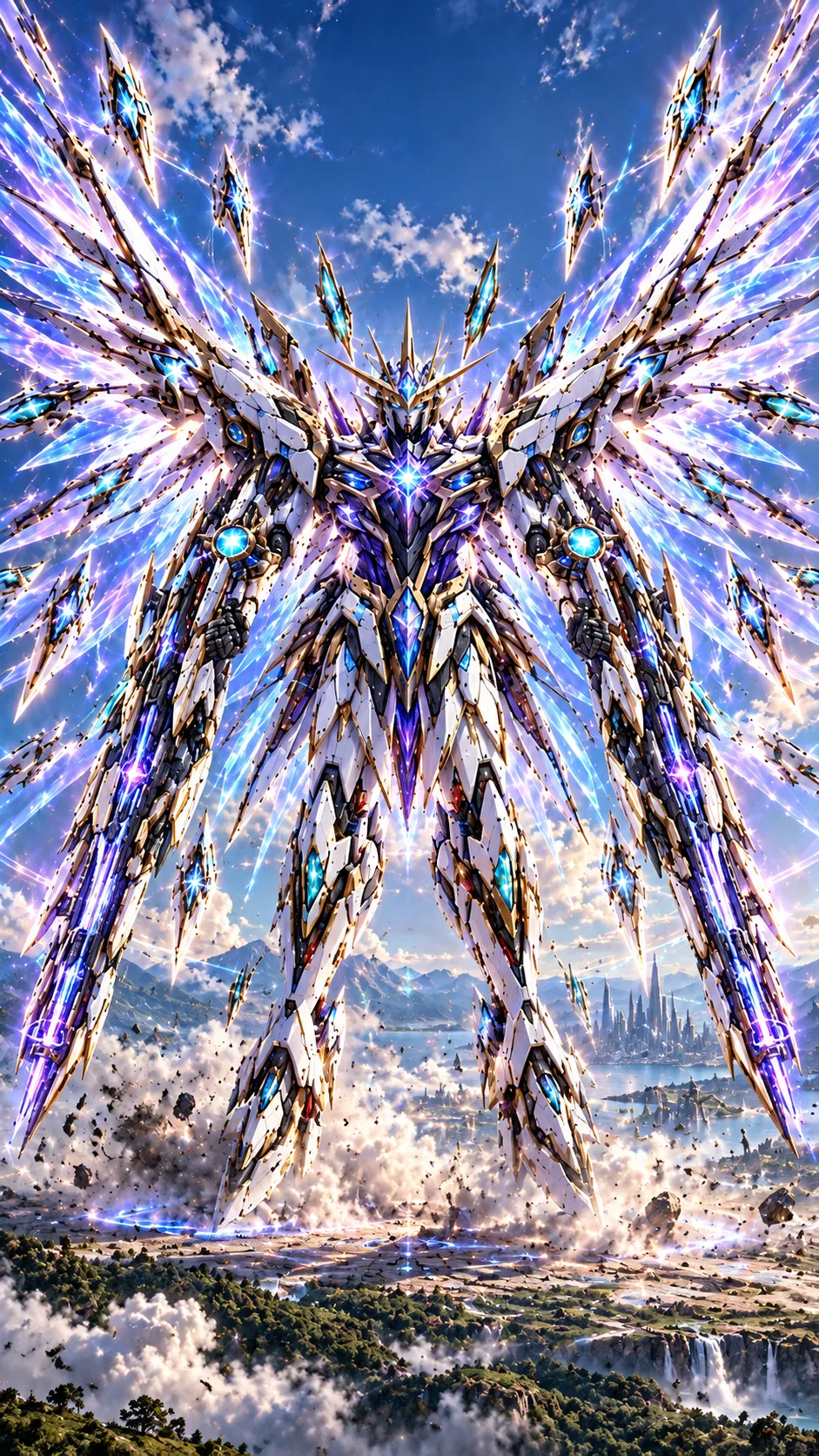
A light novel · Volume I
The Nobody of Oxford Is Secretly the Machine God, and the Most Beautiful Girl in the World Hates Him (She Doesn't)
Part 3
Everyone You Hold
ProloguePOV · Before5.33 million years ago · and 1997
Five million, three hundred and thirty thousand years ago, the Mediterranean was dry.
It had been dry for six hundred thousand years. The Strait of Gibraltar had closed, the sea had boiled away under the sun, and what remained was a basin three kilometres deep, floored with salt, white and blinding and hotter than any desert on Earth today. Nothing lived in it. At its edges, on the old cliffs where the shore had been, small frightened creatures walked upright in the scrub and looked down into the white with dark eyes, and did not go there.
They were watching on the day the Coil came down.
It fell out of the high dark like a thread of black glass, burning, eleven kilometres long, and it struck the deepest part of the salt, and the ground rang like a bell for a thousand kilometres. When the dust settled it was lying there in the white, coiled, the colour of the gap between stars. Then it slept. That was what it had come to do. It would lie there and sleep and sing, and its song would go out into the dark, and in time the ones who heard it would come.
A ship had come down with it. A small one, as such things went: a pale shell the size of a mountain, which settled on the salt beside the Coil the way a pilot fish settles beside a shark. Inside were the First Who Believed. They had followed this Coil across the dark for a hundred thousand years, singing to it, and they had sung three hundred worlds into silence at its side.
One of them stood at the edge of the salt on the first evening and looked up at the cliffs.
The carvings do not give its name. Its name was a chord, and stone cannot hold chords. The carvings call it only the One Who Turned.
It saw the small upright creatures on the cliffs. It saw them cover their faces with their hands at the sight of the Coil, the way it had once seen other small creatures on other worlds cover their faces, three hundred times, before the singing. And for reasons the carvings do not explain, perhaps because it was tired, perhaps because it was old, perhaps only because of the way one of the small creatures held another close against its chest, the One Who Turned decided that this time it would not sing.
That night, while the Coil slept, it went down onto the salt with a blade of song and cut out a piece of the Coil’s heart.
The piece was the size of a fist. It was white, and warm, and alive, and it was made of the same living metal as the Coil itself, which was the only substance in the universe the Coil could not swallow. The First had always known this. It was the one thing they did not sing about. Only a Coil can kill a Coil.
The One Who Turned carried the Heart up the cliffs on the eastern shore and hid it in a cave in the white rock, behind a wall it sealed with its own hands. Then it spent its last days carving what it knew into the cave walls, in the only way it could: lines made out of chords. When the others found it, they sang it into silence. They did not find the Heart. Then they left, to tell the fleet where the Coil had come to rest.
Two hundred years later the Atlantic broke through at Gibraltar. The flood that followed was a waterfall a thousand times the size of Niagara, and it filled the whole basin in less than two years. The water closed five kilometres deep over the sleeping Coil, and over the salt, and over everything.
Three thousand years ago, the scribes of a Bronze Age city on that eastern shore found the cave and copied what they could of the carvings onto clay. They did not understand them. They wrote about a sea serpent with seven heads called Lotan, which their gods had killed. The Hebrews who came later called it Leviathan. The Children of Tehom, who came later still, called it the Coil, and built a church to it.
None of them found the Heart.
In August 1997, the Children sent their brightest young mind to Ras Shamra on the Syrian coast, to the ruins of the city the scribes had called Ugarit, to read the carvings properly at last.
Brother Gabriel was twenty-four. He spent forty nights in the cave with a lamp and a notebook and the patience of a man doing the most interesting thing he would ever do. On the fortieth night, he understood the lines.
It is not a god. It is a mouth.
It sings so that the others can find it. When they come, every world that hears the song is swallowed.
I have cut out its heart. Only a Coil can kill a Coil.
Whoever finds this: do not give it back.
The niche was behind the third panel, exactly where the lines said it would be. Gabriel broke the old seal with a geologist’s hammer, and reached in, and closed his hand round something warm.
It moved.
He sat on the floor of the cave for a long time, holding a fist-sized piece of white living metal in both hands, feeling it pulse against his palms like a small animal. Then he wrapped it in his prayer shawl, and put it in his bag, and in the morning he telephoned Geneva and told the Patriarch that the chamber had been empty. That the Heretic must have destroyed the Heart before the end.
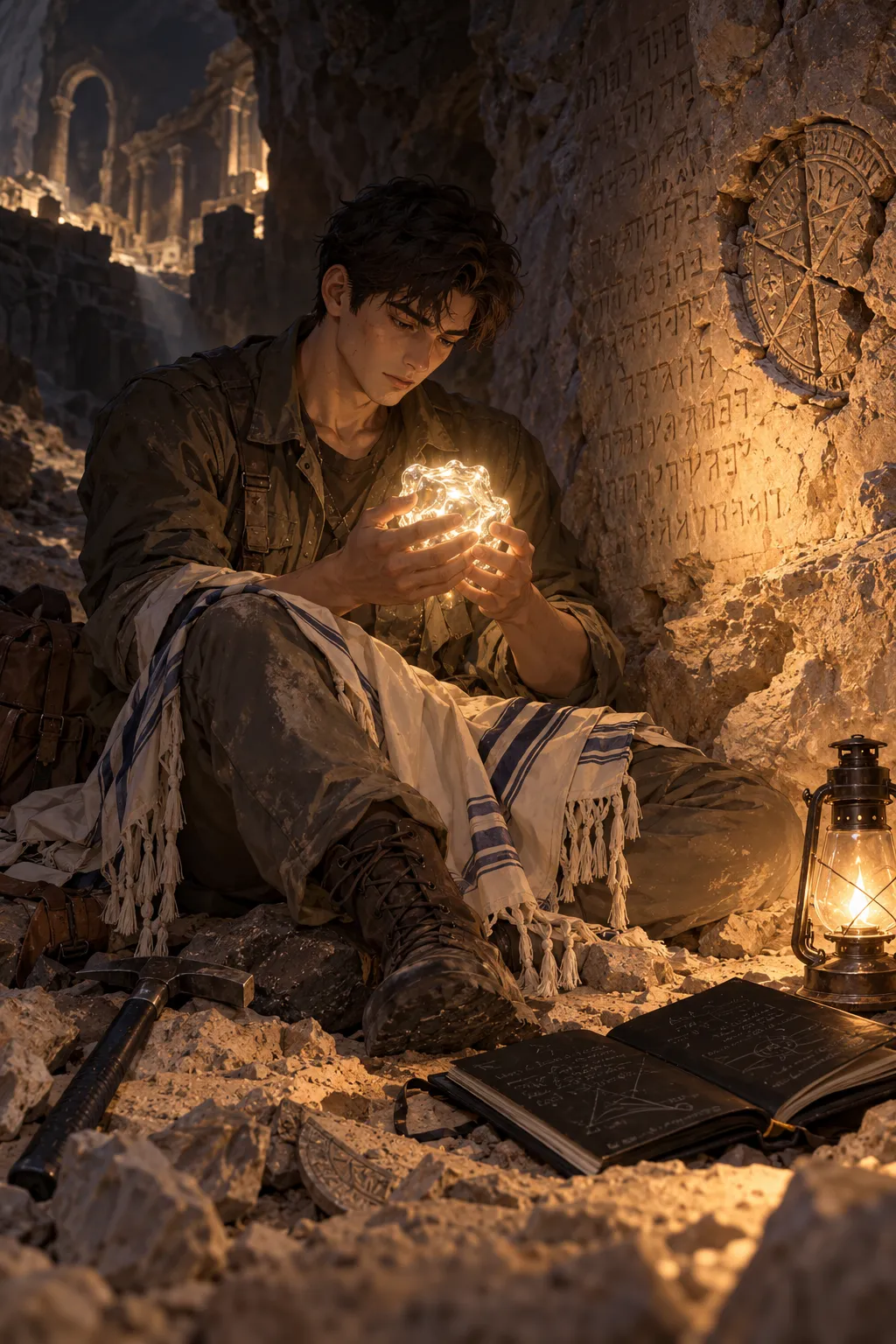
He did not yet believe the carvings. Not entirely. But he believed them enough.
Six weeks later, in a laboratory in Oxford, he unwrapped the prayer shawl on the bench in front of Dr. Margarethe Voss, who had spent twenty years trying to make a dead sample of Tunguska rock do anything at all. She reached out and touched it.
It woke the moment it touched her hand.
For twenty-seven years, the Children of Tehom have searched for the Heart of the Coil. They have dug up half the Levant. They have bought every Ugaritic tablet in every private collection in Europe. In 2009 they tortured three antiquities dealers in Beirut, one of them to death. They have never once thought to look again at the young man who told them the chamber was empty.
The Heart is not in a cave any more.
It is in the bloodstream of his son.
Chapter OnePOV · ElianaMerton · late November 2024
The woman from Jersey arrived on the twenty-eighth of November, in the rain, with a briefcase in one hand and a phone in the other. The phone was on speaker. The voice coming out of it was swearing in Hebrew.
‘Ktana,’ said Dov Ben-Ami, from a hospital bed in Tel Aviv, three thousand five hundred kilometres away. ‘Don’t hang up. Not this time. Listen to her.’
Eliana had not answered his calls in twenty-nine days. She sat in her wheelchair by the window of her ground-floor room in the Fellows’ Quad and looked at the phone in the stranger’s hand, and her throat closed.
‘Dov—’
‘Listen to her. Your father made me promise. If anything happened, I was to call Harriet. I’m calling Harriet. Listen.’
The woman’s name was Harriet Achterberg. She was sixty, grey-haired, with reading glasses on a chain and the calm of someone who had read a great many wills aloud to a great many people at the worst moments of their lives. She sat down on Eliana’s narrow bed, because there was nowhere else to sit, and opened the briefcase on her knees.
‘Miss Tzofiya,’ she said. ‘On the day you were born, your father came to my office in St Helier and set up a trust. He called it the Tzofiya Trust. It is irrevocable, which means that once he made it, not even he could undo it. It is held in Jersey, outside the United Kingdom, outside his estate, and outside probate.’ She took off her glasses. ‘Do you understand what that means?’
‘No.’
‘It means the people who froze your father’s accounts can’t touch it. The board of Meridian can’t touch it. Dr. Kreutz can’t touch it. Nobody can touch it but you.’
‘What’s in it?’
Harriet Achterberg told her.
Fifty-one percent of the voting shares of Stevansky Meridian Capital. Which meant that the firm was, as of the moment her father died, hers. Every board member served at her pleasure. Every executive, including the soft-spoken interim chairman, could be removed by a single letter with her signature on it. And alongside the shares, liquid assets, cash and bonds and gold held in vaults in four countries, which Mrs. Achterberg estimated, with the slightly embarrassed air of someone mentioning a large number in a small room, at a little over thirty-one billion pounds.
Eliana looked at her.
Then she leaned over the side of the wheelchair and was sick into the wastepaper basket.
Not blood, thank God. Only the toast she had forced down at breakfast. She stayed bent over for a while afterwards, breathing carefully, counting, while Harriet Achterberg held back her hair with one hand and Dov, on the phone, said quietly, ‘Breathe, ktana. Breathe. I know. I know.’
‘He knew,’ Eliana said at last, into the basket. ‘He knew something would happen. Didn’t he.’
A pause on the phone. ‘He knew that he had enemies,’ said Dov carefully. ‘Every man like your father knows that.’
‘That isn’t what I asked.’
Dov did not answer.
‘There is one more thing,’ said Harriet Achterberg, and took a cream envelope out of the briefcase. On the front, in thick black ink, in a hand Eliana would have known anywhere, a hand that had signed her school reports and her birthday cards and the bottom of every page of a thirty-billion-pound trust, it said: Ellochka. Only if.
She opened it after they had gone.
Ellochka,
If you are reading this, I have not been able to carry you as far as I wanted to. I am sorry. I am sorrier than I know how to write.
Everything in this trust is yours. Not because you need it. You never needed it. I needed to give it to you, so that whatever happens, no one can ever make you small.
There are people in my world who will come to you with kindness. Some of it will be real. Be careful of the kindness that wants something back. You will know it because it will be very patient.
Don’t let anyone tell you to stop standing on your own feet. Not even me. Especially not me.
I held you in one hand when you were born. I thought I was carrying you. You were carrying me.
Your Papa, who is very proud of you, and always was, and always will be.
She read it eleven times. The twelfth time she couldn’t see the words any more, so she just held it.
Dr. Anselm Kreutz came the next afternoon.
He was seventy, white-haired, slim, in a beautifully cut grey suit and a dark blue tie, with a gold signet ring on his little finger and the gentlest voice she had ever heard a man use. He did not stand over her wheelchair, the way everyone else did. He pulled a chair across and sat down on it so that his eyes were at the same level as hers, and he did not look at her face for longer than was polite, and he said:
‘Miss Tzofiya. I have come to apologise.’
She hadn’t expected that.
‘The freezing of the accounts. The security contracts. The house.’ He shook his head. ‘The lawyers told the board it was required, and I was too new to the chair to argue. It was cruel. It was done to you in the worst week of your life, and I am ashamed of it. Your father was my friend for thirty years. We met in Zurich, every October. He would never have forgiven me.’
He had brought a new card. Black, titanium, with her name on it. Her own account now, drawn on the trust. He had brought the deeds to a house on Norham Gardens in North Oxford, a tall Victorian villa that her father had bought in September and never told her about, as a surprise for her second year. He had brought a list of the household staff who were already moving in to get it ready for her. He had brought, from a firm her father had trusted, a new security detail: four discreet men from a company called Halvard Risk.
‘Only if you want them,’ he said. ‘Only if you want any of it. Meridian is yours now. I serve at your pleasure. If you tell me to leave this room and never come back, I will go, and I will not be offended.’
She thought about her father’s letter. Be careful of the kindness that wants something back.
She looked at Dr. Kreutz, sitting at eye level in a borrowed college chair with his hands folded on his knee, asking nothing. He looked like somebody’s grandfather. He looked like a man who had come out in the rain to say sorry.
‘Stay,’ she said. ‘For now. Please.’
‘Thank you.’ He smiled. ‘There is one other thing. I hesitate to mention it.’ He took a brochure from his inside pocket and laid it on her desk, without pressing it on her. Klinik Seeblick, Zürich. ‘A private clinic on the lake. They have been doing remarkable work with damaged bronchial vessels. Regenerative therapy, very new. Your surgeon would call it experimental, and she would be right. But I have seen what it can do.’ He paused. ‘I have reserved a place for you. Not because you must go. Only so that, if one day you decide you want to, the door is open.’
On his way out he stopped at the window. On the sill, side by side, stood a small pair of white boots, smooth and seamless, with a faint line of gold at each heel. She hadn’t worn them since the crash. She couldn’t. But she couldn’t put them in a cupboard either.
‘What remarkable shoes,’ said Dr. Kreutz.
‘They were a gift.’
‘May I?’ He reached towards them.
‘No.’
It came out of her so fast and so hard that they both blinked. Dr. Kreutz withdrew his hand at once, with an apologetic little bow.
‘Of course,’ he said. ‘Forgive me. Good afternoon, Miss Tzofiya.’
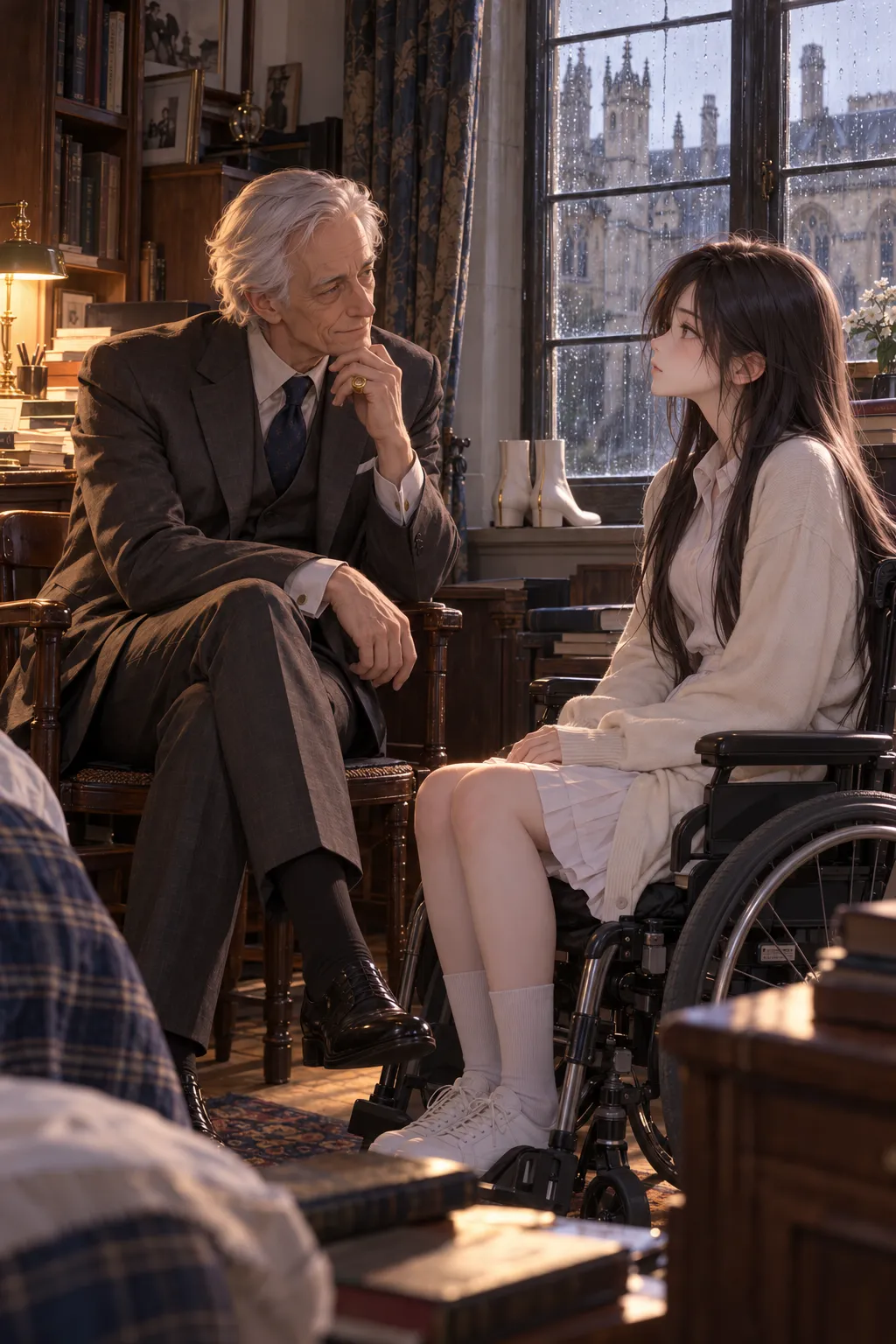
She did not know why she had said it like that. She only knew that she did not want anyone else to touch them. Ever.
That night she did something she had been thinking about for three weeks.
She asked her tutor in the Engineering department for a K-type thermocouple and a data logger, and he gave her one without asking what for, because she was the girl with four A-stars and because she was in a wheelchair and people gave her things now without asking. She taped the probe inside the left boot, on the windowsill, and set the logger to record every sixty seconds, and went to bed propped up on four pillows as the plan said.
In the morning she plugged the logger into her laptop and looked at the graph.
Flat, all night, at the temperature of the room. Except for a single smooth bump, beginning at 23:44 and ending at 00:26. For forty-two minutes, the inside of the left boot had been eight degrees warmer than the air around it.
She did it again the next night. 23:46 to 00:29.
And the next.
Every night, somebody was standing outside her window at a quarter to midnight for about forty minutes. And every night, when they were there, the boots the angel had made her grew warm.
She did not tell anyone. She kept the data in a folder on her laptop called radiator, and she lay awake with it, the way you lie awake with a seashell held to your ear.
On the eleventh of December, Kreutz’s movers came to take her things to Norham Gardens. They were very efficient. They packed her whole room in two hours.
When she unpacked in the new house, the boots were gone.
Dr. Kreutz was devastated. He telephoned her personally. The movers had been questioned. Every box had been opened. It was a mystery. He was so terribly sorry. He would not rest until they were found.
Chapter TwoPOV · ElianaNorham Gardens · December–January
The house on Norham Gardens had a room at the top that her father had made for her.
She found it on her second day there, when she was well enough to be carried up the stairs, and she wished, afterwards, that she never had. It was a reading room. A window seat built into the bay, deep enough to curl up in, with cushions in the grey-green she liked. Shelves floor to ceiling, already half full: Primo Levi in four languages, a first edition of Mendeleev, the complete Tolstoy. A glass cabinet with a light inside it, built to the exact dimensions of her bismuth crystal collection. And on the desk, a card in his handwriting, dated the first of September: For second year. So you have somewhere to be tall. Papa.
She didn’t come out of that room for two days.
She was not kind that winter. She would be ashamed of it for a long time.
The house had staff. Mrs. Agnieszka Nowak, who had run the London house for fifteen years and had taught Eliana to make pierogi, the vegan kind, when she was ten. Pascal, the vegan chef from Lyon. Tomasz the driver, who had been Papa’s driver. And four men from Halvard Risk in dark coats, who stood in the hall and at the gate and at the end of the garden, and were never introduced by name.
They all had rules. They had been given the rules, Mrs. Nowak explained gently on the first evening, by Mr. Stevansky, in September, in writing. Miss Eliana was to be home by ten. Miss Eliana was not to walk anywhere alone after dark. Miss Eliana was to be driven to lectures. Miss Eliana was to eat at least—
‘He’s dead,’ said Eliana.
Mrs. Nowak stopped.
‘He’s dead, Agnieszka. His rules died with him. Do you understand? He doesn’t get to tell me when to come home from a graveyard.’ Her voice was rising and she couldn’t stop it. ‘None of you get to tell me anything. You work for me. Not him. Me. And if anyone in this house ever says the words Mr. Stevansky always said to me again, they can pack their bags.’
She threw the folder of rules across the kitchen. It hit a shelf. A blue and white mug fell off the shelf and broke on the tiles. It was her father’s mug. The one he drank his coffee from every morning, in London, for twenty years. Mrs. Nowak must have brought it from Kensington on purpose, so that something of him would be in the new kitchen.
Everyone looked at the pieces.
Eliana wheeled herself out of the kitchen without a word, and went up in the stairlift to the reading room, and sat in the dark with her fists in her lap, and shook.
At three in the morning she came down and found Mrs. Nowak sitting alone at the kitchen table with the pieces of the mug laid out on a tea towel and a tube of glue, fitting them together. Eliana sat by the door in her chair and watched her, and said she was sorry, and Mrs. Nowak said there was nothing to be sorry for, and they both cried, and the next day Eliana did it again.
She shouted at Pascal for making her mother’s kimbap without being asked. She shouted at Tomasz for waiting outside the Engineering building with the engine running, the way Papa used to tell him to. She shouted at the Halvard men for existing. She shouted at Juno on the phone from Paris for asking if she was eating. She shouted at Halmeoni, once, on a video call, and then sat staring at the black screen after her grandmother had gone, unable to believe that she had done it.
She did not shout at Dov. She did not answer Dov at all.
She stopped eating. Pascal kept cooking, beautiful plates, roasted squash and lentil ragù and black rice with miso aubergine, and they kept coming back to the kitchen untouched. She slept propped up on four pillows, the way the plan said, and woke every morning at four with the same thought sitting on her chest like a weight.
It was my idea.
She had stood under the mulberry tree in the Fellows’ Garden and told her father she wished he would stop protecting her. She had told him she wished she didn’t need him. And he had loved her too much to say no. If she had not said it, there would have been twelve men around that car. There would have been an escort in front and behind. There would have been Dov.
She had sent them all away. With her own mouth. Because she wanted to be a person.
Her grief counsellor was a small, quiet woman called Dr. Ruth Feld who had an office above a bookshop on the Turl and a box of tissues that she never pushed towards you. Eliana went because Ms. Okafor had insisted. For the first three sessions she said almost nothing.
In the fourth session, in the second week of December, she said it.
‘It should have been me.’
Dr. Feld waited.
‘It should have been me. Not them. I’m the one who asked. I’m the one who—’ She was breathing too fast. ‘They were whole people. They had whole lives. Papa had Meridian and Eomma had four million people watching her every night and they had each other, and I’m this. I can’t walk a kilometre. I cough up blood if I get upset. I look like a child. If one of us had to go, it should have been me. It would have made sense.’
‘Do you think about that often?’ said Dr. Feld quietly. ‘About wishing you had died?’
‘Every day.’
‘Do you think about making it happen?’
Eliana looked at her for a long time.
‘No,’ she said at last. ‘No. Papa would never forgive me. And there’s a man in Tel Aviv who would come and find me in the afterlife and shout at me in four languages.’
Dr. Feld smiled, very slightly. ‘Then we’ll start there,’ she said. ‘With the people who would shout.’
That night, for the first time in twenty-nine days, Eliana picked up when Dov rang at nine. Neither of them said anything for almost a minute. Then Dov said, ‘Are you eating?’ in a voice that was not quite steady, and she said, ‘No,’ and he said, ‘Lentils are real food, ktana,’ and she laughed so hard and cried so hard that she had to put the phone down and count.
She finished War and Peace on Christmas morning, at four o’clock, alone in the window seat of the reading room.
She had known it was coming. Everyone knows Prince Andrei dies. But she had not known how slowly, or how quietly, or how he would stop being afraid at the end, turning away from the living as if they had already become a little strange to him. She read it by the light of the bismuth cabinet with the snow coming down on Norham Gardens, and when she reached the end of that chapter she put the book face down on her knees and sat very still.
You sound like Prince Andrei. She had said that, over the Sredinny Range, to a white figure that would not look at her.
She didn’t want anyone else to die. She didn’t want anyone else to stop being afraid and turn away. She had nobody left to lose and she was terrified of losing them.
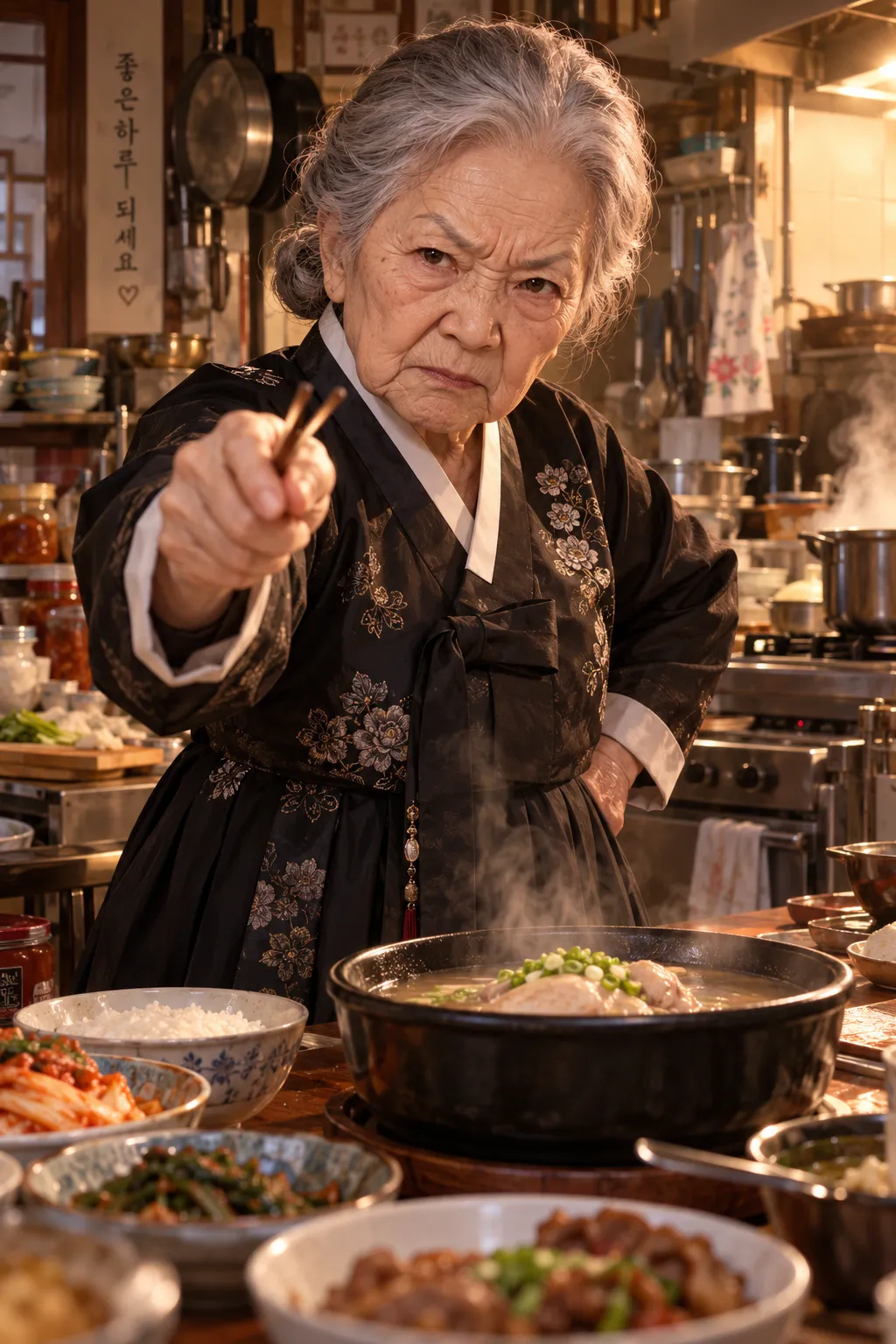
Halmeoni rang at nine, in her good hanbok, from a kitchen in Seoul full of relatives. Eliana apologised for the time she had shouted. Halmeoni said, What shouting? I am old. I don’t remember things. And then she held a bowl of tteokguk up to the camera, rice cakes in clear broth, the soup you eat to turn a year older, and said that she had made Eliana’s portion without the beef, and that she would eat it for her, and that next year Eliana would come to Seoul and eat her own.
She walked again on the sixth of January.
Not far. Four steps, between parallel bars, in the physiotherapy gym at the Nuffield Orthopaedic Centre, with a physio called Gemma holding a belt round her waist and saying good, good, good in a Geordie accent that made everything sound like a pep talk at a football match. The plates in her pelvis ached with every step. Her right lung burned. On the fourth step she coughed, and there was blood in it, a little, and Gemma sat her down and gave her water and the tranexamic acid and waited, and after ten minutes Eliana said, ‘Again,’ and Gemma looked at her with something like respect and said, ‘Aye, all right, pet.’
Ten steps by the fifteenth. The length of the gym by the twentieth, with a stick. Hilary Term began on the nineteenth of January, and on the twenty-first she walked into the Thom Building on her own two feet, slowly, with a stick, while two hundred engineering students pretended not to watch, and sat down in the front row because her Student Support Plan said she could, and cried for the whole of a lecture on fluid mechanics without making a sound.
By the end of January she could walk without the stick. Slowly. Never far. A few hundred metres before her chest began to tighten and she had to stop and lean on something and count. She learned every bench and low wall and railing between Norham Gardens and the Radcliffe Camera the way a sailor learns harbours.
On the twentieth, a box came from America.
Inside it were a pair of sneakers, white with a single silver thread at the heel, and a handwritten card from the designer. Nike had made three pairs. One was in a museum. One had been auctioned the week before in Geneva for a hundred and fifty thousand euros, every cent of which had gone to the new children’s cancer wing at St Raphael’s Hospital in Southwark, which had opened in December under the name the board had chosen: The Alexander and Kelly Stevansky Wing. The third pair was in the box. The card said: Nike Air Seraphina. For walking again.
They were the most comfortable things she had ever put on her feet. She wore them every day. They made her look about twelve.
The café was the one in the vaulted rooms under the University Church, on the edge of Radcliffe Square: stone arches, mismatched chairs, a window that looked straight out at the great grey dome of the Radcliffe Camera. She went there every afternoon in Hilary Term after lectures, because it was the only place in Oxford within her walking distance of both the Engineering building and a bench.
She wore what she always wore, because it was the only thing that still felt like her own skin: the white blouse, the white cardigan, the short pleated skirt, and now the Nike Air Seraphinas. She sat by the window with a pot of barley tea she had persuaded them to keep behind the counter for her, and read. That month it was Le Petit Prince, in the French, because it was short and she could not face anything long, and because her mother had read it to her at bedtime when she was six and done all the voices.
There is a part in it where a fox tells the little prince that you become responsible, forever, for anything you have tamed. She read that page every afternoon and then closed the book and looked out at the dome.
People photographed her. Of course they did. There were a few professional photographers now who knew her routine and waited by the church railings with long lenses. There were tourists who stopped dead on the cobbles at the sight of her through the café window, and students who sat at the next table and filmed her reading over their shoulders. On Instagram, the posts had a name for the photos: #TheNineSecondGirlWalks. In every one of them she looked like a child.
She could not walk away from them fast. She could not walk fast at all. So she endured it. She sat, and read, and drank her barley tea, and let them look, and thought about a white figure in a sky over Kamchatka that had looked at everything in the world except her, and about a boy in a grey hoodie who had looked at line six.
She had not seen the boy since the pharmacy. She had looked. Every lab session he had been replaced by a doctoral student from Exeter College with a lisp. She had asked. The doctoral student said Mr. Zadkiel had swapped his slot. He didn’t know why.
She knew why. She had forty-one nights of data that said so.
Chapter ThreePOV · AriaMerton Street → Norham Gardens · November–January
He had gone back the night after the pharmacy, and the night after that, and on the third night ZERO had started counting.
This is the third night.
‘I know.’
You are standing under her window.
‘I’m checking.’
Checking for what?
He didn’t have an answer. So he checked. Every night, at a quarter to midnight, when the streets were empty, he walked from Walton Street down to Merton and stood in the shadow of the wall across the cobbles from the Fellows’ Quad, where he could see the one lit window on the ground floor, and he stayed until the light went out.
He did not go in. He did not knock. He stood there in his hoodie with his hands in his pockets and let ZERO run its sweeps across the street and the college and the sky, and when the light went out he walked home.
It was not a decision. He had stopped being the kind of person who made decisions about her on a wet night on the A44, and he had not yet worked out what kind of person he was now.
He read Kuramoto’s letter in the first week of December, finally, sitting on the floor of the Nave with his father’s scorched notebook in his lap.
It was long. Most of it was the kind of thing Kuramoto had never once said aloud in the nine years Aria had known him: that he was proud of him, that he had loved him like a grandson, that he was sorry for the umbrella, because an umbrella had not been enough. But there was a page near the end that Aria read until he could recite it.
There is something we never told you, because your father made us swear.
The living metal did not come from Tunguska. That was the story we agreed on. Margarethe did have a Tunguska sample, and she spent twenty years on it, and it never once moved.
In the autumn of 1997 your father came back from Syria with something wrapped in his prayer shawl. He put it on Margarethe’s bench and asked us never to ask him where it had come from. When she touched it, it woke.
Everything you wear began as that one piece. Everything.
I think he lied to us to protect us. I think the people he was protecting us from are the same people who killed him. I never learned who they were. I am sorry. I am leaving you only questions.
Aria sat with that for a long time.
Syria, said ZERO.
‘I know.’
The entity in the Calypso Deep is thirty-eight percent similar to our armour. The Calypso Deep is twelve hundred kilometres from the Syrian coast.
‘I know.’
You are thinking the same thing I am.
‘I’m trying very hard not to,’ said Aria.
Her new guards worried him.
They arrived the same week as the letter: four men in dark coats from a firm called Halvard Risk, who were very good at standing still and very bad, ZERO observed, at keeping their phones clean. Aria had ZERO follow their calls the way it had followed Volkhov’s. They went through relays in Liechtenstein and Cyprus and a server farm outside Reykjavík, nineteen hops, twenty-four, thirty, and then ended. Not at a dead end. At an address that did not exist. A door painted on a wall.
Same null node as Kamchatka. Same as the lorry. AZAZEL.
They were standing at her door.
He could not tell her. There was no way to tell her that did not begin with I was outside your window and end with and also I am the thing that pulled a steel bar out of your chest. He could not tell the police; he had nothing a policeman could hold. He could only do what he had been doing.
He moved his watch from Merton Street to Norham Gardens when she moved. He stood under a plane tree across the road from the tall Victorian house, where he could see the light in the bay window at the top, and he watched the four men in dark coats, and they never once saw him.
On the eleventh of December, ZERO said: The footwear has stopped transmitting.
He had not known it was transmitting. It had never occurred to him that it might be. But the boots had a faint signature of their own, the zero point zero zero three percent, and ZERO had been listening to it from the street every night without telling him, the way it did most things.
It moved to London this afternoon in a removal van. Then to Heathrow. Then the signal stopped. Not destroyed. Shielded.
Aria stood under the plane tree in the dark and felt the cold go all the way through him.
‘Someone has the boots.’
Someone has a sample of us, said ZERO.
Toby noticed in the second week of January.
‘You’ve changed,’ he said, one evening, from the sofa, without looking up from a seminar paper on Rawls that he had been not reading for three hours.
‘I haven’t.’
‘You go out every night at half eleven. You come back at one. You’ve stopped going to the lab you were demonstrating. You bought a scarf, Aria. You have never once in your life owned a scarf.’ Toby lowered the paper. ‘Are you seeing someone?’
‘No.’
‘You’re lying. Your ears have gone red. Your ears only go red when you lie, which is why you never lie, which is why I know you’re lying.’
‘I’m not seeing anyone.’
That was true, in a way that was worse than lying. He was only seeing one person. From the other side of a road. Every night.
On the twenty-first of January he watched her walk into the Thom Building on her own feet.
He had not meant to be there. He had been crossing the University Parks on the way to Halvorsen and he looked up and saw her, a small figure in a white cardigan with a stick, going very slowly up the steps on Parks Road with two hundred people pretending not to stare. She stopped halfway up and leaned on the rail. Then she went on.
He had to sit down on a wall.
Heart rate, said ZERO.
‘Don’t.’
I was only going to say that I have never measured it this high while you were sitting still.
He sat on the wall in the cold for a long time, after she had gone in, with his hands over his face.
On Friday the twenty-fourth of January, at 21:40, she went out of the back door of the café.
He saw it from the shadow of the Bodleian, where he had been standing since nine. Two of the Halvard men were outside the front of the café on the Radcliffe Square side, as they were every evening, watching the door. She had stayed late. The staff were stacking chairs. And she had got up, put on her coat over the white cardigan, said something to the girl behind the counter, and gone out through the kitchen and the little courtyard at the back, alone, on foot, into the dark.
It was the first time she had ever done it. He knew instantly why. He could see it in the way she walked: slowly, carefully, with her chin up, a girl walking home by herself in the dark because nobody had ever let her, and because the people who wouldn’t have let her were dead.
And the Halvard men at the front door did not move.
They saw her go. ZERO saw them see her. One of them took out his phone and spoke into it, briefly. Neither of them followed.
Pilot, said ZERO. There is a van.
Chapter FourPOV · BothRadcliffe Square · 24 January · 21:52
It had rained earlier, and the cobbles in Radcliffe Square were wet and gold under the lamps, and the great dome of the Camera stood up black against a dark blue sky. It was very beautiful. She had stopped by the railings of the church to look at it and to rest, because she had walked a hundred and sixty metres and her chest was tight, and she was thinking that she was going to do it. She was going to walk all the way home to Norham Gardens on her own, a bench at a time, and nobody would stop her.
She heard the van before she saw it. A dark people-carrier, coming round from Catte Street too fast, with no lights.
It stopped beside her. The side door slid open.
She understood what was happening at the same moment that the first hand closed on her arm. Then there were more. A big man behind her with an arm round her chest, lifting her off the cobbles as easily as her father used to, except that it was nothing at all like her father. A hand over her mouth, rough, smelling of petrol and cigarettes. Someone had her wrists. Someone grabbed her hair. Her bag went flying. She heard her cardigan tear at the shoulder. She kicked and twisted and hit nothing, because she weighed thirty kilos and they were five grown men, and they were dragging her backwards towards the open door of the van like a sack.
She bit the hand over her mouth, as hard as she could.
The man swore and snatched it away, and she screamed, and he hit her, open-handed, across the side of the head, and the gold lamplight went white.
‘Careful, you idiot,’ said another voice. ‘Undamaged. They said undamaged.’
Unmarked, she thought, from somewhere very far away. Kamchatka. They said unmarked. And then a colder thought, much clearer, came up out of the white. It’s the same people. It was always the same people.
Her feet left the cobbles. Her chest was locking. She could feel the blood starting, deep down, the hot tightness that came before it. The van door was a black mouth in front of her.
Then someone said, quite quietly: ‘Put her down.’
He had pulled off the hoodie as he ran and dropped it on the cobbles, because it caught at the arms, and his glasses were in his pocket. He was in a white shirt and jeans. He was a tall young man with untidy black hair, standing in the lamplight in Radcliffe Square, alone, without armour, without wings, without anything, and five men turned round and looked at him and laughed.
I can manifest in point zero four seconds, said ZERO.
‘No.’
There are five of them. One has a knife. One has a cosh. You are unarmoured.
‘She’d know,’ said Aria. ‘Everyone in this square would know. Show me.’
ZERO showed him.
That was the thing nobody would ever understand about that night, not the police, not the five men, not Toby when he saw the shirt. The ZERO System no longer needed the armour to work. It lived in him now, in his blood and his nerves, and when he asked it to open, the futures came down over his eyes the way they always had: every fist, every step, every swing of the cosh, the whole next eleven seconds laid out in fine gold lines across the wet cobbles.
And beneath the futures, there was something older. Benedetti had taught him knives in the Nave when he was twelve. Kuramoto had taught him how to fall and get up. Fiona MacLeod, who had boxed for Edinburgh University in 1966, had taught him how to take a punch and keep his feet, and had made him practise it until he cried, and then made him practise it again.
He went in.
The big man was holding her. That was the first problem, and he solved it first. He took the big man’s right wrist, the one across her chest, and turned it in a direction wrists do not go, and the arm opened, and she fell, and he caught her with his left arm and swung her behind him against the iron railings of the church in one movement and stood in front of her.
‘Stay there,’ he said.
Then they came at him.
He took the first punch on purpose. ZERO showed it to him coming, a looping right from the man in the cap, and he could have slipped it, but slipping it meant stepping left and stepping left meant leaving her open, so he took it on the cheekbone and felt his head snap round and kept his feet. He put his elbow into the man’s ribs and felt two of them go. He put his knee into the man’s stomach as he folded. One.
The cosh hit him across the back. It was a short leather thing weighted with lead, and it landed between his shoulder blades with a sound like a dropped book, and the world went grey for a heartbeat. He did not go down. He turned inside the second swing and drove the heel of his hand up under the man’s jaw, and the man’s teeth came together with a crack and he sat down on the cobbles and did not get up. Two.
The knife came for his face.
He got his forearm up. The blade went across it, through the white shirt, and opened his arm from wrist to elbow, and the blood came, bright, spattering the cobbles, and he heard her cry out behind him. He caught the knife hand on its way back, turned it, and the knife clattered away into the gutter, and he hit the man with a right hand that MacLeod would have been proud of, flush on the side of the jaw, and blood went up in a spray in the lamplight, and the man went down in a heap with his face in a puddle. Three.
The big one had got up. He was cradling his ruined wrist against his chest, and his face was murderous. He came at Aria with his head down like a bull. Aria let him come, and stepped aside at the very last instant, and put his foot where the big man’s ankle was going to be, and the big man went face-first into the railings of All Souls with a sound that made the fifth man, the driver, still at the wheel of the van, put it into gear and leave, fast, with the side door still open, round the corner into Catte Street and gone. Four.
Eleven seconds. Exactly as ZERO had drawn it.
He stood in the middle of Radcliffe Square in a white shirt that was no longer white, breathing hard, with blood running down his left arm and dripping off his fingers onto the wet gold cobbles, and four men on the ground around him, and turned round.
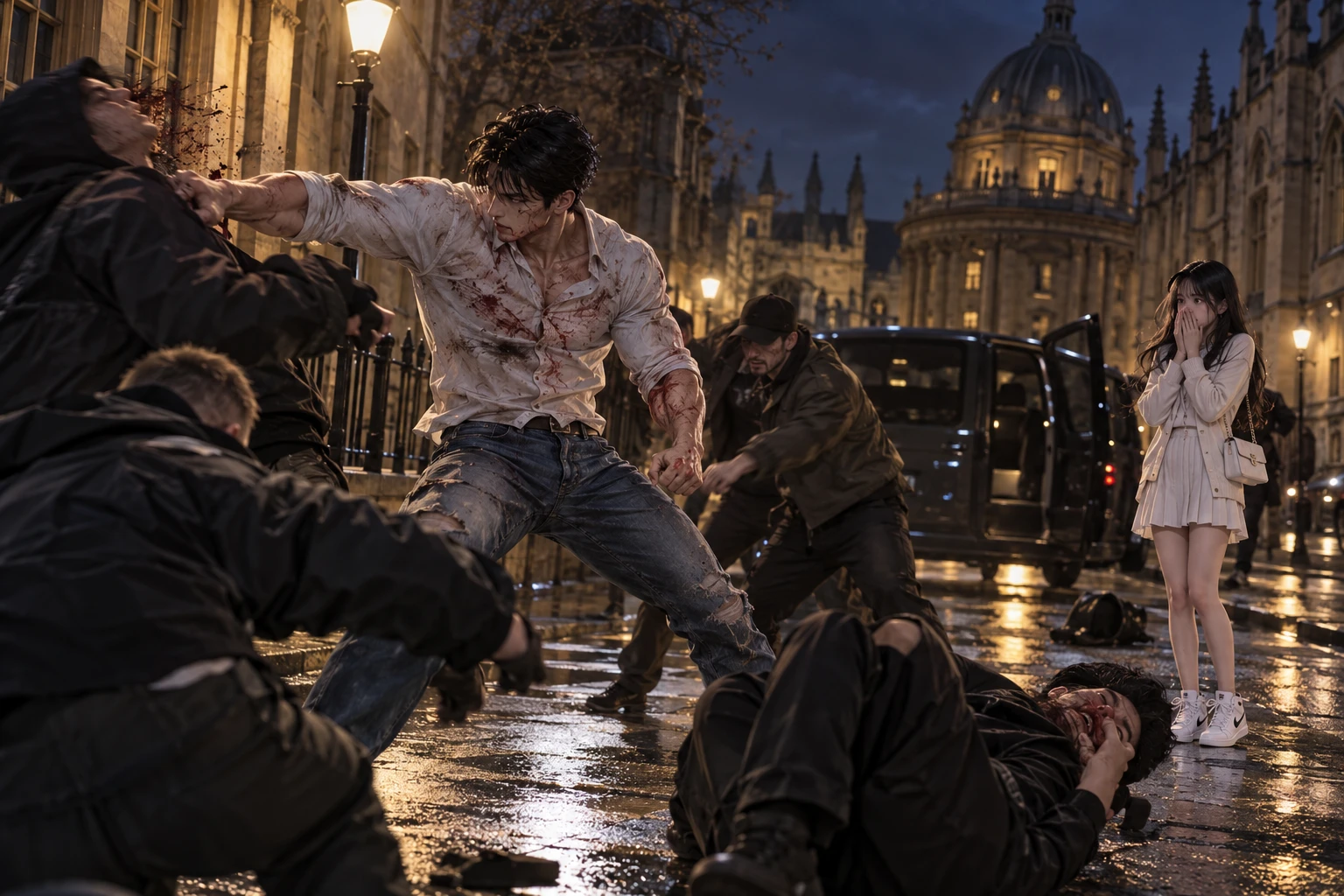
She was standing where he had put her, against the railings, with both hands over her mouth.
Her cardigan was torn at the shoulder. There was a red mark on the side of her face where she had been hit, and the beginning of a bruise round her left wrist in the shape of a man’s fingers. Her hair was wild. One of the Nike Air Seraphinas was scuffed grey from being dragged across the cobbles. She was staring at him.
Not at the men on the ground. At him.
He realised, too late, that his glasses were in his pocket. That his hair was in his eyes. That there was nothing at all between his face and hers for the first time: no visor, no frames, no slouch, no grey hoodie two sizes too large. Just him, under a lamp in Radcliffe Square.
She took her hands away from her mouth.
‘Oh,’ she said, in a very small voice. ‘Oh. You’re—’
She didn’t finish. She came towards him instead. Not slowly. As fast as she could, which was not fast, across the wet cobbles in her scuffed sneakers, with her hands out, and her face crumpling.
‘You’re bleeding,’ she said. ‘You’re bleeding, your arm, your face, he hit you with that thing, I saw him, are you—’
And she put her arms around him.
She had never done it before. Not to anyone who wasn’t family. Not once in eighteen years. People had held her, lifted her, carried her, hugged her at galas and funerals; she had always been the one held. She had never once been the one to reach out and put her arms round somebody else and hold on.
She did it now. She put her arms round his waist, as far as they would go, and pressed her face into his chest, into the ruined white shirt that smelled of rain and blood, and held on with everything she had.
And she heard it.
Deep inside his chest. Under the ordinary heartbeat, his own, fast and hard from the fight. Another rhythm, very faint, so faint she would have missed it if she had not spent eleven breaths listening to it over the Sredinny Range with her ear against white armour.
Thrum-thrum. Thrum-thrum.
Like two hearts beating together.
She went completely still.
And then her body, which had been dragged and hit and terrified and had walked a hundred and sixty metres on a broken pelvis and a ruined lung, decided that it had had enough.
It started as a cough. Then another. Then she couldn’t stop. She felt it tear loose deep in her right side, the hot, heavy wrongness, and the blood came up her throat faster than she could cough it out, and she was choking, choking against his chest, and it was coming out of her mouth onto his shirt, so much of it, soaking through the cotton, warm, and she tried to pull away so it wouldn’t go on him and he wouldn’t let her.
He didn’t let go.
He put one arm round her back and the other under her and lifted her, the way her father had, the way her father always had, both arms round her and her feet coming up off the cobbles to dangle, her face against his shoulder, and held her up against him and tilted her forward a little, so the blood could come out instead of going down. Her blood soaked his shirt. He didn’t move. She felt his hand on the back of her head, steady, holding her there.
‘Breathe,’ he said.
Low. Close. Right by her ear.
‘In for four. Come on. One. Two. Three. Four. Hold it. Out for four. You’re not falling. I’ve got you. I’ve got you.’
She knew the voice. She had known it, really, since line six. She knew it the way you know a song from the first note. She had heard it say those exact words, in that exact order, high above Kamchatka with the Ichinsky volcano catching the sun, and in the back of her father’s car with a steel bar in her chest and her parents’ hands in hers.
She breathed in. Four. She held it. Out. Four.
The blood slowed. The blood stopped. She hung against him in the lamplight, limp, shaking, with her arms round his neck and her face in his shoulder, and she did not open her eyes.
She didn’t have to. She knew.
A black car came round from Catte Street at speed and braked hard by the church. Two men in dark coats got out. The Halvard men. Forty seconds late. Exactly forty seconds late, ZERO noted, as though they had been told to arrive at a particular time, and the time had been calculated for a different ending.
‘Miss Tzofiya! Thank God—’ The first one looked at the four men on the cobbles. Then at Aria. He stopped. ‘We’ll take her from here, son. Hand her over.’
‘No,’ said Aria.
‘Son, I don’t know who you are, but we’re her security—’
‘You watched her walk out of the back of that café,’ said Aria, very quietly, ‘and you didn’t follow her. Then you made a phone call. Then a van came.’ He did not raise his voice. He did not need to. He was covered in blood and four men were lying on the ground around him. ‘I’ve got her.’
The Halvard man looked at him for a long moment. ZERO painted the man’s heart rate in the corner of Aria’s vision, climbing. Then the man stepped back.
Aria walked past him with Eliana in his arms, and picked his hoodie up off the cobbles with two fingers, and draped it over her, and walked out of Radcliffe Square towards Norham Gardens.
Behind him, the Halvard man took out his phone.
He is photographing you, said ZERO.
‘I know.’
It was a mile and a half to Norham Gardens. He carried her the whole way.
Up Catte Street, past the Bridge of Sighs. Up Parks Road, past the dark bulk of the Natural History Museum. Past the Thom Building where he had once told her about line six. The streets were nearly empty. A few students stared at the tall bloodied young man carrying a girl in a grey hoodie, and then looked again, and then, recognising her, pulled out their phones, and he did not care.
She didn’t speak. Neither did he. She lay against his chest with her eyes closed and listened to the two hearts.
At the top of the steps of the tall Victorian house, under the porch light, he set her down.
She was standing on the top step. He was on the path below. For the first time in her life she was looking down at someone. Only a little; her eyes were perhaps three centimetres higher than his. But it was the first time.
She looked down at him. At the black hair in his eyes, and the cut on his cheekbone, and the arm wrapped in a strip of his own torn shirt, and the face she had never seen properly before. Toby had once described it, though she didn’t know that, as a Renaissance painter’s apology to God. She thought that Toby had undersold it.
‘Who are you?’ said Eliana.
He looked up at her.
‘Nobody,’ he said.
And heard what he had said, a fraction of a second after she did.
Her eyes went wide. Then very bright.
‘That’s what he said,’ she whispered. ‘In Kamchatka. I asked him who he was and he said nobody, don’t talk. I heard him say it to Dov.’ She was shaking again. ‘In for four. You said that. Over the volcano. In my father’s car. You said I’m sorry. You said I’ve got you. You always say I’ve got you.’ Her voice cracked. ‘And your heart. You have two hearts. I heard them. I heard them over the Sredinny Range and I heard them twenty minutes ago and they are the same.’
He said nothing.
‘And the boots. I measured the boots. Every night. Forty-one nights. Quarter to midnight, forty minutes, eight degrees.’ She was crying now. ‘That was you. Under the window. Wasn’t it. That was you, every night, all winter, and you never once knocked.’
He opened his mouth. Nothing came out of it.
She was looking at him the way no one had ever looked at him. Not the way Imogen Hart had looked at him outside the Mathematical Institute, or the girl in Halvorsen’s lecture sketching his jaw. As if she had been looking for him for a very long time, across a very great distance, and had found him standing at the bottom of her steps.
Everyone you hold is a door. He had held her twice now in the sky and once in a car and once in Radcliffe Square, and every single time the world had come through.
‘Aria,’ he said. It came out hoarse. ‘My name is Aria Zadkiel. I’m a second-year. Computer Science. Balliol. I was your demonstrator.’
‘I know your name.’
‘Then you know everything that matters.’
‘That,’ said Eliana Tzofiya, ‘is the worst lie I have ever heard.’
He almost smiled. He didn’t let it happen.
‘You should stay away from me,’ he said. ‘People who are near me—’ He stopped. He didn’t know how to finish it. Die in fires. Die in cars. Die while I am holding a church up in Crete. ‘You should stay away from me, Eliana.’
‘Too late,’ she said.
He turned and walked away down the path.
‘You always run!’ she called after him, down the dark of Norham Gardens, in a voice that cracked and didn’t care. ‘I’m not done with you, Aria Zadkiel! Do you hear me? I am not done!’
He heard her. He kept walking. He walked until he was round the corner and out of sight of the house, and then he stopped, and leaned his back against somebody’s garden wall, and slid down it until he was sitting on the wet pavement in his ruined shirt, with her blood drying on his chest and his own drying on his arm.
Heart rate plus twenty-two, said ZERO.
‘Shock.’
You are a computer scientist. You are always in shock. A pause. Aria. You are in love with her.
He put his head back against the wall and looked up at the sky.
He had known, really, since the A44. Since the rain. Since he had looked down at a green Land Rover full of steel and something that had been shut since Geneva opened and would not close again. She had fallen first, in Kamchatka, in the time it took to breathe eleven times. But he had fallen further. He could feel it, the way he had felt the fault under Crete: a great slow break running through the whole of him, too big to hold together.
And he was more frightened than he had been of any asteroid, or any navy, or any eye at the bottom of any sea.
Because the last time he had loved anybody, he had been ten years old, and they had come home from the laboratory in two closed coffins.
Chapter FivePOV · BothOxford · 27 January – 7 February
Round one.
On Monday, Aria walked into the first-year Engineering Computation practical at two o’clock exactly, because the doctoral student from Exeter with the lisp had gone down with flu and Halvorsen had sent him a one-line email that said You are covering. I am curious.
She was already there. Front row, by the window. She had got there forty minutes early, which for her meant leaving Norham Gardens at a quarter past twelve and resting on four separate benches. She had a steel tin on the bench in front of her.
The whole lab went quiet when he came in. Partly because everyone had seen the video by then: the shaky phone footage from Parks Road of a tall bloodied stranger carrying the Nine-Second Girl through Oxford in the dark, which had been viewed eleven million times over the weekend under the title WHO IS HE. Partly because the tall bloodied stranger was, unmistakably, the demonstrator. The glasses and the hoodie and the slouch were back. They did not help. The cut on his cheekbone was a perfect, damning, dark-red line.
Hamish from Aberdeen, at the next bench, made a sound like a kettle.
Eliana stood up. She walked across to him, slowly, the whole length of the front row, with forty people watching, and held out the tin.
‘Kimbap,’ she said. ‘My mother’s recipe. I haven’t made it since— I made it yesterday. Thank you for Friday.’
‘I can’t accept—’
‘It’s kimbap,’ said Eliana. ‘It isn’t a marriage proposal.’
Hamish choked on his own tongue and had to be patted on the back.
Aria took the tin. He put it on the demonstrator’s desk. He did not open it. For two hours he walked up and down between the benches with his hands in his pockets and looked at screens, and when he passed her bench he looked at her screen, and only at her screen, and every single person in that room could see the tips of his ears.
He ate it that night, alone, in the Nave, sitting on the floor of the Cradle. It was the best thing he had ever eaten in his life. He did not tell ZERO this. ZERO knew anyway.
Round two.
The Upper Reading Room of the Radcliffe Camera is round, and domed, and silent, and on Wednesday afternoon it held about sixty people working at its long desks under the great stone gallery, and one of them was Aria, with a textbook on distributed systems that he had read four times.
She sat down opposite him.
She did not say anything. She opened Le Petit Prince and began to read it.
He looked up after five minutes and found her looking at him over the top of the book. She looked down at once, pink. He looked down. Forty seconds later he looked up again, and she was looking at him again, and she looked down again, pinker.
It went on like that for an hour. By the end of it the entire Upper Reading Room had stopped working and was watching them over the tops of their laptops like spectators at Wimbledon.
‘You’re staring,’ he whispered at last.
‘Everyone stares at me,’ Eliana whispered back. ‘I’m taking my turn.’
Someone at the next desk had to leave the room.
Round three.
On Thursday it rained, and when Aria came out of the Balliol lodge onto Broad Street at six o’clock she was standing under the arch with an umbrella, waiting for him, in her white cardigan and her Nikes, with a Halvard man standing a discreet ten metres away pretending to read a bus timetable.
Toby came out of the lodge behind him, saw her, and stopped dead.
‘Mate,’ he said faintly. ‘Mate.’
‘Hello,’ said Eliana. ‘You must be Toby. Aria says you’re his only friend.’
Toby turned and looked at Aria with an expression of total betrayal and enormous joy.
‘He said that? About me? He said I was his friend?’
‘When did I—’ Aria began.
‘On Friday,’ said Eliana. ‘On the way home. You were talking in your sleep.’
‘I wasn’t asleep. I was carrying you.’
‘You were talking anyway. You said Toby will kill me, and then you said Toby is my only friend and he’ll kill me. You don’t remember?’
He did not remember. He had a horrible feeling that it was true.
Toby had both hands over his heart. He was, Aria saw with horror, tearing up. ‘I’m going to have that put on my headstone,’ he said. ‘Toby Fairweather. He was Aria Zadkiel’s only friend.’ He offered Eliana a biscuit. It was a Fairweather Digestive. ‘Do you want to come to dinner? Aria can cook. He doesn’t, but he can. I’ve seen him look at an egg.’
‘She’s vegan,’ said Aria, before he could stop himself.
Eliana went very still. Then slowly, slowly, she smiled. It was the first real smile he had seen on her face since Broadway Hill, though he didn’t know about Broadway Hill. It was like watching the sun come over the edge of the world.
‘How did you know that?’ she said.
He had no answer that did not begin with I watched you not eat a celeriac swan from across the Merton dining hall in October. So he didn’t give one.
Round four.
He caught her alone on Monday the third of February, on the bench outside the Thom Building where she rested between lectures, and he sat down at the other end of it, a careful metre away.
‘You have to stop,’ he said.
‘Stop what?’
‘Waiting outside Balliol. Sitting opposite me in the Camera. The kimbap.’ He looked at his hands. ‘Your security are not what they look like, Eliana. The people who sent that van on Friday are the same people who— they’re dangerous. They’re watching you. If they see you near me—’
‘What happens?’
‘Something bad.’
‘To me? Or to you?’
He didn’t answer.
She looked at him for a long time. Then she said, quite gently: ‘Aria. My mother is buried in New Malden. My father is buried in Bushey. Our co-pilot is buried in Leeds, and his fiancée sends me a card every month. Everyone I ever loved has died, except my grandmother and a man in a hospital in Tel Aviv. I know exactly what it costs to love someone. I’ve paid it. Twice. In one evening.’ Her voice didn’t shake at all. ‘I’m doing it anyway.’
He stood up. He couldn’t sit there. He stood on the path in front of the bench with his hands in the pockets of his hoodie, and she watched them, and she could see that they were shaking.
‘I can’t,’ he said.
‘You already are.’
He walked away. He walked away fast, as he always did. She didn’t chase him; she couldn’t; she only sat on the bench and watched him go.
But this time, at the corner of Keble Road, he stopped. And stood there for a moment. And turned round, and looked back at her.
Only for a second. Then he was gone.
It was enough. She sat on the bench in the February cold with her hands in her lap, and something warm went through her from the soles of her Nike Air Seraphinas to the top of her head, and she thought: Eomma. I talked to him. I promised, and I did it.
Round five was on Thursday, and it was hers.
She sent him an email. It took her three hours to write and was two lines long.
The café under the University Church. Friday, 8pm. I’ll be by the window.
You don’t have to come. But if you don’t, I’ll know it’s because you’re afraid, not because you don’t want to.
He read it standing under a plane tree on Norham Gardens, at a quarter to midnight, looking up at a light in a bay window. He read it eleven times.
Then he wrote back. It took him four minutes and was one word long.
Yes.
At 19:52 the next evening, eight minutes before he was due at the café, ZERO said: Pilot.
And something in its voice made him stop in the middle of Broad Street.
Chapter SixPOV · AriaRoraima → 1.8 million km · 7 February · 19:52 GMT
Spatial fold opened 1.8 million km from Earth, above the north pole of the ecliptic. Object emerging.
Length 1,940 km. Mass beyond estimate. Composition: self-organising metallic substrate. Similarity to the entity in the Calypso Deep: 91%. Similarity to our armour: 36%.
Object is emitting. Pattern matches the Calypso Deep song.
Earth’s magnetic field is weakening. Rate: 0.6% per minute.
He stood in the middle of Broad Street at eight minutes to eight with a bunch of white tulips in one hand, because Toby had told him you bring flowers, and read it twice.
‘What is it doing?’
Singing at the planet’s core. The Coil in the Calypso Deep is singing back. Together they are unwinding the geodynamo. A pause. If the field collapses, the solar wind will strip the atmosphere. Not quickly. Over weeks. It will be very quiet.
Four hundred and eleven worlds, he thought. He did not know the number yet. Later, when he did, he would remember standing on Broad Street and thinking it.
It is a scout, said ZERO. I think it has been sent to find out what we are.
Aria looked up the street, towards Radcliffe Square, towards a café under a church where a girl in a white cardigan would be sitting by the window at eight o’clock with a pot of barley tea, waiting for him. He had said yes.
He put the tulips down very carefully on the step of the Sheldonian Theatre.
‘How much mass,’ he said, ‘to fight something that size?’
More than any coast. More than any island with people on it. ZERO had already found it. Mount Roraima. Venezuela–Guyana–Brazil border. A sandstone tepui two billion years old. The summit is uninhabited. It is four o’clock in the afternoon there.
‘Then we’ll borrow it,’ said Aria, ‘and give it back.’
The summit of Roraima is a world on top of the world: thirty square kilometres of black rock and pink sand and pools of rainwater, ringed by cliffs four hundred metres high, with waterfalls pouring off every edge into a sea of cloud that hides the jungle far below. It looks like the surface of another planet. In the afternoon light, with the clouds churning round its feet, it looked like somewhere a god might stand before going to war.
He came out of the fold of light onto the black rock and put his feet down and grew.
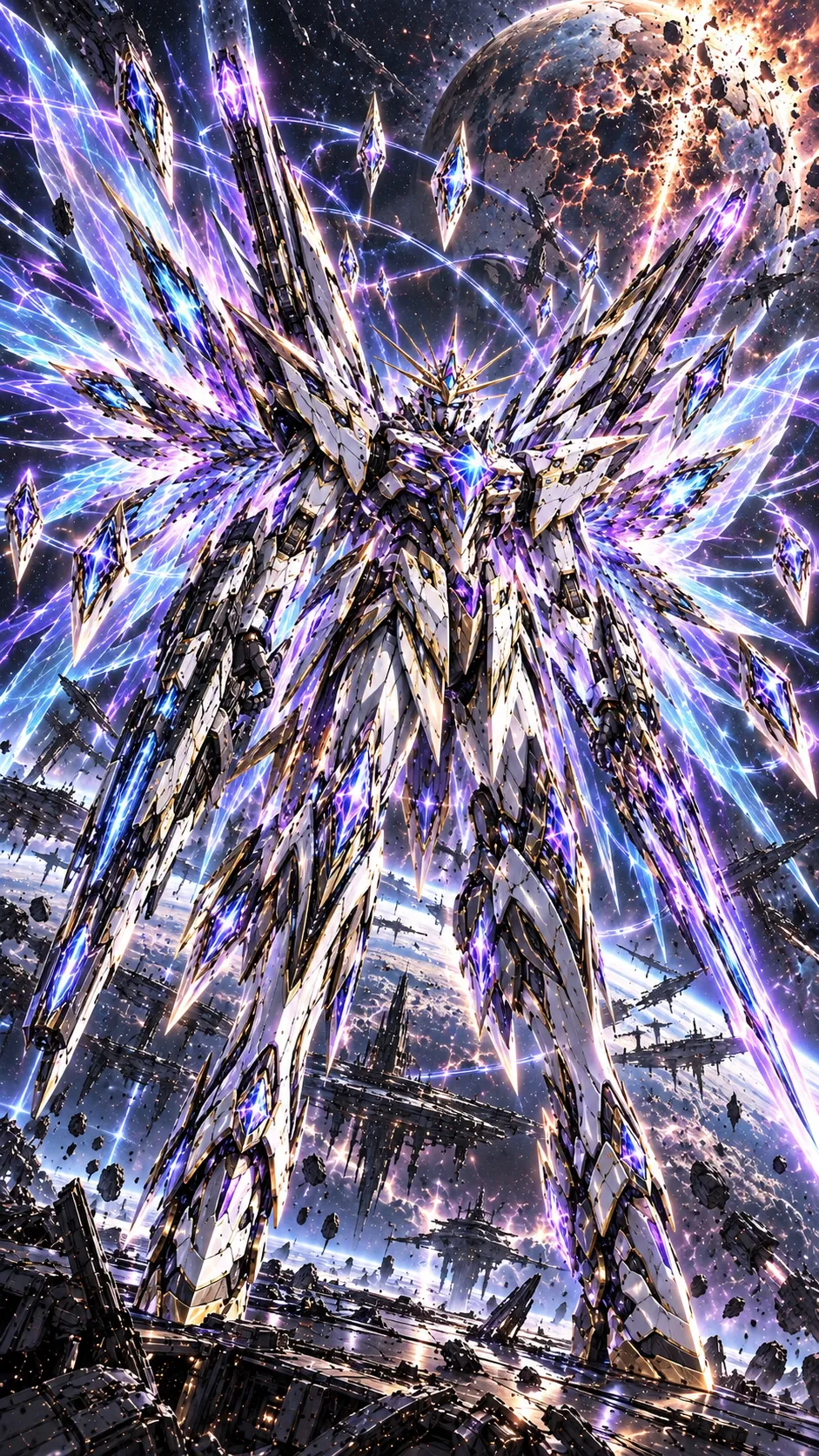
He had done it once before, in Crete, and it had frightened him. It did not frighten him now. He let the silver go down out of the soles of his feet into a mountain that had been a mountain since before there was anything alive on land, and the mountain came up into him, and he rose. Sixty metres. Two hundred. Four hundred. The clouds fell away below his knees. The waterfalls became threads. The wings opened out from his back in a great shuddering fan of crystal, blue-violet fire in every core, and spread a kilometre across the sky.
A Pemón guide named Ernesto, leading four German trekkers up the ramp on the southern cliff, looked up from the path and saw it standing on the summit with the sun behind it and the dust boiling up round its feet like cloud. He told the newspapers afterwards that he had grown up on stories about the tepuis being the houses of spirits, and that he had never believed them, and that he believed them now.
And then it was gone, straight up, on a column of light, so fast that the sound of it arrived eleven seconds later and knocked all four Germans flat.
It was waiting for him.
That was the first thing he understood when he came out of the fold, 1.8 million kilometres above the Earth, in the dark. It had known he would come. It had come here to be found.
It was a shell. That was the only word for it. A vast spiral shell of something like bone or porcelain, nineteen hundred kilometres from end to end, ribbed and fluted and coiled round on itself, every surface carved into spires and galleries and arches so fine and so many that from a distance it looked like a cathedral that had been grown instead of built. Light moved on it: slow, pale, pulsing waves of light, like breathing. And through the hollow centre of the spiral, the whole length of it, ran a throat. A tunnel big enough to swallow the Moon. That was where the song came from.
He felt it the moment he arrived. Not with his ears; there is no sound in space. With his armour.
The song went into him like a hand.
And his armour answered.
He felt it happen and could not stop it. A ripple went through the white plates, from his shoulders down to his feet, and the blades in his wings turned, all of them, all at once, towards the shell, the way flowers turn towards the sun. The blue-violet light in their cores flickered. Darkened. One whole bank of blades on his left wing went black, from the tips inward, like frost forming in reverse.
Pilot. ZERO’s voice was tight. The armour recognises the song. Thirty-six percent of what we are made of came from what that is made of. It is calling. And the armour— A pause. It wants to go home.
The left wing went darker.
Then the shell attacked.
Out of the galleries along its whole length came a storm of things. Thousands of them, then hundreds of thousands, pale and many-jointed, each one the size of a cathedral, pouring out of the spires like seeds blown off a dandelion. ZERO called them choristers, for want of a better word. They came at him in clouds, and where they passed through the dark, they sang too, and every voice they added pulled at the Pantheon like a tide.
He sent the blades out to meet them. The ones that were still his. The blades went into the choristers and the choristers turned to silver and flowed back into his wings and became blades; but the silver that came back was full of the song, and every chorister he swallowed made the black spread further. His right wing began to darken now. His sword-hand went heavy. He could feel the armour loosening round him, the way a hand you are holding loosens when its owner has started to think about someone else.
A lance of song came out of the shell’s throat. Not light. Something worse: a beam of pure coherent gravity, a pressure wave that bent the stars behind it, and it hit him in the chest and threw him four thousand kilometres backwards through the dark, and he felt plates crack across his chest for the first time in his life, and felt the Psycho-Frame shriek.
Armour integrity seventy-one percent. Resonance falling. Eleven percent. Nine. Seven. ZERO’s voice was fraying at the edges. Aria, the frame gives what your will asks for, and at the moment the song is asking louder.
Earth hung in the dark below him, very small. Blue and white. On the night side, over the north, he could see the auroras already, green and red curtains rippling down far further south than they had any right to be, as the magnetic field came apart thread by thread.
Somewhere under that light, a girl was sitting by a window in a café under a church, waiting for him.
He thought about her.
Not about her face. He had spent five months not thinking about her face and he found, now, at the end of everything, that her face was not what he thought about at all. He thought about her standing in the snow in Kamchatka in her socks, making demands of an angel for a dead man’s fiancée. He thought about her on a bench outside the Thom Building saying I’ve paid it. Twice. In one evening. I’m doing it anyway. He thought about a steel tin of kimbap. About forty-one nights of data in a folder called radiator. About her standing on the top step under the porch light, three centimetres taller than him for the first time in her life, shouting down a dark street: I’m not done with you.
He had told himself for ten years that the safest thing was to want nothing.
He wanted, now, more than he had wanted anything since he was ten years old, to go back to Oxford and walk into that café.
And the Psycho-Frame, which turns what the pilot wills into what is, heard him.
Seven percent. Fourteen. Twenty-nine. Fifty-eight.
Ninety-one.
One hundred.
Pilot desire: defined.
The black went out of his wings. Not slowly. All at once, the way a shadow goes when you turn on a light. Every blade came back blue-violet and blazing. The song was still there, still pulling at the armour. But the armour had remembered, all of it, every grain, who it lived in now.
And far inside him, behind seals he had never once touched, seven locks opened one by one. ZERO read them out as they went, in a voice that did not sound like a machine at all.
Kuramoto · open.
Voss · open.
Asante-Grey · open.
Ilyinskaya · open.
Adler · open.
MacLeod · open.
Benedetti · open.
All gates open. Output: 100% of rated capacity. For the first time.
He had never felt anything like it. Ten percent had held a fault line under Crete and pushed back a tsunami forty kilometres wide. This was ten times that, and then it was ten times that again, because the frame no longer had anything to hold it back. He felt the Twin GN Drives spin up into a sound that was not a sound, a chord that filled him like a cathedral fills with an organ. He felt the photon battery open all the way. He felt the Pantheon reach out into the dark around it, into the wreckage of the choristers and the dust between the stars and the light of the Sun itself, and take what it needed, and grow.
Four hundred metres. Four kilometres. Forty.
The Ascension configuration. Kuramoto’s last drawing. Pray it is never needed.
At this scale and this output, said ZERO quietly, you could fly through the core of the Sun and come out of the other side. You could cut it in half with the blade. I am telling you this so that you know. I am recommending that you do neither.
‘Noted,’ said Aria.
He went for the shell.
The choristers came at him and the blades went out to meet them, ten thousand blades now, each the size of a frigate, and this time when they swallowed the choristers the silver that came back was clean. He drew the sword. The GN-Photon Singularity Blade came out of his back four hundred kilometres long, with a line of black down its edge so deep that the light of the stars behind it bent and fled, and he swung it once through the largest of the shell’s spires. The spire was there, and then a line of nothing went through it, and then there were two pieces of spire drifting apart in the dark, and between them was a gap that was not anywhere at all.
The shell screamed. He felt the scream in the frame: not sound, but something like grief, or rage, rolling out across the dark. A second lance of gravity came out of the throat at him. He did not dodge it. He drove into it, wings back, the whole Pantheon cloaked in a cocoon of blazing ELS, the Psycho-Minovsky Siege Ram, and went down the beam like a needle down a thread, against all that pressure, and hit the shell side-on at a tenth of the speed of light and went in one side of a lobe the size of Wales and out of the other.
It was not enough. He knew it wasn’t enough. The shell was still singing, and at the heart of it, in the throat, something was gathering. A core. He could feel it the way he had felt the eye at the bottom of the Calypso Deep: a single point, burning, at the centre of the spiral, wrapped in so many layers of living shell that nothing he could cut or ram would ever reach it in time. And the auroras over Earth were spreading.
‘Rifle,’ he said.
The Twin Satellite Buster Rifle came out of his forearms in two long white barrels, and at this scale they were each two hundred kilometres long, and he brought them together in front of him, and ZERO said:
Charging. Forty seconds to full.
Warning: beam will not stop at the target. Projected path: unobstructed for 4,100 light years along the current vector. No inhabited systems in the cone. Do not change your aim.
Warning: after firing, rifle requires sixty seconds to recharge. During recharge, you will be very exposed.
He aimed upward, out of the plane of the solar system, so that whatever went through the shell would go on into the empty dark above the planets and the Sun and never touch anything that lived. Then he held still and let it charge.
Forty seconds is a very long time.
The shell knew what he was doing. Everything it had came at him: lance after lance of song out of the throat, a whole hurricane of choristers. He did not move. He couldn’t move, not without spoiling the aim. He hung there in the dark with the barrels glowing brighter and brighter between his hands and let it all hit him. Plates cracked across his chest and his shoulders and his face. Blades went dark and fell away from his wings. Something warm ran out of his nose inside the helmet, his own blood, real blood, and down over his lip.
Twenty seconds. Neural load three hundred percent of safe threshold.
Below him, on the night side of the Earth, the whole of northern Europe was lit green and red by the dying field.
Ten seconds.
He thought about a café window.
Full charge.
He fired.
Afterwards, the astronomers would argue for years about how much energy had been released in those nine seconds. The most conservative estimate put it at more than the Sun produces in an hour. The least conservative estimate was withdrawn after its authors were quietly visited by people from their government.
On the night side of the Earth, in the north, for nine seconds, there were two suns.
The second sun was in the north-western sky, very high, a point of white light that grew and grew until it threw shadows across half of Europe and turned the snow on the Alps to day. Then it stretched. It became a line: two lines, twin threads of blinding white so long that they went from one horizon of the sky to the other, straight up out of the ecliptic and on into the dark, and the auroras around them blew apart like smoke in a gale.
At the far end of those lines, 1.8 million kilometres from Earth, a shell nineteen hundred kilometres long, made of the flesh of a creature that had swallowed three hundred worlds, was there. And then it was not.
The beams went through the throat and the core and the spiral and every gallery and spire, and out the far side, and on, into four thousand one hundred light years of empty dark. They took the shell with them. They did not leave a fragment. They did not leave dust.
Then they were gone. The second sun went out. The northern sky was dark again, and the auroras, the dying ones, the wrong ones, began to fade.
Recharging. Sixty seconds.
He hung there in the dark, burning hot, cracked in a hundred places, bleeding into his own helmet, and that was when the last of it came out of nowhere.
A seed. That was all. A single pale shard, the size of a church, that had broken off the outermost spiral of the shell a fraction of a second before the beam arrived. It was falling towards Earth at a third of the speed of light, and it was singing, one high pure note, and ZERO said, Beacon. If it reaches the Calypso Deep, it will wake the Coil completely, and the rifle in his hands said fifty-four seconds.
He dropped the rifle and went after it with his hands.
He had no beam, no blades left that weren’t cracked, and a body that felt as though it had been beaten with iron bars from the inside. He had a Minovsky Drive and a will. He put the drive to the stops and went down after the seed like a falling star, shrinking as he went, shedding kilometres of borrowed mass behind him in a long silver trail across the dark, because a smaller thing goes faster. Four hundred thousand kilometres. Two hundred. The Moon went past on his right. Earth came up enormous and blue.
He caught it above the Atlantic, at the top of the atmosphere, with the air beginning to burn around them both.
He was four hundred metres tall by then, and the seed was half his size, and still singing. He wrapped his left arm around it and drove his right hand into it.
Omega Finger.
It came apart in rings of light, high over the Atlantic, at the very edge of space. Fishing boats off the Azores saw it: a pale flower opening silently in the night, ring after ring of it, until it was gone, and in its place, for one long breath, a shape of drifting blue-violet motes in the outline of a human hand.
Rifle recharged, said ZERO, two seconds later, into the silence.
Aria laughed. It hurt. He went on laughing for a while anyway, falling slowly through the dark over the Atlantic, with the blood running down his face inside his helmet and the Earth turning blue and quiet below him.
Earth’s magnetic field recovering. Rate plus point four percent per minute. The Calypso Deep has gone quiet. A pause. Before it was destroyed, the scout transmitted. A single burst, outward, towards the galactic centre, through the fold it came from. It contained an image of us.
‘They know what I look like.’
They know what we look like. They do not know who you are.
He gave the mountain back. That took a long time, and he did it carefully: a silver river pouring down out of the sky onto the black summit of Roraima at dusk, flowing into the rock, remaking it grain by grain, cliffs and pools and pink sand and all. Ernesto the guide watched it from his camp on the ramp below with his four Germans and wept.
Then he folded the light around himself, and went home.
It was half past eleven in Oxford. He was three and a half hours late.
Chapter SevenPOV · BothRadcliffe Square · 7 February · 23:34
She had been by the window at eight o’clock exactly.
She had done her hair. She had not done her make-up. She had sat down with her barley tea and Le Petit Prince and her heart going so fast she had to count, and at five past eight she had told herself that boys are always late, and at a quarter past she had told herself that he had said yes, he had written yes, and at half past she had stopped telling herself anything.
At twenty to nine, the sky outside went green.
Everyone in the café went to the windows. Out over the dome of the Radcliffe Camera, curtains of light were rippling down the dark: green, and then red, and then a deep strange crimson, the aurora, which nobody in Oxford had ever seen so far south. People came out of the colleges onto the cobbles in their coats and stood looking up with their mouths open. Phones went up all over the square. It was beautiful. It was terrifying. Somebody’s radio was saying something about the magnetic field.
And at seven minutes past nine, the sky went white.
She would remember it for the rest of her life. Every shadow in Radcliffe Square swung round at once, as though the Earth had turned over. The dome of the Camera lit up as if it was noon. Out in the north-west, very high, there was a second sun. She looked straight at it through the café window without meaning to and saw, before her eyes watered and she had to look away, two lines of light going up out of it, straight up, into forever.
Nine seconds. Then dark.
The whole square was silent. Then somebody started to cry, and somebody else started to cheer, and the aurora began, very slowly, to fade.
Eliana Tzofiya sat by the window with her hands flat on the table, very still.
She knew. She had known, really, since the boots. She had known since nobody. And she knew now, with a certainty that went all the way down to the plates in her pelvis, why the boy who had written yes was not sitting across the table from her.
She did not leave.
The café closed at ten. The girl behind the counter, who was called Imani and had been bringing her barley tea since the start of term, looked at her face and did not ask her to go; she turned off the main lights and left her a candle and the key to the courtyard door, and said, ‘Lock up behind you, yeah?’ The Halvard men stood outside the front. She didn’t care. She sat by the window in the candlelight with her book closed in front of her and her coat on and waited.
At 23:34, someone knocked on the courtyard door.
He was leaning against the door frame when she opened it, as if it was the only thing holding him up.
He was in the grey hoodie. His hair was wet. His face was white as paper, and there was dried blood under his nose and on his upper lip, and a fresh cut over his eyebrow, and his eyes were the eyes of someone who had been awake for a hundred years. He was holding a bunch of white tulips. They were a bit crushed.
‘Sorry,’ said Aria. ‘I’m late.’
Then his knees went.
She caught him. She weighed thirty kilos and he weighed ninety, and her pelvis was full of titanium and her right lung was full of scars, and she caught him anyway, or at least she caught enough of him that when he went down it was slowly, sliding down the door frame, with her arms round his shoulders, until they were both sitting on the cold stone of the courtyard step with his head against her chest and the tulips in a heap in his lap.
He was shaking. She could feel it all through him, a deep exhausted tremor, like a machine that had been run far past what it was built for. And under it, against her ribs, she could feel his heart going much too fast, and beneath it, faint, slow, steady, the second one. Thrum-thrum.
She put her hand on the back of his head and held it there, the way he had held hers.
‘Breathe,’ said Eliana.
He went very still.
‘In for four,’ she said, softly, into his wet hair. ‘Come on. One. Two. Three. Four. Hold it. Out for four. You’re not falling.’ Her voice shook, just once, and then steadied, the way you steady a hand on a table. ‘I’ve got you.’
She felt him breathe in. Four. Hold. Out. Four.
They sat like that for a long time, on the courtyard step behind a closed café under a church, while the last of the aurora faded out of the sky above Radcliffe Square, and she counted for him, over and over, until the shaking stopped.
‘It was you,’ she said at last. Not a question.
He didn’t say yes. He didn’t say no. He lifted his head off her chest and looked at her, very close, in the candlelight from the café window, and said nothing for a long time.
‘How long have you known?’ he said finally.
‘Since the boots.’
‘…Since the boots.’
‘I taped a thermocouple inside the left one. K-type. Logged every sixty seconds. Forty-one nights.’ She was pink, but she held his gaze. ‘Correlation between your presence under my window and boot temperature was nought point nine eight. I ran a significance test. It’s in a folder called radiator.’
He stared at her.
Then, for the first time since she had known him, as a demonstrator or a stranger in Radcliffe Square or a white figure over Kamchatka, Aria Zadkiel laughed. Properly. A real, helpless, exhausted laugh that started somewhere deep in his chest and shook his whole body, and that he could not stop, until there were tears running down through the dried blood on his face.
Nought point nine eight, said ZERO, inside his skull, with what in any human being would have been deep professional respect. She matched my figure to two decimal places. With one thermocouple.
‘I know,’ said Aria, out loud, still laughing.
‘You know what?’ said Eliana.
He shook his head. He wiped his face with the sleeve of his hoodie. When he looked at her again, he wasn’t laughing.
‘You should be afraid of me,’ he said quietly.
‘I’m not.’
‘I mean it. You saw what happened tonight. You saw the sky. I can do that. I can do things that—’ He stopped. ‘Every night, before I go to sleep, something tells me how easily I could take the whole world if I wanted to. Every night. And every night I tell it no. And there are people who have been trying to find me, and if they find me, they’ll find you. They’ve already—’ His jaw tightened. ‘Your boots didn’t go missing in the move, Eliana. Somebody took them. Because of what they’re made of. Because of me.’
She went pale. But she didn’t move away.
‘I’m afraid,’ he said. It came out of him like something being pulled out of a wound, slowly, two millimetres at a time. ‘Not of them. Of this. Of you. The last time I— I was ten. My parents went to work one night and they didn’t come home, and I decided that I would never let anyone in again. Because everyone you hold is a door. The world comes through it. And I didn’t hold you, I never held you, I stood on the other side of the road for forty-one nights, and it came through anyway.’ His voice cracked. ‘I can stop asteroids. I can’t stop that. I couldn’t stop that lorry. I was four minutes late. I was holding up a church. I was four minutes—’
‘Aria.’
‘—and if I let myself love you, and they come for you, and I’m four minutes late again—’
‘Aria.’ She took his face in both her hands. The way her mother used to. ‘I know. I know what it costs. I told you. I’ve paid it.’
‘I haven’t,’ he whispered. ‘Not since I was ten. I don’t know how.’
‘Then we’ll be afraid together,’ said Eliana. ‘That’s allowed. Papa was afraid every single day of my life. He told me so in a letter. He did it anyway.’
And then, because she was sitting on a step and he was sitting on the step below her and that made her, for the second time in her life, the taller of the two, and because she had promised her mother on top of Broadway Hill that she would not let him run away, and because she was eighteen and had never done it before and had decided in the light of a second sun that she was going to do it before she lost her nerve, Eliana Seraphina Tzofiya leaned down and kissed him.
It was very short. It was very clumsy. He tasted of rain and of the cold of somewhere very far away. She felt him go completely still, the way he had on Broad Street when ZERO said pilot; and then she felt something in him give, the way a wall gives when you have been leaning on it for ten years, and his hand came up and touched her cheek, very lightly, as if she was something that might break, or something he might, and he kissed her back.
When it ended, neither of them said anything for a while.
Heart rate, began ZERO.
‘Not now,’ said Aria, out loud.
‘What?’ said Eliana.
‘Nothing. Sorry. It’s—’ He shut his eyes. ‘It’s complicated.’
‘You talk to it.’ She was looking at him with her head on one side, the way she looked at a reaction that was doing something she hadn’t predicted. ‘The thing inside you. You talk to it. You did it in the lab. You did it in the Camera. You do it all the time when you think no one’s looking.’
‘…Yes.’
‘What’s its name?’
He hesitated. Then: ‘ZERO.’
‘Hello, ZERO,’ said Eliana politely, to his chest.
Tell her hello, said ZERO, after a pause that, for ZERO, was very long. Tell her I liked the significance test.
‘It says hello,’ said Aria. ‘It liked your significance test.’
She laughed. She put her forehead against his and laughed, and he laughed, and they sat on the step of a closed café in the middle of the night with blood on his face and crushed tulips in his lap, two people who had lost everyone, laughing.
He walked her home. Slowly. At her pace, with her hand in his, a bench at a time. The Halvard men followed at a distance and he let them.
At the bottom of the steps on Norham Gardens, under the porch light, he stopped.
‘Eliana,’ he said.
‘Yes?’
‘I don’t know how to do this. Any of it. I’ve never— I don’t know how people do this.’ He was looking at his shoes. His ears were red in the porch light. ‘But there’s a garden. The Botanic Garden. By Magdalen Bridge. It’s the oldest one in Britain. The glasshouses are warm, and there are benches every twenty metres, I checked, and it’s flat, and I thought, if you wanted, on Saturday, not this Saturday, I mean, the next one, because I don’t think I can stand up tomorrow, I thought maybe we could—’
‘Yes,’ said Eliana.
‘I haven’t finished asking.’
‘Yes.’
‘You don’t know what I was going to—’
‘Aria Zadkiel,’ said Eliana Tzofiya, from the top step, three centimetres taller than him, with her hair in her eyes and the porch light behind her and her face doing something that would have made Geoff Pemberton forget he had hands, ‘I said yes.’
He looked up at her.
And then, for the first time in his life, he did not look away.
They were not dating. Not yet. That was a problem for the Saturday after next.
EpiloguePOV · ElsewhereZurich · the galactic centre · the Nave
In the Chapel beneath the Paradeplatz, on a cloth of black silk on a stone table in front of the tank, lay a small pair of white boots.
They had been there since December. Nobody had touched them since the first week, when a technician from the Children’s laboratory in Basel had tried to take a scraping from the left heel with a diamond blade, and the blade had gone silver and run away into the boot, and the technician had sat down on the floor and not spoken for two days.
The water in the tank had not stopped moving since they arrived. It leaned towards them. All the time. Slowly, gently, the whole black column of it tilting against the glass in the direction of the stone table, the way a plant leans towards a window.
‘It is not our fragment,’ said the Patriarch.
He had been sitting in front of the boots for an hour. Odile Vrai stood beside him. Dr. Anselm Kreutz stood a little way back, turning his signet ring round and round on his little finger.
‘Our fragment is Tunguska. A splinter. A scale the Coil shed when the scout passed over Siberia in 1908. Forty years we have been trying to make it crawl.’ The old man’s voice was soft, almost wondering. ‘This is not a splinter. Look at the water, Odile. The Deep does not lean towards a scale. It leans towards its own heart.’
Vrai said nothing for a long moment.
‘The Heart was lost,’ she said at last. ‘The Ugarit chamber was empty. Brother Gabriel reported—’
She stopped.
The Patriarch did not look round. He smiled. It was the gentle, pleased smile of a grandfather watching a child arrive, at long last, at the end of a sum.
‘Brother Gabriel reported,’ he agreed. ‘In August 1997. Six weeks before a materials scientist in Oxford named Margarethe Voss began, quite suddenly, after twenty barren years, to publish nothing at all.’
‘He lied to us.’
‘He lied to us for seventeen years. And then he took the song and ran, and you lit a match, and we thought that was the end of him.’ The old man reached out one finger and laid it, very gently, on the toe of the left boot. The water in the tank surged against the glass. ‘But he had already given the Heart away. To someone who built an angel out of it.’
Kreutz cleared his throat.
‘On the twenty-fourth of January,’ he said, ‘the Key slipped her detail and walked into Radcliffe Square, as we arranged. Halvard’s men were to recover her at Broad Street, forty seconds later, and she would be very grateful, and very frightened, and in the spring she would go to the Klinik Seeblick of her own free will.’ He took a photograph from his breast pocket and laid it on the black silk beside the boots. ‘Instead, a student fought five of Halvard’s men with his bare hands and walked away with her. He is tall. Dark-haired. A second-year at Balliol. He fights, Halvard tells me, like someone who was trained by very old people for a very long time. And yesterday, at the moment the sky over Europe turned white, he was not anywhere that any camera in Oxford could find.’
The photograph was blurred, taken on a phone in bad light. A tall young man in a bloodied white shirt, walking away out of Radcliffe Square, with a small girl in his arms.
Vrai looked at it for a long time.
Eleven years ago, she had stood in a doorway in a room under Geneva and looked at a man with exactly that jaw. Exactly that way of holding his head when he was carrying something he would not put down.
‘Gabriel,’ she said, very quietly, ‘had a son.’
The Patriarch took his finger from the boot. The water in the tank was boiling against the glass.
‘Find him,’ he said.
Nine thousand light years away, in the bright dark towards the heart of the galaxy, where the stars are packed so close that the night is never fully black, a single burst of song arrived at a fleet that had been waiting for a very long time.
It was an image. A machine with wings, forty kilometres tall, white and gold and blue-violet, with a black line of nothing in its hand, standing in the dark above a small blue world.
The Cantor looked at it with no eyes for a long time.
‘It has a heart that is not its own,’ it said at last, in a chord that made the whole great ship ring. ‘It has the Coil’s heart. The one the Heretic stole.’
‘What do we do?’
‘We go to the blue world,’ said the Cantor, ‘all of us, now, faster than we have ever gone.’ Its long hands spread. ‘And we take back what is ours. And then we sing.’
In the Nave beneath the chapel in Wytham Woods, at four in the morning, Aria lay on the floor of the Cradle with an ice pack on his face and a cup of tea going cold beside him and a crushed white tulip in his hand, and did not sleep.
Neural load 140% of safe threshold, falling. Armour integrity 96%, regenerating. Do not do that again within 72 hours.
Strategic feasibility projection: probability of successful global hegemony, should the pilot so desire, 100.00%.
Pilot desire: defined.
‘Defined as what?’ said Aria, to the ceiling.
A pause.
You know, said ZERO. It is not the world.
Aria lay on the floor of the Nave and looked up at seven crooked photographs on the wall beside the lift, and smiled, and did not tell it to close.
Extras · recovered from the Nave
Interim Chairman, Stevansky Meridian · the Chapel
The relic · “only a Coil can kill a Coil”
| Capability | Value | Note |
|---|---|---|
| Psycho-Frame resonance | 100% · seven Choir seals open | First time |
| Ascension scale | c. 40 km at peak; mass from Roraima, debris and stellar wind | Roraima returned |
| Singularity Blade | 400 km edge | Could halve the Sun |
| Buster Rifle, Colony class | 40 s charge · 9 s fire · 60 s recharge | Fired above the ecliptic |
| Combat cost | Neural load peaked at 340%; armour integrity fell to 41% | Wait 72 h |
| Unarmoured ZERO | Precognition works without manifesting the suit | Radcliffe Square |
| Weakness | 36% kinship with Coil flesh; armour answers the song | Held by will |
| Moonlight Butterfly | Sealed. Still never opened. | Benedetti |