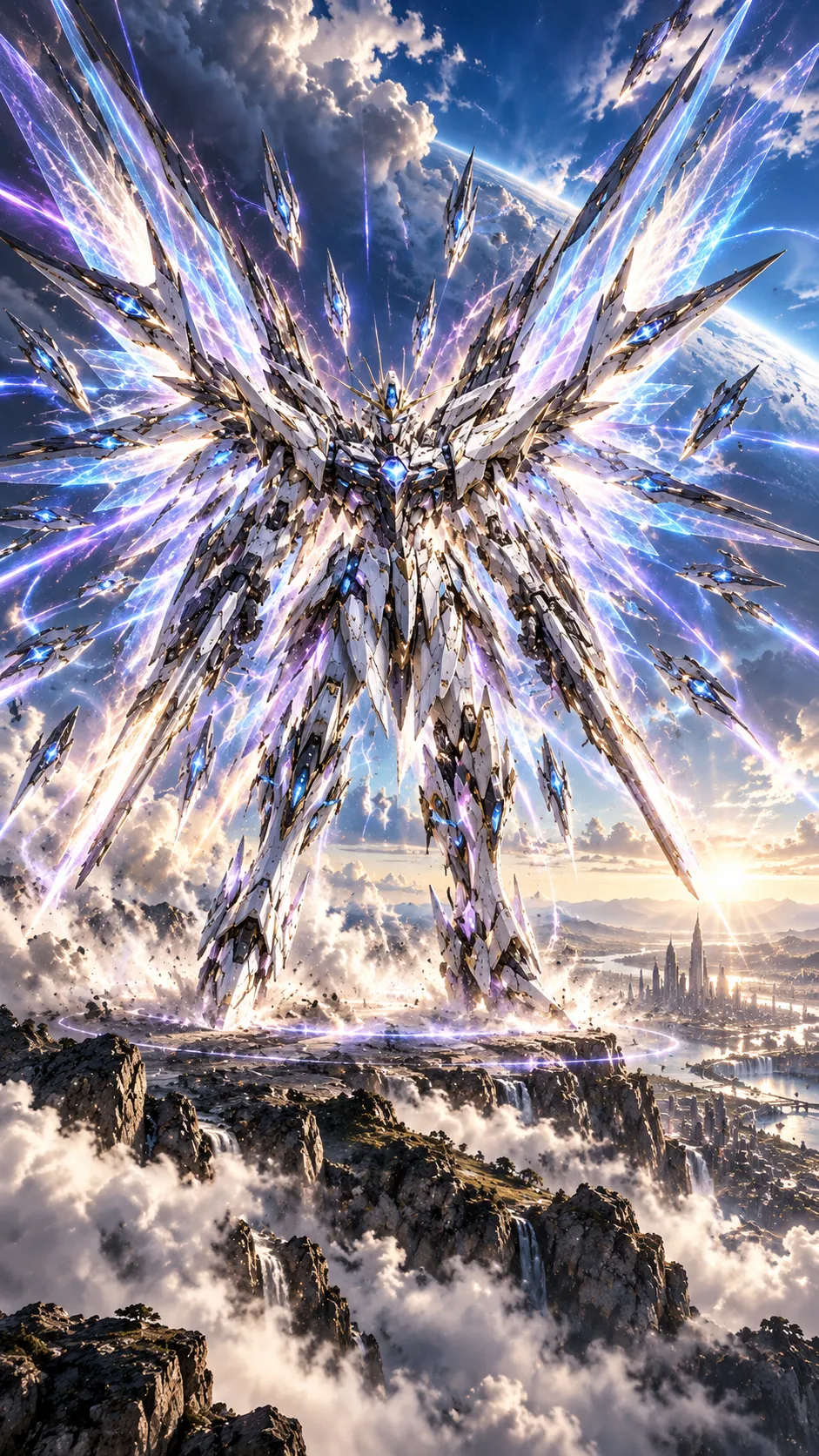
Stage II, full scale. South coast of Crete, 26 October 2024, 18:11 local time. Photographed from a fishing boat off Lentas.
A light novel · Volume I
PANTHEONSystem-Ω
The Nobody of Oxford Is Secretly the Machine God, and the Most Beautiful Girl in the World Hates Him (She Doesn't)
Part 2
The Only One Who Didn’t Look
序章
ProloguePOV · GabrielGeneva · March 2014
The Deep
Aria Zadkiel has never heard the word Tehom. He does not know that his father once held a title, or that the title came with a key, or what the key opened. This chapter is not for him. It is for you.
The Book of the Coil · Canticle IVAramaic copy, 3rd c. · original older
Before the waters were divided, the Coil came down out of the high dark and lay down in the Deep to sleep.
It is not of this world. It does not love this world. It sings.
And those who hear the song beyond the stars shall come, the First Who Believed, in ships like falling cities; and every world that is sung shall be swallowed, and every galaxy shall turn about the Coil as water turns about a drain.
Blessed are the Children who keep the Deep. They shall stand beside the First upon the ruins of the stars.
And a Key shall be born of the line of the Watcher. In her thirteenth year she shall be made still, and in her eighteenth year she shall be given, and in her stillness the Deep shall open.
Marginal note in a modern hand, blue ink, signed G.Z.: “Not a god. A signal. Read it again as a signal.”
Beneath the Old Town of Geneva, below the crypt of a church most of the city has forgotten, there is a room whose walls sweat seawater, though the nearest sea is four hundred kilometres away.
Dr. Gabriel Zadkiel had been coming to that room for nineteen years.
He had been twenty-two when a man in a grey suit knocked on his door at Cambridge and offered him the one thing a young genius cannot refuse: a question nobody else had been allowed to ask. The Children of Tehom were very old, very patient and very rich, and they collected brilliant minds the way other people collect stamps. They gave him the key to a library that did not officially exist. They gave him a seat at their table. In time they gave him a title, Keeper of the Third Lamp, and he had been honoured by it. For a while he had even been proud.
Tonight, at fourteen minutes past two in the morning, he had decoded the song.
For three thousand years the Children had listened to it: a pulse that rose out of the deepest trench of the Mediterranean, slow and enormous, like breathing. The priests called it the Coil’s breath. Gabriel had spent six years feeding it through spare cycles on CERN’s grid, and tonight it had stopped being music and turned into mathematics.
It was a beacon. Not a prayer. Not the voice of a god. A navigation signal, repeating, over and over, the coordinates of a single planet. Here. Here. Here.
And beneath it, faint, was a second signal. A reply. It had begun in 1908, the summer something fell on Tunguska, and it had been getting louder every year since.
Something was answering. Something was coming.
He sat in the sweating room with the printout across his knees and understood several things at once. That the Coil was not a god but a creature, a living thing from somewhere else, laid down in the sea like a buoy. That the First Who Believed were not angels but a species, and their ships were already moving. That the Book’s great promise, they shall stand beside the First upon the ruins of the stars, was not a promise at all. It was the description of a harvest, written down by the harvested.
And that the Patriarch knew. Had always known. And did not care, because the Children believed with the whole of their ancient, patient, cruel hearts that they were chosen. That when the First came, they alone would be lifted up and given the galaxies to rule.
Gabriel thought of his son. Aria was ten. He would be asleep now in the flat on the Rue de Lausanne, one arm thrown over his face the way he always slept, as if shielding his eyes from something only he could see.
‘Brother Gabriel. You’re up late.’
Odile Vrai stood in the doorway. She was forty-two and had sat beside him at the Children’s table for nineteen years, a brilliant, frightening woman from nowhere in particular who had sanded the accent off her own voice at nineteen so that no one would ever be able to say where she came from. She looked at the printout on his knees. She looked at his face. And she smiled, with real warmth, the way you smile at a friend who has finally understood a joke.
‘You’ve heard it properly,’ she said. ‘I’m so glad.’
‘You knew.’
‘The Patriarch thought you’d be honoured to work it out yourself.’
‘Odile. It’s a harvest.’
‘Yes,’ she said. ‘Isn’t it wonderful? And we’ll be on the right side of it.’
She let him leave. That was the part he would think about, in the two hours he had left: she simply stepped aside and let him walk out with the printout under his coat, and wished him goodnight.
He called Hideo Kuramoto from a phone box on the Quai du Mont-Blanc.
‘Finish it,’ he said. ‘Whatever it costs. When Aria is ready, give it to him. And Hideo, listen. There is a child. A girl, eight years old, in London. The Book calls her the Key. Stevansky’s daughter. When she is grown they will come for her, and if I can’t—’
The line clicked. He looked at the receiver for a moment. Then he hung up and went to the laboratory, because the decoded song was on a server there, and because Leah was working late, and because he did not yet understand that Odile Vrai had let him go only so that she would know exactly where he went.
The fire started at 4:06 a.m. The newspapers would call it a faulty cryogenic line.
Odile Vrai watched it from the far side of the street with her hands in her coat pockets. She had liked Gabriel. She had told the Patriarch so. Then she had struck the match herself, because liking someone was no reason to let them stand between the Children and the stars.
Ten years later, the song changed key.
In a room without windows, Odile Vrai, no longer young and still without an accent, opened a file marked TZOFIYA and began to plan the death of a man who had refused to give them his daughter.
She was in no hurry. The Deep had waited since before the waters were divided. She could wait for the right moment.
She knew exactly what the right moment would look like. It would look like love.
第一章
Chapter OnePOV · ElianaOxford · October 2024
Michaelmas
Oxford was not ready for her. She was not ready for Oxford. And the six men in dark coats who followed her everywhere were not ready for anything, because they had been hired by a father who had watched his daughter fall out of the sky.
After Kamchatka, Alexander Stevansky did what very rich, very frightened men do. He built a wall. Six bodyguards in rotation. Two cars. A drone that hovered over Merton’s Fellows’ Garden until the Warden wrote to the Home Office. The students called the bodyguards the Convoy and called her the Princess of Merton, and on the first night of Freshers’ Week someone hung a bedsheet out of a window on Merton Street painted with I HATE YOU!! and a heart. It was meant affectionately. It nearly killed her.
Dov wasn’t there. That was the worst part. The knife wound from Kamchatka had healed perfectly, so perfectly that the surgeons in London reopened it in September to find out how. The infection came in with them. He was in a hospital in Tel Aviv after a second operation, swearing at the nurses in four languages and calling her every night at nine o’clock exactly.
‘Are you eating?’ he asked, every night.
‘Yes, Dov.’
‘Real food?’
‘Lentils are real food.’
A long, Israeli silence, full of opinions about lentils.
Her days had a shape, and she held on to the shape the way you hold a banister in the dark.
She woke at half past six and read for thirty minutes before she let herself look at her phone. She had read in bed since she was four. She read everywhere: in the bath, in queues, on staircases, walking down the street, which Dov considered a security risk and her mother considered a miracle she hadn’t yet been run over. In the right-hand pocket of her cardigan there was always a battered paperback of Primo Levi’s The Periodic Table, which she had read eleven times. On her bedside table that term was War and Peace, which she had started on the flight home from Kamchatka for a reason she would not have admitted under torture. She was on page six hundred and twelve. Prince Andrei had just been wounded at Austerlitz and was lying on his back, looking up at the sky.
Breakfast she made herself, in the tiny kitchen at the end of her corridor: oats soaked overnight in oat milk, blueberries, a spoon of tahini, a thread of date syrup, a sprinkle of ground flax. She had been vegan since she was eleven, when she watched a documentary about dairy farms, cried for a week and then simply stopped. No meat, no fish, no milk, no eggs, no honey, no leather, no wool, no exceptions. She had once returned a two-thousand-pound cashmere coat that her father had bought her, with a note to the shop apologising to the goat. Her father, who regarded a meal without meat as a kind of hostage situation, had hired a vegan chef for the London house and then eaten everything the chef made her when she wasn’t looking.
Halmeoni sent kimchi from Seoul every week by courier in an insulated box, made specially without fish sauce, which Halmeoni considered a personal sacrifice of historic proportions. Eliana’s whole staircase smelled faintly of it. Her scout, Brenda, who cleaned the corridor and had opinions, called it ‘the situation.’
Lunch was the problem. Merton’s kitchen, overwhelmed at finding the Nine-Second Girl on its books, had decided to impress her. On her first day the vegan option was a stuffed pepper. On her third, a beetroot Wellington. By the second week the head chef had produced a celeriac swan with lentil wings and a pomegranate eye, and the whole of Hall turned to watch her receive it, and she said ‘Thank you, it’s beautiful,’ in a very small voice, and ate the swan with an expression of polite grief, and that afternoon went back to bringing her own lunch: brown rice, sesame tofu, steamed greens and Halmeoni’s kimchi, in a plain steel tin.
Dinner she mostly skipped. She knew she shouldn’t. Dov knew she did. It was one of the opinions in the silence.
On her first Monday, she walked to the Engineering building.
It was one point three kilometres from Merton to the Thom Building on Parks Road: up past Christ Church, across the High, through Radcliffe Square, past the Bodleian and the King’s Arms and up. The Convoy offered her a car. She refused. Everyone else walked to lectures. She was going to walk to lectures. That was the whole point of Oxford, she told the head of her detail, a man called Briggs who had a neck like a fire hydrant. She was going to be a normal undergraduate with normal legs who went normal places on foot.
Her normal legs got her as far as the Radcliffe Camera.
It came on gently at first: a tightness, a lightness in the head, a sense that the air in Radcliffe Square was thinner than it ought to be. Then her heart was going much too fast and her breath would not come in deep enough, and the cobbles tilted slightly, and she sat down on the steps of the Camera because the alternative was falling down on them.
She sat there for fourteen minutes. A Japanese tour group photographed her. Two of the Convoy stood at a discreet distance, looking at their shoes in a way that was somehow worse than looking at her. A Labrador came and put its head in her lap, and she was so grateful she nearly cried.
She reached her first lecture twenty-two minutes late and grey to the lips, and on Wednesday, after the college nurse had a quiet word with someone, a document arrived in her inbox.
University of Oxford · Disability Advisory ServiceStudent Support Plan · summary
Student
TZOFIYA, Eliana S. · Merton College · Engineering Science (Chemical)
Condition
Rare chromosomal variant (growth arrest, age 13). Reduced cardiopulmonary reserve.
Observed
Significant fatigue after walking c. 800–1,000 m on level ground. Required a 14-minute seated rest (Radcliffe Square, 14 Oct). Late to lecture as a result.
Adjust.
Ten minutes’ grace between lectures in different buildings. Ground-floor or front-row seating. Access to the rest room in the Thom Building. Use of a mobility scooter if desired.
Note
Scooter offered. Declined by student.
She read the last line nine times. Declined by student. She was quite proud of it, and also wanted to put her head on her desk and stay there until Christmas.
She let Briggs drive her after that. She didn’t like it. She sat in the back of the car with Primo Levi open on her knees and didn’t read a word, and watched the other first-years walking up Parks Road in twos and threes, laughing, carrying coffee, being looked at by no one.
Everyone else was looking at her, of course.
Oxford had two thousand freshers that year, and roughly one thousand nine hundred and ninety-nine of them had at some point rehearsed what they would say if they met Eliana Tzofiya. Some had rehearsed it in front of mirrors. One boy at Keble had made flashcards. When she walked into a lecture hall the noise in it dropped, like a radio being turned down. When she sat, the seats around her filled from the outside in until she was the centre of a ring of people very carefully not looking at her and looking at her the entire time.
The meme didn’t help. Seven weeks after Esso, the clip of her screaming at the Seraph had been watched nine hundred million times. There were remixes. There was a K-pop version that had charted in four countries. Strangers on Cornmarket shouted I HATE YOU! at her as she passed, cheerfully, the way people shout the catchphrase of a sitcom they love, and every time it happened she remembered a muddy street, and a downwash of hot wind, and a white figure hanging in the sky with its gold visor turned towards her, perfectly still.
She remembered something else, too. She didn’t tell anyone. She only thought about it at night, with War and Peace on her chest and the light still on.
He hadn’t looked at her.
Of all the billions of eyes on Earth, the only pair that had refused to look at her face belonged to something that could cut missiles out of the sky. And she had screamed at it in front of a village. And it had left.
Not where I live.
Kamchatka was eleven hours ahead of London. She had worked it out on the plane home, with a pencil, on the back of a sick bag. Ten thirty in the morning in Esso was eleven thirty at night in Britain.
She did not know what to do with that. She kept it anyway, the way you keep a smooth stone in your pocket and turn it over when you’re nervous.
On Monday of second week she had her first Engineering Computation practical. Python, two hours, the computer lab on the second floor of the Thom Building. The demonstrator, people said, was a second-year from Computer Science who had been lent to the Engineering department as some sort of punishment.
第二章
Chapter TwoPOV · BothThom Building · 21 October
The Radiator
It was, in fact, a punishment.
‘You fixed line six,’ Professor Halvorsen had said at the end of the previous term, handing him back the proof with a single tick on it and a look that went right through his glasses. ‘Good. Now you can go and teach first-year engineers why line six matters. The Engineering department has lost a demonstrator. I have volunteered you.’
‘I’m not sure I’m—’
‘Mr. Zadkiel. If you refuse, I will become curious about why you refused. Do you want me curious?’
He did not want her curious. He took the job.
The principal from Kamchatka is enrolled in this practical, ZERO said on the Monday morning, as he locked his bicycle outside the Thom Building.
‘I know.’
You will be in the same room for two hours.
‘It’s a lab. There are forty people.’
Thirty-nine people and her.
‘That’s not how numbers work.’
I was not speaking numerically. I recommend you avoid eye contact.
‘I always avoid eye contact.’
I recommend you avoid it more.
ZERO no longer lived in a band on his wrist. Three weeks ago, the armour had asked to come inside. He would explain that later, to himself, when he had found a way of explaining it that didn’t make him feel slightly sick. For now it was enough that the voice in his skull was closer than it had ever been, and that it had developed what Aria could only describe as a sense of humour.
The demonstrator was tall. That was the first thing Eliana noticed. The second was that he was trying very hard not to be.
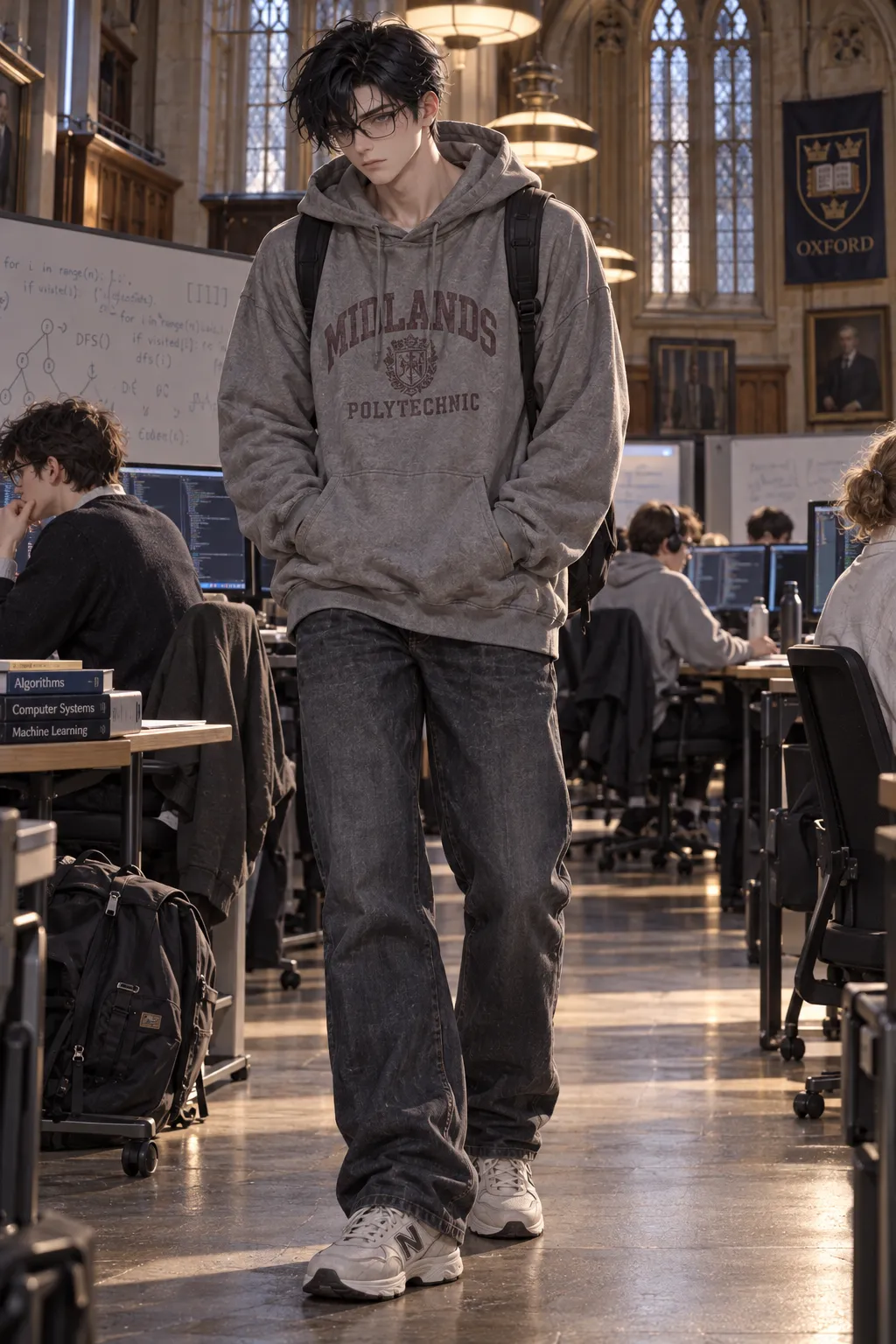
He came in at two minutes past two in a grey hoodie two sizes too big, with heavy black glasses and hair that looked as though it had been cut by a committee, and he slouched. It was an elaborate slouch, she thought, watching him: the shoulders rolled forward, the chin down, as though he was apologising to the ceiling for being so close to it. He said, ‘Hi. Sheet three. Put your hand up if you get stuck,’ in a voice that was low and quiet and carried perfectly to the back of the room, and then he walked up and down between the benches with his hands in his pockets and looked at screens.
Only at screens.
She noticed it after twenty minutes. Every other person in the room had looked at her at least once; most of them roughly every forty seconds, with the guilty sidelong flick of people trying to check the time on a clock behind her head. Hamish from Aberdeen, at the next computer, who had a mullet and a heart of gold, had looked at her so many times that he’d typed his variable name as eliana_rate by mistake and gone the colour of a tomato.
The demonstrator hadn’t looked at her once. When he passed her bench, his eyes went to her monitor, and stayed there, and moved on.
She told herself it didn’t matter. She told herself she was glad. She did, in fact, have a bug.
She put her hand up.
He came over. He stood at her shoulder and looked at her screen. A numerical integration of a first-order reaction, the concentration curve wandering off in the wrong direction.
‘Your loop stops one step short,’ he said. ‘Line six. range(n) gives you nought to n minus one. You want the last step too.’ He pointed at the screen without touching it. ‘So you’re integrating the reaction and stopping just before it finishes. Which is why your concentration never gets to where it should.’
Thom Building, 21 October. “Line six.”
His voice was exactly the same as it had been for Hamish four minutes earlier. Patient, clear, slightly dry. Not warmer. Not colder. Not careful in the way people were always careful with her, as if she might break or bite or be filmed.
He had not said her name. Everyone knew her name. He hadn’t used it, or looked at it on the sign-in sheet, or looked at her.
She sat very still.
The second one. The thought came up in her slowly, like a bubble through honey. He’s the second one. Out of eight billion people on Earth, two had looked at her as though she were simply a person with a problem to solve. One had wings of light. The other was standing at her shoulder in a hoodie that said MIDLANDS POLYTECHNIC in cracked letters.
Her feet were warm.
It was such an odd thing to notice that she almost didn’t. But they were: warm, inside the white boots she had worn every day for seven weeks, the boots she had told everyone were a gift from a designer friend. Warm in a way the rest of her wasn’t. She glanced automatically at the radiator under the window.
It was off. It was October, and the University’s Estates Services did not turn on the heating in the Thom Building until November, as a matter of principle, and the whole lab was cold enough that Hamish was typing in fingerless gloves.
Her feet were getting warmer.
Pilot, said ZERO, very quietly, inside his skull. Her footwear is at thirty-one degrees.
Aria kept his eyes on line six.
Thirty-two. Thirty-three. The residual ELS is responding to proximity. She has noticed. She looked at the radiator.
‘—so change it to range(n + 1),’ said Aria, ‘and that should converge.’ He straightened up. ‘I’ll be back in five minutes,’ he told the room in general, and walked out.
Eliana stared at the door.
Then she looked at the projector screen at the front of the room, where the practical’s title slide was still showing, and at the bottom of it, in small type: Demonstrator: A. Zadkiel (Computer Science).
Zadkiel.
She knew that name. She knew it from a book of her grandmother’s, from the long lists of angels that old Tzofiya used to read her at bedtime instead of fairy tales. Zadkiel. The archangel of mercy. The angel who stayed Abraham’s hand.
Her feet were cooling down.
She got up.
‘Excuse me,’ she said in the corridor, slightly louder than she meant to. He was twenty metres ahead, walking briskly towards the stairs. ‘Excuse me! Mr. Zadkiel—’
He walked faster.
She walked faster.
He broke into a jog.
She broke into a jog, which for a person whose Student Support Plan specified eight hundred metres on level ground was a serious commitment, and for the first fifteen metres she was actually gaining on him, because she was furious and because he had done it again, he had walked away from her, and she had questions, she had so many questions, and nobody, nobody had ever—
A door on her left opened, and a lab technician backed out of it pulling a wheeled lab bench.
The corner of the bench arrived at exactly the height of her hip.
There was a sound like a set of bagpipes being sat on. Eliana folded over the corner of the bench like a deckchair closing and stayed there, draped across it, with her cheek on the melamine and every particle of air gone out of her.
‘Oh God,’ said the technician. ‘Oh God, sorry, love, are you all right? Are you lost? The schools’ open day was last week—’
‘I’m,’ wheezed Eliana, into the bench, ‘eighteen.’
‘Course you are, petal. Deep breaths.’
At the far end of the corridor, the stairwell door was still swinging. There was no one in the stairwell. She had heard no footsteps on the stairs. It was as if he had simply stepped through the door and been somewhere else.
She lifted her head an inch off the lab bench and glared at the swinging door with her whole soul.
‘Ow,’ she said. ‘Ow.’ And then, with deep, involuntary, aggrieved respect: ‘…Damn, he’s fast.’
In the stairwell, two floors down and leaning against the wall with his eyes shut, Aria said: ‘Is she hurt?’
Bruised. Left iliac crest. Her dignity has sustained more damage than her pelvis.
‘Footwear?’
Cooling with distance. Correlation between your proximity and her boot temperature: zero point nine eight.
‘Has she noticed the correlation?’
She got four A-stars, said ZERO.
Aria put his head back against the cold wall and closed his eyes.
‘Mate,’ said Toby that evening, with the expression of a man watching a slow-motion car crash. ‘Let me get this straight. Eliana Tzofiya. The Nine-Second Girl. The most beautiful woman alive. Was in your lab. You were her demonstrator. You stood next to her and helped her with her code. And then you ran away.’
‘I didn’t run away. I had a thing.’
‘What thing?’
Aria thought about it.
‘A radiator thing,’ he said.
第三章
Chapter ThreePOV · AlexanderZurich · 23 October
The Accounting
On the Paradeplatz in Zurich there is a private bank founded in 1741 that has never once advertised, and in that bank there is a lift that goes below the vaults.
Alexander Stevansky had ridden it every October for fifteen years. Before that, his father had ridden it for sixteen. The lift had no buttons. It knew where you were going.
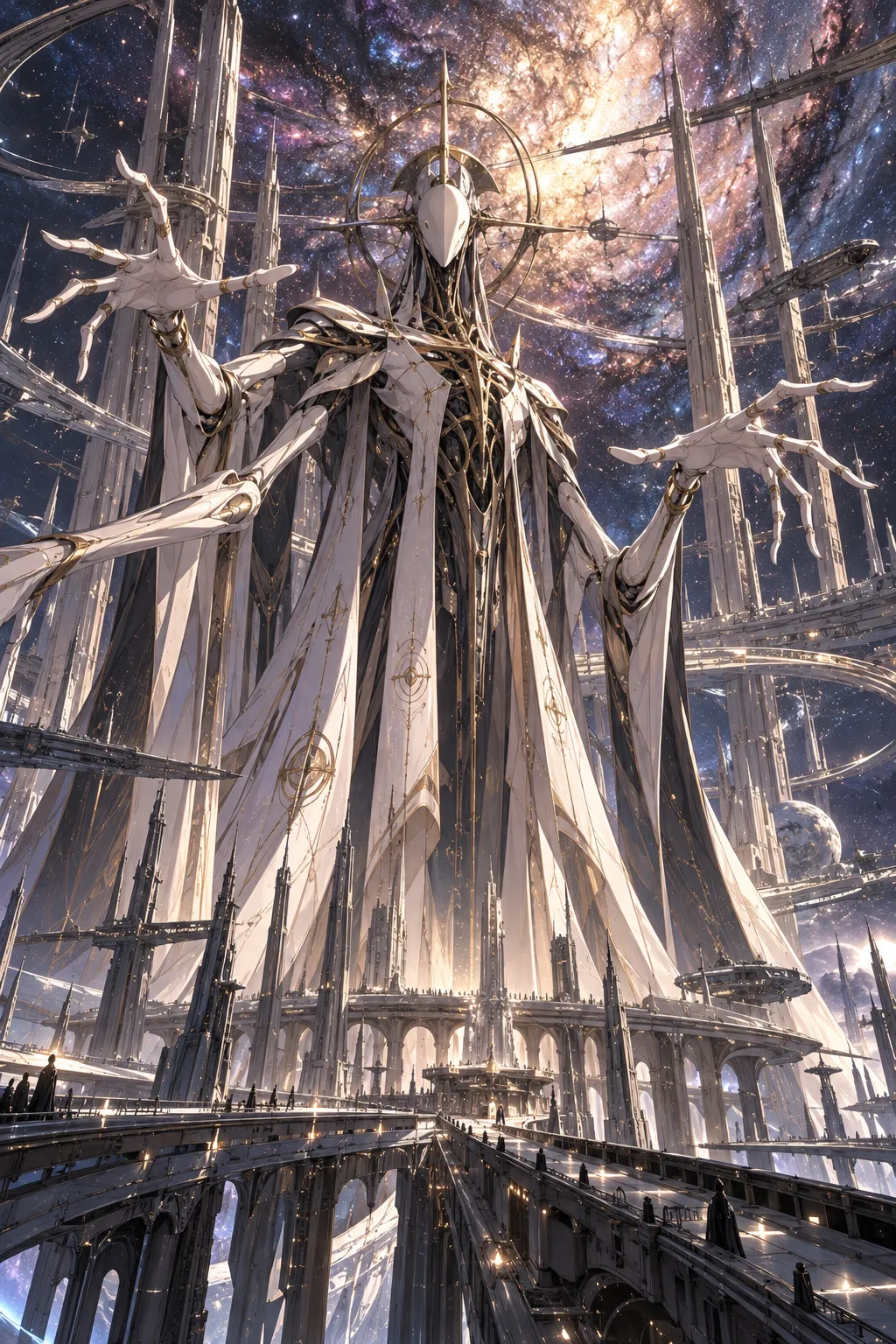
At the bottom was a room they called the Chapel: a long hall cut into the rock beneath the city, lit by lamps that burned with a faint green flame, with stone benches on either side like the pews of a church and, at the far end where an altar should have been, a glass tank three metres tall full of black water. Seawater. Drawn, they said, from the Calypso Deep, five thousand metres down in the Mediterranean, and carried here in sealed casks the way pilgrims once carried relics. It never needed changing. It never went stale. Sometimes, if you watched it long enough, it moved when nothing had moved it.
Once a year, the Children of Tehom came here to give account.
They wore masks. It made no difference. Alexander knew most of them by their hands and their shoes and their way of standing, because he had sat across from them in boardrooms and at dinners and on the covers of the Financial Times. Two bankers he had beaten in the market. A shipping magnate. A minister of something. A pair of arms dealers who wore matching cufflinks. A soft-spoken man with a signet ring whom Alexander had seen interviewed on Swiss television about ethical investment. Perhaps eighty people, every one of whom owed the Deep something, and had come to show that they were paying.
Alexander sat at the back, as he always did, without a mask, as he always did, because he had decided long ago that if he was going to sit in hell he would at least do it with his own face.
He had been twenty-three in 1993, in Moscow, when the men came to his father’s office.
There had been two sets of them that winter. The first set had pistols and wanted Isaak Stevansky’s brokerage, and Isaak’s life if it came to that, and it would have come to that by the end of the week. The second set wore grey suits and had no visible weapons at all, and they came the next day, and they offered everything. Passports for the whole family. A private aircraft to London. Forty million dollars of capital, at no interest, for as long as Isaak needed it. All they asked in return was a signature on a single page of a very old ledger.
Ledger of the Deep · folio 1993/44Moscow · 9 December 1993
The house of STEVANSKY, Isaak, receives of the Deep: passage, protection, and capital in the sum of forty million.
In return the house of Stevansky gives to the Deep its first daughter, in her eighteenth year, to be the Key.
Signed, I. Stevansky. Witnessed for the Children, O. V.
In the margin, in pencil, in a younger hand: “Papa, this is insane.” Below it, in Isaak’s hand: “There is no daughter, Sasha. Superstition costs nothing.”
Isaak had been a rationalist, a chess player, a man who believed in numbers and nothing else. He had laughed, and signed, and they had flown to London that same week. Alexander had been unmarried, with no children and no plans for any. The page had seemed like a joke someone else would one day find funny.
Then, in 2006, Kelly had put a tiny, furious, black-haired girl into his arms, and he had looked down into the most extraordinary face he had ever seen, and for the first time in thirteen years he had remembered the ledger.
He had told himself it was nothing. He had given her his mother’s name instead of his own, so that no one searching for Stevansky would find her. He had hired Dov. He had built walls.
And when she was thirteen, exactly as the Book foretold, his daughter stopped growing.
That was the year Alexander stopped telling himself it was nothing.
Tonight, a man was going into the water.
He was a Luxembourg banker named Weisz who had taken money from the Deep and tried to keep it. They brought him up the aisle between the benches in a white shirt, without his mask, and he was not struggling, which was the worst part; he walked as if he had already understood something the rest of them were still waiting to learn. Two attendants lifted him onto a step and lowered him into the black tank, and the water closed over his head, and he did not swim.
Eighty people watched. Alexander watched, because not watching was noticed.
For a while nothing happened. Then the water moved.
It moved the way the sea moves around something very large rising from beneath it, except that the tank was three metres deep and there was nothing in it but a man. A dark filament, thin as a hair and black as the gap between stars, rose out of the bottom of the tank and touched his wrist. Then another. Then a hundred, a thousand, a slow black blossoming of threads that wrapped him, gently, almost lovingly, like the roots of a plant finding water. Weisz’s eyes were open. He looked out through the glass at the congregation with an expression of enormous peace.
Then the threads drew back down into the dark, and took him with them, and the tank held nothing but black water again.
Nobody spoke. Somebody near the front was weeping quietly, with what sounded like joy.
Alexander sat with his hands on his knees and thought about his daughter eating a celeriac swan.
She found him afterwards, in the antechamber by the lift, where he was waiting with his coat over his arm.
‘Mr. Stevansky. Odile Vrai.’
He knew the voice before he turned. He had never heard it before, but Ellochka had described it to him in a clinic in Esso, and he had lain awake for seven weeks hearing it: cool, unhurried, with no accent at all, as though its owner had been born nowhere.
She was in her fifties, elegant, grey-eyed, in a dark coat with no jewellery. She looked like a museum director. She held out her hand. He did not take it.
‘You signed the witness line,’ he said. ‘In 1993. O. V.’
‘I was very young. Your father had lovely handwriting.’ She smiled. ‘She is eighteen, Alexander. The debt is due. Give us the Key, and Meridian keeps its name, its money, its future. Your wife keeps her show. You keep everything you have built. Refuse—’
‘I have paid you,’ said Alexander, ‘more than two billion dollars over thirty years. Take all of it. Take Meridian. Take the house. I will sign it over tonight.’
‘We don’t want money. We never wanted money.’ She said it kindly, as if explaining something to a child. ‘We gave your father money so that you would have something to lose. That was the only purpose of it. Haven’t you understood that yet?’
He had. He had understood it for years.
‘If you touch her,’ he said, very quietly, ‘I will burn your Deep to the waterline. I will spend every rouble, shekel and pound I have. I will find every one of those masks in there and I will take their companies and their houses and their children’s trust funds and I will leave them nothing but the clothes they drown in.’
‘I know you would try.’ Vrai buttoned her coat. ‘But you can’t protect her forever, Alexander. No one can. Every father learns that. One day she will turn round and ask you to stop.’ She paused at the lift doors. ‘They always do. And love,’ she said, ‘always says yes.’
In the car to the airport he made two phone calls.
The first was to Briggs in Oxford. ‘Double the detail,’ he said. ‘No, triple it. Twelve men. I don’t care what the college says. I don’t care what she says. Nobody comes within ten metres of her that we haven’t checked.’
The second was to a number in Tel Aviv that did not belong to Dov. He spoke in Hebrew, briefly. He gave a name and a description. He said: ‘Find out where she sleeps.’ Then he hung up and sat in the back of the car with his hand over his eyes.
It was the world he lived in. He had never once let his daughter see it. He had spent his whole life standing in the doorway between that world and hers, with his back to her and his arms spread wide, so that whatever came through would have to come through him first.
He would have done it forever.
He did not know that he had only three days left.
第四章
Chapter FourPOV · ElianaMerton · 24–25 October
Glass
By Thursday there were twelve of them.
They stood outside her lectures. They stood outside the lab. One stood outside the ladies’ loo on the first floor of the Thom Building with his hands folded, like a bouncer outside a very small nightclub, and three girls from her year went in, saw him, and came straight back out again. One of them, a lanky boy from Exeter College who had only wanted a selfie with the Nine-Second Girl, had his phone taken off him in Radcliffe Square and handed back with the photo deleted, and he cried. Actually cried, with two thousand people walking past, and Eliana stood behind a wall of dark coats and watched him cry and wanted to die.
She called her father. He didn’t pick up. He was flying. She called again. And at four o’clock that afternoon he arrived at Merton himself, in person, enormous in a camel overcoat, and found her in the Fellows’ Garden under the old mulberry tree, and they had the worst argument of their lives.
She would remember all of it. She would remember it word for word for a very long time.
‘I can’t breathe, Papa.’ She was shaking. ‘They follow me into the loo. They took a boy’s phone. Everyone already looks at me like I’m a doll in a glass case, and now there’s an actual glass case, and you built it, and I can’t—’
‘Ellochka, there are reasons—’
‘There are always reasons! There were reasons when I was nine and there were reasons when I was thirteen and there’ll be reasons when I’m forty! I’m not a child, Papa. Everyone treats me like a child and you treat me like a baby. You pick me up like I’m a doll. You carry me everywhere. I can’t walk a kilometre, I can’t go to the loo, I can’t have a friend—’
‘I only want—’
‘I know what you want! You want to keep me in a box! I want to be a person, Papa. I want to walk to my lectures without twelve men behind me. I want to be on my own, just once, like everyone else. I wish you would stop protecting me.’ It was coming out of her now in a flood, too fast to stop. ‘I wish I could stand on my own. I wish—’
She heard herself say it. She would hear it for the rest of her life.
‘I wish I didn’t need you.’
Her father’s face did something she had never seen it do. It didn’t get angry. It didn’t get hurt, exactly. It went very quiet and very still, like a man who has heard a sound a long way off that he has been dreading for years.
‘I understand,’ he said.
He put his hand on her head, very lightly, the way he used to when she was small. Then he turned and walked out of the Fellows’ Garden, and she stood under the mulberry tree and watched the camel overcoat go through the gate, and did not run after him.
She cried all night. Not because of the bodyguards. Because of his face.
She thought about it until three in the morning, with War and Peace open on her chest and not read.
She thought about how she had always leaned. On Papa, who lifted her off the ground every time he saw her, as though the ground were not quite good enough for her. On Eomma, who held her face in both hands and told her what to say to journalists. On Dov, who had stood between her and the world since she was nine. On Juno, who painted her face so the world could bear to look at it. Her whole life, people had been carrying her. She had been grateful. She had been loved. And somewhere in the middle of all that love, she had never once found out how much she could carry herself.
She thought about the two people who hadn’t carried her.
The angel had picked her up, yes; but he had set her down in Esso on her own feet, in her own new boots, and said let go, and she had let go. And the demonstrator in the grey hoodie had stood at her shoulder and told her what was wrong with line six and then let her fix it. Not fixed it for her. Let her.
Two people in the whole world had treated her like someone who could stand up on her own.
She wanted, more than she had ever wanted anything, to be that person.
She didn’t know yet that wishes are dangerous things. That the universe does sometimes listen. That it grants them the way a sea grants a swimmer’s wish to be alone: completely, and at once, and forever.
Her father called on Friday at noon.
‘Ellochka.’ His voice was gentle. It was his Sunday-morning voice, the one he used when he came into her room with tea. ‘Tomorrow. Saturday. Just us. Your mother, you, me. No security. Nobody. I’ll pick you up in the old Defender and we’ll drive to the Cotswolds like normal people, and walk up a hill, and eat your mother’s kimbap, and I’ll drop you back at Merton for dinner. Just a family. Just us.’
She couldn’t speak for a second.
‘Really? No one?’
‘No one.’
‘Papa, I’m sorry, I didn’t mean—’
‘I know you didn’t.’ She could hear him smiling. ‘Tomorrow. Nine o’clock. Wear something warm.’
She saved the voicemail he left an hour later, the one that just said Nine o’clock, Ellochka, don’t forget, I love you, though she had never saved a voicemail in her life. She didn’t know why. She would listen to it forty-one times before the end of November.
In Kensington, after he had put the phone down, Alexander Stevansky sat at his desk for a long time.
He had said yes. Of course he had said yes. She had stood under the mulberry tree and told him she couldn’t breathe, and there was nothing in him, nothing in his whole body, that could have said anything else.
But he was not a fool.
He made one more call, to a small, discreet firm called Halvard Risk that a friend at Lloyd’s had sworn by. One unmarked car, he told them. Two kilometres behind, all day. Never close enough to be seen. If anything, anything at all, looks wrong, you close the distance.
Halvard Risk said they understood perfectly.
Alexander had no way of knowing that Halvard Risk was owned, through four shell companies in three jurisdictions, by a foundation in Liechtenstein whose sole director was a woman with no accent.
Love always says yes.
第五章
Chapter FivePOV · AriaCrete · 26 October · 18:02 local
The Hellenic Arc
In the seven weeks since Kamchatka, the Seraph had ended two wars.
The first had lasted nine days, in a mountain valley in Central Asia, between two armies who had been shelling each other’s villages over a river that had changed course. For nine days, every shell either side fired stopped in the air above the river and fell into it, harmless, as silver dust. On the tenth day both armies ran out of shells, and their generals, having nothing left to shoot, were obliged to talk to each other.
The second had not quite started. Two destroyers, one flag each, had spent a week playing chicken in a disputed strait. On the eighth day, one of them woke up sitting on a sandbar four kilometres inland, perfectly level, perfectly undamaged, with its crew unharmed and its guns full of silver. Nobody had felt it move.
The newspapers ran out of adjectives. Governments ran out of patience. Three separate intelligence services had concluded, independently, that the Seraph was getting stronger.
They were right.
It had happened on the first of October, in the Nave, at two in the morning.
The armour requests integration, ZERO had said.
Aria had been elbow-deep in the left Minovsky emitter. ‘Requests what?’
Since Kamchatka the ELS has assimilated an attack helicopter, an armoured personnel carrier, approximately two tonnes of autocannon rounds and a nine-metre section of a surface-to-air missile. The DG cells have been evolving. The armour has reached a threshold. It no longer wishes to sleep in a band on your wrist. A pause. It wishes to live in you.
He had sat with that for a long time.
Kuramoto had warned him, years ago. One day it will grow up, Aria. Living things do. When it does, it will ask. And you will have to decide whether you are its pilot or its home.
He had said yes.
The band on his wrist went soft, and warm, and sank into his skin like a stone into still water. He had been feverish for three days. He had lain on the floor of the Nave with his teeth chattering, feeling it thread through him: into his blood, along his nerves, down into the marrow of his bones, a fine living lace of white metal encoding itself into every cell of his body the way a song encodes itself into memory. On the fourth day the fever broke, and he sat up, and the Pantheon came out of his skin.
Not poured. Came out. As if it had always been there underneath, and he had only now remembered how to let it show.
ZERO System · Stage II · Integration complete
Pilot–armour symbiosis 100%. Manifestation time 0.04 s. Dormant mass held in pilot tissue: 0 kg (encoded).
Full-scale manifestation available. Height up to 60 m. Mass required c. 2,300 t, drawn from environment and returned on reversion.
Accessible output: 10.4% of rated capacity. Remaining 89.6% gated by Psycho-Frame resonance.
Twin Satellite Buster Rifle, full-charge mode (“Colony class”): 40 s charge, projected yield sufficient to sever a small moon. Status: locked at current resonance.
‘Gated by what?’ he had asked.
By you. The frame gives what the pilot’s will asks for. You have never asked for more than ten percent.
‘I’ve never needed more than ten percent.’
Correct, said ZERO. You have never yet had a reason.
On Saturday the twenty-sixth of October, at two minutes past four in the afternoon British time, the floor of the Mediterranean broke.
The Hellenic Arc is a long curved fault that runs under the sea south of Crete, where Africa grinds slowly north into Europe. In the year 365 it broke along a hundred kilometres of its length, lifted the western end of Crete nine metres into the air, and sent a tsunami across the whole eastern Mediterranean. In Alexandria, the historians wrote, the sea drew back so far that ships lay on the bare sand and the townspeople walked out to gather fish. Then it came back.
Tsunami generated. First arrival south coast of Crete: 6 min. Libya: 31 min. Alexandria: 54 min. Projected fatalities without intervention: 61,000–190,000.
Anomaly: rupture initiated by pressure pulse from 5,180 m depth. Origin: not tectonic.
He was on Port Meadow when it came, walking back from the Perch with a library book under his arm. He stepped behind a hawthorn hedge, and the Pantheon came out of his skin, and there was a smell of ozone, and a fold of green light, and he was gone.
He arrived above the south coast of Crete at five minutes past six in the evening, local time, with the sun going down red over the Libyan Sea and the island screaming.
The ground was still moving. Whole hillsides were sliding into the sea in long brown avalanches. Villages along the cliffs were folding up like paper. Dust rose from everywhere at once, from the gorges and the towns and the cliff faces, in such quantities that the whole coast was drowning in cloud, and above the cloud the evening sky was enormous and clear and full of red light. And out on the sea, perhaps twenty kilometres off, something was coming toward the shore that looked, from above, like a long grey hill.
Twenty-two metres high. Forty kilometres wide.
Too big, he thought. Too big for a man-sized machine to hold back with its arms.
Full-scale manifestation recommended.
He had never done it. He had run it in simulation four hundred times. He had never once let the Pantheon be what Kuramoto had drawn on that last design board, with the words underneath: Pray it is never needed.
‘Do it,’ said Aria.
He came down onto the highest cliff above the coast, and put his feet on the rock, and grew.
The cliff went first. Silver ran out of the soles of his feet into the stone, and the stone turned to silver, and the silver came up into him, a whole headland of limestone flowing upward into white-gold armour as fast as water up a wick. He felt himself rising. Twenty metres. Forty. Sixty. His head came up out of the dust into the clear red evening, and his wings unfolded behind him, and they were not green any more.
He noticed that, distantly, the way you notice a change in your own voice. Since the integration, the light in the blades’ cores had shifted, away from GN green and towards a deep blue-violet, the colour of the sky an hour after sunset. ZERO called it a spectral artefact of Stage II. Rabbi Adler, he thought, would have called it something else.
Sixty metres of white and gold stood on the cliffs of Crete with the sun behind it, wings spread a hundred and forty metres across, crystal blades turning slowly in the dust like the feathers of something that had never needed to be born. A fisherman in a small boat off the village of Lentas looked up at it, crossed himself three times, and photographed it with a phone that had a cracked screen. That photograph would be on the front page of every newspaper on Earth by morning.
Aria spread his hands and pressed down.
The Psycho-Frame went into the earth.
He felt the fault. That was the strangest thing: through the frame he could feel it, a hundred kilometres of broken rock grinding under the sea like two halves of a cracked plate, and he took hold of the two halves with his will and pushed them back together, and held them there. The island stopped shaking. Not slowly. All at once, as if a hand had been laid flat on a trembling table.
Then the wave arrived.
He met it with the wings. The Wings of Light came off his back and went out across the sea, forty kilometres of blue-violet radiance laid flat along the water like a sheet of glass, and the wave hit the light and stopped. Twenty-two metres of grey water rose up against nothing and hung there, trembling. Then it folded over, slowly, the way a sheet folds when you shake it out, and fell back into the sea it had come from, and spread, and went flat.
On the cliffs below him, in the dust, people began to come out of the ruins of their houses and look up.
He held the fault for eleven minutes while it settled. And it was in the tenth minute, with the Psycho-Frame reaching down through the rock and the water, five kilometres down into the deepest trench of the Mediterranean, that he touched something that was not rock.
It was very large. That was the first thing.
He felt it the way you feel a ship pass under a small boat in the dark: not with your eyes, but with the whole of your body, a sense of sudden enormous mass moving below you where there should only have been water. It was lying along the floor of the trench. It went on and on. It curved.
ZERO System · contact
Biological signature. Depth 5,180 m. Length estimate 11.4 km. Coiled.
Substrate: metallic, self-organising. Similarity to our armour: 38%.
‘…What?’
It is made, said ZERO, and for the first time in Aria’s life its voice was not quite steady, in part, of what we are made of.
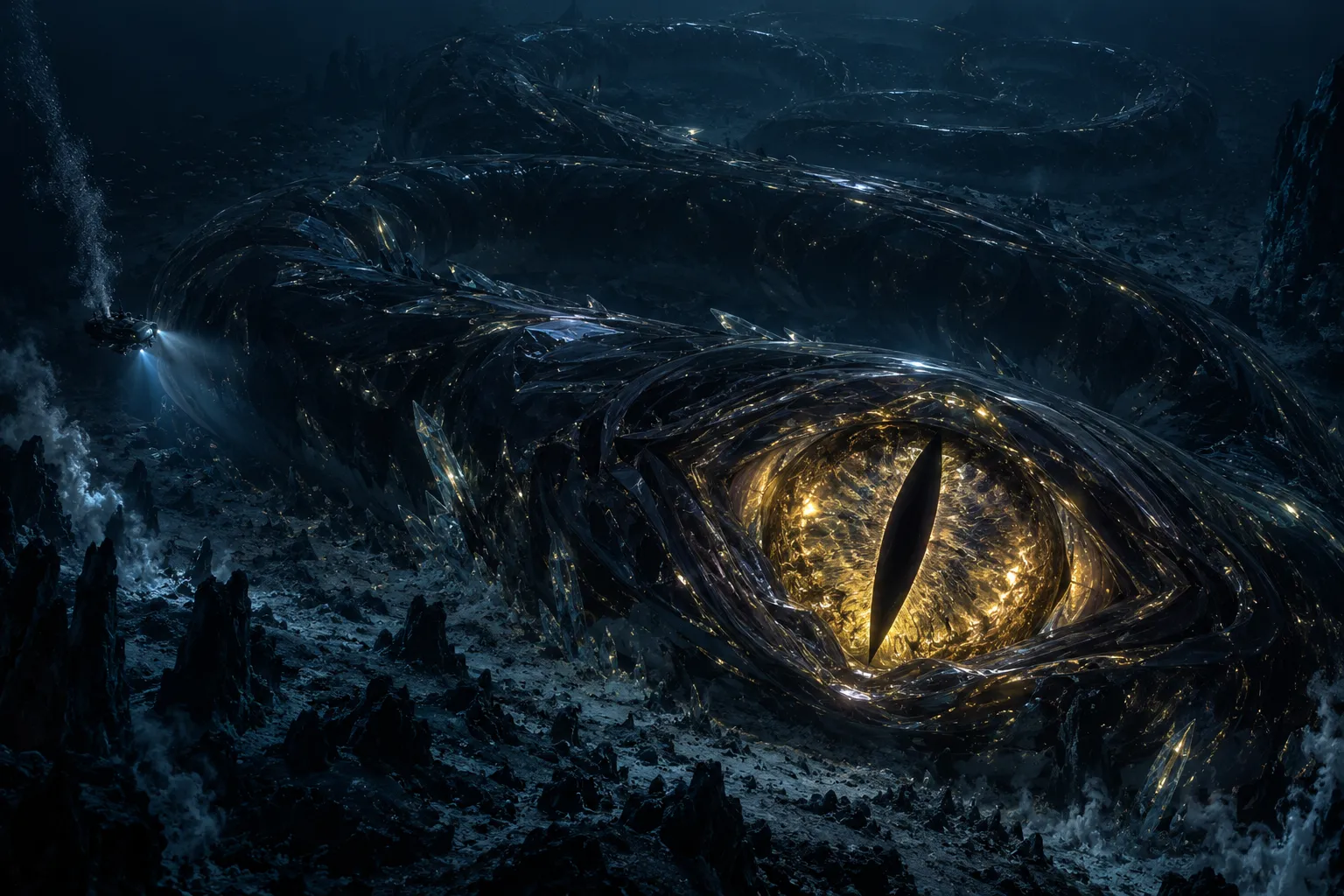
Five kilometres down, in the black, something opened an eye.
He felt it open. He could not have seen it, not through five kilometres of water and rock and dark, but the Psycho-Frame showed it to him anyway, the way it showed him the futures: an eye the size of a cathedral, gold, with a slit of absolute black down its centre. It did not move. It only looked up, through all that water, at the sixty-metre machine standing on the cliff.
Calypso Deep, 26 October. What the Psycho-Frame showed him.
It was not hungry. That was what frightened him most, afterwards. He had expected, if anything was ever down there, that it would be hungry.
It looked at him the way you look at someone across a crowded room and recognise them. Or recognise what they are wearing.
Then the eye closed, and the vast shape in the trench was still, and Aria stood on the cliffs of Crete with his hands pressed to the earth and found that his whole body was cold.
Rupture initiated by pressure pulse from that depth, ZERO said quietly. The fault did not break on its own, Aria. It was pushed.
Forty-one people had died in Heraklion in the first ninety seconds, before he arrived. He was fast. He was not everywhere at once. ZERO gave him the names, as it always did when he asked, and he made himself read every one.
At 17:21 British time, as he was preparing to leave, an aftershock hit the town of Sitia on the north-east coast, where three hundred people were sheltering in the church of Agia Aikaterini for Saturday vespers. The bell tower started to fall. He went, and held it, and held the church around it, for eleven minutes, until the last of the aftershock passed and the last child was out of the door.
Then he gave the mountain back. The Pantheon shrank, and the silver ran out of him into the cliffs, and the cliffs remade themselves from it, limestone and all, so that by morning the geologists who came to survey the coast would find a headland that was, strangely, in slightly better condition than it had been before the quake.
Quantum burst plotted: Oxfordshire, altitude 3,000 m. Stage II heat bloom requires 8 min subsonic flight to dissipate before landing.
At 17:34 he came out of the fold of light in the evening sky above Oxfordshire, three thousand metres up, with the last red light going out over the Cotswolds and the drives singing hot in his chest. He turned east and came down slowly through the dusk towards Wytham, low over the dark fields and the strings of headlights on the roads, letting the cold air take the heat off the armour.
He was very tired. He was thinking about an eye.
At 17:41, ZERO spoke.
ZERO System · alert 17:41:52 BST
Vehicle collision, A44, 2.3 km ahead. Articulated lorry and one private vehicle. Three occupants.
Vehicle: Land Rover Defender 110, 1994. Registered keeper: STEVANSKY, Alexander I.
第六章
Chapter SixPOV · ElianaThe Cotswolds · 26 October
The Road Home
It was the best day of her life. She would always be sure of that, afterwards. Whatever else she had to believe, she would never have to doubt that.
Her father pulled up outside Merton at nine o’clock exactly in the old Defender: a battered green Land Rover he had bought in 1994 with his very first bonus, which he refused to sell, refused to replace, and refused to let anyone else drive. It had no airbags and no electric windows. The heater worked when it felt like it. It smelled of thirty years of dogs that had died long ago and coffee that had been spilled in another century. Eliana loved it more than any car in the world.
She wasn’t wearing make-up. It was Juno’s day off, and she had stood in front of the mirror at half past seven with the brushes in her hand and thought: No. Not today. Today I am just a girl going out with her parents. So she had put on her white blouse and her white cardigan and her grey skirt and her white boots and a scarf of her mother’s, and walked out to the car with her bare face, and her father had looked at her and gone completely silent for a moment.
Then he had got out of the car and lifted her off the pavement, right there on Merton Street, with the porters watching, and held her up in the cold morning air and said, ‘There she is,’ as though he had been looking for her for a long time.
Her mother had made kimbap. Proper kimbap, the way Halmeoni made it: seaweed and rice and pickled radish, spinach and carrot and sesame tofu instead of the egg and ham, rolled tight and cut into coins, in a three-tier lacquered box. There was a flask of barley tea. Her father had brought a hamper from Fortnum’s full of things she couldn’t eat, and over the course of the day he ate every one of them himself, theatrically, describing each to her in loving detail until she threw a rice ball at him.
They drove out of Oxford with the heater roaring and the windows steaming up. Her mother sang. Kelly Kim had a beautiful voice, a professional voice, and she used it to sing old Korean ballads deliberately, exuberantly off-key, until Eliana was laughing so hard she had to hold her ribs. Her father retaliated with a Red Army marching song he had learned in school, in a bass that rattled the loose door panel, and her mother retaliated with ABBA, and by Woodstock they were all three singing Dancing Queen in three different keys and a lorry driver at the traffic lights was staring at them with his mouth open.
She read to them. That was a family thing; she had read aloud to her parents in cars since she was six. She read from War and Peace, from the place she’d got to: Prince Andrei lying wounded on the battlefield at Austerlitz, looking up at the high, endless grey sky and thinking how strange it was that he had never truly seen it before, and how everything, all the noise and glory and fighting, was nothing beside it.
‘Gloomy,’ said her father.
‘It’s beautiful, Papa.’
‘It’s Tolstoy. It’s the same thing.’
They walked up Broadway Hill to the tower at the top, a folly built two hundred years ago by someone with more money than purpose, from where you could see, on a clear day, sixteen counties. It took her a long time. She had to stop three times. Nobody carried her. Her father walked beside her the whole way at exactly her pace, with his hands in his pockets, not saying anything, and she understood that this was his apology, and that it had cost him more than any present he had ever given her.
At the top he lifted her up onto the low wall so she could see over it. Just that. It was the last time.
They ate the kimbap sitting on a tartan rug in the wind, and looked at sixteen counties, and her mother turned to her with the look Eliana knew too well, the look of a television presenter who had smelled a story.
‘So,’ said Kelly. ‘Tell me about the radiator boy.’
Eliana went pink. ‘He’s not a boy. He’s a demonstrator. And he’s not a radiator, that was—it’s complicated.’
‘He didn’t look at you.’
‘He didn’t look at me. Not once. He looked at my code.’
Her mother began to laugh. She laughed until she had to put down her kimbap and wipe her eyes. ‘Didn’t I tell you? On the balcony? Didn’t I say?’
‘You said.’
‘Is it infuriating?’
‘It’s so infuriating, Eomma.’
‘And you ran after him.’
‘…Into a lab bench.’
Her father, who had been pretending not to listen, sat up. ‘What’s his name?’ he said. ‘I’ll have him looked into.’
‘Papa!’
‘A father has a right to know who his daughter is running into lab benches for.’
‘Zadkiel,’ said Eliana, red to the ears. ‘His name is Zadkiel.’
Something happened to her father’s face.
It was very quick. If she hadn’t been looking straight at him, she would have missed it. He went still, the way he had in the Fellows’ Garden, and for a second he wasn’t on a hill in the Cotswolds at all. He was somewhere a long way away and a long time ago.
‘Zadkiel,’ he said slowly. ‘I knew a Zadkiel once. A long time ago. A physicist, in Geneva.’
‘Really? What was he like?’
‘He was…’ Her father looked out at the sixteen counties. ‘He was a good man. The only one in a room full of very bad ones. He told me once to take my family and run as far as I could.’
‘What happened to him?’
A pause.
‘He died,’ said Alexander Stevansky. Then he smiled at her, his ordinary enormous smile, as though he had put something down that he didn’t want her to see. ‘It’s a common enough name. Probably no relation.’
She would think about that pause for years.
‘Ellie.’ Her mother took her hand. ‘Promise me something.’
‘What?’
‘Talk to him. The radiator boy. Find out who he is. Don’t let him run away.’
‘Eomma—’
‘Promise me.’
Eliana looked at her mother, whose eyes were bright and whose hair was blowing across her face in the wind on top of Broadway Hill, and who was the most beautiful woman she had ever known, and said: ‘I promise.’
Broadway Hill, 26 October. “I promise.”
Later, she would understand that this was the last thing her mother ever asked of her.
On the way down the hill she said to her father, very quietly, so that her mother wouldn’t hear: ‘Papa. On Thursday. What I said. I didn’t mean it. I do need you. I’ll always need you.’
He stopped walking. He looked down at her.
‘When you were born,’ he said, ‘you fitted in one of my hands. Just one. I held you and I thought: I will carry this one until she doesn’t need me any more.’ He smiled. ‘And then I’ll carry her a little longer, because I’m selfish.’
She laughed, and cried, and did both at once, which in that family was considered a perfectly normal response.
They drove home at dusk.
The sky over the Cotswolds went from gold to rose to a deep clear violet, with one star out in the west. The heater had decided to work. Her mother had turned round in the front passenger seat to talk to her, one arm over the back of the seat, the way she used to on school runs when Eliana was small.
‘Ellie,’ she was saying, ‘when you do talk to him, don’t—’
Eliana never found out what she wasn’t supposed to do.
There was a bend on the A44 between the woods. A lorry came round it towards them, an articulated flatbed carrying long bundles of steel bars, scaffold tubes and reinforcing rods, chained down in a dark mass on the trailer. She saw its headlights swing. She saw the trailer begin, quite slowly, almost gracefully, to slide sideways across the road behind the cab, the whole long weight of it coming round like the arm of a clock.
She heard her father say one word in Russian, very calmly.
She felt the Defender swerve.
Then the world came apart.
Afterwards, there was a sound she could not place. A high, thin ringing, like a wet finger round the rim of a glass, going on and on.
It took her a long time to understand that the sound was coming from inside her own head.
She was sitting up. That was strange. She was sitting up, in the back seat, in the dark, and the car was not moving, and it was very cold, and the windows were gone, and through the place where the windscreen had been she could see the sky, deep violet, with the one star.
She tried to breathe.
Something was in the way.
She looked down. There was a steel bar in her chest. It came in through the shattered rear window behind her and went through the back of the seat and through her, on the right side, just below the collarbone and a little in from the shoulder, and came out of the front of her white blouse, dark and wet, and went on into the back of the seat in front, where it stopped. It was pinning her to the seat. It did not hurt yet. She looked at it with a sort of mild, distant interest, the way she would look at an odd result in the lab.
She opened her mouth to say something.
‘Uakh—’
Blood came out instead. Not a little. A hot, heavy rush of it, up from somewhere deep in her chest, filling her mouth and pouring out over her lip and her chin and down the front of the white blouse, the white cardigan, so much of it, far more than she would have believed a body could hold. She choked on it. She tried to cough it out and more came up, thick and metallic and warm, and she could not lean forward to let it out because the bar held her upright, and for a few terrible seconds she was drowning, sitting up, in the back of her father’s car.
She got a breath. A thin, bubbling, rattling breath, but a breath.
Then the pain arrived, all of it at once, and she understood.
‘Eomma,’ she said. It came out as a wet whisper. ‘Eomma—’
Her mother was still turned round in the front seat, one arm over its back, the way she had been when she said Ellie, when you do talk to him, don’t—. Her face was turned towards Eliana. Her eyes were open. There was a bar through the front of the car, too, through the windscreen and through the passenger seat, and Kelly Kim, who had once been the most beautiful face in the world, who had sung ABBA off-key on purpose an hour ago, was looking straight at her daughter with an expression of faint, loving surprise, and was not there.
Eliana reached for her.
She couldn’t move her legs. She tried, and nothing below her waist answered at all. The side of the car had folded in on her, and something in her pelvis had broken with a deep wrongness she could feel more than hurt, as if the bottom half of her body had been unplugged. So she reached with her arms instead, with the bar in her chest grinding as she moved, past the headrest, into the front, and found her mother’s hand on the back of the seat, and took it.
It was still warm.
‘Eomma.’
Nothing.
‘Papa?’
Something moved in her lap.
The driver’s seat had torn loose from its mountings and folded backward, and her father had come back with it, half between the front seats, half across her knees, so that his head and shoulders were lying in her lap. She hadn’t felt him there. She couldn’t feel anything there. She looked down and saw him, and his eyes were open, and he was looking up at her.
He was alive.
‘Papa,’ she said. ‘Papa, Papa, Papa—’
His breathing was wet. There was blood at the corner of his mouth and a great deal more somewhere she couldn’t see and didn’t want to. His face was grey. But his eyes found hers, and held them, and she saw him understand everything: the bar, the blood, her mother in the front seat. She saw him understand that the unmarked car he had paid to follow them was not coming. She saw him understand who had done this.
Slowly, so slowly, as if it weighed a thousand kilos, his right hand came up.
It found her head. It rested there, on her hair. It patted her, very gently, twice. The way he had when she was small. The way she had hated from strangers all her life and had never, ever, hated from him.
His hand slid down off her hair, and down the side of her face, leaving a warm smear, and came to rest on her shoulder. And stayed there. And the great weight of him in her lap, the weight she couldn’t feel, became somehow heavier, and she knew, the way you know a door has closed in another room, that Alexander Isaakovich Stevansky, the hardest man in global finance, who had carried her since she fitted in one of his hands, had put her down.
She held her mother’s hand in her left hand. She held her father’s hand, on her shoulder, with her right. She sat in the wreck in the violet dusk with the two of them, and she couldn’t scream, because there was no room in her lungs for a scream.
So her body screamed for her.
It came up from the bottom of her chest, the way the first rush had but worse, so much worse, a great black flood of it, and she could not lean forward and could not turn her head and could not stop it. Blood poured out of her mouth and her nose and down over her parents’ hands in hers, hot, choking, endless, and she was coughing and drowning and coughing, her whole small body convulsing against the bar that pinned it, and still it came, more than she had known there was in the world, until the violet sky went grey at the edges and then darker, and her hands, still holding theirs, went slack.
The last thing she saw, through the hole where the windscreen had been, was the sky. High and endless and quiet, like Prince Andrei’s sky at Austerlitz. With one star in it.
And then a second light. Blue-violet. Falling towards her very fast.
第七章
Chapter SevenPOV · AriaA44 · 17:42 BST
In for Four
He came down on the road so hard that the tarmac cracked in a ring around his feet.
The lorry lay across both carriageways, jackknifed, its cab in the ditch on the far side and its trailer twisted round. Half its load of steel was gone, scattered across the road like straws, and the other half was in the Defender. The old green Land Rover had been hit side-on and thrown back against the bank, and the bars had gone into it from the front and the side and the back, a dozen of them, through glass and steel and seats, so that the car looked like something a child had stuck full of pins.
ZERO was already talking. He had never heard it talk so fast.
ZERO System · triage 17:42:07
Occupant 1, driver: deceased. Occupant 2, front passenger: deceased.
Occupant 3, rear: alive. ELIANA SERAPHINA TZOFIYA. Penetrating thoracic trauma, right hemithorax, through-and-through. Bar 19 mm from pericardium. Right lung perforated. Bronchial and intercostal arteries lacerated. Airway flooding. Pelvic ring fracture.
Time to death if bar remains: 5–6 min (airway). If bar is withdrawn without control: 90 s (haemorrhage). Nearest ambulance: 14 min.
She was dying either way. It was simply a question of how.
He tore the back door off the Defender and looked in.
She was sitting upright in the back seat, held there by the bar. Her head had fallen forward. There was so much blood that for a moment he couldn’t understand what he was seeing: her white blouse and her white cardigan were black with it in the dusk, and it was all down her chin and her throat, and it was on her hands, which were still reaching forward, the left into the front of the car, the right resting on a man’s shoulder. The man was lying across her lap. His eyes were open. His hand had left a long smear down the side of her face.
Aria had seen death before. He had seen it in Kamchatka and Crete and in two valleys in Central Asia. He had read forty-one names that afternoon. He had stood in a cemetery in Geneva when he was ten.
He had never seen anything like this.
She wasn’t wearing make-up. He noticed that through the blood, and hated himself for noticing it, and could not stop. In Kamchatka her face had been muted, dulled, softened by a stranger’s brushes into something the world could bear to look at. Now there was nothing between him and it. Not even her eyes, which were closed.
ZERO, without being asked, opened a panel. It was very small. It was in the corner of his vision, as if ZERO itself was ashamed of it.
ZERO System
Facial harmonic index, revised: 0.999993. Previous measurements taken under cosmetic occlusion.
‘Not now,’ he said.
No, said ZERO, very quietly. Not now. And closed it at once.
It was the most beautiful face he had ever seen. And it was grey.
He moved her father first.
He did it as gently as anything he had ever done in his life. He lifted the big man off her lap, a hundred kilos of dead weight in a camel overcoat, and laid him down on the verge in the grass, and then went back for her mother and laid her down beside him, and closed both their eyes. It took eleven seconds. ZERO counted them aloud in his skull, and he let it, and did not hurry.
Then he knelt in the back of the Defender.
‘Bits,’ he said. ‘Cut it outside her. Don’t touch the part inside.’
Two blades slid out of his back into the wreck. They took the bar where it came through the rear window and where it went into the seat in front, and the steel turned to silver and ran away into them, and the bar was free: a short length of steel through a girl and a seat-back, and nothing holding it to the world.
Withdrawal plan ready. ELS will follow the bar in and seal each vessel as it is exposed. Thirty-one vessels. Rate of withdrawal: two millimetres per second. It will take nineteen seconds. A pause. She will feel all of it.
He put his left arm around her and lifted her, very slightly, off the seat, to take her weight. She was so light.
Her eyes opened.
For a moment she didn’t know where she was. He watched her not know. Then he watched her see the white armour, and the gold V of the crown, and the visor, very close to her face, and he watched her know.
‘…You,’ she whispered. It bubbled. ‘You came.’
‘I’m going to take it out,’ he said. ‘It’s going to hurt. I’m sorry.’
Something broke in her face when he said I’m sorry. He didn’t know why. He would find out much later, and when he did he would sit on the floor of the Nave for an hour without moving.
He took hold of the bar.
He drew it out.
Two millimetres per second. ELS running in along the steel as it came, a silver film finding each torn vessel and closing it, and he could feel every one through the frame, thirty-one of them, one by one, like stitches.
She screamed without any air to scream with. Her whole body went rigid and then convulsed against his arm, her back arching, her hands clawing at the white armour of his chest, and she was coughing, coughing blood, great racking coughs that brought it up in dark gouts over his chestplate and down his arm, and he held her and did not stop, because stopping would kill her, and the count in his skull went on, eleven seconds, twelve, thirteen, and she was looking at him the whole time with her eyes wide open and full of tears, and he heard himself say it. He didn’t decide to. It came out of him the way it had over Kamchatka.
‘Breathe. In for four. Come on. I’ve got you. You’re not falling. I’ve got you.’
Her eyes changed.
Through the agony and the blood and the dark, he saw her hear it. He saw her know the words. She had heard them eleven times above the Sredinny Range with her ear against his chest, and she knew them, and something in her held on to them like a hand.
She breathed in. A thin, wet, broken breath. Four.
The bar came free.
Withdrawal complete. Thirty-one of thirty-one sealed. Seal will hold approximately forty minutes. Airway partially cleared. She needs a theatre.
She coughed once more, a long, terrible cough that brought up the last of the blood in her airway in a dark rush over his arm. Then her eyes rolled up, and her head fell against his chest, and she was gone again, limp, light as a coat.
Still breathing. He could feel it through the armour. Thin and fast and wet. But breathing.
He gathered her up, the way he had in Kamchatka. Arms around her, lifting her against his chest, her head on his shoulder. Her boots, the small white boots he had made her out of a helicopter, knocked gently against his thigh.
They were very warm.
The John Radcliffe Hospital in Headington has a helipad on the roof of its trauma building. At 17:46 on the twenty-sixth of October, a white figure with blue-violet wings came down on it out of the dark without a sound, and walked through the doors of the major trauma centre carrying a girl covered in blood, and said to the first person in a white coat it saw:
‘Penetrating chest trauma, right side, through and through. Nineteen millimetres from the pericardium. Thirty-one vessels sealed in the field. The seal will hold about forty minutes. Pelvic fracture. Don’t wait.’
The person in the white coat was a thoracic surgeon named Adaeze Okafor, who had been a trauma surgeon for twenty-two years and was not, as a rule, impressed by anything. She looked up at the visor. She looked at the girl. She said, ‘Who on earth are you?’ while already turning to shout for a trolley.
When she turned back, there was nobody there. Only the girl, on the trolley, and a smell of ozone, and a faint lingering of blue light in the air, fading.
He went back to the road.
The ambulances had arrived, and the police, and a fire crew, and the blue lights were going round and round over the wreck and the scattered steel and the two shapes on the verge under foil blankets. Nobody saw him. He stood above them in the dark at four hundred metres, wings folded, and let ZERO look.
The lorry driver, it said.
He was in the cab, in the ditch, slumped over the wheel. He had not been injured in the crash at all.
ZERO System · forensic
Driver: male, c. 50. Core temperature at ambient. Rigor resolved. Lividity fixed. Estimated time of death: 68–72 hours before collision.
Foreign object wired to steering column and brake controller: self-organising metallic substrate. Similarity to our armour 11%. Match: Kamchatka unit. AZAZEL.
The lorry was driven by a man who had been dead since Thursday.
Aria hung in the dark above the blue lights for a long time.
‘Zero,’ he said at last. ‘Crete.’
Yes.
‘If we had left when the tsunami was stabilised. Before Sitia.’
A long pause. Long for ZERO. Long enough that he knew the answer before it came.
We would have arrived here four minutes before the collision.
‘And the church at Sitia.’
Three hundred and two people. Probability of bell-tower collapse without intervention: 96%.
Three hundred and two. Against three.
It was the right choice. It was obviously, mathematically, unarguably the right choice. Any member of the Choir would have made it. His father would have made it. Every metric the most powerful combat computer ever built could bring to bear said that it was the right choice.
None of that mattered at all.
There is something else. ZERO’s voice was very careful. The rupture on the Hellenic Arc began ninety-nine minutes before this collision, from a pressure pulse that was not tectonic. Correlation with this event is not proof. But probability that the earthquake was induced to draw us away from Oxfordshire this evening: seventy-one percent.
‘Someone made me choose.’
Someone knew that you would choose the three hundred. A pause. Someone knew you very well.
It began to rain. A thin, cold, English rain, falling through the blue lights onto the road, onto the steel, onto the white armour of the thing that hung above it all in the dark. It ran down the visor. It ran down the chestplate. It washed away a little of her blood and left the rest.
Aria Zadkiel had spent ten years not looking at things. He had made it into a discipline, an art, a kind of armour of its own: the girl who re-tied her hair, the girl who sketched his jaw, the most beautiful face in the world filed away beside the population of Belgium. Everyone you hold is a door. So he did not look, and he did not hold, and nothing came through.
He looked now.
He looked down at the wreck in the rain and made himself see it. The green Land Rover full of steel. The two shapes under foil on the verge. The back seat, where she had sat holding both their hands. He looked at it for a long time, and something in him that had been shut since a wet afternoon in Geneva opened, and he did not know how to shut it again.
He had not held her.
And the world had come through anyway.
第八章
Chapter EightPOV · ElianaOxford · November 2024
Probate
She was in intensive care for eleven days and in hospital for twenty-six.
She remembered very little of the first week. A ceiling. A tube in her throat. Her grandmother’s hand, small and dry and strong, holding hers. Halmeoni had flown in from Seoul at eighty years old, alone, and slept for six nights in a plastic chair beside the bed, and spoken to her in Korean the whole time, steadily, the way you keep talking to someone on a narrow ledge.
Her father was buried on the Tuesday, at the Jewish cemetery in Bushey, as quickly as the law allows, as he would have wanted. She watched it on a tablet held up by a nurse, with a tube down her throat, unable to speak. She watched them lower him. She watched the men take turns with the spade, the old way, each one turning the shovel upside down for the first scoop to show how unwilling they were. She watched until the nurse gently took the tablet away.
Dov tried to come. He discharged himself from the hospital in Tel Aviv against every medical opinion in Israel, got as far as the departure gate at Ben Gurion, and collapsed there, and was readmitted with his wound reopened. He called her every night at nine. She didn’t answer. She couldn’t. She didn’t know how to hear his voice.
Ms. Okafor came to see her on the twelfth day, when the tube was out and she could talk.
The surgeon sat on the edge of the bed, which consultants are not supposed to do, and told her the truth, which consultants sometimes aren’t either.
The bar had missed her heart by nineteen millimetres. It had gone through the upper part of her right lung and torn the small arteries that feed the airways, the bronchial arteries, and those arteries had been badly damaged, and some had been repaired and some had been closed off for good, and what was left would never be quite right.
‘What does that mean?’ Eliana asked. Her voice was a ruined whisper.
‘It means the vessels in your right lung are fragile. They’ll stay fragile.’ Ms. Okafor did not look away. ‘When you’re very tired, or very stressed, or you push your body too hard, they may bleed. You may cough up blood. Sometimes a little. Sometimes a lot. If it’s a lot, and you’re lying flat, it can block your airway. So you’ll sleep propped up. You’ll carry tranexamic acid. You’ll have a plan, and the people around you will know the plan.’
The people around you.
‘For how long?’
‘I’m sorry,’ said Ms. Okafor. ‘For good.’
The pelvis would heal. It had been plated and pinned; she would walk again, eventually, with a great deal of physiotherapy and a great deal of pain. For now there was a wheelchair.
‘One more thing.’ The surgeon hesitated. ‘Whoever sealed those vessels at the roadside. I’ve been doing this a long time. I have never seen anything like it. Every one of them closed. Perfectly. Like stitching done under a microscope. And when we opened you up, whatever material it was had gone. Dissolved, or absorbed, or—’ She shook her head. ‘Without it you’d have bled out in ninety seconds. I don’t know who he is. But you’re alive because of him.’
Eliana looked at the ceiling.
In for four.
‘I know,’ she whispered.
Her mother’s funeral was on the first Saturday in November, at the Korean church in New Malden where Kelly Kim had been baptised. They let Eliana out for the day in a wheelchair, with a nurse, an oxygen cylinder and a written plan.
She got through the service. She got through the hymns, in Korean, which her mother had sung beautifully and deliberately off-key. She got through the eulogies, four of them, from a television executive and a famous designer and a woman from Seoul who had modelled with Kelly in 1999 and a weeping man who turned out to be Geoff Pemberton, Camera Two, who said that in thirty-one years of television Kelly had been the only presenter who ever learned his children’s names.
She got through all of it. It was at the graveside that her body stopped asking her permission.
They were lowering the coffin. It was white, with white flowers on it, and the November wind was blowing her mother’s scarf, the one she had been wearing that day, against Eliana’s cheek, and she was thinking, very clearly and calmly, Ellie, when you do talk to him, don’t— and that she would never know the end of the sentence. Never. Not if she lived to be a hundred.
Something tore in her chest.
She coughed. Once. And blood came up, bright and sudden, over her lips and onto her black coat. Then she coughed again, and it came harder, and she couldn’t stop. It came in waves, rising up her throat faster than she could cough it out, filling her mouth, choking her. She bent forward in the wheelchair, drowning in it, and it spattered onto the grass and onto the white flowers at the edge of the grave, and she could hear people screaming, and the nurse shouting her name, and she couldn’t breathe, she couldn’t breathe, she couldn’t—
Halmeoni was there. Eighty years old and less than five feet tall, kneeling in the wet grass in her good black hanbok with her arms round her granddaughter, holding her forward so the blood could come out instead of going down, talking to her in Korean, quietly and steadily, as though they were in a kitchen in Seoul and nothing in the world was wrong.
Breathe, my puppy. Breathe. Halmeoni’s got you. Breathe.
It took four minutes. The paramedics said afterwards that it was a mild episode.
They took her back to the John Radcliffe before the grave was filled in. She did not see her mother buried.
In the third week, the letters began to arrive.
Stevansky Meridian Capital had an interim chairman now, appointed by the board in an emergency session two days after the crash: a soft-spoken Swiss named Dr. Anselm Kreutz, who wore a signet ring and had once been interviewed on Swiss television about ethical investment. The estate, the letters explained, was subject to probate. The probate would be complex. It would take, the lawyers estimated, between eighteen months and three years. In the meantime the trustees had a fiduciary duty to preserve the assets.
The house in Kensington was sealed for inventory. She was not permitted to live in it.
The security contracts, all of them, Briggs and the Convoy and the drone and the cars, were terminated pending review. As a cost-control measure.
Dov’s contract was terminated too.
And she discovered the last thing on her first day back in Oxford, at the Boots on Cornmarket, in her wheelchair, trying to pay for her prescription. Her black card, the titanium Centurion with her name on it in raised capitals, was declined.
She tried it again. Declined.
She didn’t understand. Then she did. It had never been her card. It was an additional card on her father’s account, and her father was dead, and when the account holder dies, the account is frozen, and every card on it stops. The card that had funded a hospital wing. The card she had used five times in her life and been ashamed of every time. It would not pay for nine pounds and ninety pence of tranexamic acid.
She had no cash. She had never in her life carried cash. She sat in her wheelchair at the counter in Boots with a queue forming behind her, and the pharmacist looking at her with a terrible, gentle pity, and she felt her chest begin to tighten in the way she now knew meant blood.
‘I’ve got it,’ said someone behind her.
A card touched the reader. It beeped. The pharmacist handed her the paper bag.
She twisted round in the chair. All she saw was a grey hoodie going out through the door into Cornmarket, two sizes too big, with cracked letters across the back. He didn’t look round. He didn’t look at her at all.
Her boots were warm.
She put her hands on the wheels of the chair and pushed. She got it two metres. Then the queue was in the way, and the doorway was narrow, and her arms were too weak, and by the time a kind woman had helped her out onto Cornmarket there were only hundreds of people walking up and down in the November afternoon, and none of them were him.
She couldn’t run after him. She couldn’t even stand up.
She sat on Cornmarket in her wheelchair with the paper bag in her lap and looked down at her boots for a long time. They were cooling now. Slowly. With distance.
She was the girl with four A-stars. She knew what a correlation was.
She did not let herself finish the thought. It was impossible. It was the kind of thought that a person who had just lost everything might invent, to give herself something to hold.
She put it in her pocket anyway, next to the other one. Two smooth stones.
She went back to Merton because she refused to go anywhere else.
The college gave her a ground-floor room in the Fellows’ Quad, with a ramp. Halmeoni had to go back to Seoul; she had a heart condition of her own, and the doctors would not let her stay another week. Juno was in Paris and kept calling. Dov kept calling. Eliana didn’t answer anyone. She sat by the window in her wheelchair with War and Peace on her knees, propped up as she had been told, with a steel tin of tablets and a written plan on the desk beside her, and the plan said the people around you will know the plan, and there was nobody around her at all.
No Papa to lift her off the ground. No Eomma to hold her face in both hands. No Dov on the stairs. No Convoy. No drone. No black card. No house. No one following her into the loo or deleting a boy’s photos or standing at the end of the corridor with his hands folded, watching the world for her so that she didn’t have to.
I wish you would stop protecting me.
I wish I could stand on my own.
I wish I didn’t need you.
She had been given every single thing she had wished for. Every one. Completely, and at once, and forever.
She laughed. She couldn’t help it. It came up out of her chest the way the blood did, without asking, a small cracked terrible laugh in the dark room, at a universe that had a sense of humour and no mercy at all.
The laugh turned into a cough. The cough turned red. She held a handkerchief to her mouth, one of her father’s, with his initials on it, and waited for it to stop, alone, and counted, the way she had been taught. In for four.
Then she took out her phone and played the voicemail. Nine o’clock, Ellochka, don’t forget, I love you.
She played it again.
And again.
Outside on Merton Street, at a quarter to midnight, under the lamppost by the cobbles, a tall young man in a grey hoodie stood in the rain with his hands in his pockets and looked up at the one lit window on the ground floor of the Fellows’ Quad.
You are looking at her window, said ZERO.
He didn’t answer.
For the record, it has been forty-one minutes.
He had a rule. He had kept it for ten years. Everyone you hold is a door the world can come through to hurt you. So you hold no one, and you look at no one, and nothing comes through.
He had not held her. He had not looked at her. And the world had come through anyway, and taken everything she had, and left her in a ground-floor room with a ramp, coughing blood into her dead father’s handkerchief.
The rule had not protected her. It had only protected him.
He stood under the lamppost in the rain, the only one who had never looked at her, and looked.
終章
EpiloguePOV · ElsewhereZurich · deep space · the Nave
Indeterminate
In the Chapel beneath the Paradeplatz, the black water in the tank was moving again. Gently. The way the sea moves when something very large has turned over in its sleep and is settling back down.
‘Report,’ said the Patriarch.
He was an old man. He was always an old man; nobody in the Chapel could remember him being anything else. He sat at the head of the long table of black glass in the dim green light with his hands folded, and listened to Odile Vrai the way a grandfather listens to a favourite grandchild recite a poem.
‘The Halvard car turned left at Chipping Norton,’ said Vrai, ‘as instructed. Brother Matthias drove the lorry. He has been with the Deep since Thursday; the Coil’s thread drove for him. We rang the bell on the Hellenic Arc at four o’clock, and the Deep turned over, as the Book said it would, and the angel went to Crete to hold it.’ A small pause. ‘He came back faster than we predicted. He stayed for a church. We had counted on the church.’
‘And Stevansky?’
‘Dead. And his wife.’
‘And the Key?’
‘Alive.’ Vrai’s mouth thinned very slightly. ‘The bars were not supposed to reach the rear seat. She will carry the wound for the rest of her life.’
‘Good,’ said the Patriarch.
Vrai looked up.
‘A wound is a door,’ said the old man gently. ‘You know that, Odile. Better than anyone.’
‘The angel saved her,’ said Vrai. ‘He pulled the bar out with his own hands. He flew her to the hospital. Without him, she would have died in that car.’
‘Yes.’ The Patriarch smiled. ‘He saved her for us. Wasn’t that kind of him?’
On the black glass of the table, the cracked-screen photograph from the fishing boat off Lentas was glowing: sixty metres of white and gold on the cliffs of Crete, wings spread against the sunset.
‘She has no father now,’ said the Patriarch. ‘No mother. No money. No guards. Nobody stands in the doorway any more. Let her be alone for a while. Grief hollows a vessel out. When she is empty enough, Odile, you will go to her, and you will be very kind, and you will offer to fill her.’ He tapped the glass. ‘Offer to heal the lung. She will not be able to refuse. The Book is very clear. The Key must open by its own hand.’
‘And the angel?’
The old man looked at the photograph for a long time.
‘When he held the fault,’ he said, ‘he reached all the way down. Did you know that? He touched it. And the Deep opened its eye and looked up at him, and saw what he is made of.’ He leaned forward, into the light. ‘It was pleased, Odile. For the first time in three thousand years, the Deep was pleased.’
Nine thousand light years from Earth, in a ship the size of a continent that had been travelling since before the first stone of the first pyramid was laid, the song changed key.
The First Who Believed heard it in their sleep.
They were not serpents. They had never been serpents. They were tall, pale, many-jointed things, with long hands and faces like smooth porcelain masks, without eyes, because they had stopped needing eyes ten thousand years ago when they learned to hear the Coil instead. They had found the first of the great Coils drifting between the stars when their own world was young, and listened to it, and loved it, and it had taught them that the universe was a single vast throat, and that every galaxy would one day turn about the Coil like water about a drain, and that they, its First, were chosen to help it swallow.
They had sung four hundred and eleven worlds into silence.
‘The Coil on the blue world has woken,’ said the one at the heart of the ship, whom the others called the Cantor. Its voice was not a voice. It was a chord. ‘It has seen something.’
‘What has it seen?’
‘A machine. Standing over the Deep with wings. Made of the Coil’s own flesh.’
There was a silence in the great ship, a silence like a held breath.
‘Then the blue world has thieves,’ said the Cantor at last, and the chord of its voice rang with something that in a human would have been joy. ‘Good. A world with thieves is a world that will fight. And a world that fights tastes sweeter in the swallowing.’ Its long hands spread. ‘Wake the fleet. The blue world will be the four hundred and twelfth.’
Nine thousand light years out. The one the others called the Cantor.
In the Nave, beneath the chapel in Wytham Woods, at three in the morning, a drawer in the Cradle’s console had been blinking amber for twenty-six days.
STAGE II REACHED · KURAMOTO ARCHIVE UNLOCKED
Aria had known it was there since the day the fever broke. Kuramoto had keyed it to open only when the armour came to live inside him. He had not been able to make himself open it. Tonight, soaked from standing under a lamppost on Merton Street, he did.
There was a letter in it, in Kuramoto’s small square handwriting, which he would read later, many times. And underneath the letter there was a notebook.
He knew it before he touched it. A black Moleskine, swollen with damp, scorched at one corner. His father’s. The last one. He had thought it had burned in Geneva with everything else.
He opened it at the last page.
His father had drawn a serpent. Not a careful drawing, a fast one, in blue ink, pressed so hard the nib had torn the paper: something long and coiled, wrapped round and round a circle that might have been a planet. And beneath it, in Gabriel Zadkiel’s quick, slanting hand, the hand Aria had learned to read before he learned to read print:
G. Zadkiel · notebook 31 · final pageUndated · March 2014
The Book calls her the Key. Born 2006, London. The Stevansky girl.
When she is thirteen she will be made still. When she is eighteen they will come for her. They will take everyone she loves first, so that she has nothing left to hold on to but them.
Hideo, if I am gone, someone has to stand between her and the Deep.
Underlined twice, at the bottom of the page: TZOFIYA.
Aria sat on the floor of the Nave with the notebook open in his lap, very still, for a long time.
Above him, on the wall beside the lift, seven faces in crooked photographs looked down at him. Behind him, the VEDA core breathed frost behind its armoured glass. Inside him, in his blood and his nerves and the marrow of his bones, something white and living and patient stirred, and waited, the way it had been waiting all his life, for him to ask it for more.
ZERO System · nightly diagnostic
Strategic feasibility projection: probability of successful global hegemony, should the pilot so desire, 99.97%.
Pilot desire: indeterminate.
‘Keep it null,’ said Aria.
A pause.
That is no longer accurate, said ZERO.
Extras · recovered from the Nave
The Choir Archive
Odile Vrai
Hand of Azazel · witness, folio 1993/44
Age
Early fifties
Accent
None. Removed at nineteen, deliberately.
Known for
The voice on Volkhov’s phone. The match in Geneva. Halvard Risk.
Believes
That liking someone is no reason to let them stand between the Children and the stars.
The Children of Tehom
Keepers of the Deep · est. before records
Worship
The Coil: an 11.4 km living entity in the Calypso Deep. Not a god. A beacon.
Await
The First Who Believed: an alien species that has “sung” 411 worlds into silence.
Arm
AZAZEL (weapons, Grigori frames, Halvard Risk)
Want
The Key, given by her own hand.
System-Ω “Pantheon” · Stage II record
Capability
Status
Note
Integration
ELS/DG armour encoded into pilot tissue; manifests from skin in 0.04 s
1 Oct 2024
Full-scale manifestation
Up to 60 m; ~2,300 t borrowed from environment, returned on reversion
First use: Crete
Particle spectrum
Shifted from GN green to blue-violet
“Spectral artefact”
Psycho-Frame reach
Held a 100 km fault; touched an entity at 5,180 m
It looked back
Accessible output
10.4% of rated capacity
Gated by pilot will
Buster Rifle, Colony class
40 s charge; yield sufficient to sever a small moon