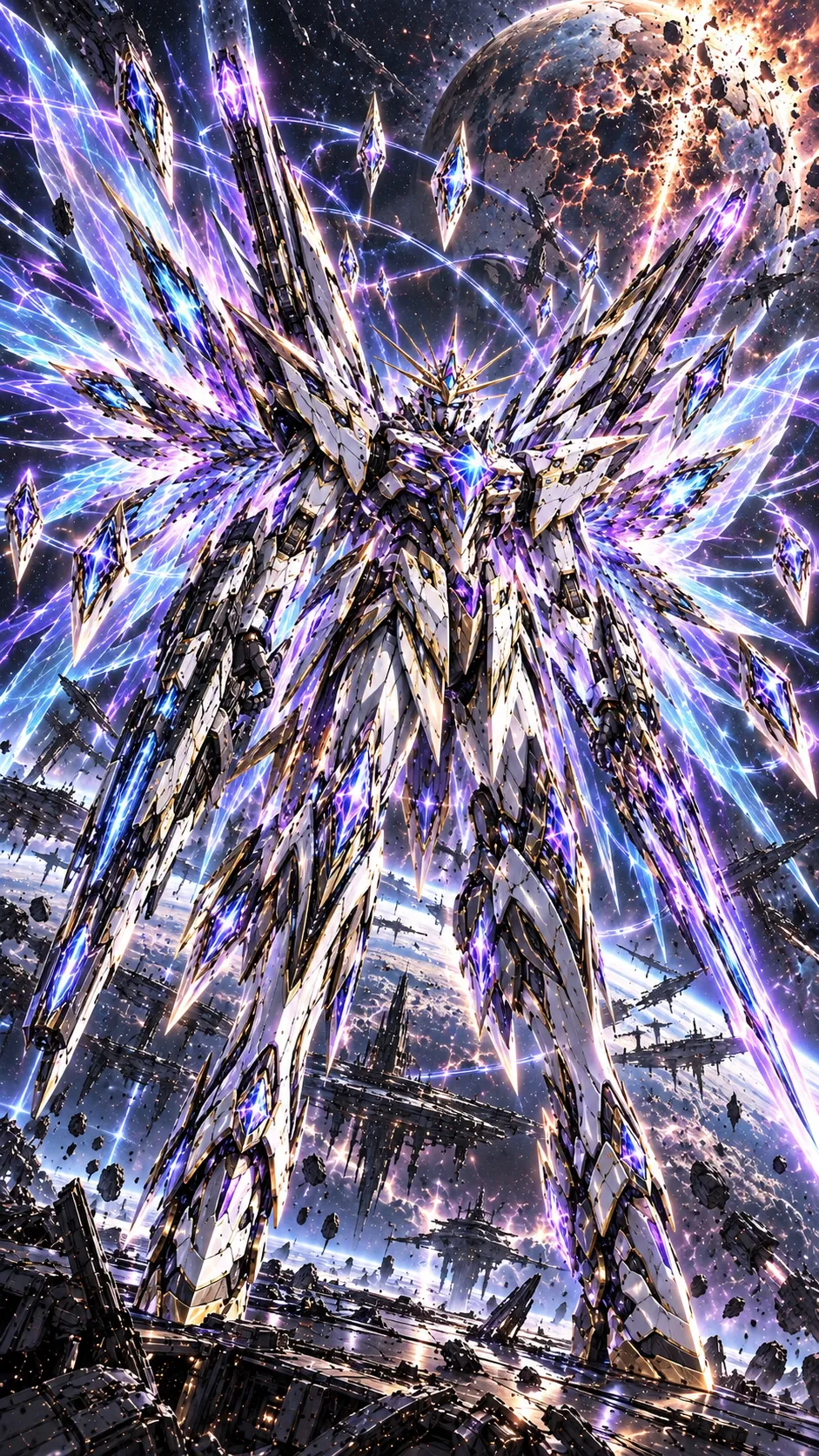
It came at him with its mouth open.
The head came round out of the sea and the wedge split down the middle and the throat opened, a kilometre of black ribbed glass going back into the dark, and it came across the water at him with the sea piling up in front of it in a white wall, and he did the only thing he could think of. He put out both hands and caught it by the jaws.
The upper in his right. The lower in his left. Three thousand metres of white and gold, hanging in the Ionian Sea to the waist, holding the mouth of the Coil open with his arms spread wide like a man holding apart a pair of doors that want very much to close.
The fishermen at Navarino would paint it, afterwards, on the walls of the harbour café. They would get the wings wrong.
The jaws closed on him. He felt them come. He felt the black glass grind into the palms of his hands and up his forearms, and the shards along the edge of the jaw, each one the size of a church, go into the plates of his wrists like teeth, and the plates where they went in begin to slide; and the throat, a hundred metres in front of his face, breathed in. Not air. Him. The pull came out of it the way the wind comes out of a tunnel when a train is coming, and every grain of borrowed basalt in him that had become living metal in the last minute heard it and leaned.
ZERO System · 13:53:11 EET
Resonance 44%. The rock we borrowed has become us. Now it hears the song too.
Its jaws: closing at 0.4 m per second against us. Our arms: holding. For now.
‘Wings.’
Four hundred blades came off his back at once.
At this scale they were not bits. Each of them was the length of a frigate and blazing blue-violet from its core, and they went off him in two great fans, round, and into the side of the Coil’s head from two directions, and through, and out. He felt them go through the black glass. He felt them come back refused, one by one, the way his blades had come back off the scale of the Grigori on Port Meadow, a long glittering stream of them returning to his wings with nothing on them; and where they had gone through, the black glass flowed, and closed. But for one second, while they were inside it, the jaws stopped.
He let go of the upper jaw and hit the eye.
He hit it with his right fist, three kilometres of borrowed basalt and five million years of stolen Heart, with the Psycho-Frame blazing gold from his heels to his crown; and the gold eye, the size of a college, took the fist full on the slit of its pupil.
It flinched.
Eleven kilometres of it. All of it. Every coil, from the head to the far end on the horizon, jerked in the sea at once like a whip being cracked, and the sea went up all along it in a single white line eleven kilometres long; and the head went back, and the jaws let go, and he was free.
He went backwards through the water and up, out of it, into the air, two kilometres, with the sea pouring off him, and hung there. His hands were black to the elbows. He could not feel his fingers.
It felt that, said ZERO. It can feel. I did not know if it could.
‘Good,’ said Aria.
On a kitchen chair in a lighthouse yard on Sapientza, forty metres above the sea, Toby Fairweather had stopped breathing some time ago and had not noticed.
He had the two news helicopters on one screen, both of them, live; they were circling at fifteen kilometres, which was as close as their pilots would go, and their cameras were zoomed to the end of their range, and the picture shook. On the second screen he had the sea: every ship in the Ionian on AIS, every aircraft on ADS-B, the coastguard’s public channel scrolling down one side in Greek he could not read. The Tin hummed at his feet. Behind him, on the fourth step of the lighthouse, Eliana Tzofiya was standing in a foil blanket with her hand over her heart, watching the horizon, where something three kilometres tall was fighting something eleven kilometres long in the sea, and was saying nothing at all; and he could hear her breathing.
‘He hit it in the eye,’ said Toby. ‘He hit it in the eye and it flinched.’
Nobody answered him. Dov was on the phone again. Yossi was standing at the corner of the yard with his rifle, watching Odile Vrai in the doorway. The grey man at the foot of the wall had lifted his head and was looking out to sea with his mouth open under his wet moustache.
‘Aria.’ Toby touched the earpiece. ZERO would not go into a network to save its life, but it would follow a telephone call that touched it, and Toby had rung Aria’s phone at 13:20 and had not hung up since. ‘Aria. Can you hear me?’
‘Yes.’
His voice was very calm. It was the calmest Toby had ever heard it. Toby did not like it at all.
‘Ships,’ said Toby. ‘You need to know about ships. There are a lot of ships coming, and they’re all coming at you.’ He read them out, fast. He did not know what half of them were; he read the AIS names and the flags and let Aria’s thing work it out. ‘Big American one from the south, thirty knots, forty-five kilometres. Two French, from the west. Italian, three of them, from Taranto. Greek frigates out of Souda. Something Russian off Malta that’s turned its transponder off but I can see the planes going round it. And submarines, Ezra says, he says you’ll know where those are better than me—’
Seven, said ZERO. Tell him seven.
‘Seven,’ said Aria.
‘Seven?’
And then, on his screen, the American carrier’s aircraft came up off its deck, four of them, then eight, and the Greek F-16s at twenty kilometres turned in, and the French frigates to the west put something into the air, and Toby watched four hundred million people’s worth of news helicopter footage show a line of white smoke go up off the sea on the horizon and bend across the sky towards the two things fighting in it.
‘They’re shooting,’ said Toby. ‘Aria. They’re shooting at both of you.’
The first ones hit the Coil.
He watched them go in: sea-skimmers, a dozen, coming in low over the water from the west in a spread, faster than sound, and the Coil turned its head towards them the way it had turned towards the light from his rifle, and opened its mouth. They went into it. They went down the throat like the light had gone, one after another, a dozen sparks into a tunnel, and none of them came out, and nothing exploded. The shards round the mouth glowed, from inside, warm, and went dark again.
It ate those too, said ZERO. It is stronger. A little. Everything we throw at it, it eats. Everything they throw at it, it eats. A pause. Aria, the next wave is for us.
They came in from the south, off the carrier: eight aircraft, and under each of them, as they came over the horizon, a flicker of white as something dropped away and lit. Sixteen of them. They came up at him in long climbing curves, and they were good, they were very good, they had been built by the best engineers in the world to find one thing in a sky full of things and fly into it, and the thing they had been told to find was three thousand metres tall and white and gold and had just punched a sea-monster in the eye on live television.
He let them hit him.
He did not have time to do anything else. The Coil was coming round again. Sixteen warheads went into his back and his shoulders and the roots of his wings in a long rippling roll of fire, and the plates there went in round them in soft bright rings and drank them, and the fire went out on his back like a match in the rain. ZERO said mass assimilated, four tonnes, in a voice like a man reading out a bill he did not intend to pay.
On the news, four hundred million people watched sixteen missiles hit the Seraph and nothing happen.
The Coil hit him from the side while he was still burning.
Not the head. A coil, three hundred metres thick, out of the sea on his left, swinging round like the boom of a ship in a gale, and it took him across the ribs and the left arm and kept going, and he went with it, sideways through the air, two kilometres, and into the sea in a burst of white water that went up five hundred metres; and as he went in it was round him. A loop of it. It had thrown a coil round his body as he fell, and it closed.
It closed on his chest like a hand on a bird.
He heard his own plates go, inside the borrowed basalt, deep in, where the real ones were. He heard the Psycho-Frame creak. He felt the black glass of the coil press into the white all the way round his ribs, and where it pressed, the white went dark and soft, and slid, and went into it, like snow going into dark water.
ZERO System · 13:58:40 EET
Resonance 38%. 33%. Armour integrity 61%.
It is not crushing us. It is eating us. Where it touches us, it takes us back.
He drew.
The GN-Photon Singularity Blade came out over his shoulder from between his wings three kilometres of white-gold with a black edge so deep that the sea round it bent and fled in a long curving trough, and he could not swing it, the coil had his arms; so he did not swing it. He turned it, in his hand, against his own side, and drew it up, slowly, between the coil and his own ribs, and the coil came apart round him.
There was a coil, three hundred metres of black glass, and a line of nowhere through it, and two ends of a coil falling away from each other in the sea, and the gap between them was not anywhere.
It did not heal that time. Not at once. The two cut ends lay in the sea, smoking, with the black glass along the edges of the cut shivering, trying to flow, and not flowing, because the place it would have had to flow across did not exist any more. Then, very slowly, it began to grow round.
The Coil screamed.
It was not a sound. It was the whole of the Ionian Sea, and the sky over it, and the sea floor under it, flinching; and on Sapientza the last pane of the keeper’s house fell out of its frame, and on the coast at Pylos every car alarm in the town went off at once, and on the bridge of an American carrier forty kilometres away a captain who had commanded ships for twenty-six years put his hand flat on the chart table, very slowly, to keep it still.
‘That,’ said Aria, coming up out of the sea, ‘it can’t eat.’
No. But we have cut one coil. It has a great many.
‘Aria.’ Toby’s voice. Very fast. ‘Aria, there’s a plane.’
Athinai Control · cockpit voice and ATC excerpt8 March 2025 · 12:01 UTC
░░░ 417: Athinai, ░░░ four-one-seven, we’ve, uh— we have a problem. Both engines. Both engines have run down. Everything’s— the displays have gone. We’re on the standby instruments. We’re at three-six-zero, we’ve got two hundred and twelve on board.
ATHINAI: Four-one-seven, Athinai, mayday acknowledged, say your position—
░░░ 417: I don’t know my position, the box is dead. We were over the sea west of Zakynthos when the— there was a sound. Through the airframe. Like a, like a note. Then everything went. We are descending through three-four-zero, three-four thousand feet, no thrust, no relight. We’re trying.
ATHINAI: Four-one-seven, nearest suitable, Kalamata, seven-zero miles—
░░░ 417: We won’t make Kalamata. We won’t make anything. Athinai, there’s— I can see it. Off the nose. There’s something in the sea, it’s the size of— oh my God. It’s the size of a country. And there’s something standing in the water next to it.
ATHINAI: Four-one-seven, say again?
░░░ 417: It’s turning its head. It’s looking at us.
‘Two hundred and twelve,’ said Toby. ‘An Airbus. It was at thirty-six thousand feet sixty kilometres north of you and the song killed it, both engines, all the electrics, it’s gliding, it’s coming down at about four thousand feet a minute and it’s going to come down—’ His voice cracked. ‘Mate, it’s going to come down right on top of you. It’s gliding straight at the thing. I think it’s— I think the thing’s pulling it.’
He saw it. ZERO put it in front of him before Toby had finished: a white airliner, very small, very high, coming down out of the north-east in a long shallow silent curve, with no contrail behind it, because nothing in it was burning, and the sun on its wings. Under it, the Coil had lifted its head out of the sea, and turned the gold eye up towards it, and the mouth was opening.
‘Got it,’ said Aria.
And left the Coil.
He felt what that meant, as he went. He went up out of the sea at three kilometres tall, which is not a size that is meant to go up quickly, and the Coil, which he had been holding with his whole body and his whole will, was free, and turned, and came after him; and he went up anyway, with the sea falling off him in a waterfall, and went north, towards the falling plane, faster than anything that size had ever moved, so that the sound of it reached Pylos twelve seconds later and blew in every window the song had left.
He could not catch it with his hands. Not at this size. His hands were a hundred metres across. He would crush it like a moth.
So he did what he had done, once, to a whole valley in Kamchatka. He reached out with the Psycho-Frame, not with his hands, and thought up.
The plane stopped falling.
It hung in the air four thousand metres above the sea, with its wings level and its nose a little high, in a field of gold light so faint that the passengers at the windows would say afterwards they had not seen it at all, only felt it: a pressure, gentle, under the floor, like the moment when a lift stops. He held it there. He held it the way Fiona MacLeod had held a Tiger Moth level over Oxfordshire in a crosswind with her hands off the stick, shouting at him to feel it, laddie, feel it; and then he began to carry it north. Away from the song. Away from the open gold eye.
‘ATHINAI,’ said a voice in Toby’s ear, from a channel Toby should not have been able to hear and was, ‘ATHINAI, FOUR-ONE-SEVEN, WE’RE— WE HAVE NO ENGINES AND WE ARE CLIMBING—’
Toby put his face in his hands.
‘That’s what the Nordavia pilot said,’ he said into them. ‘That’s what the Nordavia pilot said, in 2024, it’s on Wikipedia, it’s on my spreadsheet—’
Behind him, on the lighthouse steps, someone laughed. It was a small cracked wet laugh, and it was Eliana.
He carried it forty kilometres. At forty kilometres, ZERO said, the song was quiet enough. The left engine of the Airbus coughed, and smoked, and caught, and then the right, and its displays came back on one by one in the cockpit in front of two pilots who had been talking to each other for six minutes in the voices people use at the end of things; and he set it down. Not on the ground. In the air, at three thousand metres, flying, with both engines turning, pointed at Kalamata.
He let go.
It flew.
And the Coil, which had followed him north across the sea while he did it, came up out of the water behind him and hit him in the back.
He went into the sea face first.
It came down on him, the whole head of it, the great blunt wedge of black glass, and drove him under, and held him there, and the song came into him through his back where it was touching him and went through him like a current through a wire. Every plate on his back went black. Every blade in his left wing. He felt the borrowed basalt in his legs begin to go, not to the Coil but just to go, to fall away from him in the dark as rock, as if it had remembered that it was only rock and had never wanted to be anything else. He shrank. He felt himself shrink, a kilometre, in the black water, with the Coil on top of him.
ZERO System · 14:07:02 EET
Resonance 29%. Height 2,060 m and falling. Armour integrity 48%.
Aria. Every time you look away from it, it gets stronger.
‘Then I won’t look away.’
‘Aria.’ Toby, in his ear. ‘Aria. I’m so sorry. There’s a ship.’
He came up out of the sea under the head of the Coil with his shoulders, and threw it off him, and turned, and looked where ZERO was showing him.
South. Twenty-two kilometres. A ship.
A big car ferry, white, with a blue funnel and a long row of windows along her side and her name in blue letters on her bow, which ZERO read to him and which he would never afterwards be able to remember, because of what she was doing. She had been bound from Kalamata for Crete when the sea went flat, and her master had turned her out to sea, as the fishermen had turned out, to ride whatever came in open water. It had been the right thing to do. It had been the right thing to do for any wave the sea had ever made.
The Coil had made the wave. When he hit it in the eye, and it flinched, all eleven kilometres of it had jerked in the sea at once, and the sea had gone up all along it, and the white line it had made was still going, out across the Ionian in both directions; and on the south side, as it ran into the shallower water off the coast, it had stood up.
Forty metres. Grey, with a white crest. Coming at the side of the ferry.
Eight hundred and twelve persons aboard, said ZERO. She is turning into it. She will not turn in time.
He went.
He went south over the sea at two kilometres tall with the Coil coming after him, and the wave got to the ferry first.
He saw it hit her. He saw her lean. She was turning, her master had her hard over and her bow coming round, and she was too long and too slow, and the wave took her on the beam, and she went over. Not all the way. Thirty degrees. Forty. He saw cars break loose on her vehicle deck through the open stern door, a long sliding avalanche of cars and lorries going down to the low side of her in a pile, and the deck lights going out, and people on her upper decks, very small, holding on to the rails with their legs in the air. Fifty degrees. The sea came in through the stern door onto the vehicle deck in a long green rush, and he knew what that meant, everybody who had ever read about ferries knew what that meant, she would fill and roll and go over and go down in four minutes and take eight hundred and twelve people with her into the dark.
He got his hands under her.
Both of them, under her keel, from below, through the wave, as she rolled. Not to catch her; she was a hundred and seventy metres long and his hands were seventy across. To hold her. The Psycho-Frame came out of his palms into the steel of her hull, gold, the whole length of her, the way it had once gone into a church at Sitia with a bell tower falling on it, and he held her, and stopped her rolling, at fifty-four degrees.
Then he lifted her.
He lifted the whole ship out of the sea.
She came up out of the water in his hands, streaming, with the sea pouring out of her stern door in a waterfall and her propellers turning in the open air, white and enormous and tiny, and the wave went on past under her and under him and away towards the coast, and he held her up in the air above the Ionian Sea in two cupped hands like a man holding a bird he has found in the road. He brought her level. He did it a degree at a time, slowly, feeling her the way MacLeod had taught him to feel a wing, so that nothing else inside her would break loose and fall; and the people on her upper decks, who had been hanging by their hands from the rails with the sea under them, found the deck coming level under their feet, and let go, and sat down on it.
On her bridge, her master, who was sixty-one and from Chania and had been at sea since he was fifteen, looked out of his bridge windows at a white-gold face the size of a mountain, a hundred metres away, looking back at him through a cracked visor; and took off his cap.
Aria set her down in the sea.
He set her down level, in the trough behind the wave, as gently as you set a full glass down on a table, and took his hands away, and she floated. Her engines were still running. She had a list of six degrees, from the cars piled against her side, and her stern door was jammed open and her vehicle deck was full of water to the axles, and every one of the eight hundred and twelve people aboard her was alive.
And the Coil, which had come after him again, threw a loop of itself round his legs from behind while his hands were still in the sea round her hull, and pulled him under.
On Sapientza, Toby was standing up.
He did not remember standing. He was standing in front of the kitchen chair with the laptop held in both hands, watching a white ship that he had just seen held up out of the sea in two hands float on the screen of a news helicopter, and then watching the white figure behind it go under, all at once, as if something had pulled it down by the ankles.
‘No,’ he said. ‘No, no, he just— he was helping, he just—’
Behind him, somebody said something in a level voice with no accent at all.
He turned round.
Odile Vrai was standing in the doorway of the keeper’s house with a telephone to her ear. A satellite telephone, a fat grey one with a stubby aerial, which she must have had in the pocket of her coat all day, because nobody had thought to search a woman who had stood with her feet in silver and her hands in her pockets and said how very exciting. She was speaking into it, quietly, in French, fast, and Toby did not have very much French; he had a GCSE and a summer in the Dordogne. He had enough.
…les deux à la fois… il est affaibli… maintenant ou jamais…
Both at once. He’s weakened. Now or never.
‘DOV!’
Dov was across the yard before Toby had finished the word. He did not run. He moved the way he had moved across the marble of Alexander Stevansky’s hall, low and fast and perfectly calm, with a tube in his side and four broken ribs and his face broken in two places, and he took the telephone out of her hand and dropped it on the paving and put his heel on it, and it went.
She did not resist. She looked down at the pieces with mild regret.
‘Too late,’ said Odile Vrai.
Dov’s own phone was ringing. He answered it without taking his eyes off her. He listened.
Then his face did something Toby had never seen it do, and Toby had seen it, by then, do three things.
‘Ezra says,’ said Dov. ‘A launch.’ He did not raise his voice. ‘From a submarine, in the Ionian. Not one of the seven he knows. Flag unknown. Three governments have already said it is not theirs.’ He looked at Vrai. ‘Nuclear. Ninety seconds.’ A pause. ‘Target: the two of them.’
On the lighthouse steps, Eliana made a sound.
‘Aria,’ said Toby, into the earpiece. His voice had gone very high and very calm, the voice of somebody reading out lottery numbers in a burning building. ‘Aria. Aria, can you hear me? There’s a nuke. It’s coming at you. Ninety seconds. Eighty-five.’
Nothing.
‘Aria.’
From the bottom of the Ionian Sea, through the bones of a telephone, a voice said: ‘I know.’
He came up out of the sea at 14:16 with a loop of the Coil still round his legs, and tore it off himself with both hands, and it did not want to come; and he was not three kilometres tall any more. He was eight hundred metres. He had left the rest of himself on the floor of the sea in the dark.
ZERO System · 14:16:20 EET
Inbound: one. Ballistic. Launched 14:14:58 from 37.1N 19.8E. Depressed trajectory, apogee 90 km. Terminal approach in 61 s.
Yield: thermonuclear. I estimate 300 kilotons. Airburst, planned, over the Coil. We are 2 km from the Coil.
Pylos: 52 km. Methoni: 49. Sapientza: 47.
He thought of a lighthouse on a hill, forty-seven kilometres away, with a small girl on its fourth step.
He thought of a fireball more than a kilometre across, and the light of it on the windows of Pylos and Methoni and Kalamata, and what forty-seven kilometres meant for a flash like that. For eyes that were looking at it. For a girl who had promised herself in a valley in Kamchatka that she would never close her eyes.
He went up.
He shed everything on the way. Every tonne of borrowed rock that was still on him, all eight hundred metres of it, in one long silver shrug that fell away behind him into the sea like a cliff calving into a fjord, because a smaller thing goes faster; and the Pantheon that went up out of the shower of falling rock was his own size, a hundred and eighty-five centimetres of white and gold, a slightly-too-tall computer science student with wings, going straight up into the sky over the Ionian Sea at Mach twenty with the drives screaming.
The Coil watched him go. He felt it watch.
It did not follow him. It turned its head, slowly, in the sea, the way it had turned it at 13:31 when it first came up, and the gold eye looked east, across forty-seven kilometres of water, towards a small green island with a lighthouse on it.
He did not see that. He was looking up.
It was coming down out of the top of the sky on a long falling curve: a black cone the size of a dustbin, glowing a little at the tip from the heat of coming back into the air, very fast, very quiet, with no smoke behind it, because it had stopped burning a long time ago, over the edge of space. A re-entry vehicle. He had read about them. Everybody of his generation had read about them, the way earlier generations had read about the plague: a fact about the world that you hoped would always stay a fact about the world and nothing more.
Forty seconds. It will fuse at four thousand metres.
He met it at eleven thousand.
He did not try to catch it. A nuclear warhead is a very simple thing, at the end: a fuse, and a great deal of very careful arithmetic, and the fuse tells the arithmetic when. You do not catch it. You do not hit it, or melt it, or swallow it. You take the fuse away.
He reached back over his right shoulder, and drew.
The Singularity Blade came out of the roots of his wings a metre and a half long, its proper length, his length, the length Asante-Grey had built it with tears in his eyes and claimed afterwards it was the smoke; and the black edge lit. He had cut a missile once with it, in a valley in Kamchatka, in the snow, when he was twenty and had never been angry in his life, and the fuse had been in the part that no longer existed.
He cut it now.
There was a black cone falling out of the top of the sky at three kilometres a second, and a stroke of nothing through the air across the front of it, a hand’s breadth behind the tip, and then there were two pieces of a black cone, falling, a hand’s breadth apart, and the hand’s breadth between them was not anywhere. It had been taken off the universe’s list of places. The fuse had been in it.
Nothing happened.
Nothing at all. That was the whole of it. Two pieces of metal falling through the bright afternoon air over the Ionian Sea, tumbling, inert, and a white figure going down after them; and he caught them, both, one in each hand, and held them against his chest while the armour went into them, all of it, the casing and the arithmetic and the eleven kilograms of something at the heart of it that should never have been in the sky over anybody, and drank them, until there was nothing in his hands at all.
ZERO System · 14:17:41 EET
Warhead: none.
Mass assimilated: 214 kg. Some of it I would rather not have. I will keep it somewhere quiet.
On Sapientza, on a kitchen chair, Toby Fairweather watched it on a news helicopter’s shaking camera and said nothing at all, for once in his life, and put his hand over his mouth.
On the bridge of an American carrier forty kilometres away, the captain who had kept his hand flat on the chart table took it off, and turned to the officer beside him, and said, very quietly, ‘Find out whose that was.’
And in Aria’s ear, very fast:
‘Aria— Aria, the island. It’s coming for the island. It turned round the second you went up. It’s coming here. It’s— Aria, it’s fast, I didn’t know it could go that fast, it’s ten kilometres out, it’s—’
He turned in the sky and looked east.
It was going for her.
He saw it. ZERO did not need to show him. The whole eleven kilometres of it was moving through the sea towards Sapientza, coil after coil, rising and falling like the back of something swimming, with the sea piling up in front of its head in a white hill, faster than any ship, faster than a train; and the gold eye in the front of the wedge was fixed on a lighthouse on a green hill, and on the fourth step under the lighthouse, on a small girl in a foil blanket.
It had the Heart back in the water. It had felt it there, beside her hand. It wanted both. It had always wanted both.
He went down out of the sky after it like a falling star.
He was his own size. He had nothing borrowed left, no basalt, no three kilometres, only a hundred and eighty-five centimetres of white and gold and fifty-two black blades and twenty-nine percent of a will that the thing in front of him had been drinking out of him all afternoon. He did not stop to grow. There was no time to grow. He hit it in the head from above at Mach twenty, three kilometres from the island, with the whole of the Pantheon cloaked in blazing living metal like a spearhead. The Siege Ram. MacLeod and Kuramoto, on a whiteboard, the summer he was thirteen.
It was like hitting a mountain with a needle.
He went into the black glass of the wedge a hundred metres and stopped. He felt it stop him. He felt the shards close round him, the way the coil had closed round him at the bottom of the sea, and the song come into him from all sides at once, not through a jaw or a coil, but from inside it, from everywhere, because he was inside it now; and the resonance did not fall. It went.
Twenty-nine. Eighteen. Eleven. Six.
The armour came off him. All of it. Not into the Coil. Just off, the way his own clothes come off him in a dream: plates and blades and crown and wings, peeling away from him in the black glass in long pale streams, and going into it, and being home. The Psycho-Frame under them lit and flickered and went out, line by line, from his heels upward, like a street of lamps going out at dawn. He felt the drives in his chest falter.
And the head of the Coil came up out of the sea off the western cliffs of Sapientza with him inside it, and lifted, and swung, the way a horse swings its head to rid itself of a fly, and threw him at the island.
He went across a kilometre of air and into the cliffs below the lighthouse.
He did not go into them. He went off them. He hit the rock a third of the way up, and the rock broke, and he came down the face of the cliff with it in a long roaring slide of stone and dust, turning over, a white thing with half its plates gone and the rest going, and hit the boulders at the foot of the cliff by the sea, and lay there.
The armour did not go back into him. It was mostly gone.
What was left of it lay on him in pieces, white and cracked and blackening from every edge, like the shell of an egg that something had stood on; and inside it, on his back on the rocks at the edge of the sea below the lighthouse, with the song pressing down on him like the whole weight of the Ionian Sea, Aria Zadkiel opened his eyes behind a cracked visor and looked up at the sky, and could not move.
ZERO System · 14:22:09 EET
Resonance 4%. Armour integrity 9%. Drives 6%.
Ribs, left 4 to 8; right 4 to 6. Left femur cracked. Left hand: I have stopped counting. Blood in the airway. Blood in the helmet.
The entity: 600 m offshore. Stationary. Looking at us.
Aria. I am so sorry. I do not know what to do.