A Cantor of the First Who Believed. On 8 March 2025, off the island of Sapientza, one of them stood up out of the sea.
A light novel · Volume I
PANTHEONSystem-Ω
The Nobody of Oxford Is Secretly the Machine God, and the Most Beautiful Girl in the World Hates Him (She Doesn't)
Part 5
Men Are Brave
序章
ProloguePOV · Before5.33 million years ago – 1597
The Chamber of Imagery
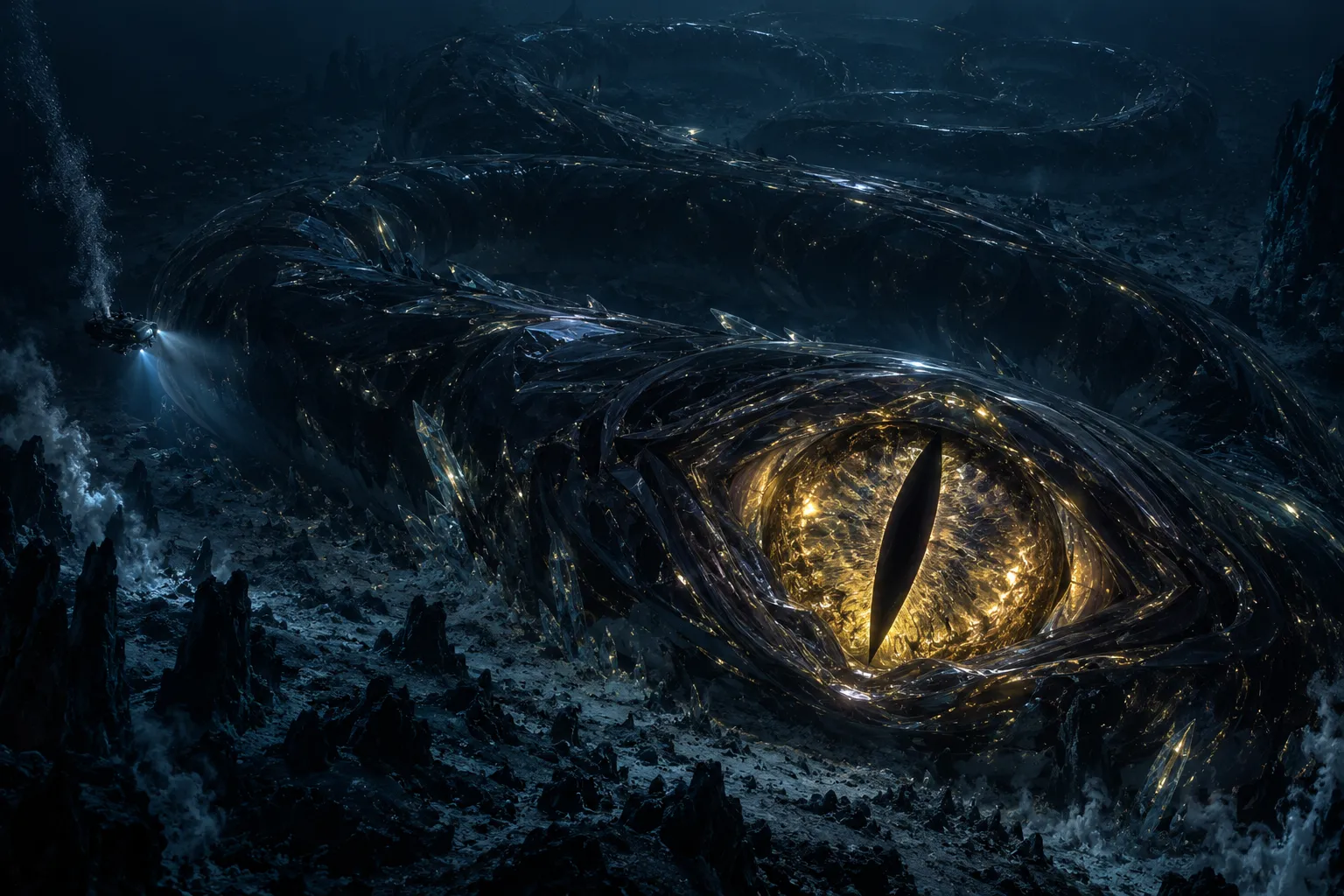
Every people that has ever lived beside deep water has a story about the serpent.
At Ugarit it was Lotan, the twisting one, with seven heads, whom Baal struck down in the sea. In Babylon it was Tiamat, who was the salt water itself, and whom Marduk split like a shellfish to make the sky out of one half of her and the earth out of the other. In Egypt it was Apep, who lay under the horizon every night with his mouth open to swallow the sun, so that every night the sun had to fight its way through him to reach the morning. In India the gods and the demons made a truce for the length of one labour, and took the great serpent Vasuki for a rope, and wound him round a mountain, and churned the ocean with him for a thousand years; and out of the churning came first a poison that would have ended the world, and then, in a white cup, amrita, the drink that makes the drinker deathless. In the north the serpent lay at the bottom of the sea, round the whole of the world, with its tail in its mouth, waiting for the end of things. In China the dragons came up out of the rivers with a pearl held under the chin, and whoever held the pearl held rain, and long life, and the favour of heaven. At Delphi, Apollo had to kill a serpent before he could have its oracle. In Australia they remember a serpent who made the rivers. In Mexico they built pyramids to one with feathers.
The scholars have a word for this. They say that the human mind, wherever it is born, finds the same shapes in the dark, the way children in every country are afraid of the same things under the bed.
The Children of Tehom have another word for it. They call it a memory.
Read the stories side by side, and under the seven heads and the feathers and the tail in the mouth, a great many of them say the same three things. That the serpent was made by the gods, or brought by them, or was there before them. That it lies in the deep. And that from it, if you are very brave or very lucky or very wicked, there comes something precious: a pearl, a cup, a drink, a fruit, a scale, that lets a man live much longer than a man should.
The stories are wrong about almost everything. They are right about that.
When the First Who Believed left the salt, five million, three hundred and thirty thousand years ago, they did not all go.
They had sung the One Who Turned into silence on the cliffs. They had turned the cliffs over for the piece it had cut out of the Coil and not found it, and decided that the traitor had destroyed it; and since the Coil still slept, and still sang, they had decided that it did not matter very much. A Coil lies down on a world and sings, and the song takes a long time to reach the ones who are listening for it: a hundred thousand years, a million, five. Somebody must sit beside it for all that time, the way somebody sits up with a fire that has to last the night.
So when the pale ship lifted off the salt, one of them stayed.
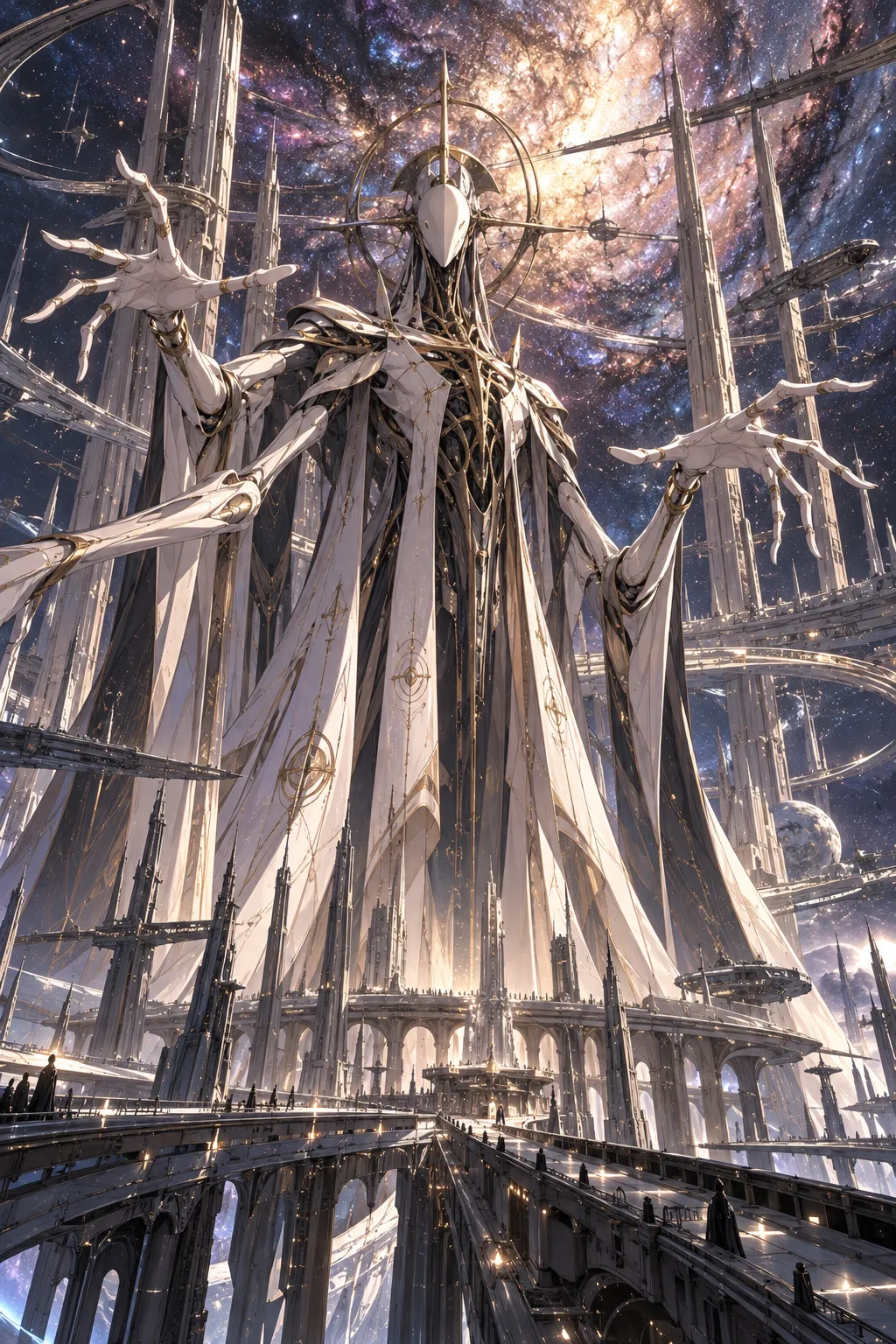
It was a Cantor. It had been a Cantor for longer than the small upright creatures on the cliffs had been upright. Its name was a chord, and stone cannot hold chords, and neither can paper; in five million years nobody on Earth has ever written it down.
The First are not made for worlds. They are tall and pale and many-jointed, with long hands and faces like smooth porcelain masks, and they were shaped by ships and by the long dark between the stars, where nothing weighs anything. A world is a weight on them. A world’s air dries them and its sun cracks them, and left to itself, under a sky, a Cantor would have lived about as long as a fish lives on a riverbank.
It was not left to itself. It had the Coil.
A Coil, while it sleeps, breathes. And every so often, deep in the folds of its sleeping body, a little of it comes loose: a bead of white metal the size of a lentil or a grape, warm, alive, that the Coil’s flesh has grown too much of and lets go, the way an oyster lets go of a pearl. It rises. The First have a chord for it that means, as near as anyone can render it, what is given.
A very long time afterwards, a woman in an Oxford laboratory, who had spent her life trying to make a dead fragment of Tunguska rock want anything at all, would give it a name that fitted on a label. Extraterrestrial living-metal substrate. When that did not fit either, she shortened it to three letters, and wrote them on the jar in green ink.
ELS.
On this world there has only ever been one living source of it. Everything else that has ever been called by that name was given, once, by the thing asleep in the Deep.
The Cantor lived on it. That was what it was for. A Cantor holds a pearl in its long hand, and the pearl gives itself up into the hand that holds it: warmth, and strength, and time. A Cantor with a pearl does not tire. A Cantor with a pearl every few centuries does not die. The First had lived like this, alongside their Coils, for longer than there had been stars over the place where they were born, and had come to believe that the Coil gave because it loved them.
There was a law to it, and in a hundred thousand years the First had never found a way round it. The living metal answers a will, but only a will that is touching it. A Cantor cannot sing to a pearl across a room. It must close its hand, and listen, and want something very hard; and then the white metal will run over its fingers like milk running backwards and become whatever it is wanted to become. A blade. A skin. A wing. Let go of it, and it is only a pearl again, warm and patient, lying in the palm of a hand.
Two hundred years after the ship left, the Atlantic came through at Gibraltar.
The Cantor stood on the eastern cliffs and watched it come: a wall of water a thousand times the size of Niagara, pouring across the salt for two years, roaring so loudly that every living thing for three hundred kilometres around went deaf or went away. The water closed over the Coil five kilometres deep, and over the salt, and over the place where the ship had stood. When it was finished, there was a sea.
After that the pearls came up rarely.
They had five kilometres of cold black water to rise through, and most of them never reached the light. Perhaps one in a hundred years did. It came up in the dark and floated in on a current and lay at last on a beach somewhere along the eastern shore, white and warm in the wrack, among the cuttlefish bones, where anyone might pick it up.
And the small upright creatures had learned to walk along beaches.
They found the pearls before the Cantor did, more often than not, and knew what they were the moment they held them, the way a hand knows a fire. A fisherman on the coast below what would one day be Byblos picked one up out of the tideline when he was thirty and was still mending nets with his great-great-grandchildren a hundred and sixty years later. A woman who carried one in her mouth for a month dreamed the whole of the sea. They lived long, the ones who held them. They lived long and saw far and remembered things nobody had told them, and when they died, the pearl did not die with them; it lay in the grave, warm, until somebody dug it up.
The Cantor watched them. It had a very long time in which to watch.
At first, when they saw it, they did what small creatures had done on three hundred other worlds. They covered their faces with their hands.
So it made itself a face.
It took the pearls it had saved, and laid them over its long pale body, layer on layer, over a great many years, and taught them to be skin. It made itself short, as they were short. It made itself a pair of hands with five fingers each, which it found very strange. It made itself old, because it had noticed that among the small upright creatures the old are never asked where they have come from. The one thing it could not make was eyes. The First had given up their eyes ten thousand years before the Coil, when they learned to hear it instead, and the Cantor found that it did not know how to want them. So it made a pair of lids over nothing, and kept them closed. And it discovered, in time, that the small creatures took a man whose eyes were always closed for a man who was blind, or praying, or wise.
It was all three, after its fashion.
Then it taught them what to worship.
Never the Coil, by name. It gave them a serpent. A serpent in the deep, which the gods had made, which held a pearl under its chin, and which, if you served it, gave. The story went out along the coasts the way rings go out from a stone dropped in still water, and every people it reached told it a little differently, as people do; and in the back rooms of their temples, under the altars and behind the walls, the priests who had once been allowed to hold a pearl painted the serpent on the plaster, and burned incense to it in the dark.
The last letter ever written at Ugarit was still in the kiln when the city burned.
The archaeologists found it there, three thousand years later, baked hard by the fire that had destroyed everything else. It was from the king to his brother king across the water in Cyprus, and it said, more or less: My father, the enemy’s ships have come. My cities are burned. My soldiers are in the Hittite country and my ships are in Lycia, and the land is abandoned to itself. Seven ships came, and did evil things. It was never sent.
On the last night, there was a boy at the sea gate.
He was seventeen and had been a soldier for a month. He had a bronze spear and a leather cap and a wound in his side from a raider’s sword that had gone in under the ribs as far as the hilt, and he was sitting with his back to the gatepost in the light of the burning harbour, holding himself together with both hands, because the people of the lower town were still coming down to the water behind him to get into the last of the boats, and there was nobody else left to hold the gate.
An old man came down the street towards him through the smoke. He walked unhurriedly, though the street was on fire, with his eyes closed and his hands folded in front of him, and the raiders at the top of the street let him through as if they had not seen him. He stopped in front of the boy and looked down at him, without opening his eyes, for a long time.
‘You are going to die,’ he said, in the boy’s own language, gently. ‘Before the boats are full.’
‘Yes,’ said the boy.
‘Do you want to?’
‘No,’ said the boy. ‘I want to hold the gate.’
The old man smiled. Then he knelt, and took something out of his sleeve that was white and warm and the size of a grape, and pressed it into the wound in the boy’s side with one finger, the way you press a seed into earth.
Every priest in every back room along that coast had held a pearl, and given it back. Nobody had ever been given one to keep. It went into the boy and did not come out. He felt it go through him like cold water and then like fire. He felt it find the edges of the wound and close them. He felt it go out along his bones and into his skin and lie down there, and stay, the way a dog lies down at the foot of a bed that is going to be its bed from now on.
He stood up. There was something on his skin, on his arms and his hands and the side of his neck, like ash. It was not ash. It was grey, and hard, and it moved when he moved.
He held the gate for a night and a day. The raiders came down the street at him in sevens, and then in twenties, and he killed them with a bronze spear and then with his hands, and the grey on his skin turned their swords; and behind him the last boats filled, and pushed off, and went north up the coast with the last of the people of Ugarit in them, and lived.
When it was over, the old man came back and stood in the ruins of the gate with his eyes closed and told the boy that he had been chosen. That there was a great work in the world, and that the boy would be its hand, and that he would do more good than any man who had ever lived.
The boy believed him.
He would go on believing him for three thousand two hundred years.
Six hundred years after that, in the sixth year of the exile, in the sixth month, on the fifth day of the month, a priest of Judah called Ezekiel was sitting in his house by the river Chebar in Babylon with the elders of Judah sitting before him; and he was taken, he wrote, by a lock of his hair, and lifted up between the earth and the heaven, and set down in Jerusalem at the door of the inner gate of the Temple.
What he saw there, he wrote down too.
The Book of the Prophet Ezekiel · chapter 8Authorised Version, 1611
7 And he brought me to the door of the court; and when I looked, behold a hole in the wall.
8 Then said he unto me, Son of man, dig now in the wall: and when I had digged in the wall, behold a door.
9 And he said unto me, Go in, and behold the wicked abominations that they do here.
10 So I went in and saw; and behold every form of creeping things, and abominable beasts, and all the idols of the house of Israel, pourtrayed upon the wall round about.
11 And there stood before them seventy men of the ancients of the house of Israel, and in the midst of them stood Jaazaniah the son of Shaphan, with every man his censer in his hand; and a thick cloud of incense went up.
12 Then said he unto me, Son of man, hast thou seen what the ancients of the house of Israel do in the dark, every man in the chambers of his imagery? for they say, The LORD seeth us not; the LORD hath forsaken the earth.
13 He said also unto me, Turn thee yet again, and thou shalt see greater abominations that they do.
In the margin of a copy in the library under the Paradeplatz, in blue ink, in a modern hand signed G.Z.: “He counts seventy, and names one. He does not count the seventy-first.”
He counted seventy, and named one. He did not count the seventy-first.
At the far end of the chamber of imagery, under the painted serpent on the plaster, where the incense was thickest, an old man stood with his hands folded and his eyes closed. He had taught them the pictures. He had taught them the incense, and the dark, and the words. When the wall gave way and the face of the prophet came through the hole in it, the old man turned his own face towards him, without opening his eyes, and smiled, the way a grandfather smiles at a child who has found the cupboard where the presents are kept.
The LORD seeth us not, said the elders, in the dark, with their censers in their hands.
They were half right. There was someone in that room who could not see. He had never needed to.
The Hebrew word that the prophet’s people used for the deep, for the waters under the earth that were there before the light, was tehom. It is in the second verse of their Bible. And darkness was upon the face of the deep. The old man liked it. He took it, and gave it to the people who served him, and they have kept it ever since.
In the winter of 1588, in a tower room in Bohemia with snow on the sill, an Englishman with no ears was looking for an angel in a black mirror.
His name was Edward Kelley. He wore a cap pulled down low over the sides of his head, always, even in bed, because a court in Lancaster had once had his ears cut off for forging coin, and he did not like to be reminded. For six years he had sat across a table from the great Doctor Dee, Queen Elizabeth’s astrologer, the most learned man in England, and stared into a disc of polished black stone that had come out of Mexico in a Spanish ship, and told the Doctor what the angels in it said. The angels had a language of their own, which Kelley spoke and the Doctor wrote down. They had told the two of them to go to Poland, and then to Prague, and then to share everything they owned, including their wives. The Doctor had wept, and obeyed. The Doctor was very learned, and believed almost anything that was told to him in Latin.
Kelley did not believe in the angels. He had made them up. He was the best liar in Europe and the most notorious alchemist in it, and the Emperor Rudolf in Prague was paying him to make gold, and he could not make gold, and he was beginning to be frightened.
That night, when he looked into the black mirror, there was an old man standing behind him.
He turned round so fast that the stool went over. There was nobody at the door. The door was barred, as he had left it. The old man stood by the cold hearth with his hands folded, in a plain dark coat with the snow not melting on its shoulders, and his eyes were closed.
‘You have been asking for an angel for six years, Master Kelley,’ said the old man, in English, with no accent at all. ‘You have been asking very loudly. I have come to see what the noise was about.’
Kelley crossed himself with one hand and reached for the knife on the bench with the other. The old man did not seem to notice either.
He came to the bench where Kelley kept his crucibles and his furnace and the lump of grey lead he had been failing to change for nine months, and took something out of his sleeve, and held it up in the light of the candle between finger and thumb. It was white. It was the size of a grape. It was, Kelley thought afterwards, the only beautiful thing he had ever seen that was not a lie.
The old man closed his hand round it.
Kelley would try for the rest of his life to describe what he saw next, and never manage it. He wrote it down eleven times. He burned all eleven. The white came out between the old man’s fingers like milk, and ran over the back of his hand, and down onto the bench, and found the lump of lead, and climbed it. Where it went, the lead went white. Then the white went gold. Not the gold of paint, or of gilt, or of the brass filings Kelley had once rolled in wax and dropped into a crucible in front of a credulous earl. Gold all the way through, bright and soft and heavy, so heavy that the bench creaked.
‘It is not gold,’ said the old man. ‘It is something that wishes to be gold, for as long as it is asked to. That will be enough for your Emperor.’ He laid one finger on it. ‘Shall I show you the rest?’
Kelley could not speak. He nodded.
The old man took his hand away from the gold, and the white ran back up off it into his palm, and the lump was lead again, grey and dull, as if nothing had happened. Then he went to the window and opened it on the snow, and stood on the sill in the dark with the wind in his coat and the white thing cupped in his hand; and he reached up behind himself, and laid that hand flat between his own shoulder blades.
Wings came out of his back.
They were not feathers. They were white, and they were made of long overlapping plates like the armour of something that had never needed to be born, and they spread across the whole of the window and further, wider than the tower, and creaked as they spread like a ship’s timbers in a swell. He did not flap them. He leaned forward off the sill, and they took him; and Edward Kelley, who had invented a whole language of angels, went to the window on his knees and watched a real one go up into the snow over the river, slow and pale and enormous, and turn once round the tower, against the falling flakes, without a sound.
When the old man came back in over the sill, the wings ran down into his hand and were a pearl again.
‘There is a book,’ he said. ‘I keep it. People sign it. They receive of the Deep, and they give to the Deep, and the Deep remembers both.’ He put the pearl into Kelley’s shaking palm and folded Kelley’s fingers over it, one by one. ‘Keep this as long as you are useful. Make your Emperor his gold. And one day, Master Kelley, I will ask you for something, and you will give it.’
Kelley signed. Anyone would have.
He made the Emperor his gold. He was knighted for it. He lived like a prince for three years, in a palace in Prague with a moat full of swans, and was the most famous man in Bohemia. Then one winter morning he woke up and the pearl was gone from the locked box under his bed, as if it had never been there, and every ounce of gold he had ever made in front of the Emperor turned back to lead in the Emperor’s treasury, all on the same night.
They put him in a tower in the forest at Křivoklát. He tried to escape twice. The second time, in 1597, he went out of the window of a castle at Most on a rope made of bedsheets, and the rope was too short, and he fell.
People said afterwards that he had been trying to fly.
Ledger of the Deep · extractsParadeplatz · the lower library
1382/1
Paris. FLAMEL, Nicolas, scrivener. Receives of the Deep one grain. Gives his name, to be remembered for it.
1588/7
Bohemia. KELLEY, Edward, scryer. Receives one grain, and an angel. Gives his hand, when it is asked for. Called in, 1591.
1785/3
Paris. “Count CAGLIOSTRO.” Receives the Egyptian elixir. Gives a necklace, and the scandal that goes with it.
1908/1
Tunguska. Recovered, one scale, not given. Dead. Kept.
1993/44
Moscow. STEVANSKY, Isaak. Receives passage, protection and capital. Gives the first daughter, in her eighteenth year, to be the Key.
There is no folio for the Count of Saint-Germain, who told the court of Louis XV that he was two thousand years old, spoke every language at the table, and was remembered by nobody who met him for longer than an evening. The ledger in those years is in his handwriting.
Every one of the eighty who come down to the Accounting each October has held a grain, once, for a little while, and given it back. That is what they are paying for. The Book promises that when the Deep opens there will be no more need to give anything back.
So that is what he is.
Not a man. Not a god, although he has been taken for several. A Cantor of the First Who Believed, who stayed on the salt when the others went home, and has lived for five million years on what a sleeping monster lets fall in its sleep, and taught the small upright creatures of the blue world to paint its picture in the dark and burn incense to it and call it holy. He has worn a man for longer than men have written. He has been the seventy-first in the chamber of imagery, and the old man in the burning street at Ugarit, and the angel in a black mirror in Bohemia, and a grandfather at the head of a long black glass table under a bank in Zurich, with his hands folded and his eyes closed, listening to a woman with no accent tell him about a car on the A44.
He can do everything he did in that tower room. He can do a great deal more. He has not flown in four hundred and thirty-seven years.
He did not go round the black thing. There was no time to go round anything. He went straight past it, low over the concrete, with the wings throwing smouldering red light across the wet apron and the drives labouring in his chest at a third of their strength; and at a third of their strength, ZERO told him afterwards, he had been travelling at a little under four hundred metres a second when it caught him.
It caught him by the wing roots. Both hands, from behind, the way you catch a dog by the scruff.
He felt the black fingers close on the base of his wings, where the blades went down into his back, and felt them squeeze, and felt the plates there crack. Then the world turned over, once, very fast, and the north apron of Oxford Airport came up and hit him in the face.
The concrete did not crack. It went. A crater opened under him two metres deep in a spray of hot grit and steam, and he went down into the bottom of it with the Nephil on his back and its knee between his shoulder blades, and the visor filled with red warnings, and for a quarter of a second he could not see anything at all.
ZERO System · combat 23:59:22 GMT
Drives 31%. Unknown unit output: full. At this output it is faster than we are.
Wing roots, left and right: plates cracked. Ribs, left: the two from the kitchen. Now three.
Behind him, at the end of the runway, the jet’s engines went up to a howl. He heard it begin to roll.
He got his hands under him and pushed. The Psycho-Frame lit gold along every line of his spine, and the Nephil’s knee came up off his back a centimetre, two, and he twisted and drove his left elbow back into the side of its head. It was like hitting a church. The black head snapped sideways and came back. He got one knee under him, then the other, and came up out of the crater with the thing still hanging off his wings, and threw himself straight up.
It came with him. It did not let go. They went up together, two hundred metres, three hundred, turning over and over each other in the dark above the runway lights in a shower of red sparks, its hands on his wings and his hands on its wrists, and below them the white jet went down the runway in a long rising roar with its landing lights blazing, faster, faster, and its nose came up.
At 00:00:31 its wheels left the ground.
He tore his right wing out of the black hand. It cost him four blades; he felt them go, the way you feel a fingernail go, and watched them tumble away glittering into the dark. He turned in the air towards the jet, which was climbing away south into the cloud with its lights going grey in the murk, and the Wings of Light came up behind him, ragged and red and much too small, and he went.
Something went through his left wing.
Then something else. Then six more, so fast he heard them as a single sound, like a handful of gravel thrown at a window. Black blades: long and narrow and black as the gap between stars, each with a sullen red light in its core, which had come off the Nephil’s back without its moving, the way his own came off his. They went through the roots of his wings, through the plates and through what lay under the plates, and kept going, and took him down with them. He hit the concrete on his back beside the runway and felt them go into it behind him, eight of them, all at once, a ring of black stakes through his wings into the apron, so that he lay spread out and pinned on the ground like a moth on a board.
And the red cores sang.
He knew the song. It had gone into him like a hand 1.8 million kilometres above the Earth, and by the lake at Worcester, and in the flood on Port Meadow. Now it was coming out of eight blades driven through his own wings, and the armour heard it from the inside. The blue-violet in his left wing went dark from the tips inward. The plates over his heart loosened, the way a hand loosens in sleep.
Above the cloud, very faint, he heard the jet turn.
And in his chest, under his own heart and the labouring drives, the third heartbeat, forty-one, forty, thirty-nine, very slow and very small and getting further away every second—
—stopped.
Cut, said ZERO, at once, before he could think it. Not faded. Cut. Shielded again, like the box. She was alive at 00:01:12. She is in a box on that aircraft, and someone on it has worked out that there is something on her.
He lay on his back on the runway and looked up at the cloud where the jet had been.
‘Ну вот,’ said a voice above him, in Russian. Well, then.
The Nephil stood over him with its feet either side of his chest.
It had not hurried. It looked down at him with its black crowned head on one side and its broken halo burning dull red behind it, the crescent with the bite out of it, and its hand of black metal hanging loose at its side, and he could hear Yaroslav Volkhov breathing inside it, quick and pleased and a little hoarse, like a man who has just run up a flight of stairs to win a bet.
‘I said you came all this way for nothing,’ said Volkhov. ‘You thought I was being poetic.’
Aria pulled. The Psycho-Frame screamed. One of the eight black stakes came up out of the concrete with a crack and a spray of grit, and he got his left arm free, and the Nephil put its foot on it.
‘Do you know what they put in me, angel?’ It leaned down. Its voice dropped, as if this were a confidence between friends. ‘Tunguska. Seawater. A frame from Halcyon, that your girl’s company stopped paying for a month too late. And her shoes.’ It tapped the glass in its own chest with one black finger. ‘Those little white boots you made her in the street at Esso, with the gold line at the heel. You gave her a present, and they took it off her windowsill, and they grew this round it. Every gram of me that fights like you is you.’ It laughed softly. ‘You’re fighting your own gift. Isn’t that interesting?’
ZERO System · 00:01:40 GMT
Similarity to our armour: 61%. Rising on every contact.
It is learning us. It is learning us through the boots. They remember us, and it is reading what they remember.
‘Get off my arm,’ said Aria.
‘Make me.’
He did not answer. He opened his left hand flat under the black foot, on the concrete, and the concrete under it went silver.
It went in a ring, fast, a metre across, then five, a bright branching frost racing out across the apron under both of them like ice across a pond, and the Nephil’s foot sank into it to the ankle. It looked down. In the quarter-second that it looked down, he let the frost go into the eight black stakes through his wings, which were the only things on the apron he could not have touched, and the stakes refused it, as Tunguska scale always did, and spat it back out; but the concrete they were standing in did not. It went to silver around them and then to liquid, and they leaned, all eight, and he tore his wings up out of them and rolled.
He came up onto one knee with the Singularity Blade already coming out over his shoulder.
The black edge lit. Grit blowing across the apron curved round it and went the wrong way. He cut at the Nephil’s legs, low and flat, the stroke Benedetti had made him practise four thousand times in the Nave until he could do it asleep, and the Nephil was not there. It had gone up and over the blade the way he would have gone over it. Exactly the way. The same height, the same turn of the shoulders, the same small adjustment of the left wing to come down on the far side, and as it came down its own blade came out over its shoulder.
It was black too. It had a line of red down its edge instead of a line of nothing.
They met in the middle of the apron.
He would remember the next four minutes as a series of injuries.
The first was the shoulder. The red edge came down at his neck and he got the Singularity Blade under it, and the two blades met with a sound like a cathedral bell dropped on stone, and the red edge did not stop, because nothing had ever met the Singularity Blade before and it had never been taught to stop. It slid. It went down the black line of his own edge in a shriek of sparks and off the hilt and into his left shoulder, through the pauldron, through the plates beneath it, and into what was under the plates, which was Aria Zadkiel. He felt it go in a few centimetres below the collarbone. He felt it grate on something. He felt it come out.
The second was the ribs. He had taken them in the kitchen, unarmoured, from a backhand the size of a car door, and the Nephil seemed to know it. It came in low under his guard with its claws open and raked him across the left side of the chest, and the plates over the broken ribs came away in its fingers like bark off a tree, and the ribs underneath them went. Not cracked. Went. He heard it inside his own head as a wet, flat snap, two of them together, and something in his chest that had been a breath became a sharp red point, and the next thing that came up his throat was blood. It filled his mouth. It ran down his chin inside the helmet, hot, and pooled in the bottom of the visor where he could taste it every time he breathed.
Fifth and sixth ribs, left side. Displaced. The lung beneath is bruised. Not punctured. Not yet.
The third was the hand. The left one, which he had opened to the bone on the glass core of a Grigori by the lake at Worcester barely half an hour earlier. The Nephil caught it in its black metal fist when he threw it, and closed, and the gauntlet cracked across the knuckles, and the cut inside it opened again, and he felt his own blood run into the palm of his own armour.
And every time it touched him, it got better.
ZERO System · 00:03:51 GMT
Similarity: 64%. 67%. 70%.
Armour integrity: 61%. Drives: 31% and not recovering. Every manoeuvre we make, it makes a quarter of a second later, and then it makes it first.
He tried the bits. Eight blades went out of what was left of his right wing, and the Nephil threw out eight of its own to meet them, and the two flights met in the air above the apron in a shriek of crystal on black glass, and his blades went silver into the Nephil’s blades and came back refused, and the Nephil’s blades went into his and came back with pieces of them. He tried the rifle. He brought it up out of his forearm at two percent power and the Nephil was inside it before it had finished unfolding, the way he would have been inside it, and the beam went into the sky over Kidlington in a long white thread and lit the cloud from end to end.
Somewhere to the south, on the A44, cars were pulling onto the verge. He could see their hazard lights. He could see the little white squares of the phones held up out of their windows.
At the gate on Langford Lane, blue lights. Four police cars and a van, and men getting out of them with carbines, and stopping, and staring.
Two airport staff in the fuel office beside the second hangar, said ZERO. Tied to chairs. Alive. Heart rates a hundred and sixty. Somebody opened this airport for them tonight, and did not ask these two first.
‘Then we don’t go near the fuel office.’
We are three metres from the fuel bowser.
He looked round. It was there: a big white Jet A-1 tanker on a lorry chassis, parked by the hangar doors where the white jet had filled up, with a coiled hose on its side and a hand-painted sign on its door that said NO SMOKING WITHIN 15 M. The Nephil was coming at him across the apron with both hands open, unhurried, the way a man walks up to a dog he has already decided to kick.
And he understood, all at once, the way he had understood a gadget construction on a whiteboard at nine in the morning a lifetime ago.
‘It learns us,’ he said.
Yes.
‘Every time it touches us.’
Yes.
‘Then stop letting it touch us.’
Benedetti had taught him knives. Kuramoto had taught him how to break a wrist, MacLeod how to fly, and the rabbi how to think. Nobody had ever taught him fuel bowsers. Nobody had taught him saucepans either, and half an hour ago he had cracked a Grigori open with one.
He put his right hand on the side of the tanker and lifted it.
Not with the armour. With the Psycho-Frame, which was not a part of him the Nephil had ever seen used like this, because he had never used it like this; he had only ever used it to hold things up. Thirty-odd tonnes of lorry and kerosene came up off the apron on a field of gold light with its wheels still turning and its hose swinging loose, and he threw it.
The Nephil cut it in half. Of course it did. It was what he would have done.
Thirty thousand litres of aviation fuel came out of the two halves of the tank in a single brown wave, all over it, and the halves of the tank hit the concrete either side of it and struck sparks, and the apron of Oxford Airport turned into the sun.
The fireball went up four hundred metres. The people on the A44 felt the heat of it on their faces through their windscreens. The police officers at the gate went flat on the road. The Nephil stood in the middle of it, black against white fire, with burning kerosene running off its shoulders in sheets, and for one second, for the first time since it had stood up beside the hangar, it did not know what was happening, because nothing in the boots had ever stood in a burning lake of jet fuel and the boots had nothing to tell it.
He came through the fire.
He did not use the wings. He ran. He went through the flames on foot, low, like a man going into a burning house, with the armour blistering and the visor gone white with heat, and hit it in the middle of the chest with his shoulder, the wounded one, the one it had just put its blade through, and drove it backwards out of the fire and across twenty metres of apron and into the side of the hangar.
The hangar wall folded round them like paper.
And there, with the corrugated steel coming down on both of them in long screaming sheets and the fire roaring in through the hole behind, he put his left hand, his cut hand, flat on the glass in its chest.
The song came up his arm like a current.
It was worse than the kitchen and worse than the lake. This close, through the glass, through his own palm, it was not a hum or a voice. It was the bottom of the Calypso Deep in a jar, all five thousand metres of it, cold and black and enormously patient, and it went into the armour of his left arm and the armour of his left arm turned towards it like a face. The white went dark. It went dark from the fingertips, over the knuckles, up the wrist, the forearm, the elbow, black as Tunguska, and he felt the plates of his own arm begin to slide, very gently, off him and towards the glass, wanting in.
Aria. The arm.
‘I know.’
There was no heartbeat in his chest to hold on to. They had shut it in a box. So he held on to something she had shouted at him once. He had heard it on Norham Gardens in January, at night, from the top step under the porch light, where she stood three centimetres taller than him for the first time in her life and shouted it down the dark street at his back.
I’m not done with you, Aria Zadkiel. Do you hear me? I am not done.
The black stopped at his elbow.
‘Kill it, then,’ said Volkhov, inside the thing, in a voice gone thin and strange. ‘Go on. Put your famous hand through it. Go on, angel.’
Aria did not put his hand through it. He reached past the water.
It was there, under the glass, at the bottom of the black water, where its heart should be. Small. Two small shapes, side by side, that he had made once in a muddy street at the edge of the world out of the metal of a helicopter, with his hands over a pair of cold feet in wet socks. A pair of seamless white boots with one faint line of gold at each heel. They had grown things round them since. A frame and a skin and a crown and a broken halo and seventy percent of him. But they were there, under all of it, and they were warm, because he was near; they always had been.
They will remember us, ZERO had said, a long time ago, over a cup of tea on Walton Street. And they will grow warm when we are near.
‘I know you,’ he said to them.
He did not say it out loud. The Psycho-Frame said it for him, into the glass, into the water, the way it had once said down to thirty men in a valley in Kamchatka.
‘Come home.’
They came.
It took less than a second, and he felt every part of it. He felt the two small warm shapes at the bottom of the water turn towards his hand, the way his own blades turned towards the song, and let go of everything that had been grown round them. He felt them come up through the black water, through the glass, which did not stop them, because the glass had been made to keep his blades out and these were not blades. He felt them come into his palm, and up through his cut hand, and into him, like two small birds coming in through a window, and lie down.
The Nephil made a sound.
It was not a sound a machine makes. It was the sound a house makes when the beam that has been holding up the middle of it is pulled out. Every plate on it shifted at once. The black crown sagged sideways on its head. The broken halo flickered, and went out. Down its back, the long black blades let go of whatever had been holding them on and fell off it, all of them, and clattered onto the floor of the hangar round its feet like a drawer of cutlery tipped out.
ZERO System · 00:05:58 GMT
Similarity: 70%. 41%. 9%. 0%.
It is a Halcyon frame, some Tunguska scale and six litres of seawater. That is all it ever was without us.
He closed his fingers on the glass and tore it out of its chest.
It came away with a long wet crack and a spray of black water that was already only water, cold and salt and dead, and he threw it the length of the hangar, and it burst on the far wall and ran down it, hissing a little, into the drain. The thing in front of him went down on its knees. It stayed there, knelt in the wreck of the hangar wall with the fire behind it, a black shell with nothing in it, the way the fourth Grigori had folded down on Eliana’s doorstep like a coat with nobody inside.
His left arm was white again, to the fingertips.
Then the chest of the thing opened.
Not on its own. Somebody inside was unbolting it, with one hand, swearing steadily in Russian.
The plates came apart down the middle like a pair of doors and Yaroslav Volkhov looked out.
He was sitting in a sort of cradle, strapped in at the chest and the hips, in a black suit of something rubbery that was soaked through with sweat. He was thinner than he had been in Kamchatka and much greyer, with the pale eyes and the broken nose and the gold tooth, and the left side of his face was blistered red from the fire that had come in through the seams. His right arm went into the wall of the cradle to the elbow. It went into it the way a root goes into a pot. And where the arm met the frame, it was not an arm. It was black metal from the elbow down, a long hand of black metal with a man’s fingers, wired into the machine with something that was not wire.
He looked at Aria. Then he started to laugh. It hurt him; he did it anyway. It was still, Aria thought, a good laugh.
‘Ah,’ said Volkhov. ‘Shoes.’
Aria said nothing. He was holding himself up on the hangar wall with one hand. The other, the left, hung at his side and dripped.
‘Do you know,’ said Volkhov, ‘they told me it was mine. Forty days in a tank in Zurich, angel, with that black water going into my arm and up my spine, and they told me when it was done it would be mine.’ He spat to one side. There was blood in it. ‘And you walk up and say come home and it gets up and goes home. Like a dog that was never mine.’ He shook his head. ‘The old man won’t like it.’
‘Your hand,’ said Aria.
Volkhov stopped laughing.
He looked down at the black metal where his right hand should have been. Aria had crushed that hand in a valley in Kamchatka, in September, in the snow, for holding a knife to a girl’s throat. And then he had left a little of himself in the stones round the man’s wrists and knees to hold him, and flown away, and the little of himself had stayed, and grown, in a tank of black water under Zurich, into this.
‘That’s mine too,’ said Aria.
He put his hand on it.
The black metal went white under his palm, and then silver, and then it came up off the bones of Volkhov’s wrist like water off a stone, and ran into Aria’s hand, all of it, every gram, and was gone. Underneath it there was nothing. There had been nothing there since September. There was a wrist, ending, and a stump that the metal had been covering, raw and wet and bleeding fast now that nothing was covering it, and Volkhov looked at it for one second with no expression at all, the way a man looks at a bill.
Then he screamed.
Aria laid two fingers on the end of the wrist. A thin film of silver ran out of them and over the stump, and closed it, and set.
‘Temporary,’ he said. ‘You’ll need a surgeon.’
He had said that once before, to another man bleeding in the snow, in another country. He did not think about it until afterwards.
Volkhov sat in the open chest of the empty machine with his ruined arm clutched against his body and his blistered face running with sweat, breathing in great ragged sobs. When he could talk again, the first thing he did was laugh. It came out in pieces.
‘Three times,’ he said. ‘Three times, now. You break my hand, you give it back, you take it away again. And still you don’t kill me.’ He looked up. The pale eyes were wet and very bright. ‘I have run out of things to hate you with, angel. Isn’t that interesting.’
‘Where is she going?’
‘Zurich.’
‘I know Zurich.’
‘No, you don’t.’ Volkhov leaned his head back against the cradle and closed his eyes. ‘Under Zurich there is a church in a rock, and in the church there is a tank, and in the tank there is a cup of the sea. She will go there first, because the old man likes to show people his tank. She will not stay.’ He opened his eyes again. ‘He doesn’t want her hand in his fish tank, angel. He wants it in the sea itself. Over the place where the thing sleeps.’
‘Why are you telling me this?’
Volkhov thought about it. He seemed to find the question genuinely interesting.
‘Because he made me ask permission to speak,’ he said at last. ‘Tonight. On the telephone. Brother Yaroslav asks whether he may speak first. And they laughed.’ He bared his teeth. ‘And because I wanted to beat you. I did not want to hold a little girl’s hand under the water for an old man while she cries. A man must have some standards, angel. Mine are very low. But they are mine.’
Outside the hangar, somebody with a loudhailer was shouting ARMED POLICE at a burning lake of jet fuel.
‘Go on,’ said Volkhov, and shut his eyes. ‘Go. Fly. Let them have me. I will tell them all about you, and none of them will believe a word.’
He got as far as the field at the north end of the airport.
He went out through the back of the hangar and low across the grass with no lights, because the lights would not come on any more, and over the perimeter fence, and a hundred metres into a ploughed field on the far side of it, where the drives in his chest coughed, once, like an engine running out of fuel. He came down hard. He did not choose how. The armour went back into him on its own, without being asked, in a long cold slithering rush, the way the tide goes out, and he was lying on his back in a frozen furrow in a torn white shirt and jeans and one trainer, with the stars going round overhead and his own blood all over him, and the other trainer somewhere in Kidlington.
ZERO System · 00:08:40 GMT
Involuntary reversion. Drives at 17%.
Left shoulder: penetrating wound, clean through, 4 cm below the clavicle. Bleeding. Left ribs 4, 5, 6: fractured, two displaced. Left lung bruised. Left hand: laceration to bone, reopened. Burns, face and neck, first and second degree. Right eyebrow: half gone. You will not like that one.
Recovered: the boots. 0.31 kg. At Esso they were three-thousandths of one percent us. In the tank in Zurich they grew. They are all us now, and they are asleep.
Quantum System: unavailable below 40%. At the present rate, available at about half past one.
He lay in the field and breathed in short pieces round the broken ribs and watched the cloud where the jet had gone.
It filed a flight plan, said ZERO quietly, for Zurich. I heard it on the tower frequency while we were on the ground. It will be over Reims in half an hour.
‘I can’t catch it.’
Not tonight. Not like this. And if you could, I could not tell you where it was. It has turned off its transponder. A pause. Aria. She is alive in a box, and she is going to Zurich, and a man with no hand has just told you that she will not stay there. You have ninety minutes before you can fold. Please spend some of them not bleeding.
He shut his eyes.
He was very good, he had always been very good, at not thinking about things. He had had ten years of practice. Lying in a frozen field outside Kidlington at ten past midnight, with his blood going into the furrow, he found for the first time in his life that he could not do it at all.
Everyone else was already moving.
00:09. On Walton Street, the Honourable Tobias Fairweather put on a pair of jeans under his rowing jacket for the first time that night, filled a thermos from the kettle, which he had boiled again, because there is always time to boil a kettle, and put the thermos and the first-aid kit from under the sink and a clean white shirt from the drawer in Aria’s room and the Tin into a Waitrose bag for life. The constable at the hole in the kitchen wall asked him where he thought he was going. ‘I’ve got to go and see a man,’ said Toby, ‘about a gas main.’ He drove north up the A44 in his mother’s old Volvo estate, which was the same model Lady Penelope had once attacked in Cirencester, with ARGUS open on the phone in the cradle on the dashboard and the Tin on the passenger seat with its seatbelt on.
00:14. In the resuscitation room at the John Radcliffe, Dov Ben-Ami opened his eyes, found a cannula in the back of his hand, and took it out. The registrar told him that his cheekbone was broken in two places, that he had four broken ribs and blood in his chest, and that he would die if he stood up. ‘Then put a tube in it,’ said Dov. They put a drain into the side of his chest in eleven minutes, because that was how long he would agree to lie still, and he walked out of the hospital at twenty to one with the drain bag in one hand, half full of his own blood, and his jacket over his other arm. On the way he stopped for four seconds at a door on the lower ground floor that had no window in it. Then Yossi brought the car round.
00:20. In Hampstead, in her dressing gown, with her reading glasses on their chain, Harriet Achterberg took a call from Dov that lasted forty seconds, and made six that lasted two minutes each. The fifth was to a man who owned a great deal of Farnborough Airport and had once owed Alexander Stevansky a favour that he had not expected to be asked to repay at twenty past midnight. By one o’clock a Meridian jet was fuelled and crewed on the stand at Farnborough, with a flight plan to Zurich, and a lawyer in Zurich had been woken up and told, in German, to put her clothes on.
00:26. In Tel Aviv, a man called Ezra, who did not officially have a job, rang Dov and said: ‘Your jet filed for Zurich Kloten. It went dark over Reims. I will know where it lands. I will not know where it goes afterwards, and neither will anybody else, because the kind of people who own that jet do not go anywhere afterwards that has a name.’
00:28. In the hall at Norham Gardens, where Pascal was sweeping the chandelier into a corner very slowly with tears running down his face, Mrs. Agnieszka Nowak opened the drawer of the hall table, took out the black notebook she had put there eleven nights before under the guest book without reading it, and packed a bag. A white cardigan. A clean blouse and a pleated skirt. A hairbrush. The steel tin of tablets from the floor by the sofa, which she wiped clean of glass and of something else with her apron. And, after a moment, from the window seat in the wreck of the reading room upstairs, a paperback copy of The Amber Spyglass with a bus ticket sticking out of it two pages from the end. She put the notebook on top, and gave the bag to Yossi at the door, and said, ‘Tell her to eat something.’
00:31. In Seoul it was half past nine on a Saturday morning, and an old woman in a flat in Mapo-gu watched a clip on the television news of something red and something black fighting over an English airfield, and rang her granddaughter’s telephone eleven times, and got no answer, and put on her good black hanbok and went to church, where she did not pray so much as argue.
00:37. And at the north end of Oxford Airport, where the A44 runs along the perimeter fence, a Volvo estate pulled onto the verge with its hazard lights on, and a young man in a rowing jacket got out of it with a torch and a Waitrose bag and climbed the fence and went into a ploughed field, following a dot on his phone that was a thermal camera on the airport’s own perimeter, whose password had never been changed from the one on the box.
‘Oh, mate,’ said Toby. ‘Oh, mate. Look at you.’
He knelt in the furrow. He put the torch down in the mud so that it shone sideways across them both, and took off his rowing jacket and put it over Aria’s chest, and took Aria’s face between his hands and turned it towards the light, carefully, the way you turn a vase to see if it is cracked.
‘You look like an exploded crime scene,’ he said. ‘Half your eyebrow’s gone. You’ve got one shoe on. Can you sit up? No, don’t sit up. Don’t do anything. Hold this.’ He pressed a wad of dressing from the first-aid kit into the hole under Aria’s collarbone, front and back, and leaned on it with both hands, and Aria made a sound through his teeth. ‘Sorry. Sorry. I know. I did a course. St John Ambulance, at school. I got a badge. They didn’t do this one.’
‘Toby.’
‘Yes, sir.’
Aria looked at him.
‘Sorry,’ said Toby. ‘It just came out. Shock.’ He took one hand off the dressing long enough to unscrew the top of the thermos with his teeth. ‘Tea. Don’t argue. You’ve lost about a pint and you’re lying in a field in March. It’s got three sugars in, because I didn’t know if you’d gone into shock and three seemed like a good shock number.’
He held the cup to Aria’s mouth. Aria drank. It was the worst tea he had ever tasted, and he drank all of it, and then Toby poured another and he drank that too.
‘She’s in a box,’ Aria said. ‘On the jet. They’ve shut her in again.’
‘I know. I heard it go quiet on your end. You made a noise.’
‘Zurich. Volkhov says Zurich, and then the sea.’
‘Volkhov.’ Toby frowned. ‘Is that the black one? The one you set on fire?’
‘I didn’t set it on fire. I set the fuel on fire.’
‘You can see it from Woodstock, Aria.’ Toby got the clean shirt out of the Waitrose bag, and shook it out, and looked at the hole in Aria’s shoulder, and at the shirt, and put the shirt back in the bag. ‘Later. When you’ve stopped leaking. Right.’ He sat back on his heels in the mud. ‘Right. What do we need?’
And Aria, lying in a field with his blood in the furrows and the airport burning behind the hedge, found that the answer to that question had changed in the last twenty-four hours, without anybody asking him, from nothing to a great many things; and that one of them was kneeling in front of him in the mud with a thermos.
‘An hour,’ he said. ‘Until I can fold. And somewhere to be when I do.’
‘Then you’ll have both,’ said Toby, ‘in my mother’s car. With the heater on.’
Dov found them at five to one in a lay-by on the A44, south of Woodstock, with the engine running and the windows steamed and Aria in the back of the Volvo with his feet on the Tin.
He got out of Yossi’s car very slowly. He had a bag of his own blood in one hand, on a tube that went into his side under his shirt, and a carrier bag in the other, and one side of his face was a dark, swollen, shining purple from the temple to the jaw. He opened the back door of the Volvo and looked in.
The two of them looked at each other for a while. Neither of their faces did anything.
‘You look terrible,’ said Dov.
‘So do you.’
‘I was thrown into a wall.’
‘I was thrown into a runway.’
Dov considered this. He seemed to find it fair. He lowered himself onto the edge of the back seat with the drain bag on his knee and his breath going in and out of him in short careful pieces, and held out the carrier bag. ‘From Mrs. Nowak. For her. Her cardigan. Her tablets. A book.’ A pause. ‘And this. She says it’s yours.’
It was the notebook. Black, swollen with damp, scorched at one corner. His father’s. He had left it on the marble at her feet eleven nights ago, open at the last page, and walked out of her house.
He did not take it. ‘Give it to her. When we have her back.’
Dov looked at him for a long moment. Then he put the notebook back into the bag, on top of the cardigan, without a word.
‘The jet filed for Zurich,’ he said. ‘Ezra will know where it lands. Harriet has a plane at Farnborough. We leave at half past two.’ He shifted on the seat, and his face did something, briefly, that might in another man have been pain. ‘Listen to me, boy. Her father went to Zurich every October. Twice, when his own driver was ill, I drove him. The same night, both times. There is a bank on the Paradeplatz with no name on the door. He went in at eight o’clock in the evening and he came out at one in the morning, and when he came out he was grey, and he did not speak until we were in the air. I asked him once what was under it.’
‘What did he say?’
‘He said: Dov, there is a lift in there with no buttons.’ Dov looked out through the steamed windscreen at the dark. ‘Go and find the lift.’
‘I will.’
‘And bring her back.’
‘I will.’
‘I didn’t ask you,’ said Dov. ‘I told you.’
At 01:31, in a lay-by on the A44, ZERO said Forty percent, and Toby, who could not hear it, saw Aria’s eyes change, and reached over the back of the driver’s seat and gripped his good shoulder, once, hard.
‘I’ll be in the chair,’ he said.
‘There isn’t a chair, Toby. You’re in a car.’
Toby patted the driver’s seat of his mother’s Volvo.
‘There’s always a chair,’ he said.
There was a smell of ozone, and a sphere of blue-violet light folded inward in the back of the car like a flower closing for the night, and the seat was empty, and the lid of the Tin on the floor was warm where somebody’s feet had been.
Dov looked at the empty seat. Then at Toby.
‘Farnborough,’ he said. ‘You drive. I am not allowed to.’
Not the orange of the hangar. A low, steady, underwater green, from lamps that burned with a flame the colour of a bottle held up to the sun, set in iron brackets along a wall of bare rock. The air was cold and very still and smelled of incense and the sea. Somewhere a long way above her, through a great deal of stone, a tram went by; she felt it in her teeth rather than heard it.
She tried to sit up, and her body told her, in a number of places at once, that she was not going to.
Her throat was the worst. It had swollen in the dark of the box until every breath went in past it like thread through the eye of a needle, with a thin wet whistle she could hear. Her left cheekbone was split where the concrete had met it, and the skin round it had gone tight and hot. The little finger of her left hand was the wrong shape. There was glass in her palms and in both knees, and blood dried stiff in the cotton of her skirt where she had knelt in it, and every time she breathed in, deep down on the left, in the lung she was supposed to keep clean, something bubbled. And under all of it, deep in her right hip, where the surgeons had put the plates in November, a deep dull grinding ache that had begun when her knees hit the hangar floor and had not stopped since.
A woman’s face came down over the side of the box. Grey eyes. Grey-streaked hair drawn back. No jewellery.
‘Don’t try to talk,’ said Odile Vrai. ‘Your larynx is badly bruised. I’ve given you something for the swelling.’
There was a mask over Eliana’s mouth and nose. She had not noticed it. Oxygen hissed into it from a little green cylinder that Vrai held in her other hand, and the woman’s fingers were on the inside of her right wrist, counting, as gently as they had once counted in the drawing room at Norham Gardens, with a stethoscope warmed first in her palm.
‘Sixty-two,’ said Vrai, to someone Eliana could not see. ‘Saturation eighty-eight. She’ll do. Anselm, if you ever do that again, I will have you put in the tank.’
Nobody answered.
They lifted her out. Two men she did not know, one at her shoulders and one at her knees, and put her down in a chair: a heavy carved chair, black, with a high back, the only chair she could see that was not a stone bench. It had been set facing the end of the hall. She looked where it was facing, because it was the only direction she could look without moving her neck.
There was a tank of black water there.
It stood where the altar of a church would stand, at the top of three steps: a column of glass three metres tall and as wide as a man’s arms could reach, full to the brim with water so dark it did not look like water. It looked like a hole somebody had cut in the green light and filled with night. And it was moving. Not sloshing, the way water moves when a tram goes overhead. Leaning. The whole black column of it was pressed against the near side of the glass, towards her, the way a dog presses against the inside of a door when it hears the car in the drive.
She knew where she was. Papa had been coming here every October since she was three. She had always thought it was a meeting.
‘Miss Tzofiya.’
The voice came from her right. Old, and soft, and very kind, with an accent she could not place at all, not because it had been sanded away like Vrai’s, but because there seemed to be several underneath it, worn smooth over one another like steps in a very old church.
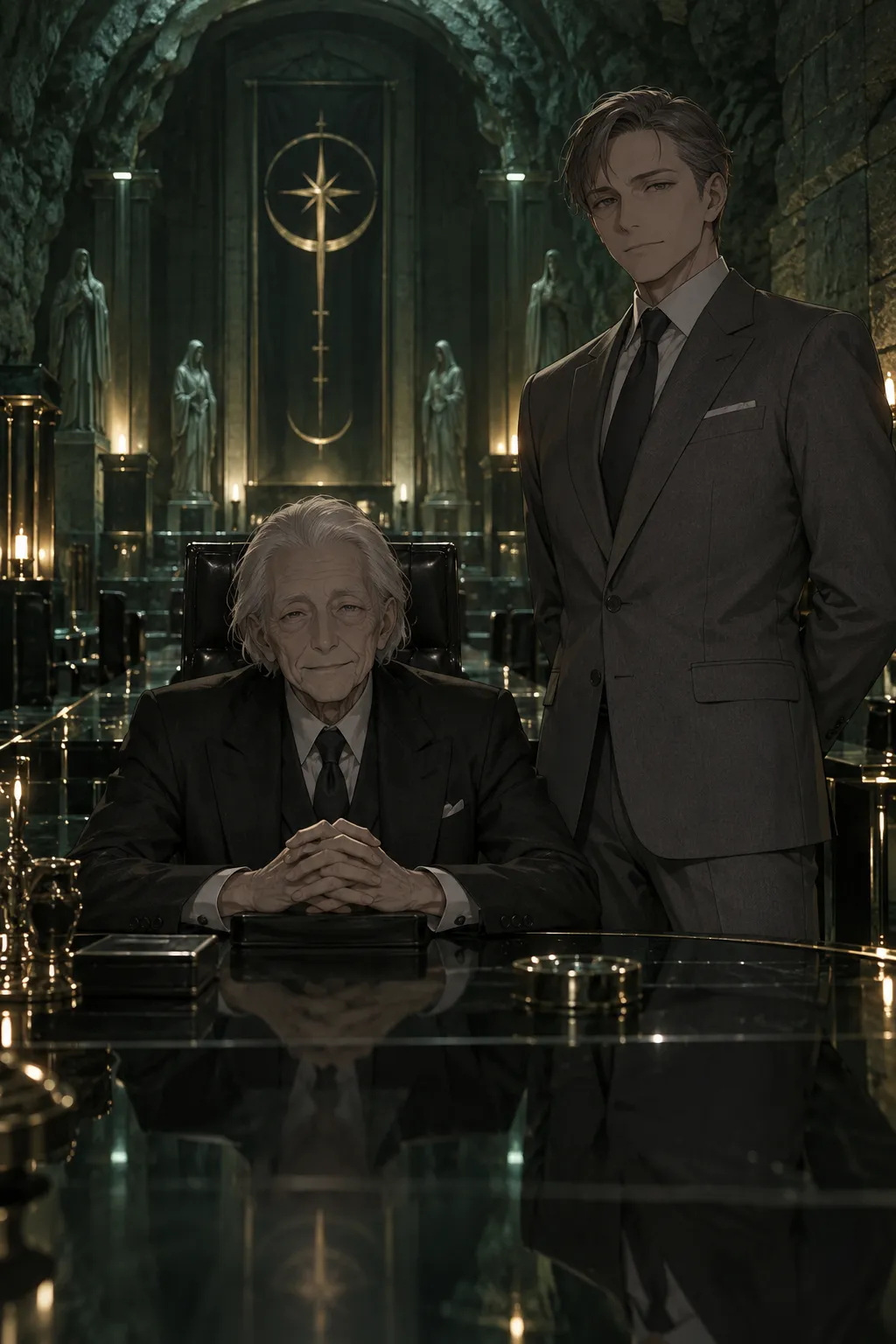
An old man was sitting at the head of a long table of black glass, a few metres away, with his hands folded in front of him. White hair. A black suit. A soft, delighted face, like a grandfather’s at a school play. His eyes were closed.
‘I am so pleased to meet you at last,’ he said. ‘I have been looking forward to it for thirty-one years. And a great deal longer than that, if I am honest, though I didn’t know it would be you.’
A tall man in a grey suit stood at his shoulder. She looked at him and, while she was still looking, could not have said what his face was like.
Kreutz stood further back, by the wall. He had changed his shoes. His cuff was still brown with her blood.
She pulled the mask off her face with her good hand. It took a long time.
‘Is he alive?’ It came out as a whisper with no voice in it at all, a shape of breath.
The old man did not need to ask who she meant.
‘Very much so,’ he said, and smiled. ‘Not two hours ago he reached into the chest of a machine we were rather proud of and took back a pair of shoes. Brother Yaroslav is in the hands of the English police, and is without his right hand again.’ He tilted his face towards her. ‘He will be coming. I expect he is on his way already. Mr. Gray will meet him at the door.’
Beside him the man in the grey suit inclined his head, very slightly.
‘You have your grandmother’s eyes,’ said the old man. ‘Tzofiya. The one who watches. The Book says the Key will be born of the line of the Watcher, and in her thirteenth year she will be made still.’
‘It’s a chromosomal variant.’ She had said it so many times in her life, to doctors and journalists and strangers who thought she was lying about her age, that it came out even now, in a whisper, in the right order. ‘Great Ormond Street. One of forty cases.’
‘Yes,’ said the old man gently. ‘That is what it looks like, from the outside.’
She stared at him.
‘A key is cut to its lock and then kept as it is,’ he said. ‘You were kept. That is all. It isn’t anything you did.’ He turned his closed eyes to the tank. ‘You need not be afraid of that water. It is only a cup of the sea, carried here a long time ago. It knows you. It has been leaning towards you since you came down the lift. But it is not the door.’ He smiled. ‘In a few hours you will go to the sea itself, and stand where I tell you, and put your hand in it. Of your own free will.’
‘No.’
‘Yes,’ said the old man, without any change at all in his kind voice. ‘Because if you do not, the boy dies. And then the bodyguard with the broken face, in the hospital. And then your Halmeoni.’ He said her grandmother’s name, the Korean word, correctly, as she said it herself. ‘Anselm told you all this in the hangar, I know. I only wanted you to hear it from me, so that you would know that it is true.’
He stood up. He did it like an old man, a little stiffly, with one hand on the black glass.
‘We will move you in an hour,’ he said. ‘Sit with it until then. People usually find it a comfort.’
He went away down the hall between the benches, with Kreutz and the man in the grey suit following, and Vrai stayed a moment longer, looking down at her with an expression that Eliana could not read at all; and then she too went, and Eliana was alone in the green light with the black water.
Not quite alone. There were people on some of the stone benches. A dozen, perhaps. More were coming in quietly at the far end of the hall in ones and twos, the way people come into a church late, and sitting down, and they all wore masks, plain white masks with no expression on them, and they were all looking at her.
She had been looked at her whole life. She knew how to sit in a chair and be looked at. She had never in her life been looked at like this, by people who did not want anything from her face at all.
The water leaned.
She did not know, afterwards, exactly when she decided. She found she was sliding forward off the edge of the black chair, very slowly, holding on to its carved arm with her good hand, and that her knees, full of glass, had found the stone floor; and the pain from the front of her pelvis when her weight came down on them went through her like a bell, and she knelt there with her head down and her eyes shut until it stopped ringing. Then she put her hands together in front of her, the broken finger and all, because she did not know what else you did with them.
She had prayed properly once in her life. In the snow, in Kamchatka, on her back, with a gunship over her and Dov being dragged through the snow by his arms. Not in words. There had only been one word left.
She had more words now. She did not know if they were the right ones. She used the ones she had.
‘Shema Yisrael,’ she said.
It came out as a whisper with blood in it. It was the first thing her grandmother Tzofiya had ever taught her, at bedtime in Kensington, holding her face in both hands: Hear, O Israel. She did not know the rest of it any more. She had not said it since she was eleven.
‘하늘에 계신 우리 아버지,’ she said. Our Father, who art in heaven. That was Eomma, in the Korean church in New Malden on Christmas Eve, with Halmeoni on her other side singing a beat behind the organ on purpose. She did not know the rest of that either.
‘I don’t know how to do this,’ she said, in English, to the floor. ‘I’m sorry. Nobody taught me properly. Babushka said every name is a prayer. So I’m going to say names. I hope that counts.’
She said them.
‘Dov.’ It came out cracked. ‘He’s in a hospital with his face broken and he’s going to get up. Please don’t let him get up. Please make him lie down for once in his life. Please let him be all right.’
‘Shai.’ She had to stop. ‘He was twenty-six. He taught Pascal a song about aubergines. He waved at the camera every forty minutes. Please, wherever he is, please let somebody be laughing with him.’
‘Amir. Natan. Yossi. Mrs. Nowak, and Pascal, and Tomasz. Harriet. Halmeoni, who isn’t to be frightened, she has a weak heart, please don’t let anybody frighten her. Toby, who fell out from behind the bananas in the palm house on the best day of my life and asked for it to be minuted. Ms. Okafor. Priya, whose Tom I couldn’t bring home alive. Misha. Sophie.’
‘Eomma. Papa.’ She was crying now, quite quietly, onto her folded hands. ‘I didn’t believe him, Papa. You said he was a good man and I didn’t listen. I’m sorry.’
The water had stopped leaning.
She did not see it. Her eyes were shut. The masked people on the benches saw it: the whole black column of the Calypso Deep, which had been pressed against the glass towards her like a face against a window, draw back, slowly, from the near side of the tank, and settle, and go still, in the way water goes still in a bowl when something that has been stirring it stops.
‘And Anselm,’ said Eliana.
At the far end of the hall, by the door, Kreutz stopped walking.
‘Because he is so frightened. I didn’t know until tonight. He’s been frightened for thirty-one years, and that’s why he sat at my eye level. Please let somebody be kind to him who doesn’t want anything back.’ She swallowed, and it hurt. ‘And the woman with no accent. Who must be so tired. I think it must be very tiring, being nobody from nowhere for so long. Please let her be somebody, one day, before the end.’
Somewhere on one of the benches, behind a white mask, somebody had begun to weep, very softly, the way a person weeps at a funeral for someone they did not know they had loved.
‘And him.’ She did not open her eyes. She did not need to; she could feel exactly where the old man had sat, the way you can feel where a fire is in a dark room. ‘Whatever he is. I don’t know what to ask for him. Please let him have been loved, once. I think that might help.’
She stopped, and breathed, in for four, round the swelling in her throat. She held it. She let it out.
‘And Aria.’
It was the first time she had said his name out loud since the night in her father’s hall when she had told him not to come back.
‘Please don’t let him come,’ she said. ‘That’s all. That’s the only thing I want for me, and it isn’t even for me. He’s going to come, I know he is, he always comes, and they’re waiting for him, they’ve got a man at the door. So please don’t let him. Please let him stay at home and be angry with me. And if he comes anyway, because he’s an idiot, then please,’ and here her voice went altogether and she said the rest of it with no sound at all, only the shape of it on her lips, ‘please let him go home afterwards. Please let him have a home to go to. He hasn’t had one since he was ten.’
She sat back on her heels, with her hands still folded, and her face wet, and blood at the corner of her mouth.
‘Amen,’ she said. And then, because she had been raised in six languages and did not want to leave anybody out: ‘아멘. Amen.’
The hall was entirely silent.
At the head of the long black table, where he had come back to stand without her hearing, the old man was standing with one hand on the glass and his closed eyes turned towards her. He had been there, she understood, for most of it. His face was doing nothing at all. It was the first time she had seen it do nothing; until then it had always been smiling.
By the door, Odile Vrai had turned her back on the hall, and was looking at the wall.
The men who came for her were not the men from Halvard.
She knew it at once, the way she would have known a different orchestra by the first chord. There were six of them, and they were older, forty and fifty, with the weathered, careful, unremarkable faces of men who had spent their lives being sent to places that did not appear in newspapers until afterwards. They spoke to one another in a low murmur of French, and something that sounded like Afrikaans, and Polish. They did not have boxer’s ears. They did not film anything.
The oldest of them, a grey man with a grey moustache, knelt down on the stone in front of her so that his face was a little below hers, and looked, not at her face, but at her hands.
‘Mademoiselle. Vous pouvez vous lever?’ Can you stand?
She shook her head.
He nodded as if he had expected that. He said something over his shoulder, and one of the others came forward with a grey blanket and put it round her, all of it, over her shoulders and her ruined blouse and her bloody skirt, and tucked it in at the sides as though he did it every night for somebody. Then the grey man put one arm under her knees and the other behind her back and lifted her.
He did it the way you carry a full glass across a crowded room. Slowly. Level. Watching her and not his feet. When her pelvis moved and she made a sound through her teeth, he stopped dead, and waited, and did not move again until her breathing had come back.
‘Pardon,’ he said. ‘Doucement. On y va doucement.’ Gently. We’ll go gently.
None of them looked at her face. She noticed it the way you notice the sudden silence when a fridge stops humming. They looked at her hands and her knees and the swelling at her throat; they looked at the floor in front of the grey man’s feet, and at the doors, and at each other. Not once did any of them look her in the face. It was not shyness. She had seen a great deal of shyness in her life and she knew it. It was something else. They were careful with her the way people are careful with a thing they have been told will break, and have decided, privately, each of them, that when it does it is not going to be in their hands.
They carried her up the hall between the masked people on the benches. Kreutz stepped back against the wall to let them pass, and when she looked at him he looked down at his clean shoes.
At the door, Vrai fell in beside the grey man, and did not look at Eliana either. She was holding the oxygen cylinder. Her face was perfectly smooth.
‘The sea,’ said Vrai to the grey man, in French. ‘By dawn.’
Behind them, as the doors of the Chapel closed, the black water in the tank leaned after her again, against the glass, as far as it could go.
第三章
Chapter ThreePOV · AriaParadeplatz, Zurich · 8 March · 04:11
Mr. Gray
He did not go straight to Zurich. ZERO would not let him.
If you fold into that church now, it had said, in the back of the Volvo, at the moment the drives touched forty percent, you will arrive with a hole through your shoulder and sixty-one percent of your armour, in a room full of people who have had a month to think about what to do when you walk in. Give me until three.
So he had folded to the Nave first.
He had lain in the Cradle in the green light under Wytham Woods with the armour open round him like a white flower, while it took a crate and a half of scrap aluminium from the salvage yard at Didcot, and the lead flashing off a church roof in Eynsham that had been sitting in the corner since November, and a broken lawnmower, and ate them, and grew back the plates the Nephil had torn off him and the four blades he had lost over the runway. While it did that, it went into him. He felt it go into the hole under his collarbone from both sides, thin and cold, and close it from the inside out, the way it had closed Dov’s side in the snow. He felt it go round the broken ribs and set them, and splint them, and hold. It did not take the pain away. It never had. Ilyinskaya had refused to let it. Pain is information, she had said, in the kitchen at Wytham, with a ten-year-old’s grazed knee in her lap. Machines that take away pain also take away the reasons.
The boots are still asleep. I have not woken them. They have had a long night.
At 03:11 Greenwich, which was 04:11 in Zurich, he folded.
The Paradeplatz at four in the morning in March is a wide wet square of black stone with tram rails across it shining like knife blades, and sleet coming down slantwise through the light of the lamps, and nobody in it at all.
There was somebody in it now.
He stood in the middle of the tram rails in the sleet, white and gold and blue-violet, with his wings folded down his back and the halo faint behind his head and the water running off the plates of his shoulders, and the six night cameras of the six banks on the square turned on their brackets, one after another, with small electric whines, to look at him. He did not care. He found, standing there, that he did not care about anything at all except the building in front of him.
It was old and grey and plain. It had no name on it. It had a pair of bronze doors, and above them a stone lintel carved with the year 1741 and nothing else.
He put his hand on the doors.
They were not bronze all the way through. Under a skin of bronze they were thirty centimetres of hardened steel, and under that, he felt with his palm, a thin wet lining of something that tingled, like the inside of a shell. He did not bother to be careful. The silver went into them from his hand in one hot rush and they were not doors any more, and he walked through the place where they had been, and they ran down behind him onto the step like wax.
An alarm began somewhere. Nobody came.
The lobby was marble and dark wood and a single lamp. At the far end of it there was a lift with a brass gate, standing open, and inside it there were no buttons.
Dov, there is a lift in there with no buttons.
He did not get into it. He put his hand flat on the floor of it, and the floor went silver, and he let it go, and it fell, and he went down the shaft after it.
It was a long way. He counted it without meaning to, the way ZERO counted things: a hundred and ninety metres, straight down through the rock under the city, through the vaults where Zurich kept the gold of half the world, and further, past where any bank had ever needed to go, until the shaft walls stopped being concrete and began to be bare stone, and then began to sweat. Salt water. He could smell it. Three hundred kilometres from the nearest sea, the rock round him was weeping seawater the way the walls of a room under Geneva had once wept it round his father.
The lift floor hit the bottom ahead of him with a sound like the end of the world. He landed on it a second later and went through it, and through a pair of black iron doors beyond it, and into the Chapel.
They were all there.
That was the first thing he understood. Not a dozen. The whole long hall of benches under the green lamps was full, from the doors to the steps of the tank: eighty people, perhaps more, in dark coats and good shoes, with plain white masks over their faces, sitting in rows as if for a service, and every white mask had turned at the sound of the doors to look at him. They had been waiting. They had been called here in the middle of the night, from their houses on the lake and their banks and their ministries, to watch the angel come through the door.
Along the walls between the lamps stood men with guns.
At the far end, at the head of a long table of black glass, under the tank, an old man sat with his hands folded and his eyes closed. A tall man in a grey suit stood at his shoulder.
The Chapel, Zurich, 8 March, 04:14. “Gabriel’s boy.”
‘Gabriel’s boy,’ said the Patriarch.
His voice was not loud. It carried the length of the hall the way a voice carries in a church that was built to carry it.
‘Come here,’ he said. ‘Let me look at you.’
The men along the walls opened fire.
He had expected it. ZERO had drawn it for him a quarter of a second before the first trigger moved: sixteen men, sixteen rifles, and in the magazines of eleven of them, rounds with something in their tips that was not lead. They hit him from both sides in a long hammering roar that filled the Chapel with muzzle-flash and the scream of ricochets off the rock, and most of them sank into the white plates in soft rippling rings, the way bullets always had; but the eleven did not sink. Where they struck, they burst, and something black and wet splashed across the plates and clung, and where it clung the white went dark in spots the size of coins, and stung.
Calypso water, said ZERO. In the tips. They have been making these since Kamchatka.
‘Bits.’
Sixteen blades left his wings. They went down the hall along both walls in two long glittering lines, a hand’s breadth above the heads of the masked people on the benches, so close that the masks fluttered in the wind of them, and every rifle along the walls went silver in the hands that held it, and ran out of those hands onto the floor as a fine bright dust, and blew away. It took less than a second. The men who had been holding the rifles stood with their hands still up and empty, in the shape of holding something, and stared at them.
Nobody else moved.
He walked up the hall between the benches.
He was aware of the white masks turning as he passed them, row after row, the way flowers turn. He was aware of a woman in the third row with her hands pressed over the mouth of her mask, and a heavy man near the front with cufflinks in the shape of a little silver anchor, and of the sweet, heavy smell of the incense, and of his own heartbeat, which was very slow. He was aware, mostly, of the tank.
It was leaning towards him.
Not the way it had leaned towards her, he would learn later, gently, like a dog at a door. Hard. The whole three-metre column of black water was pressed against the near side of the glass so violently that the glass creaked in its iron frame, a long low groan that went on and on, and the surface of the water at the top of the tank was not level any more but tilted, towards him, as if the whole of it were trying to pour out of the tank sideways and across the floor to where he was.
The Patriarch tilted his closed eyes towards it.
‘It knows you,’ he said, and for one moment his kind face showed something that was not kindness: an interest so sharp it was almost hunger. ‘How very strange. It has never done that for anyone.’ Then the smile came back. ‘It knows what you are wearing, I expect. Stolen goods always want to go home.’
ZERO System · 04:15 CET
Pilot heart rate 51. You are very calm.
I do not like it.
‘Where is she?’ said Aria.
‘Gone to the sea,’ said the Patriarch. ‘Twenty minutes ago. You are a little late, I’m afraid. You usually are. You were four minutes late to the A44.’
Something in the Chapel went silver.
He did not do it. He did not mean to do it. It went out from his feet across the stone floor in a ring of frost that ran under the benches and up the legs of them and over the good shoes of the people sitting on them, and they drew their feet up, gasping, like people on a beach when a wave comes further than they thought it would. It stopped at the foot of the steps. It did not touch the tank. Nothing in him would go near the tank.
The man in the grey suit stepped out from behind the old man’s chair.
‘Father,’ he said. ‘Go.’
The Patriarch turned his head.
‘He took the Nephil apart with one hand,’ said Mr. Gray. He did not raise his voice. He had the voice of a man who has never in his life needed to raise it. ‘He came through that door as if it were paper. You wanted to look at him. You have looked at him. Now go, and do what you have waited for, and let me hold the door.’ A pause. ‘I have held gates before.’
For a moment the old man said nothing at all. Then he stood, stiffly, the way old men stand, with one hand on the black glass, and turned, and lifted his other hand, and laid one finger on Mr. Gray’s shoulder, very lightly, the way you lay a finger on the head of a child.
‘My first,’ he said, quite softly.
Then he went. Not towards the doors. Round the end of the table and behind the tank, where there was a low door in the rock that Aria had not seen, and through it, without hurrying, and the door closed behind him.
Aria went after him.
He was across the steps and past the end of the table in a twentieth of a second, wings half open, his hand already reaching for the low door; and a hand came out of nowhere and closed round his wrist.
A human hand. A man’s hand, with a plain gold cufflink at the wrist, in a grey sleeve.
It stopped him dead.
He had been stopped before. He had been caught by the Nephil over a runway three hours ago, and he had felt that through every plate he owned. This was not that. This was a man in a grey suit, standing on the stone floor in polished shoes, holding the wrist of the Pantheon in one hand as though it were the wrist of a child reaching for a hot pan, and not moving it, and not being moved by it, while the Psycho-Frame screamed gold up and down Aria’s spine and the floor under the man’s shoes cracked in a slow star.
‘No,’ said Mr. Gray.
Then he threw him.
He went the length of the Chapel in the air.
Over the long table, over the benches and the masks, which ducked, and into a pillar of the living rock beside the doors, which did not give, and then through it, because the pillar gave after all. He came down in a landslide of stone onto the bench nearest the door and broke it in half, and two masked men fell off the end of it and scrambled away on their hands and knees across the frosted floor, and he lay on his back in the rubble with the green lamps swinging on their chains above him and every one of ZERO’s lines in his visor gone red.
That was not a man, said ZERO.
‘No.’
He got up.
At the far end of the hall, Mr. Gray was taking off his jacket.
He did it without any hurry at all. He took it off, and shook it out, and folded it in half along the seams and laid it on the black glass table, the way a man lays his jacket on the back seat of a car. He loosened his tie, and took it off, and laid it on the jacket. He undid his cufflinks, both of them, and put them in his trouser pocket, and rolled up his sleeves, twice each, to just below the elbow. Then he came down the steps.
And the grey came up out of him.
It came out of his forearms first, where he had rolled his sleeves. A grey like ash on the skin, like the ash on the arms of a man who has been standing too near a fire; and then it was not ash, it was hard, and it moved when he moved, and it was spreading. Up his arms under his shirt. Out of his collar and up his neck and over his face. It came up through the white cotton of the shirt and the cloth fell away from it in rags. It built itself on him as he walked, plate on plate, in the green light, in the colour of a wet pavement, and it was armour, but it was not the Pantheon’s. It was cruder. Older. The plates were thick and blunt and overlapping, like the scales of a fish, or like bronze hammered on a stone; there was a high ridged crest on the head like the leather cap of a soldier in some very old picture, and no crown, and no halo, and no wings. Where the Pantheon’s visor was, there was a smooth grey face with two dull pale shapes in it like pearls that had been left too long in a drawer. And as he came down the last step, a spear grew out of his right hand, grey, long, with a broad leaf-shaped blade, the way the boots had once grown out of Aria’s hands in a muddy street.
It was the Pantheon drawn by a child who had only ever heard it described, three thousand years before it was built.
ZERO System · 04:17 CET
Composition: ELS. Our kind.
Old. Very old. Age of substrate approximately three thousand two hundred years.
No Heart. Similarity to our armour: 22%. Aria. It is one pearl. One. Grown in a single human body for thirty centuries.
He came up the hall between the benches at a walk.
Then not at a walk.
He was faster than the Nephil. That was the first thing Aria learned, and he learned it with his face. The grey spear came at him and he had the Singularity Blade up and the spear was not there, it was low, at his knee, and the knee went, and as he went down on it the grey fist came round and hit him in the side of the helmet, and the visor cracked from the brow to the jaw, and the Chapel went white and rang.
He came up. Mr. Gray hit him again.
He did not fight like the Nephil had fought, which had been like fighting a mirror. He fought like nothing Aria had ever met. Every blow was something that had worked before: on a man with a bronze sword at a burning gate, on a man with a pike in a breach in a wall, on a man with a bayonet in mud. It was all the war there had ever been, in one body. He used the spear and the butt of the spear and his elbows and his knees and his forehead, and the stone floor, and the benches, and the people on them; once, when Aria cut at him, he took a masked man by the collar off the nearest bench and held him up in the way of the blade, and Aria had to turn the edge, and in the turning the spear went into his side under the arm, through the plates, and he felt it scrape.
‘I held the sea gate at Ugarit,’ said Mr. Gray.
He said it conversationally. He was not even breathing hard. He pulled the spear out of Aria’s side and turned it in the same movement and drove the butt of it into Aria’s throat, and Aria went back into the wall.
‘For a night and a day,’ said Mr. Gray, coming after him. ‘With a bronze spear and a wound in my side you could have put your fist into. I was seventeen. Behind me the last boats were filling with the last people of my city, and I held the gate until every one of them was gone. Every one.’ The spear came down. Aria caught it on the blade. They stood locked, the grey and the white, with the Chapel shaking round them. ‘In the summer of five hundred and forty-two, in Constantinople, when the plague came and the dead were stacked in the towers of the city walls because there was nowhere else to put them, I carried living children out of those towers. Two hundred and eleven. I counted. I stood on the walls of Vienna in 1683. In 1827 I went into the water at Navarino, when the fleets burned, and brought out men who did not speak my language, nineteen of them, one at a time.’
He twisted the spear. Aria’s blade went sideways. The grey fist came in under it and hit him in the broken ribs, the ones the armour had just splinted, and they went again. He heard them. He tasted blood.
‘I have saved more lives,’ said Mr. Gray, ‘than you have met. And you.’ He stepped back. He looked at the white figure on its knees on the frosted floor with something that, on a face, might have been contempt. ‘What have you done? Played at angels for two years in a suit made of stolen flesh. Caught some aeroplanes. Stopped some missiles that men had been foolish enough to fire. He told me I would do more good than any man who ever lived.’ The spear came up. ‘And I have.’
Aria spat blood into his own helmet.
‘He told you,’ he said.
‘He chose me.’
‘He chose you.’ Aria got one foot under him. ‘In the burning street. Out of the whole city. He walked down the street with his eyes shut and the raiders let him through as if they couldn’t see him, and he picked you.’
For the first time, Mr. Gray was still.
‘Do you know what’s in that tank?’ said Aria.
‘The Deep.’
‘It’s a mouth.’
He said it into the silence of the Chapel, and eighty white masks heard it.
‘It came down out of the sky five million years ago and lay down in the bottom of the sea,’ he said, ‘and it sings, so that the ones who sent it can find this world. And when they come, every world that hears the song is swallowed. Four hundred and eleven of them, so far. This one is going to be the four hundred and twelfth. That’s the Deep. That’s what your Book means by they shall stand beside the First upon the ruins of the stars. It’s a harvest. It was written down by the harvested.’
‘Lies.’
‘My father read it on a cave wall.’ He was standing now. ‘In 1997. Forty nights with a lamp. Under Ras Shamra. Under Ugarit, Mr. Gray. Under your city. It was carved into the rock there five million years before you were born. It was under your feet the whole night you held the gate.’
The grey face did not move. The pale shapes in it did not move.
‘Has he ever opened his eyes?’ said Aria.
Nothing.
‘In three thousand years. Once. Have you ever seen him eat? Has he ever been cold? Has he ever once told you where he was born?’ He took a step forward. ‘Has he ever said anything to you that you took for a figure of speech?’
And there, in the green light, under the masks, he watched it happen.
He watched it go through the grey armour like a crack goes through ice when you put your weight on it at last. Not quickly. A long, slow, splitting stillness, beginning somewhere deep inside the man, at the bottom of thirty centuries, and travelling outward. He saw it reach the hands; the spear in the grey fist trembled. He did not know what it was that Mr. Gray remembered in that second. He would never know. A meal not eaten at a long table in Byzantium. A pair of eyelids that had never once opened in candlelight in Vienna, in Paris, in a room in Moscow in 1993. An old man sitting in the green light last night, smiling at the red on the glass, saying softly, I remember when all of this was salt.
‘No,’ said Mr. Gray.
It was not an argument. It was a sound.
‘No.’ Louder. ‘No.’
And the grey armour grew.
It came up out of him like a fire coming up out of a dry wood when the wind finds it.
Plates bloomed on plates. The crest on his head went up and back in a long ragged blade of grey. Spikes came out of his shoulders and his elbows and the backs of his hands, crooked, wrong, like the thorns of a plant that has grown in the dark. He was taller. He was taller every second, two metres, two and a half, three, and his voice when it came out of the grey face was no longer the voice of a man who had never needed to raise it. It was a roar.
It is eating him, said ZERO. The pearl. Without a Heart it has only his will to tell it what to be. His will has just broken. It is growing into the gap.
The spear came at him like a train.
It did not come at the blade. It came at the floor at his feet, and the floor came up in a fountain of stone, and in the stone came the grey shape, and it took him round the waist with both arms and carried him backwards the length of the steps, and up them, and into the tank.
The glass broke.
All of it, the whole three-metre column, in one enormous bursting crack like a bell splitting, and eight tonnes of the deepest water in the Mediterranean came out over the steps and the black glass table and the front rows of the benches in a single cold black wave, and over him.
He went down under it.
It was the lake at Worcester and Port Meadow and the shell above the ecliptic all at once, and it was not a jar or a glass core or a splash on the tip of a bullet. It was the whole cup of the sea, all over him, in his joints and his seams and the crack across his visor, and it was singing. The armour answered it from every grain. He felt it begin at once, everywhere, the long sweet terrible loosening, as if every plate on him had been waiting all its life to hear its name called in that voice and had just heard it; the white going black from the edges inward, the blades going dark in his wings, the plates over his heart lifting away from him, gently, towards the water, wanting in.
And the grey thing in the water with him laughed.
It knelt on his chest in the flood on the steps where the tank had been and laughed and laughed, and hit him, and the water made it stronger. He could see it. Every time the song went through the Chapel the grey plates thickened, and the crooked spikes grew longer, and the pale shapes in its face burned brighter, because whatever it had told itself for three thousand years, it had been made of the same thing as the water, and the water was calling it too, and to Mr. Gray’s one pearl the call was not come home. It was more.
‘Do you feel it?’ It hit him. The visor cracked again. ‘Do you feel it, thief? It’s mine. It’s always been mine. I had the power of the Deep in me when your father’s fathers were scratching in the dirt, and I did good with it.’ It hit him. ‘I did good with it.’
Armour integrity fifty-one, said ZERO, very fast. Forty-four. Aria, the left wing has gone dark, the chest is— Aria. She isn’t here. There is no heartbeat for you to hold. You have to hold it with something else.
He knew.
He lay on his back in the black water under a three-thousand-year-old soldier with the Chapel ringing round him and the song in every grain of him, and looked for something to hold it with, and found that he did not have to look very far.
It was not her voice this time. It was the other thing. The thing that had come up out of the bottom of him over Jericho. He had been holding it down all night, since the fourth Grigori, since the hall, since a white hand open on a black and white floor, reaching. He had held it in the field and in the Nave and in the square. He did not hold it any more.
He did not send it into the drives. He had learned that much. Not in temper. He sent it into the armour instead, into every plate that was turning away from him towards the water, and said to each of them, in the only voice the Psycho-Frame had ever obeyed:
Mine.
The black stopped.
Then it went back. Not slowly. All at once, from his heart outward, the way a shadow goes when a door is opened into a dark room, and the plates came down onto him again like hands, and the blades in his wings blazed blue-violet in the black flood, and the song went on, and on, and the armour heard it, and did not care.
He put his hand flat on the grey chest above him, and stood up.
Mr. Gray hit him with the spear.
He hit him with everything. Aria saw it come. ZERO drew it for him in a single fine gold line, from the grey shoulder to the centre of his own chest; three thousand years of a man who had never once lost, behind a blade of living metal, with the song of the Deep pouring into it. He did not move. He let it come.
It hit the plate over his heart, and broke.
Not the plate. The spear. It went to pieces against the white like a pane of glass against a wall, and the pieces fell into the water round their feet and lay there, grey, and did not move.
Mr. Gray looked at the stump of it in his hand.
Then he hit Aria with his fist, and Aria caught it. He caught the grey fist in his own right hand, in the palm, and closed his fingers round it, and held it, exactly the way it had held his wrist ten minutes ago: not moving it, not being moved by it. The grey thing pushed. It pushed with its whole body, three metres of it, roaring, with the song in it, and the floor under its feet broke and sank, and Aria did not go back one centimetre.
He squeezed.
The grey fist folded up in his hand like a paper cup.
‘You had one pearl,’ said Aria.
He said it quietly, the way Mr. Gray had said no. He had been very angry, he understood, for some time, and it had made him very calm.
‘One. Off the floor of a beach. Something it let fall in its sleep, and an old man picked up and put in you, and you grew it for three thousand years.’ He did not let go of the fist. ‘I have its heart.’
He opened his other hand.
And Mr. Gray’s armour came to it.
He did not have to call it. He did not have to say come home, the way he had to the boots, and the boots had been his own. He only opened his hand, palm up, in the green light, in the flood, the way you open a hand to a bird; and every plate on Mr. Gray, every scale and spike and the long ragged crest and the grey of his face, turned towards it the way the blades of the Pantheon turned towards the song. The way iron filings turn towards a magnet. The way the black water in the tank had leaned towards him through the glass, groaning, because it knew what he was wearing.
It had never been Mr. Gray’s. It had been lost, for three thousand two hundred years, and looking for its Heart.
It came off him in rivers.
It came off the crest first and ran down over the grey face in streams, and off the shoulders and the arms and the crooked thorns, and across the air between them in long grey ribbons that went pale as they went, then white, then silver, and poured into Aria’s open palm and were gone into him; and where it had been, there was a man again. A tall man in grey trousers and the rags of a white shirt, standing in black water to his shins, with one hand crushed in Aria’s fist and the other clawing at the ribbons as they left him, trying to hold them, to push them back into himself, and they went through his fingers like smoke.
And three thousand two hundred years came back to him all at once.
Aria watched it happen. He did not look away. He had decided, lying in a frozen field outside Kidlington, that he was finished with looking away from things.
The hair went first. It went white from the roots, and then it was not there; it came away from his scalp in handfuls and drifted down onto the black water and floated. The skin of his face went grey, and then yellow, and then tight, tight over the bones, until it was parchment, until it was paper, and split at the corners of the mouth. The teeth went. The eyes, which had been grey, the forgettable grey of a man nobody remembers, clouded white like the eyes of a fish on a slab, and sank into his head. The arm in Aria’s hand was not an arm any more but a bundle of sticks in a sleeve.
And he screamed.
He screamed in a voice that was not any longer the voice of a man who had never needed to raise it, but a high, cracked, ancient voice, a voice from the bottom of a well, in a language that had not been spoken on Earth since the last boats left Ugarit and then, as if he had remembered at the last where he was, in English.
‘But I had the power of the Coil!’
The last of the grey went out of him into Aria’s palm.
‘Impossible—’ It was a rattle now. His jaw would not close on it. ‘Impossible— I am— I am unstoppable— I am—’
He was right.
He had been right once. Three thousand years ago, in a world where nobody had ever heard of living metal, a boy with one pearl in him had been unstoppable. He had held a gate for a night and a day. He had carried children out of the towers of Constantinople and pulled drowning sailors out of the fire at Navarino, and every one of them had been real, and he had believed with the whole of his long, patient, broken heart that he was the hero of the story. He had been, for a while. Then the world had moved on round him, as it does, and for the last forty years he had stood at an old man’s shoulder in a Chapel under Zurich, in a grey suit that nobody would ever remember, waiting to be told what the story had been about. Tonight somebody had told him.
Aria opened his hand.
There was nothing left in it to hold. A grey sleeve, and some dust, which fell into the black water and lay on it, and the water took it, slowly, the way the sea takes ash.
On the black glass table, behind him, a grey jacket lay folded in half along its seams, with a tie laid on top of it, exactly as its owner had left them.
Nobody in the Chapel moved.
They sat on their benches in the flood with the black water round their ankles, eighty of them, in their dark coats and their white masks, and looked at him, and did not run. He thought afterwards that it was because they could not. They had all held a grain once. They had all felt it go out of them again, and spent the rest of their lives paying to feel it a second time. They had just watched what happened, at the end, to a man who had been allowed to keep one.
He let the bits go.
Every blade he had went out of his wings into the green light, and went down the rows, and found the masks one after another. They did not touch the faces under the masks. They touched the masks, and the masks went silver, and ran off the faces like water and were gone; and the Children of Tehom sat in their rows in the flood, unmasked, with their real faces turned up to the lamps. He knew some of them. Everybody in the world would have known some of them. A minister of something. Two bankers. A man who appeared every Sunday on the Swiss television, talking about ethical investment.
Then the frost went out from his feet across the floor again, and this time he did mean it. It went up the stone legs of every bench and over the good shoes of everybody sitting on them, and up their ankles to the knee, and set hard. Nobody would be able to move it. He was sure of that. Not until he came back for it, or someone very patient with very good tools spent a week chipping at it, while the police of the canton of Zurich took eighty photographs.
He went to the low door in the rock behind where the tank had been, and opened it.
A tunnel, dry, lit with the same green lamps, going away a long way downhill towards the lake. Footprints in the dust on its floor. Only a few. They stopped, ZERO told him quietly, fifty metres in, as though whoever had made them had stopped walking there, and had not needed to walk any further.
There is no signal, said ZERO. From her. Nothing. They have shut her in again. A pause. A helicopter lifted from the roof of a building on the Bahnhofstrasse at 04:02 and went south. I could not follow it from here. I would not know how to look for it now.
He stood in the doorway in the green light for a while.
Then he went back up the shaft, and out through the place where the doors had been, into the Paradeplatz, where it was still sleeting, and there were blue lights now at both ends of the square, and men in the uniform of the cantonal police standing very still behind their cars. They did not shoot. He did not ask them not to. He went up past the lamps into the dark, with the frost going off his shoulders in the sleet, and ZERO counted his heart rate, which was fifty-one, and said nothing at all.
The Meridian jet came down at Kloten at a quarter past five, and taxied to a stand at the far end of the general aviation apron, and before its engines had spun down there was somebody standing under its wing in the dark.
Toby came down the stairs first. He had changed into a jumper. He stood at the bottom of the steps and looked at Aria, who was standing in the sleet in his own skin again, in a torn white shirt with the blood dried brown down one side of it and one trainer, and his face did several things very quickly, one after another, and then settled on none of them.
‘Where is she?’ he said.
‘Gone.’ Aria’s voice came out hoarse. ‘South. Before I got there. They’ve shut her in again.’
Toby nodded. He went back up the steps, and came down again with the Waitrose bag, and took out the clean white shirt from the drawer in Aria’s room, and held it out.
‘Put that on,’ he said. ‘You’ve been on the news in that one.’
Dov came down the stairs behind him very slowly, one step at a time, with Yossi’s hand under his arm and the drain bag in his other hand. At the bottom he stood and looked at the boy in the sleet.
‘The lift,’ he said.
‘I found it.’
‘And?’
Aria looked at him. ‘There was a man at the door,’ he said. ‘There isn’t now.’
Dov held his eyes for a long moment, and nodded once, the way he had nodded on a towpath at five in the morning a week ago, when a voice in the mist had said nobody.
They sat in the jet with the door shut and the cabin lights low, and waited, because there was nothing else to do. Toby sat with a laptop on each knee and the Tin on the seat beside him, wired into the jet’s wifi, and did what he could with a world that was not Oxfordshire: public flight-tracking sites, the radar enthusiasts in their forums, the port cameras of every harbour on the Italian coast that had a webcam for the tourists. Dov sat with his eyes shut and his pistol on his knee and the drain bag on the floor between his feet, and every so often his phone buzzed, and he listened to it, and said ken, or lo, and put it down. Aria sat by the window with his hand flat on his chest, over a heartbeat that was not there.
At half past six Toby turned one of the laptops round.
‘He said the sea,’ he said. ‘Your man with no hand. Over the place where the thing sleeps.’ He tapped the screen. ‘You told me in the car. The thing in the Deep. The Calypso Deep.’
On the screen was a map of the Mediterranean, and a single pin in the blue between Greece and Sicily.
‘Deepest point in the Mediterranean,’ said Toby. ‘Five thousand two hundred and sixty-seven metres. In the Hellenic Trench. Sixty kilometres south-west of a town called Pylos, in the Peloponnese.’ He looked up. ‘If I were a mad old man and I wanted to put somebody’s hand in the sea over that, I wouldn’t go to Sicily, and I wouldn’t go to Crete. I’d go to the nearest bit of land.’
Dov opened his eyes.
‘Kalamata has an airport,’ he said, after a moment. ‘Ezra says a Falcon with no transponder landed there at twenty past seven, Greek time.’ He reached down for the drain bag. ‘Tell the pilots.’
The jet left Zurich at seven, in the first grey light, with the sleet turning to rain on the windows, and went south over the Alps towards Greece, and the boy by the window sat with his hand over his heart all the way, waiting for it to beat.
第四章
Chapter FourPOV · ElianaSapientza, Messenia · 8 March · 08:50
Sapientza
The island was called Sapientza, which is an old Venetian word for wisdom. Nobody had ever told her why.
She saw it from the boat, in the low morning light, lying across the mouth of the sea south of a little white town with a castle: a long green hump of an island, wooded with something dark and shaggy, with cliffs on its seaward side and, on the highest point at the southern end, a white lighthouse with a red lantern, standing up against the sky like a lit candle someone had forgotten to blow out. There was nothing else on it. No village. No harbour. A concrete jetty in a cove on the landward side, and a track going up from it through the trees.
The sea was very blue. She had not expected that. She had expected it to be black.
The grey man with the grey moustache carried her up the track himself, with the blanket round her and the oxygen cylinder in a canvas bag over his shoulder, and stopped every forty metres to let her breathe, and did not speak. Behind them two of the others carried a long narrow box that she did not look at.
At the top of the track there was a house beside the lighthouse. It had been the keeper’s house once, a long, low, whitewashed building with blue shutters, and somebody had bought it and filled it with very good furniture and nobody had ever lived in it. She could tell. It had the smell of a house where nobody has ever cooked.
They put her in a room at the end of it.
It had a bed, and a chair, and a window with blue shutters that were closed and bolted on the outside, and it had been lined. Somebody had stood barrels along every wall of it, from the floor to the ceiling, dull grey steel barrels like the ones oil comes in, packed so close together that there was no wall left, only barrels; and every barrel was full. She knew what they were full of. She could smell it through the steel, the smell that had been in the box: a deeper sea than any sea that has ever seen the sun.
The grey man laid her on the bed. He put the oxygen within her reach, and a jug of water, and a plastic cup, and then, after a moment, he folded the blanket back and looked at her knees, which were full of glass, and went out, and came back with a bowl and a pair of tweezers and a bottle of something brown, and knelt on the floor by the bed and took the glass out of her knees, one piece at a time, without once looking at her face.
It took him forty minutes. He was very gentle. She bit the inside of her cheek and counted, in for four, and did not cry, and when he had finished he wrapped each knee in a clean white bandage and tied the ends, neatly, like a parcel.
‘Merci,’ she said.
He stopped, with the bowl in his hands. For a moment she thought he would look at her. Then he got up and went out without a word, and she heard the bolt go across on the outside of the door.
On the inside of her left wrist, the faint, fine line under the skin, finer than a hair, all the way round, was cold.
She had always been a person who counted things.
It was the only useful thing she knew how to do, and she did it now. She lay on the bed in the barrel room with her eyes half closed and counted.
Six men. The grey one, who was in charge, and spoke French. Two who spoke the clipped flat English she had heard once from a South African cameraman on her mother’s show. One Pole, the youngest, perhaps thirty-five, who said kurwa very softly whenever he dropped anything. Two she had not heard speak at all. They had been here before her; there had been others on the island already when the boat came in, she had seen them on the track and at the windows. Twenty, perhaps more. They had rifles, and some of them had bigger things, long things in green cases that had to be carried by two men, which they set up on the roof of the house and by the lighthouse and at the head of the track, pointing at the sky.
The door was locked from outside, with a bolt that went across at the top. Somebody sat in a chair outside it. Every forty minutes, by the clock she could hear ticking somewhere in the house, there was a murmur of voices and a scrape, as the chair changed hands.
Kreutz was in the house. She heard him once in the corridor, asking somebody in German whether there was any decent coffee, and being told that there was not.
The woman with no accent came to see her at half past nine.
She came in and shut the door and stood with her back to it for a while, looking at the barrels. Then she sat down on the chair by the bed and took Eliana’s right wrist in her fingers and counted, as she always did, without asking.
‘Sixty-eight,’ she said. ‘Better.’ She did not let go of the wrist. ‘You said a prayer for me last night.’
Eliana said nothing.
‘Nobody has done that before,’ said Odile Vrai. She said it the way she said everything, as though it were a fact about the weather. ‘I was very surprised. I don’t like to be surprised.’ She let go of the wrist at last and folded her hands in her lap. ‘He is coming, you know. That is the whole point of you.’
‘I know.’
‘And when he comes, they will shoot at him with everything they have brought to this island. And if that doesn’t work, which I expect it won’t, then the Patriarch will come up out of the sea and deal with him himself. And at some point in all of that, my dear, you are going to walk down to the water and put your hand in it, of your own free will, because you will understand that it is the only thing in the world you can do that will make them stop.’ She tilted her head. ‘Love always says yes. I told your father that. He didn’t believe me either.’
‘You killed my father.’
It came out of her ruined throat with no voice in it, a shape of air.
‘Yes,’ said Odile Vrai. ‘And your mother. And a good many other people.’ She stood up. ‘You’ll find, if you live long enough, that it doesn’t make as much difference as you’d think. One goes on.’ At the door, she stopped. Her back was to the room. ‘He killed Mr. Gray, by the way. Four hours ago, in Zurich. With his bare hand. I’ve never seen the Patriarch’s first fall to anything. Nobody has, in three thousand years.’
She went out. The bolt went across.
Eliana lay on the bed with her heart going very fast, so fast that she could feel it in the cut on her cheek, and thought, quite clearly, the way she had once thought not where he lives on a muddy street in Kamchatka:
He doesn’t know where I am.
She put her fingers on the inside of her left wrist. Cold. A line finer than a hair, all the way round, like a vein that went nowhere.
She had understood it on a stretcher on the apron at Kidlington, in the last seconds before the dark. She had told him to let go, and he had let go, and he had not let go at all. It had been warm every night for eleven nights. It had gone cold in the box in the van, and warm again on the apron under the open sky, and he had been coming; she had felt it on the stretcher, before the dark. And then they had put her back in the box, and it had gone cold again, and he had not come.
The box was lined with something that smelled of the deep sea.
This room was lined with barrels of it.
They know. Not what it was; she was sure of that. Vrai would have taken her wrist in her hands and turned it to the light if she had known. But they knew that something about her called him, and that the deep sea stopped it. And so they had put her in a room made of the deep sea, and waited for him to come looking, blind, so that they could shoot at him with everything they had carried onto this island in green cases.
She lay and thought about that for a long time.
Then she began to count again. Differently.
The barrels went all the way round the room. She had seen that when they carried her in. All four walls, floor to ceiling, and across the inside of the shuttered window, and two deep beside the door. But not across the door. They had needed to get in.
Beyond the door there was a corridor, whitewashed, with a tiled floor, ten steps long; she had counted the grey man’s steps as he carried her down it. At the far end of the corridor there had been a door to the outside, standing open on the morning, with the sea beyond it and the lighthouse to the left. Beyond that there was a paved yard, and on the far side of the yard, the steps up to the foot of the lighthouse, white, worn, twelve of them.
She did not know how far the barrels reached. Whether it was the room, or the house. Whether she would have to get as far as the yard, or the steps, or further.
She knew she could not walk.
She tried it, at ten o’clock, when the chair outside had just changed hands and the new man had settled into it and she could hear him reading something on his phone. She got her legs over the side of the bed, and put her feet on the cold tiles, and her bandaged knees took her weight for about a second, and then her right hip took it, and something in there, deep down, under the place where the surgeons had put the plates, grated like a stone in a shoe, and she sat down again on the edge of the bed so fast that she bit her tongue, and stayed there with both hands pressed to her hip and her eyes shut until the white went away.
She could not walk. She could, perhaps, run. Running was different. Running was falling forwards and getting your feet under you before you hit the ground. She had done it once across a field of soldiers in her socks. She had done it in the hall at Norham Gardens on her hands and knees.
She did not think about what it would cost. She had a very good idea what it would cost. She thought about the line on her wrist instead, and about the green cases on the roof, and the man on the runway, and the sound like the end of the world, and how long he had been flying blind.
She waited until 10:40.
At 10:40 the chair outside the door scraped, and two voices murmured, and one of them laughed, and footsteps went away down the corridor. The changeover. She had counted three of them. Each time, for about a quarter of a minute, the new man went to the kitchen halfway down the corridor first and put the kettle on, because there was no decent coffee and they had all decided that tea was better than nothing, and he left the bolt across and the chair empty while he did it.
She did not know how she would open a bolt that was on the outside of the door.
She did not have to. When she put her hand on the handle and pulled, it opened, because the man who had just gone off watch had forgotten to shoot the bolt across behind him when he looked in on her at the end of his watch. She had heard him look in. She had lain with her eyes shut and her breath thin and slow, and let him see a small grey-faced girl asleep on a bed, and he had gone out quietly so as not to wake her, and forgotten, because who would bolt a door on that?
She stood in the doorway in her bandaged knees and her bloody skirt and her ruined blouse, holding the frame, and looked down the corridor.
Ten steps of white tile. A door at the end, open on blue sky. To the right, halfway down, the kitchen door, and inside it the sound of a kettle beginning to roar.
She ran.
The first step was the worst thing that had ever happened to her body, and she had been impaled on a steel bar in the back of a car.
It came up from her right hip through the whole of her like a nail driven through a plank. White light went off behind her eyes. She did not stop. She was falling forward and she got her other foot under her and that was the second step and it was worse, and the third, and somewhere around the fourth she heard herself making a sound with every footfall, a high thin hh— hh— hh— that she could not stop. She passed the kitchen door. Somebody inside it said, in French, very loudly, Hé!
Six. Seven.
On her left wrist, nothing. Cold.
Eight. Nine. The door, and the light, so bright after the barrel room that it was like running into a wall of white, and she went through it into the yard and the sun hit her on the face and the wind came off the sea, and there were men in the yard, two, three, turning, and one of them shouted.
Cold.
Across the yard. Stone, warm already in the March sun. The steps of the lighthouse, white, twelve, rising in front of her. Behind her, boots on tile, running. She did not look back. She got to the foot of the steps. She got her foot on the first one.
Her wrist went warm.
Not a little. All at once, as if a hand had closed round it, the way it had on the stretcher at Kidlington under the stars; and she gasped, and her foot went onto the second step, and the third, she did not know why she was still climbing, she only knew that higher was further from the barrels and that the warmth on her wrist was the most important thing that had ever happened in the world and she must keep it, keep it, keep it—
On the fourth step her pelvis broke.
She heard it. That was what she would remember. Not the pain, at first. The sound. A deep, dull, wet crack, deep in her right hip, like a branch going under snow, and then the steps were not under her any more, and the white wall of the lighthouse went past her sideways, and she was on the stone with her cheek against the warm step and her knees drawn up and both her hands clutching her right hip, as hard as she had ever held anything, as if she could hold the bone together with her fists.
Then the pain arrived.
She screamed. She had not known she still had a voice. It came up out of her ruined throat raw and tearing, and went out across the yard and over the lighthouse and away over the blue sea, and she could not stop it, she screamed until there was no air left to scream with and then she lay on the steps with her mouth open and her hands in fists at her hip making no sound at all. Her legs would not move. She tried. They lay there on the white stone under her like things that belonged to someone else.
On the inside of her left wrist, a heartbeat that was not her own went from fifty-two to a hundred and eighty in one stroke, and stayed there. She felt it. She had never felt it before. She felt it now, through the line under her skin, the way you feel a drum through a floor.
She smiled.
Hands. Men all round her on the steps, kneeling, swearing in three languages. Somebody saying don’t move her, don’t move her. The grey man, out of breath, his moustache wet, putting his hand very gently under her head so that it was not on the stone.
‘Petite,’ he said. His voice was shaking. ‘Pourquoi? Why? Where did you think you were going to go? It’s an island.’
She looked up at him. For the first time since the Chapel, he was looking at her face.
‘I wasn’t going anywhere,’ said Eliana Tzofiya, in a whisper with blood in it. ‘I was ringing someone.’
He did not understand. She saw him not understand. She saw him look down at her, and then up, past her, at the sky over the sea to the north-east, where nothing was; and then she saw his face change.
Because the sky to the north-east, above the trees at the landward end of the island, had begun very faintly, in a perfect circle, to turn blue-violet.
He was on his feet at once, shouting. Men ran. Up on the roof of the house somebody pulled the green cover off one of the long things, and it was a launcher, with a fat grey missile in it, and it swung round on its tripod towards the circle in the sky with a whine of motors. At the head of the track a machine gun was being cocked. Two of the men who had been kneeling beside her picked her up between them, very fast, very carefully, and started back across the yard towards the open door of the house, and the barrels.
‘No.’
Odile Vrai was standing in the doorway. She had her coat on. She was looking at the sky, not at them.
‘Not inside,’ she said. ‘Out here. Put her where he can see her.’
They put her on a door. Somebody had taken it off its hinges at the end of the corridor, and they laid it across two crates in the middle of the yard at the foot of the lighthouse steps, in the sun, and laid her on it on her back, with the blanket under her. She could not have got up if the island had been on fire. The grey man knelt down beside her on the stones with his rifle across his knees. One of the South Africans stood over her and put the muzzle of a pistol against her right temple, lightly, so that she could feel the cold ring of it on her skin, and the grey man said something to him in English, sharp and low, and the pistol did not move.
On the inside of her left wrist, the line under her skin was warm.
It was going to stay warm. They had put her out in the open, under the sky, where he could see her. They had done it on purpose, and it was the stupidest thing anybody had done to her in two days, and she lay on a door in the March sun with a gun against her head and both her hands still knotted at her hip and her legs dead under her, and felt the warmth on her wrist, and a heartbeat beyond it going at a hundred and eighty, and coming closer.
She had rung him. He had answered.
The circle in the sky opened.
第五章
Chapter FivePOV · BothSapientza · 8 March · 10:41
Payment
He came out of the fold two hundred metres above the trees, and the first thing he saw was the gun.
ZERO showed him everything else at once, the way it always did, the island laid out under him in a single cold instant: twenty-three men, their weapons, the rounds in their weapons; two missile launchers on tripods, one on the roof of the house and one by the lighthouse, already tracking; a heavy machine gun at the head of the track; a long rifle on the iron gallery round the lighthouse lantern, with something black in the tips of its rounds; a boat at the jetty, its engine running, and an old man in a grey suit hurrying down the track towards it with his coat flapping; and in the doorway of the house, a woman in a dark coat with her hands in her pockets, looking up.
He saw all of that. He looked at the gun.
It was a black pistol, held in a man’s right hand, and its muzzle was resting against her right temple. She was lying on her back on a door laid across two crates in the middle of a stone yard, in the sun. Her blouse was brown with old blood. Her knees were wrapped in white bandages. Both her hands were knotted at her right hip, as if she were holding the bone together. Her face was turned up towards him, and on it, under the split cheekbone and the dried blood at her mouth, she was smiling.
In his chest, the third heartbeat. A hundred and twelve, and climbing to meet his own.
ZERO System · 10:41:06 EET
Hostile with pistol: trigger finger inside the guard. Hostile minimum reaction 0.21 s.
Subject: pelvis fractured. Not moving her legs. SpO₂ 84%. Blood in the left lung.
Two surface-to-air launchers locked. Firing in—
He did not let it finish.
Eliana saw it from the door.
She would see it for the rest of her life, in the dark, the way she would feel the hand on her throat. She did not want to. She had no choice. She was lying on her back in the middle of it with a gun at her head and her legs dead under her, and the only thing she could move was her eyes, and she would not close them. She had promised herself once, in a valley in Kamchatka, when he told her to close her eyes, that she never would.
The first thing that happened was that the hand holding the gun to her head was not there.
She did not see him move. Nobody could have. There was a white shape in the sky two hundred metres up, and then there was a sound like a sheet being torn very fast, and the cold ring of the muzzle was gone from her temple, and something hit the stones beside her face with a soft heavy slap. She turned her eyes. It was a hand. A man’s right hand, cut off clean at the wrist, still holding the black pistol, with its finger still curled inside the guard. Above her, the man it had belonged to was looking at the end of his arm.
A blade of white crystal hung in the air beside him, a hand’s breadth from his face, perfectly still, with blue-violet fire in its core and a thin bright line of his blood running down its edge.
Then the man screamed, and the blade went away, and he went with it.
It took him by the front of his jacket and went straight out over the edge of the yard, where the island fell away in cliffs to the sea, and let go. She heard him the whole way down.
The launcher on the roof of the house fired.
She felt it in her chest: a hollow concussive cough, and a long white rope of smoke that went up from the roof over her and bent across the sky towards the white shape above the trees. It got halfway. A second blade met it in the air, and there was a missile, and then there were two halves of a missile tumbling apart in a long glittering arc out over the sea, and the gap between them was not anywhere. The halves went into the water a kilometre out and did not explode.
The second launcher, by the lighthouse, did not fire at all. Its crew were still bending over it when he arrived.
He came down out of the sky onto the tripod with both feet. She saw it at the very edge of her eyes, past the white wall of the lighthouse, three metres from her: the launcher folding under him like a deckchair, and the two men bent over it going down underneath it, and not getting up. He did not look at them. He was already turning. The machine gun at the head of the track had opened up, a long hammering roar that went on and on, and the rounds were hitting him, she could see them hitting him, sparks and rings on the white plates of his back; and he walked into it. He walked across the yard into the stream of it as if it were rain, with his wings half open, and the gunner kept firing, screaming now, all the way until the white hand came down on the barrel of the gun and the barrel went silver and ran away into the ground like water, and the hand kept coming, and closed on the gunner’s face.
She looked away then. She had promised. She looked away anyway.
When she looked back, the gunner was lying beside the track with his head at an angle a head should never be at, and the white figure was already somewhere else.
There was a crack from above her, very loud, and the white figure jerked.
It was the rifle on the lighthouse gallery. She knew the sound; a sniper had fired at Dov in Kamchatka from a ridge. The round had hit him high on the left shoulder and burst there, and something black and wet splashed across the white and clung, and the plates round it went dark, and he went down on one knee on the stones of the yard, and for a moment he stayed there, with his head bowed and his hand over the place, and she heard herself say his name.
He looked up at the gallery.
One blade. She saw it go: up the white tower past her in a streak of blue-violet, straight through the iron railing of the gallery and the man behind it and the great glass lens of the lantern behind him, all at once, and out of the far side. The lens burst. It came down over the yard in a glittering rain of prisms, red and white, and the man came down with it. He fell twenty metres onto the rocks at the foot of the tower and did not move again.
‘Aria,’ she said. ‘Aria— I’m sorry— I’m sorry—’
She did not know what she was sorry for. For the stairs, and the hall, and don’t come back. For the men on the stones. For the fact that it was her, all of it, every one of them, that it was for her he was doing this. It came out of her over and over in a thin cracked whisper that nobody could have heard over the guns. ‘I’m sorry. Aria. I’m sorry. I’m sorry—’
The rest of them broke.
She had seen men break before, in a valley in Kamchatka, when the helicopter melted. She had seen thirty of them go flat on the stones under a weight like five times gravity and lie there while the angel turned their rifles to dust; and not one of them had died. She had told herself afterwards, lying awake in the clinic at Esso, that it was the most extraordinary thing she had ever seen: not the wings or the light, but that. Thirty armed men, and not one of them dead. She had told herself that it was what he was.
He raised his left hand, palm down, and pressed.
And they went down, all of them, every man still standing on the island, flat on the stones and the paving and the slope of the track and the roof of the house, as though the sky had been laid on them. But it was not five times gravity this time. She heard it. She heard the sounds that men’s bodies make when something that will not stop presses them into stone. A long crackling, like someone walking on a gravel path, all over the island at once. A man on the roof of the house went through the roof. A man at the corner of the yard, who had been running with his rifle up, went down onto it, and the rifle went into him. The screaming stopped, in most places, quite quickly.
It lasted perhaps three seconds. Then he took his hand away.
Some of them got up. Not many. Not far. A man by the house was crawling towards the door on his elbows with both his legs lying wrong behind him. A man at the head of the track was sitting up holding his arm, which was not the shape of an arm. Two near the jetty were not moving and were alive; she could see them breathing. The others were not breathing at all.
It was very quiet.
The grey man was still kneeling beside her.
He had not gone down. Or he had, and got up again; she did not know. He was on his knees by the door in the middle of the yard with his rifle on the stones in front of him, where he had laid it down, and his hands laced on top of his head, and blood was coming out of his nose and running into his moustache. He was not looking at her. He was looking at the white figure walking across the yard towards him through the broken glass of the lens.
The white figure took him by the throat and lifted him off the ground.
It did it with one hand, without any hurry, the way Kreutz had lifted her in the hangar. The grey man’s knees left the stones. His boots kicked once, and then hung. He did not fight. He hung there in the white hand in the sun, with his hands still laced on top of his head as he had been told to lace them by somebody, somewhere, a long time ago, and his face going dark.
‘No,’ said Eliana.
The white figure did not turn its head.
‘Aria. No. Please. He took the glass out of my knees.’ She did not know how she found the voice. It came up out of her ruined throat from somewhere deep and tore on the way. ‘It took him forty minutes. He was so careful. He didn’t look at my face once. He put bandages on, like parcels. Please.’
For a moment, nothing.
Then the white hand opened. The grey man fell. He hit the wall of the house with his shoulder, hard, three metres away, and she heard his collarbone go, and he slid down the wall and sat at the foot of it in the shade with his arm hanging and his mouth open, breathing in great whooping gasps, alive.
Down on the jetty, an old man in a grey suit was trying to untie a rope with his hands shaking so badly that he could not do it. A blade went into the boat beside him. The boat went silver from the bow to the stern in one long bright shiver, and then it was not a boat any more, and the sea came up through where it had been, and the old man fell off the edge of the jetty into the water with a cry. He came up spluttering, and got his hands on the concrete, and dragged himself back up onto it on his stomach like a seal, with his white hair plastered to his skull and his good shoes full of sea; and as he lay there the frost came down the jetty after him, from the shore, fast, a bright branching silver over the concrete, and over his legs to the hips, and set.
Dr. Anselm Kreutz lay on his face on the end of the jetty in the frost, and began to weep.
In the doorway of the house, Odile Vrai had not moved at all. The frost came across the yard to her and over her feet, and she looked down at it with interest as it went up over her ankles and set, and then looked up again.
‘How very exciting,’ she said.
Nobody answered her.
He was standing in the middle of the yard among the broken glass.
He was not doing anything. His wings were half open behind him, and some of the blades in them were dark at the tips, and there was a black wet stain over his left shoulder where the round had burst. There was blood on the white of his hands, and his forearms, and down the front of him in long spattered lines, and none of it was his. His head was a little bowed, and his chest was going in and out, fast, the way a man’s chest goes after he has run a long way uphill.
She had never seen him like that. Not over Kamchatka, not on the A44 with her blood all over him. She had seen him angry once, in her father’s hall, a cold quiet anger like a wall. This was not that. She did not have a word for what it was. It stood in the sun among the men it had killed, white and gold and spattered red, and its visor was turned towards the sea, and it was shaking.
She was very frightened of it.
She found that she was getting up.
It was not a decision. It was the part of her that moved before the rest of her had time to be afraid; it had run across a television studio, and up to an auction table, and out of a crashed plane into a field of soldiers in her socks, and out of a room made of the deep sea ten minutes ago, and it got her off the door now. She rolled. She went off the side of it onto her hands on the warm stones, and her hip grated and flared white, and she made a sound, and did not stop. She got one hand on the rail of the lighthouse steps. She pulled. She got her left foot under her, and then, somehow, her right, and she was standing, with one hand on the rail and the other pressed to her hip, and the yard tilting round her like the deck of a boat.
He turned his head.
She let go of the rail.
She walked to him. It was three steps, and she would never be able to say afterwards how she did them. Her right leg would not do what she told it; she dragged it, and every time it took her weight something low in the front of her shifted and ground and she felt it in her teeth. She limped across the stones through the broken glass of the lens with blood in her mouth, and the glass went into the soles of her trainers, and she looked up at the visor all the way, and on the third step her right leg went out from under her altogether, and she fell forward, and he caught her.
‘You’re okay,’ she said, into the white plates of his chest.
It was not a question. It came out of her like a breath let go after a long time held. She put both arms round as much of him as she could reach, which was not very much, and held on.
‘You’re okay. You’re okay. You’re okay.’
The armour went back into him.
He did not ask it to. It went, the way it had gone in the field at Kidlington, all at once, in a long cool slithering rush, and she felt it go under her hands: the plates under her cheek going soft, and warm, and then not plates at all but cotton, a torn white shirt, wet with something, and a chest under it going in and out very fast, and a heart in it that she could hear through her own ear, slamming.
His arms came round her.
They came round her the way her father’s had, all the way, both of them, and closed, and her feet came up off the stones and dangled, and he held her against him so hard that the world went small and dark and warm, and she could not breathe.
Not in the good way. She had a broken pelvis and a lung full of blood and a throat a man had crushed in a hangar nine hours ago, and he was holding her as if he could put her back inside himself where nobody could get at her, and the air went out of her with a squeak, exactly the squeak she had made since she was three years old on the bottom step of the stairs in Kensington.
‘Aria—’ It was barely a sound. ‘Can’t— breathe—’
He let go at once. Not all the way. He loosened his arms and held her up against him with her feet off the ground, carefully now, so carefully, the way you would hold something that had been broken and mended and broken again, and she hung there with her face in his neck and dragged in air in short wet pieces round the swelling in her throat. In for four. Hold. Out.
‘Sorry,’ he said. His voice was wrecked. ‘Sorry. I’m sorry. I’m—’
‘Don’t you dare.’
He stopped.
‘Don’t you dare apologise,’ said Eliana into his neck. ‘Not for this. Not ever. Do you understand?’
She felt him go still all over, the way he had gone still in her father’s hall when she said let go, only the opposite. She knew whose words they were. He had told her by the river in February: an old Japanese man, an umbrella, a cemetery in Geneva in the rain, a crying ten-year-old saying sorry. She had not known, until she heard herself say them, that she had been keeping them for him. She felt him breathe out, against her, a long shaking breath that seemed to come up from the bottom of him, and felt his arms go round her properly again, gently this time, and his face go down into her hair.
They stayed like that for a while. Neither of them could have said how long. Around them the island was very quiet, apart from the sea and a man somewhere by the house who was crying for his mother in Afrikaans.
Then he carried her the three steps back to the lighthouse, and went down on his knees, slowly, on the bottom step, still holding her, and set her feet on the stones in front of him, and kept his hands on her waist so that she did not have to stand on them; and on his knees he was a little shorter than she was, and she looked down at him.
His face was a ruin. The right eyebrow was half gone. There was a burn down one side of his neck, and a split in his lip, and dried blood all over his jaw, his own and other people’s, and his eyes were the colour of rain on slate and looking up at her as though she were the last lit window in a city with the power out.
She took his face in both her hands. The broken finger and all.
She kissed him.
It was not like the palm house. It tasted of blood, both of theirs, and salt, and it hurt her throat, and her split cheek, and she did not care at all. It went on for a long time. When at last she stopped, she did not let go of his face, and he did not let go of her waist, and they stayed with their foreheads together on the lighthouse steps in the sun, breathing each other’s air.
‘I will need,’ said Aria, hoarsely, against her forehead, ‘a certain type of payment.’
She drew back two centimetres and stared at him.
His face was perfectly straight. Under the blood and the half an eyebrow, it was the face of a slouching second-year in a grey hoodie explaining to a hundred and sixty people that his proof was probably wrong. Only his ears had gone red.
‘For services rendered,’ he said. ‘Two nights. A runway. A church. One island. It adds up.’
‘What kind?’ said Eliana.
‘Love kind,’ said Aria. ‘That’s for sure.’
It came out of her before she could stop it, a laugh, a small cracked wet ridiculous laugh that hurt her throat and her ribs and the front of her pelvis all at once, and she did not stop that either. She laughed with her forehead against his and tears running down her face onto his, which in her family had always been considered a perfectly normal response.
‘We’ll see about that,’ she said, ‘my guardian angel.’
I am sorry to interrupt, said ZERO, in his head.
‘You’re not.’
No. But I would like to say it anyway. A pause. Aria. Her pelvis.
ZERO System · scan 10:49:30 EET
Subject: Eliana Seraphina Tzofiya.
Pelvis: fracture of the right superior pubic ramus, through the site of the November repair. The plate is displaced. A second fracture, inferior ramus, same side. She walked on it. I do not know how.
Without fixation: months before she walks properly again. With the bleeds in her lung, she may not have months to spend on it.
I can hold it, said ZERO. Now. Here. A lattice of us, round the bone, and through it, where the plate was. Two hundred grams. It would not come out again. It would be part of her, the way the band is part of her, and it would hold, the way your ribs are holding now. A pause. I would need your hand on the place. And I would need her to say yes. I did not ask her about the band. I would like to ask her about this.
He looked up at her.
‘What?’ she said. She had seen his face change. ‘What is it? Is it Dov? Is it—’
‘It’s you.’ He told her. All of it, the way ZERO had said it, ramus and plate and months, because she had always been a person who wanted the data and not the comfort. She listened with her hands still on his face. When he had finished she was very pale.
‘It would stay in me,’ she said.
‘Yes.’
‘For good.’
‘Yes.’
‘Like the thing on my wrist.’
He held her eyes. ‘Yes,’ he said. ‘I didn’t ask you about that one. I should have. I’m asking about this.’
She looked at him for a long moment. Then down at her own left wrist, at the faint fine line under the skin that went all the way round, that had been warm every night for eleven nights while she blamed the radiator.
‘I rang you,’ she said. ‘With it. From the steps.’
‘I know. I heard.’
‘You didn’t let go.’
‘No.’
‘Good,’ said Eliana.
She took a breath, round the swelling in her throat.
‘What do you have to do?’
He told her that too. She went very pale, and then very still, the way she went still over an equation, and he waited.
Then she looked at him.
‘Yes,’ she said.
‘May I?’ said Aria.
It was the second time anybody had ever asked her. It had been him both times.
‘Yes,’ she said again. ‘Idiot.’
He laid his right hand flat on the outside of her right hip, where the bone was broken.
He did it the way a doctor does it, and the way nobody had ever done it to her, which was by waiting first, with his hand an inch away, until she nodded; and keeping his eyes on her face the whole time. His hand was very large. It covered the whole side of her hip. She could feel the warmth of it, and her own heartbeat, going very fast; and she held the sleeves of his torn shirt in both fists and looked at him, and he looked at her.
‘It’ll hurt,’ he said. ‘Then it won’t.’
‘I know. Go on.’
The silver went in.
She felt it go into the skin without breaking it, cold, a thin bright cold like a needle of ice, and then down, into the place where the grinding was. It hurt. It hurt the way it had hurt on the steps, a white nail through the middle of her, and she cried out and held his sleeves so hard her broken finger shrieked, and he did not take his hand away, and she did not ask him to. She felt the cold find the broken edges of the bone, both of them, and go round them, and into them, and through, like roots finding their way through a crack in a stone. She felt it find the plate the surgeons had fitted in November, that had come loose, and take hold of it, and move it, a few millimetres, back to where it should be. She felt it set.
And then it was warm.
All at once, from the inside, deep in the bone of her hip, a warmth like a hand held over a candle, spreading out through the whole of it and down her right leg to the knee; and the grinding stopped.
It did not lessen. It stopped. It had been there since her knees hit the concrete of a hangar floor nine hours ago, and for months before that, in fact, she understood now, in a lower, quieter way, since November, since the bar; a deep dull ache in her hip that she had stopped noticing the way you stop noticing a clock. It was gone. The silence where it had been was so enormous that she gasped.
She stared at him.
He took his hand away, and put both hands on her waist again.
‘Nobody has ever—’ she said, and stopped.
‘Asked?’
‘Made it stop.’ Her voice was shaking. ‘Seven surgeons. Eleven physios. They put the plate in and screwed it to the bone and said it will always ache a little, I’m afraid. Nobody ever—’ She could not finish it. She did not know how she had meant to finish it. ‘It stopped.’
She asked what I would do, said ZERO, in his head, and not whether it would hurt. I like her.
She stood on her own two feet at the foot of the lighthouse steps in the sun, with his hands at her waist and nothing else holding her up, and her hip was warm, and did not hurt. She took a step. It was not a good step; her right leg dragged a little, the way it had dragged since November, the hitch in her walk that she had never quite lost. But it held. She took another. She turned round on the stones of the yard, slowly, all the way round, among the broken glass and the dead men and the grey man sitting at the foot of the wall with his arm hanging, and came back to him, limping, and put her hands on his shoulders.
‘It’s part of me now,’ she said. ‘For good.’
‘Two hundred grams.’
She looked down at him for a long moment. Then she bent and put her forehead against his again, and said, very quietly, so that only he could hear it:
‘Good.’
They could not leave.
I have never folded anyone but you, said ZERO, when he asked. Not once. There is no between, so there is no acceleration; in theory it should not matter. In theory. Her left lung has blood in it and her saturation is eighty-four percent and I do not know, Aria, what it does to a lung that is already bleeding to be told by the universe that it was always somewhere else. I would rather not find out on her.
And flying her, at a speed that would not hurt her, was three hours to anywhere with a hospital that was not full of people who would know her face.
So he rang Toby.
Toby answered on the first ring, from a hire car going much too fast round a mountain road in the southern Peloponnese, with Dov in the passenger seat telling him in Hebrew to slow down and Yossi in the back holding the Tin on his knees, and said, before Aria could speak, ‘Is she— Aria, the band, you went out of the back of the car like a rocket, is she—’
‘She’s here.’
A silence. Then a sound down the line that Aria had never heard Toby make, and would never mention to him afterwards, as long as they both lived.
‘Right,’ said Toby, a few seconds later, in a voice that was nearly normal. ‘Right. Good. Brilliant. We’re twenty minutes from Methoni. Dov’s found a man with a boat. Tell her we’re coming. Tell her— is she all right? Is she hurt?’
Aria looked at her. She was sitting on the lighthouse steps beside him, with her back against his shoulder and her eyes shut and her face turned up to the sun, breathing in for four and out for four, round her ruined throat, holding his hand in her lap in both of hers.
‘Yes,’ he said. ‘She’s walking.’
There was a pause.
‘She’s what?’
‘Bring tea,’ said Aria, and rang off.
She opened one eye.
‘Was that Toby?’
‘Yes.’
‘Is he all right?’
Aria looked out at the sea for a while.
‘Last night,’ he said, ‘he threw a boiling kettle at a Grigori. In his pants.’
She opened the other eye.
‘Is that a yes?’
‘That’s a yes,’ said Aria; and she shut both eyes again, and smiled.
Below them on the end of the jetty, Dr. Anselm Kreutz lay in the frost with his face on the concrete, weeping steadily, the way rain falls. In the doorway of the house Odile Vrai stood with her feet in silver to the ankle and her hands in her coat pockets, and watched the two of them on the steps, and her face, for once, was not smooth at all.
Out over the sea to the west, fifty kilometres away, over the deepest water in the Mediterranean, nothing at all was happening.
It went on happening for nearly two hours.
第六章
Chapter SixPOV · AriaSapientza · 8 March · 11:42
Useless Humans
The boat came round the point at a quarter to twelve: a blue and white fishing caïque with a tyre hung over each side for a fender and a wheelhouse the size of a telephone box, low in the water and pushing a white moustache of foam, and a man in the bow who was not the fisherman.
Aria saw him from the top of the track. He was standing with one hand on the stem of the boat and the other holding something against his side, and the whole left side of his face was the colour of an aubergine, and he was not sitting down, though there was a bench right behind him, because he had been told to sit down by a registrar at the John Radcliffe and saw no reason to start now.
Eliana saw him at the same moment.
She was halfway down the track already. She had not waited. She had got up off the lighthouse steps when the sound of the engine came round the point and started down through the trees, limping, with one hand on Aria’s arm and then on nothing, faster than he would have let her if she had asked him, which she had not; and when the boat came into the cove and she saw who was standing in the bow, she let go of nothing at all and went down the last of the track on her own, at something that was very nearly a run.
Dov got off the boat before it reached the jetty. The fisherman shouted. Dov ignored him. He stepped off the gunwale onto the concrete with a metre of water still between the boat and the jetty and landed on it the way a man lands who has done it a thousand times in the dark off much less friendly boats, and his knees nearly went, and they did not, and he came up the jetty past the man lying on his face in the frost at the end of it without looking down.
He stopped when he saw her walking.
Aria had seen Dov Ben-Ami’s face do two things, ever. Nothing, and slightly less than nothing. It had done them in a valley in Kamchatka with a knife in his side, and in her father’s hall with his face broken, and on a towpath at five in the morning in the mist. He watched it, now, from the bottom of the track, do a third thing. He would never be able to describe it afterwards, and never tried.
‘Ktana,’ said Dov.
She reached him. She put her arms round his middle, carefully, low, under the place where the tube went into his side, and pressed her face against his shirt.
‘Abba,’ she said. ‘You were supposed to lie down.’
‘I did. For eleven minutes.’
‘You’ve got a tube in you.’
‘It was the only way they would let me leave.’ He looked down at the top of her head. Then, with the drain bag in one hand and his ribs broken in four places and his face broken in two, he put his free arm round her and lifted her off the ground. Not far. Not the way he did it every morning, delivering her to breakfast with her feet dangling. A few centimetres, slowly, with his breath going in and out of him in short, careful pieces; and held her there against his chest; and put her down.
‘Since the table attacked you,’ he said.
She laughed, and cried, and did both at once, which in that family had always been considered a perfectly normal response.
Toby came up the jetty with the Tin under one arm and a Waitrose bag for life in the other hand, and stopped in front of Aria, and looked at him.
He looked at the dried blood. At the half eyebrow and the burn and the torn shirt. At the yard at the top of the track, which he could see from there through the trees, and what was lying in it. At the grey man sitting at the foot of the wall with his arm hanging. At Eliana, standing on her own feet at the end of the jetty with her arms round Dov. He looked for a long time.
Then he put down the Tin and unscrewed the top of a thermos.
‘Tea,’ he said. ‘There’s Earl Grey, or there’s Earl Grey. They didn’t have anything else at Kalamata airport.’ He poured. ‘And I’ve brought you another shirt. That’s three tonight. I want you to know I’m keeping count.’
‘It’s the morning, Toby.’
‘It is not the morning. I haven’t been to bed. It’s still Friday.’ He held out the cup, and when Aria took it, Toby’s hand was shaking so badly that tea went over both of them. He looked at it, and then he looked at Aria, and his face did something and stopped. ‘Mate,’ he said, quite quietly. ‘You found her.’
‘She found me. She rang.’
‘With the—’ Toby touched his own left wrist.
‘Yes.’
‘From in there.’
‘From the steps. She ran out of the room to do it. It broke her pelvis.’
Toby looked at the girl at the end of the jetty, who weighed thirty kilos and was holding up a man with a tube in his chest.
‘Right,’ he said. ‘Right. Okay. I’m going to need a minute.’ He took one. Then he wiped his face with the sleeve of his jumper, picked up the Waitrose bag, and went down the jetty with it, round Dov, to her; and Aria watched him stop in front of her and hold it out, and say something, and watched her look up at him and say something back, and watched Toby Fairweather, heir to the Fairweather Digestives fortune, who had spent the whole of Freshers’ Week rehearsing forty-one versions of what he would say to the Nine-Second Girl, and had used none of them since, open his mouth, and shut it again, and go scarlet to the roots of his hair.
She took the bag. She looked into it.
Aria saw her take out the cardigan first, and hold it against her face for a moment. Then the steel tin of tablets, which she held in both hands as though somebody had given her back a piece of her own body. Then a paperback book with a bus ticket sticking out of it, two pages from the end. She held that for a long time.
Then the notebook.
Black. Swollen with damp. Scorched at one corner. She held it in both hands and looked at it, and then looked up the jetty at him, and he saw her understand what it was.
He did not go to her. He nodded, once.
She did not open it. She put the cardigan on, slowly, one sleeve and then the other, over the ruined blouse, and buttoned it to the throat; and then she put the notebook into the pocket of it, on the left side, and kept her hand flat over the pocket, the way he kept his hand over his heart.
Dov went and stood over Kreutz.
He did not do anything. He stood at the end of the jetty with the drain bag in his hand and looked down at the old man lying on his face in the frost, and the old man turned his head on the concrete and looked up at him, and his face was wet, and grey, and very old.
‘Ben-Ami,’ said Kreutz. ‘Ben-Ami, listen to me. I never wanted— the car, I never wanted the car, that was Odile, that was the Patriarch, I only ever—’
Dov said nothing.
‘Leave him, Dov,’ said Eliana, from behind him.
‘I am not going to touch him.’ Dov did not take his eyes off the man on the concrete. ‘I am going to stand here and look at him until he understands that he is being looked at.’ A pause. ‘Your father would have done it for longer. He is not here. I will do it for him.’
He stood there for a long time. Kreutz stopped talking.
In the doorway of the house at the top of the track, with her feet in silver to the ankle, Odile Vrai watched them all with her hands in her coat pockets and said nothing. Yossi had gone up the track with his rifle and was standing at the corner of the yard where he could see both her and the grey man at the foot of the wall, and his face, under the grey stubble, was doing what Dov’s did.
And for the best part of an hour, on a small island at the bottom of Greece in the March sun, nothing happened at all.
Toby sat on the end of the jetty with the Tin open on his knees, looking at the sea. Dov sat on a bollard because Eliana made him, with his drain bag between his feet. Eliana sat beside Aria on the edge of the concrete with her legs over the water, in her cardigan, with her hand flat on the pocket over the notebook and her head on his shoulder and her eyes shut, breathing in for four and out for four, and her other hand in his. He could feel her heart through it. He could feel it in his chest, too, the third heartbeat, where it had been for eleven nights; and for the first time he could also feel it in his hand. Seventy-two. Steady. A little fast. He did not think he had ever been happier in his life. He did not know what to do with it. He sat very still, so as not to spill it.
Aria, said ZERO.
He opened his eyes.
The sea had gone flat.
Not calm. Flat. The little choppy blue waves that had been slapping at the legs of the jetty all morning had stopped, all at once, as though somebody had laid a sheet of glass over the cove; and the glass went out from the cove to the point, and past the point, as far as he could see, out to the horizon in the west, without a ripple on it. The gulls that had been working the water off the rocks went up, all of them together, and away north, crying. The fisherman in the caïque at the end of the jetty stopped coiling his rope and stood very still in his wheelhouse with his cigarette halfway to his mouth.
Then the water at the foot of the rocks below the lighthouse drew back.
It went back the way the sea goes back before a tsunami, all at once, a hundred metres in a breath, and left the rocks bare and streaming and the weed hanging off them and fish flapping silver in the pools; and out of the bare place where the sea had been, up the wet rock, from somewhere much deeper than the foot of a cliff, an old man walked.
He walked up out of the Mediterranean as if he were coming up the steps of a church. He wore a black suit and a white shirt and a dark tie, and his white hair lay soft and dry on his head, and there was not a drop of water anywhere on him. His hands were folded in front of him. His eyes were closed. Behind him, as he came up over the last of the rocks onto the grass below the lighthouse, the sea came back into the place it had left with a long soft roar, and closed over his footprints.
He came up from the Deep, said ZERO, very quietly. From the bottom. Five thousand metres. I heard him coming for the last ninety seconds and I did not believe it.
The old man stopped on the grass and turned his face, with its closed eyes, slowly, round the island.
He turned it to the yard at the top of the track, and the men lying in it, and the grey man at the foot of the wall. To the empty place in the yard by the lighthouse steps where a door lay across two crates with a grey blanket on it. To Odile Vrai in the doorway, with her feet in silver. Down the track to the end of the jetty, where a man in a good grey suit lay on his face in frost. To a fishing boat. To a young man in a jumper with a biscuit tin on his knees; to a grey-haired man with a rifle; to a man with a broken face on a bollard, with a tube in his side. To a small girl in a white cardigan, sitting on the edge of the jetty with her legs over the water and her head on a young man’s shoulder, and her hand in his.
He was quiet for a long time.
‘All that trouble,’ he said.
His voice was the same as it had been in the Chapel: old and soft and kind, with the accents of several thousand years worn smooth under it like steps. It carried across the cove without his raising it.
‘Thirty-one years,’ he said. ‘A ledger, and a signature, and a family that would not sell. A car on the A44 and a lorry and a steel bar. A month of Grigori in a canal. A machine of our own, built from his own gift. My first, who held a gate at Ugarit for a night and a day.’ He turned his closed eyes on Aria. ‘Five million years, Gabriel’s son. And I come up out of the Deep to fetch my Key, and find her sitting on a jetty in the sun, holding your hand, among your pets.’
He said the word with no particular emphasis. It was all the worse for that.
‘A soldier with a tube in his side,’ he said. ‘A boy with a biscuit tin. A man with a rifle who did not get there in time to save the other one. These are what you came back for? This is what you hold?’ He shook his head, gently, the way a grandfather shakes his head over a broken toy. ‘Useless. Small, brief, frightened, useless humans. I have been watching them for five million years. I have never once seen one of them do anything that mattered.’
‘Father.’
It came from the end of the jetty. Kreutz had got his head up off the concrete, in the frost, and was looking up the slope at the old man on the grass with his white hair stuck to his skull and his face running with tears and seawater.
‘Father, it was the mercenaries,’ he said. ‘I told them. I told them to keep her inside, I told Odile, it was Odile who brought her out, I only ever did what you asked, for thirty-one years, Father, everything you asked—’
The old man came down the slope to him.
He came without hurrying. Dov got up off the bollard. Aria was already standing; he did not remember standing. The old man walked past all of them along the jetty as though they were not there, and knelt down on the concrete beside Anselm Kreutz, a little stiffly, the way old men kneel, with one hand on his own knee.
‘Anselm,’ he said gently. ‘You put your hand on her throat.’
‘I— Father, she—’
‘The Key opens by her own hand. A dead hand opens nothing. Odile told you so, in the hangar. And still you did it.’ He reached out, and laid one finger on Kreutz’s forehead, very lightly, the way he had laid it on Mr. Gray’s shoulder in the Chapel. ‘You have been very patient for thirty-one years. Thank you.’
Kreutz opened his mouth.
It went into him from the finger like frost into a window.
White. Not silver: white, a dull granular crystalline white, spreading out from the place on his forehead in a fine branching lace across his face, over his eyes, which went white and stayed open, into his hair, down his neck into his collar. It made a sound as it went, a faint dry crackling, like somebody walking on a frozen puddle. His face stopped being the colour of a face. It stopped being the texture of one. His good grey suit sagged on him, all at once, as the body inside it stopped being a body and became something else, something that could not hold its own shape, and fell in on itself; and the suit went down with it, slowly, onto the concrete, emptying, with a soft continuous hiss like sand running out of an hourglass. White grains poured out of the cuffs. Out of the collar. Out of the legs of his trousers onto the frost.
Salt.
A gold signet ring rolled out of the end of one empty sleeve, across the concrete, rang once on the edge of the jetty, and dropped into the sea.
The old man stood up.
‘I remember,’ he said, to nobody, ‘when all of this was salt.’
Eliana had both hands over her mouth.
Aria stepped in front of her.
He did it without deciding to. The old man turned his face towards the movement. Behind him, on the jetty, the empty grey suit lay in its heap of white grains with the frost round it, and the sea lapped at the end of the concrete, flat as glass.
‘And you,’ said the Patriarch. ‘Gabriel’s boy. Did Odile tell you how your father died?’
Aria said nothing.
‘No. I don’t suppose she did. She is a great deal kinder than she likes anyone to know.’ The old man smiled. ‘A laboratory in Geneva, at six minutes past four in the morning, on the eleventh of March 2014. A faulty cryogenic line, the newspapers said. Your mother was working late. You were ten, and asleep, with one arm over your face.’ A pause. ‘Odile stood across the street with her hands in her pockets and watched the windows. And then she crossed the street, Aria, and went in through the side door with a box of matches, and struck one, with her own hand, because I asked her to. And then she went back across the street, and watched it burn.’
In the doorway at the top of the track, Odile Vrai did not move.
Aria turned his head and looked at her.
She looked back. Fifty metres, up a slope through the trees, with her feet in silver and her grey eyes very steady. She did not look away. She did not look interested, or pleased, or kind. She looked at him the way she had looked at him for one moment in the doorway of the kitchen on Walton Street, before she went down the stairs: something he had not had a name for, then.
He had a name for it now. It was shame.
‘Yes,’ said Odile Vrai.
It was very quiet. It carried.
ZERO System · 12:41:03 EET
Pilot heart rate 58.
Aria. He wants you angry. He told you so, in the Chapel, in his own way. Anger is a door.
‘I know,’ said Aria.
He had been through that door already. Last night, over Jericho, with the red going into the drives; this morning, in a church full of white masks, with a grey man screaming in his hand; two hours ago, in a yard, with the sky laid on twenty men. He knew what was on the other side of it. He had walked a long way through it, further than he had ever meant to go. And at the far end of it, on the lighthouse steps, in the sun, a small girl with a broken pelvis had got up off a door, and walked three steps towards him through broken glass, and said you’re okay.
He looked at the woman in the doorway for a long moment more.
‘Later,’ he said.
Then he turned back to the old man.
‘You want me through the door,’ he said.
‘I want you to understand what you are.’
‘I’ve been through it. Twice since midnight.’ He did not raise his voice. ‘I came back.’ He felt her hand at his back, flat between his shoulder blades, where the roots of the wings were. ‘She was standing on the other side.’
For the first time, the old man did not smile.
‘Then I will take her from the other side,’ he said, ‘and you may keep your humans.’
He walked towards her.
Dov shot him.
He did it from the bollard, sitting, without getting up, a pistol that had come out of nowhere into his hand: two rounds in the chest and one in the head, at eight metres, so fast they sounded like one. They went into the old man in three small dark holes. Nothing came out of the holes. No blood. The black cloth of his suit round them went white, and grainy, and a little trickle of something white ran out of the hole in his forehead and down beside his nose, like sugar, and he did not stop walking.
Yossi fired from the corner of the yard. A burst, then another. The old man’s jacket jumped on his back, and white grains blew out of the front of it in little puffs, and he did not even turn his head.
And Toby threw the thermos.
He threw it overarm, from the end of the jetty, like a man who had played cricket for a minor public school and never once been picked for the first eleven, and it hit the old man in the side of the face, and burst. A litre of Earl Grey from Kalamata airport went across the closed eyes and the white hair and the black shoulders in a great steaming splash.
It did not hurt him. Nothing on that island could have hurt him.
But he turned his head. For one second, with tea running down his face, he turned his head towards a boy in a jumper who had just thrown a thermos at him.
One second was what ZERO needed.
Do not manifest, it said, in the same instant, fast and flat. He is a Cantor. He has held living metal in his hands for five million years. If he can sing to it by touch, Aria, I do not know whether we would answer him. I would rather not find out on this jetty, with her on it.
‘Then I won’t.’
He hit the old man in his own skin.
He did it with everything that was in him that was not the armour: the Psycho-Frame lit gold down every line of his spine under his torn shirt, the way it had lit on the lawn at Worcester when he tore an urn off its plinth, screaming in him because he would not let it out any other way; and ZERO’s lines came down over the jetty in gold, every place the old man could put his hands; and his right fist, which could cradle an egg and break a door, and had done both. It went into the old man’s face with the whole of Kuramoto’s bones behind it.
The face cracked.
Not broke. Cracked, like a plate, a long fine dark line from the hairline across the left cheekbone to the jaw, and under the line, for a moment, through the gap, Aria saw something that was not a face at all. Something pale and smooth and hard as porcelain, with no features, a long way further in than a face should go.
The old man went back three steps along the jetty.
Then he reached out, almost lazily, and laid his hand on Aria’s left forearm.
It was like putting his arm into a fire made of ice. The skin under the old man’s palm went white, and grainy, and dry, and he felt it go, he felt it go into him, the crackling, a millimetre, two, three, his own flesh turning to salt from the outside in, and he tore his arm out of the old man’s hand with a sound he did not know he could make and the skin came away with it in a white crust that split and bled.
Salt, said ZERO. To a depth of three millimetres. He does not need the armour. He can do it to you.
‘I noticed.’
The old man came at him.
He was faster than Mr. Gray. He was faster than the Nephil. He came along the jetty like a man walking, unhurried, with his hands open and his eyes closed and the crack across his face, and somehow every time ZERO drew a line to where he would be, he was already there; and every time his hand came out it was a different thing. Once it was a hand. Once it was a blade, long and white, growing out of the ends of his fingers the way, four centuries ago in a tower in Bohemia, wings had grown out of his back, and it went past Aria’s throat close enough to take a line of skin off it. Once it was only one finger, reaching, gently, for his forehead, and he went under it with his heart stopped and came up inside the old man’s guard and hit him again, in the chest this time, with the Psycho-Frame screaming, and felt the chest under the black cloth crack too, like a vase.
They went off the end of the jetty.
Into the sea, in the shallows below the rocks, waist-deep, in a burst of white water; and it was not like any fight he had ever had. There were no lances or blades or bits. There was a young man in a torn shirt and an old man in a black suit, up to their waists in the flat blue water at the foot of a lighthouse, hitting each other; and every time the old man’s hand touched him, the skin went white; and every time Aria’s fist touched the old man, the old man’s skin cracked a little further, and a little more of the pale smooth porcelain thing underneath showed through.
His left forearm was salt from the wrist to the elbow, cracked and weeping. His right hand was broken in two places. He had a white crust down the side of his neck where a finger had brushed it. He did not stop. He drove the old man backwards through the water, one step, two, towards the rocks, and hit him, and hit him, and the old man laughed.
It was not one note. It had not been one note in the Chapel either. It was a chord, and the sea round them shivered with it, the way the black water in the tank had shivered.
And the old man’s back met the rocks.
He stood there in the shallows with the cliff behind him and the sea to his waist and his face cracked from brow to jaw and his chest cracked under the black cloth, white grains running out of the cracks into the water, with nowhere left to go. And he turned his closed eyes on the boy in front of him, who was bleeding into the sea from both arms, and Aria saw it go across the cracked face for the first time in five million years, and recognised it, because he had felt it himself in a field outside Kidlington at ten past midnight.
The old man was afraid.
‘You want to see me, Gabriel’s son?’ he said. The chord was under every word now. The rocks behind him hummed with it. ‘You want to know what you are fighting?’
His hands came up to his own cracked face.
‘Then look.’
He took the face off.
He did it the way a man takes off a coat at the end of a long day. He put his fingers into the crack across his face and opened it, and the face came apart along the crack like the two halves of a shell, and so did the head, and the neck, and the black suit; the whole of the old man opened down the front like a door, from the crown of the white head to the waist where the water was, and fell away, backwards, onto the rocks, empty. A shape of a man, in a black suit and a white shirt and a dark tie, lying on its back on the wet rocks with its arms out and nothing inside it. A skin of pearl, worn so long it had forgotten it was a skin.
What had been inside it went into the sea.
Not down. Out. It went out from the rocks across the flat water like something that had been folded up very small for a very long time and had at last been allowed to unfold, and it unfolded, and unfolded, and kept on unfolding.
It was white. It was pale as porcelain, and many-jointed, and impossibly long in the limb, and it stood up out of the sea a hundred metres from the shore with the water pouring off it in sheets and the sea round its feet boiling white; and it was still rising. It had arms like the jibs of cranes, jointed in too many places, ending in long white hands with fingers like the masts of ships. It had no eyes. It had a face like a smooth porcelain mask, tilted towards the sky, and round the back of its head, ring on ring, a halo of white living metal turning slowly, catching the sun. Its body was hung with something like robes, which were not robes: plates and folds of white that had been laid on it, layer on layer, over five million years, out of everything the Coil had ever let fall in its sleep.
A hundred metres. Two hundred. Three.
It stood in the Ionian Sea off the southern tip of Greece, three hundred metres tall, with its long hands spread at its sides, and its eyeless face turned down towards the island; and it sang.
The sound hit the island like a wall of water. Every window in the keeper’s house went at once. The broken lantern of the lighthouse rang like a struck glass. In his chest, the armour asleep under his skin, every grain of it, turned towards the sound the way a sleeper turns towards a voice calling his name.
ZERO System · 12:46:40 EET
Height 310 m and rising. Mass: beyond estimate.
Composition: ELS. Our kind. All of it. Five million years of it.
It is a Cantor of the First Who Believed. It is what he was, the whole time, under the face.
On the end of the jetty, Toby Fairweather looked up at it with his mouth open and the Tin forgotten in his hands.
‘Oh,’ he said. ‘Oh, that’s not fair.’
Dov was on his feet. He had Eliana behind him, with his free arm out, and the pistol in his hand pointing at a thing three hundred metres tall, and his face doing nothing at all.
‘Ktana,’ he said. ‘Behind me.’
She was not behind him. She had come out round his arm, and was standing at the very edge of the concrete in her white cardigan, with her hand flat over the pocket where the notebook was, looking not at the white thing in the sea but at the young man standing waist-deep in the water below the rocks, with salt on both his arms and blood running down into the sea from his hands, looking up at it.
He looked back at her once.
Then he turned to the thing in the sea, and said the word.
‘Pantheon.’
第七章
Chapter SevenPOV · AriaThe Ionian Sea, off Sapientza · 8 March · 12:47
Men Are Brave
White came up out of his skin in four hundredths of a second, and over the salt.
That was the first thing he felt: the armour going on over the burned places on his forearms, plate on plate, locking with that sound like small bells, and the raw white crust under it shrieking as the plates closed over it. Then the gold ran down the seams, and the helmet came over his face, and the world went dark and came back far brighter than it had any right to be, and the wings opened in the shallows at the foot of the rocks with a sound like a flock of swans getting up off a lake.
ZERO System · 12:47:01 EET
Drives 74%. Armour integrity 88%. Forearms beneath the armour: salt burns, both. Right hand: two fractures. I have splinted them. It will hurt.
Target: 340 m. Still rising.
The song hit him.
It was not the jar in a Grigori’s chest, or the tank in the Chapel. It was the voice of the thing the jar and the tank had been filled from, the voice the Coil had been listening for in its sleep for five million years, and it was three hundred and forty metres tall and a hundred metres away. It came across the water like weather. Every blade in both his wings turned towards it in the same instant, the way flowers turn to the sun, and the blue-violet in their cores went dark from the tips, all of them, at once; and the plates over his heart lifted, and his knees went, and he was down in the sea to his chest with the armour sliding on him like a coat somebody else was taking off.
Aria—
‘I know.’
He did not have to look for something to hold it with this time. It was there. Fifty metres behind him, on the end of a jetty, under the flat of his own back where her hand had been, small and quick and steady. The third heartbeat. Seventy-eight now. Eighty. A little fast. Standing at the edge of the concrete watching him with her hand over the notebook in her pocket.
He put the whole of his will into the sound of it, the way you put your back against a door.
The black stopped, a centimetre from the roots of his wings. Then it went back down the blades the way it had come, and the blades came up blazing, and he stood up out of the sea.
The white thing turned its eyeless face down towards him.
‘Thief,’ it said.
It did not say it. It sang it. But the Pantheon heard the song the way it heard everything that was made of the same thing it was made of, and ZERO turned it into words for him, and the words came into his helmet in a voice that was not the old man’s soft voice any more but something underneath it, enormous and patient and very cold, with several thousand years of accents worn smooth under it like the steps of a church.
‘You are a thief,’ said the Cantor, ‘wearing a stolen heart.’
‘I know whose it was,’ said Aria. ‘He gave it away.’
And went up.
Fiona MacLeod had taught him to fly.
She had been seventy-eight, with two artificial hips and a pilot’s licence from 1969 that she had never let lapse, and she had taught a twelve-year-old to fly a machine that could cross the Atlantic in eleven minutes by first making him fly a Tiger Moth over Oxfordshire with her in the back seat shouting. Speed isn’t the trick, laddie. Any eejit can go fast. The trick is to be somewhere the other fellow can’t think about quickly enough.
He went from standing in the sea to a thousand metres above it in a second and a half. There was no sonic boom. The Minovsky Drive does not push air; it ignores it. There was only a flat white disc of spray standing up off the surface of the water where he had been, and a rising thread of blue-violet light, and the Cantor’s long white hand coming down through the place he had just left like a falling crane.
It missed by sixty metres. The sea where it struck went white, and then it went to salt, a great raft of crystalline white the size of a football pitch, floating, crackling, on the flat blue water.
He turned at the top of the climb and came back down at it.
Mach nine. Mach fourteen. The Wings of Light opened behind him fifty metres from tip to tip and the island and the sea and the white giant went past under him in a long blurred arc, and he went between the fingers of its left hand. Between them. It had spread them to catch him, five long white jointed masts with the sky between, and he went through the gap between the third and the fourth like a swift through a barn door and out the far side before the fingers could close, and they closed on nothing with a sound like a ship’s hull folding, and he was round behind its head.
It turned. It was fast, for a thing three hundred and forty metres tall; it turned faster than anything that size had any right to turn, and its eyeless face came round towards him with the song pouring out of it. He was not there. He was under its arm. He was round the back of its knee, where the water boiled round its legs. He was above its head again, behind the turning rings of its halo, and its long hands were sweeping the sky in front of it in huge slow arcs, grabbing at a blue-violet streak that was always somewhere the hands had just been.
ZERO System · 12:48:12 EET
It hears us. It does not see; it never has. It hears where we are by the song coming back off us.
It cannot hear us fast enough.
‘Bits.’
Fifty-two blades left his wings and went into it.
Not at it. Into the joints. ZERO had found them in the first second: the places where the long white limbs bent, too many times, where the plates of laid-down pearl overlapped and moved, a hundred and nine of them along the arms alone. The blades went into the left elbow in a ring of twelve, from twelve sides at once, and through, and out; and into the wrist, and the knuckles of the long white fingers, and the back of the knee, and the hinge of the jaw, glittering, in a storm of blue-violet sparks, faster than the eye could follow. Where they went in, the white went silver. The silver spread. The Cantor’s left arm went stiff from the elbow down, frosted, locked, and it lifted the arm to look at it with its eyeless face, and sang.
The silver went back to white.
And the blades came back to him black.
All fifty-two, dark from tip to core, tumbling out of the joints and back towards his wings in a long slow ragged stream like dead leaves, and as they reached him they did not go back into the wings. They went past him, turning, towards the white giant, wanting home.
He caught them with the Psycho-Frame and held them, all fifty-two, by force, with his teeth together.
Seventy-eight. Seventy-nine.
‘You cannot take what I am,’ sang the Cantor, ‘with what I am made of.’
‘Then I won’t,’ said Aria, and let the blades go back into his wings, black, and drew the rifle.
The Twin Satellite Buster Rifle came out of both forearms in two long white barrels and locked together in front of him.
ZERO System · 12:48:40 EET
Buster Rifle: 30%. Charge 2.1 s.
Vector check: past the target, open sea for 410 km. Two fishing vessels, south-west, 11 km. I will put the beam between them. Do not move.
He did not move. The Cantor turned its face towards the light gathering between his hands, and he saw it understand, and saw it begin, impossibly fast, to turn its shoulder.
He fired.
Twin threads of white light, each as thick as a church, went across the sky above the Ionian Sea and through the Cantor’s right shoulder where it joined its body. They did not stop there. They went on, out over the water, between two fishing boats eleven kilometres apart whose crews would tell everybody in Pylos for the rest of their lives that they had seen the sky cut in half, and on, over the horizon, and the sea under them for four hundred kilometres stood up in a long white wall of steam.
The Cantor’s right arm came off.
It came away at the shoulder in a long slow topple, white, three hundred metres of jointed limb with a hand at the end of it like a crane with a crane’s jib for a finger, and fell. Not towards the open sea. Towards the island.
He saw where it would land at the same instant ZERO did. The cove. The jetty. A blue and white fishing boat with a tyre hung over each side; a man on a bollard with a tube in his side; a boy with a biscuit tin; a girl in a white cardigan with her hand over her pocket.
He went down after it.
He did not catch it. It was three hundred metres long. He got under the falling hand, the last fifty metres of it, with the Psycho-Frame lit gold from his heels to his crown and every line of it screaming, and pushed; and the hand, and the forearm, and the long white jointed length of it, turned in the air a hundred metres above the trees, slowly, like a ship turning in a harbour, and went down past the end of the island into the open sea a kilometre west of the cove with a sound like a cliff falling, and the sea went up.
The wave came in towards the island ten metres high.
He threw the blades in front of it. All fifty-two, black and all, edge to edge, in a long curved wall across the mouth of the cove like the scales of a fish; and the wave hit them, and stood up against them, and broke over the top of them in a great white roar, and came into the cove a metre high instead of ten, and went over the end of the jetty and the bollard and the people on it in a cold green rush up to their knees, and drew back.
They are standing, said ZERO. All of them. Wet. Dov has her. He did not let go.
Something hit him from above.
It was the Cantor’s other hand. The left one, the one the blades had frosted, that it had sung back to white; it came down on him while he hung over the cove with his back to it holding back the sea, and closed, and he was inside a fist of living white the size of a cathedral, and it squeezed.
And where it touched him, the armour went to salt.
He felt it. The plates of his back and his shoulders and the roots of his wings, where the long white fingers lay across them, went white and dry and grainy, crackling, the way Kreutz’s face had gone on the end of the jetty, the way his own forearms had gone in the shallows; and it was going in. A millimetre. A centimetre. Through the plates towards what was underneath them.
ZERO System · 12:49:17 EET
Armour integrity 71%. 64%. 58%. It is not crushing us. It is singing to us through its hand. The plates it touches stop being ours.
Shed them.
He shed them.
He let go of every plate the white hand was touching, all of them, the whole of his back from the neck to the waist and the roots of both wings, and they fell away from him as salt, a great crumbling shower of white, and he came out of the bottom of the fist through the gap where they had been, naked to the Psycho-Frame down the whole of his spine, with the cold sea air on it like a burn.
He fell. He let himself fall, two hundred metres, with no wings, turning over and over, while the armour grew back across his back from the edges inward like ice across a pond, and at thirty metres above the water the wings came back out of it, ragged and short, and caught him.
He hung in the air over the cove, breathing hard, and looked up.
The Cantor’s right arm was growing back.
It grew out of the stump of its shoulder the way the grey had grown on Mr. Gray in the Chapel: plate on plate, out of the robes of laid-down pearl that hung from its body, white folds unfolding and lengthening and jointing, an elbow, a forearm, a wrist, a long hand with fingers like masts. It took eleven seconds. When it had finished, the robes it had grown it from hung a little shorter round the Cantor’s legs, and that was all.
‘Five million years,’ sang the Cantor. ‘Every grain it ever let fall. Every pearl that ever washed up on a beach. Every one your kind ever held and gave back. I have them all. You have one heart. I have its whole sleep.’
And then it did what he had been waiting, without knowing it, the whole fight for it to do.
It reached up behind itself with both long white hands, and laid them flat between its own shoulder blades.
Wings came out of its back.
They came out of the Cantor the way they had once come out of an old man on a windowsill in Bohemia, in the snow, in 1588, in front of an Englishman with no ears, long and white and made of overlapping plates like the armour of something that had never needed to be born, and they spread, and spread, until each of them was six hundred metres of white plate and together they reached across the sky towards the coast at Methoni, and creaked as they spread like the timbers of every ship that had ever been in a swell. The sea under them flattened in a great disc. The trees on the island bent flat away from them.
It had not flown in four hundred and thirty-seven years.
It rose.
I think, said ZERO, he was saving that.
‘Yes,’ said Aria.
For ninety seconds, over the southern Ionian Sea, the sky belonged to two things, and one of them was the size of a cathedral and the other was the size of a slightly-too-tall computer science student.
The fishermen at Methoni saw it from the harbour wall. The coastguard officer on the castle causeway filmed it on his telephone until the telephone ran out of space, and then stood with his hand over his mouth. Two F-16s scrambled from Araxos at 12:44 came over the horizon at 12:50 and saw it, and the lead pilot said one word over the radio, in Greek, and then, very professionally, turned away to the north and held off at twenty kilometres and watched, because nothing in his training covered either of them and he had the sense to know it.
The Cantor was fast. With its wings it was very fast, faster than it had been in the water, and huge, and every beat of those white wings sent a shockwave across the sea that flattened the swell for a kilometre and rang in the Pantheon’s plates like a gong. It came at him across the sky with its long hands open and its song pouring out of its face, and every time it came the blades in his wings went dark at the tips, and he held them, and it came again.
It did not matter. It was the wrong kind of fast.
Any eejit can go fast, laddie.
He let it chase him. He went away from it low over the sea at Mach six with the water standing up in a white wake behind him, and let it close, and close, its shadow going over him, its long hands reaching down, until he could feel the cold coming off its fingers on the plates of his back; and then he pulled straight up. Not in an arc. Straight up, a right angle, at a speed no aircraft could have survived and no pilot inside an aircraft could have lived through, and the Cantor, which had been flying for ninety seconds in four hundred and thirty-seven years, went on past underneath him, three hundred metres of it, unable to turn, and he rolled over at the top of the climb and came down on its back between the wings.
‘Blade.’
The GN-Photon Singularity Blade came out over his shoulder and unfolded and lit, and the black edge of it, blacker than the gap between stars, pulled the light of the noon sun towards it and bent it, and he cut.
He took the left wing off at the root.
There was a wing, six hundred metres of white plate, and then a line of nowhere, and then a wing falling away from a body, slowly, the way a leaf falls, turning over and over through the bright air towards the sea; and the Cantor screamed. He felt it in the frame, the way he had felt the shell scream above the ecliptic: not a sound, a shudder of something like grief, or rage, rolling out across the sky. It rolled over in the air, one-winged, and its long right hand came round over its own shoulder and swept him off its back like a man brushing off a wasp.
It caught him across the chest. He went a kilometre through the air and into the sea, and through the sea, and into the sea floor forty metres down in a cloud of silt; and the plates over his chest, where the hand had touched them, were salt.
He shed them, and came up.
He came up out of the Ionian Sea in a column of white water and steam with the armour growing back across his chest and the black spreading in his wings again, and the Cantor was coming down at him out of the sky with one wing and two hands, and it had stopped singing at him.
It was singing at the island.
He saw it gather. He had seen it before, 1.8 million kilometres above the Earth, in the throat of a shell: a lance of song, coherent, pressure and gravity in a single straight line, that bent the light behind it. It came together in the Cantor’s eyeless face as a point of white, burning, and the white face was turned not at him but at a small green island three kilometres away, with a lighthouse on it, and a jetty, and a blue and white boat.
‘Your pets first,’ sang the Cantor. ‘Then you will understand.’
There was a voice in his helmet. Not ZERO’s.
‘—RIA. Aria, can you hear me? It’s Toby. Your thing picked up, I rang your phone and your thing picked up—’ Wind, and an engine, and a man shouting in Greek. ‘We’re on the boat. The fisherman, he’s a legend, I don’t even know his name, he’s got us out of the cove, we’re going round the point. Dov’s got her. She won’t sit down. She keeps saying your name. Mate, it’s looking at us, is it looking at us—’
‘Yes.’
‘Right.’ A breath. ‘Right. Okay. Then I want you to know—’
He did not hear what Toby wanted him to know. He was already moving.
He got there first. He did not know how. ZERO told him afterwards that it had not been the Minovsky Drive or the Quantum System but something in between that it did not have a name for, and that it would very much like to know how he had done it, and that he should not do it again. He was in front of the island. He was between the burning white point in the Cantor’s face and a fishing caïque going round the point with its engine screaming and a man in its bow holding a small girl in a white cardigan against his chest with one arm; and the lance of song came out of the Cantor’s face and hit him.
It hit him in the chest. He did not dodge it. He could not dodge it; it would have gone on past him into the boat. He spread his wings across it, all of them, the black blades and the blue, and the Psycho-Frame lit every line of him gold, and he took it.
It was the worst thing that had ever happened to him.
Worse than the shell, because this time he could not drive down the beam. He had to hold. The plates of his chest cracked in a star. His visor cracked from brow to jaw. He felt ribs go, the ribs the Nephil had broken and the armour had splinted and Mr. Gray had broken again, and something warm came up his throat into his helmet and filled it, his own blood, real blood, running down over his chin and pooling at the bottom of the cracked visor where he could taste it with every breath. The beam pushed him back through the air. One metre. Five. The blades in his wings went black to the core, all of them, every one, and began, very slowly, to come apart, and the armour on his arms began to slide.
And behind him, through it all, under his own heart and the screaming drives, small and fast and terrified and not stopping:
A hundred and forty. A hundred and fifty. She’s standing up. She’s standing up in the boat.
He held.
He held the way he had once held a church at Sitia with three hundred and two people in it under a falling bell tower, for eleven minutes, until the last child was out of the door. He held it until the lance of song ran out, as all things do, and guttered, and went out; and he hung in the air in front of a small green island with his visor full of blood and his chest cracked open like a plate and every blade in his wings as black as Tunguska, and he did not fall.
Behind him, a fishing boat went round the point into the lee of the island, and out of sight.
The Cantor hung in the sky in front of him on one wing, with its eyeless face turned towards him, and for a long moment it did not sing at all.
‘Why?’ it said.
It was not a taunt. He had heard enough taunts in two days to know one. It was a question. It came out of the white face in a chord so low that the sea under them shivered, and it sounded, for the first time, very old.
‘I have watched your kind for five million years,’ sang the Cantor. ‘When the Coil came down out of the sky they stood on the cliffs and covered their faces with their hands. I made myself a face so that they would not have to. I gave them their serpents, and their pearls, and their gods, and they knelt to every one. They are small. They are brief. They are afraid of the dark, and they will kneel to anything that is bigger than they are, and they die.’ The long white hands spread. ‘Everything you hold dies, Gabriel’s son. Your father. Your mother. The banker and his television wife. The boy with the rifle at her gate. You knew it, once. You made a rule of it. Hold no one. It was the only wise thing I have ever heard a human say.’
‘I had a rule,’ said Aria.
‘And you broke it. For what? For them? Useless—’
‘A man in Kamchatka,’ said Aria, ‘with a knife in his side, tried to hit me from the snow. Because he thought I’d hurt her.’
The Cantor was silent.
‘He’s in that boat. He’s got a tube in his chest and his face broken in two places, and he walked out of a hospital to come here, and he shot you.’ Blood ran down his chin inside the helmet. He did not wipe it. ‘A boy in his pants threw a kettle at a Grigori in a kitchen with no wall. He’s in that boat too. He just threw a thermos at you. A girl who weighs thirty kilos ran out of a room she knew would break her bones, to ring me. And I came.’ He breathed, round the broken ribs. ‘You’ve watched us for five million years. You saw us cover our faces. You stopped watching too soon.’
‘What did I not see?’
‘What we did next.’
The wind blew across the sea between them.
‘One of yours stood on that same shore for one night,’ said Aria, ‘and saw it. One of us holding another one against its chest, on a cliff, with the end of the world coming down out of the sky. He turned. He cut the heart out of your god for it. And you sang him into silence and never once asked yourself what he’d seen.’
‘He was tired.’
‘He was right.’
For a long moment the white giant hung in the sky on its one wing and said nothing.
Then it began to sing again, and this time there were no words in it at all.
He knew what he was going to do.
He had known since the lance. It was in the build record, under the specification for Castor and Pollux, in Asante-Grey’s small square capitals: one word, and beneath it, underlined twice, three more. He had read them every night of his life since he was fourteen. He had broken them once, over Jericho, with the red coming up out of the bottom of him like something that had been waiting there since he was ten.
He was not angry now.
He had been angry since last night. He had been angry in a field and in a church and in a yard, and it had made him very calm and very strong and it had killed a great many men. He was not angry any more. Somewhere between the yard and the jetty, a girl had put her forehead against his and said good, and the anger had gone out of him, all of it, and left something behind that he had never felt before in his life and did not have a word for, though Halmeoni would have had one, and so would his mother.
It was certainty.
Not in temper.
‘Trans-Am,’ said Aria.
TRANS-AM.
The blue went out of him.
Red. Every seam, every blade core, every line of the Psycho-Frame, in one instant, from the colour of the sky an hour after sunset to a deep live crimson; and the black went out of his blades with it, all at once, burned out of them from the core outward as if it had never been there, and the drives stopped singing and began, very high and very far inside him, to scream.
But it was not the scream from Jericho. ZERO would tell him so afterwards, quietly, in the Nave, with something in its voice that he had never heard there. Over Jericho the drives had screamed the way a man screams, all at once, with nothing held back and nothing aimed. Over the Ionian Sea they screamed the way a choir holds a note: enormous, and steady, and in tune.
He moved, and left himself behind.
The fishermen at Methoni would say there had been ten of him. The coastguard officer on the causeway, who had run out of space on his phone and was filming on his wife’s, would say twenty: red figures hanging in the air round the white giant wherever he had just been, in a ring, like the figures round the edge of a clock. The Cantor turned its eyeless face towards the song coming back off him, and the song was coming back from everywhere at once, and it did not know where to turn.
He took the other wing.
One stroke of the black edge, at the root, from below, and the second six hundred metres of white plate went turning away through the sky towards the sea, and the Cantor fell.
It fell the way the old man had walked up out of the sea: slowly, as if it were coming down the steps of a church. It hit the Ionian Sea flat on its back three kilometres west of Sapientza, and the sea went up round it in a white wall a hundred metres high, and he was already over the wall and coming down.
‘Ram.’
The Psycho-Minovsky Siege Ram. MacLeod and Kuramoto, together, on a whiteboard in the Nave, the summer he turned thirteen: a whole-body charge that had once gone at a tenth of the speed of light, with the whole Pantheon cloaked in a cocoon of blazing living metal like a spearhead. He had used it once, against the shell, and gone in one side of a lobe the size of Wales and out the other.
He went into the Cantor’s chest.
In through the white robes of laid-down pearl, through five million years of everything the Coil had ever let fall in its sleep, in one red streak, and he felt it all go past him and through him as he went, layer on layer, the beaches of the Levant and the shell of a sea that no longer existed and a grape-sized bead pressed into the wound of a boy at a burning gate, and out of the far side of it into the sea below, and down, and round, and back up through the water, and out into the air above its face.
The Cantor lay on its back in the sea with a hole through its chest the shape of a man with wings.
It was still singing.
He came down onto its face.
It was very large, close to. He stood on it the way he had once stood on the summit of Roraima, on a white plain of porcelain the size of a city square, smooth and featureless, with no eyes in it and no mouth, only the song coming up out of it through the soles of his feet; and round the edges of it, very far away, the turning rings of the halo, catching the sun.
He raised his right hand.
The light came up in it from inside. It began in the palm, every colour and none, like oil on water turned to fire, and red at the heart of it now, and it climbed his broken fingers and brightened, and brightened, until the white face under his feet threw no shadow at all. The twin drives held their note. Every line of the Psycho-Frame blazed. In the corner of his cracked visor ZERO wrote a single line, as Benedetti had insisted it always would, because the old Italian believed that if you were going to do something this terrible you should at least have the decency to name it.
‘What are they,’ said the Cantor.
It came up through his feet. It was very quiet now, for a voice that size. It was the voice of an old man in a chair at the head of a long glass table, with his hands folded, asking a question he had never in five million years thought to ask.
‘What are they, Gabriel’s son, that he threw away a world for them? If they are not useless. What are they?’
Aria looked down at the white face.
He thought of a big man in the front of a green Land Rover on the A44 in the rain, four minutes too late; and a laboratory in Geneva at six minutes past four in the morning; and a boy in a leather cap at a burning gate; and a fisherman from Methoni whose name none of them had thought to ask, taking a blue and white caïque round a point with its engine screaming, because a boy in a jumper had asked him to.
‘Men are stupid,’ said Aria.
He said it quite gently. He did not know that an old woman in Seoul had said exactly that to her granddaughter on a video call in February, pointing her chopsticks at the camera. He said it anyway.
‘We’re small. We don’t last. We’re frightened of the dark, and we’re late, and we never say the thing we mean in time, and we die. Everything you said. All of it. It’s true.’
He drove his hand into the white face, through the porcelain, to the wrist, into whatever was underneath, and felt his fingers close on something that pulsed, and felt the light pour out of his palm into every bond of it, hyper-condensed, volatile, waiting.
Omega Finger.
‘But you were watching the wrong thing,’ said Aria Zadkiel. ‘For five million years. You watched us cover our faces.’
And then, with the whole of his voice, the voice he had never once in his life let anybody hear, so that it went out from the Pantheon across the whole of the southern Ionian Sea, to the harbour wall at Methoni and the causeway and the two fighter jets holding off at twenty kilometres and a fishing boat in the lee of an island, where a small girl in a white cardigan was standing in the bow with a bodyguard’s arm round her, listening:
MEN ARE BRAVE.
He squeezed.
It did not explode. It unravelled.
From the place where his hand was buried, the Cantor came apart in rings. Rings of light and rings of fine white dust, spreading outward through its face, and its head, and the long jointed neck, and the chest with the hole through it, and the white robes of laid-down pearl, and the long arms lying out across the sea like the jibs of fallen cranes; ring after ring, out and out, the way the scout’s last seed had once come apart in rings over the Atlantic, at the edge of space, until the whole three hundred and forty metres of it was coming undone on the surface of the Ionian Sea in a slow vast silent flower of red and white light.
And in the middle of it, where the face had been, there hung in the air for one long breath a shape of drifting crimson motes, as tall as a cathedral, in the outline of a human hand.
Then that faded too.
The white dust did not blow away. It fell. It came down onto the flat sea in a fine soft endless rain, like snow onto dark water, five million years of it, every grain the Coil had ever let fall, and where it touched the surface it did not float. It sank. It went down into the blue, glittering, all of it, in a vast slow drifting cloud of white going down into the dark, and the cloud did not spread, as dust should spread in water. It drew together, and turned, and went west.
It is going down, said ZERO, very quietly. All of it. Towards the Deep. A pause. Home.
He did not hear it. He was falling.
The red went out of him somewhere above the sea, and the blue did not come back. The drives coughed once, the way they had coughed in the field at Kidlington. He fell three kilometres through the bright noon air with no wings, turning over and over, and the island came up under him, green, with its lighthouse, and at the last moment the Psycho-Frame caught him, just enough, and he came down not on the rocks but beside them, in the shallows at the foot of the cliff below the lighthouse, where the old man had walked up out of the sea, and went down on his knees in the water.
He stayed there.
ZERO System · 12:53:30 EET
Trans-Am complete. 6.1 s. Drives: 9%.
Armour integrity 23%. Ribs, left: 4, 5, 6, 7. Right: 5. Blood in the airway: yours. Visor: gone. Hand: worse.
Target: none.
Aria. You won.
He knelt in the shallows in what was left of the white armour, with the sea round his waist and the visor gone and his own face open to the air, bloody, half an eyebrow, the colour of chalk; and beside him on the rocks, a few metres away, the empty shape of an old man in a black suit lay on its back with its arms out, staring at the sky with no eyes, as the small waves came in round it, and went out.
Round the point, very faint over the water, he heard a boat’s engine coming back.
終章
EpiloguePOV · ElsewhereSapientza · Zurich · Oxford · the galactic centre · the Deep
Do Not Give It Back
Odile Vrai watched it from the doorway of the keeper’s house, with her feet in silver to the ankle and her hands in her coat pockets, because there was nothing else she could do.
She had watched a great many things in her life from across a street. She had always been good at it. You stood still, and you kept your hands in your pockets, and you did not let your face do anything, and in the end everyone forgot you were there, and you saw everything.
She saw the boat come back round the point.
It came in fast, too fast, and hit the end of the jetty with a bang that knocked the fisherman off his feet in the wheelhouse, and before it had stopped moving the girl was over the side of it. The bodyguard with the broken face caught at her and got a handful of white cardigan and let it go again; Vrai saw him decide to let it go. The boy with the biscuit tin shouted something. The girl did not listen. She went along the jetty past the empty grey suit in its heap of salt without looking at it, and off the end of the jetty onto the rocks, and along the rocks, slipping, limping, dragging her right leg, with one hand out to the cliff for balance and the other held flat over the pocket of her cardigan, towards the place at the foot of the lighthouse where a young man was kneeling in the sea.
He was kneeling in the shallows with the water to his waist. What was left of the armour was going back into him as Vrai watched, in long slow pale streams, like a tide going out; the white plates softening, and sinking, and becoming a torn white shirt again, wet and red. His head was bowed. He did not look up when she came. He did not look up until she was in the water.
She went in without stopping. Off the last rock into the sea, to her knees, to her thighs, to her hips, in her white skirt and her white cardigan, wading, with the water dragging at her and the small waves lifting her and setting her down; and Vrai, who had sat in the girl’s drawing room in February and listened to her lungs, knew exactly what the cold of that water was doing to the bruised left one, and saw her not care.
She reached him.
He was on his knees. She was standing. For once in her life she was taller than somebody, and she looked down at him in the sea, and took his face in both her hands, the way Vrai had once watched Kelly Kim take her face on a television screen, and said something that Vrai could not hear.
Then she let go of his face, and found his hands under the water, and took them. Both of them. In both of hers. And held on.
Her own hand. In the sea. Of her own free will.
Holding his.
Vrai had been at the long table under the green lamps in the autumn of 1997, the night Gabriel read the wall.
Not the night he decoded the song, seventeen years later, in a room under Geneva; the other night, the autumn he came back from Syria, when he sat at the long table under the green lamps and read the Children his rendering of the carvings at Ras Shamra aloud, panel by panel, wall by wall, in his quick clear voice, and lied to them about only one thing, which was that the chamber had been empty. She had been twenty-five. She had written it down. They all had.
It is not a god. It is a mouth.
It sings so that the others can find it.
I have cut out its heart. Only a Coil can kill a Coil.
Whoever finds this: do not give it back.
And the Patriarch, at the head of the table, with his eyes closed, had smiled, and said that the Heretic had been afraid of the weapon he had made. That the Heart was the only thing in the world that could kill the Deep, and so the Heretic had hidden it, and begged whoever found it not to give the Deep its death. And the Children had nodded, all down the long table, because it made sense; and for twenty-seven years they had dug up half the Levant looking for the weapon, so that they could destroy it before anyone used it on their god.
Odile Vrai stood in a doorway at the bottom of Greece with her feet in silver and watched a small girl in a white cardigan stand in the sea holding the hands of the boy who had the Heart of the Coil in his blood, and understood, very slowly, the way a crack goes through ice, that the Patriarch had been wrong.
That he had been wrong for five million years.
That the One Who Turned had not cut out the Heart of the Coil because it was a weapon. It had cut it out because it was the lock. A Coil cannot wake without its heart. Sleeping, it can sing. Sleeping, it can turn over when a Key is lifted off the ground and put on a road; it can lean against the glass of a tank; it can open one eye, in October, at a machine with wings standing over Crete. But it cannot wake. Not with a Key alone. Not with any number of small hands put into any number of seas. It needs the thing that was taken out of it, put back into the water, beside the hand of the one who was born to open it.
Do not give it back.
And the Children of Tehom had spent thirty-one years making certain that the only boy in the world with the Heart of the Coil in his blood would come down to the edge of the Mediterranean, to the shore above the Deep, bleeding, on his knees, and that the Key would walk into the sea to him of her own free will and take his hands.
They had not needed to make her do anything at all.
Love always says yes.
She had said it to Alexander Stevansky in an antechamber under Zurich, and to his daughter on an island, and to Gabriel’s son across a kitchen table. She had always meant it as a threat. She found, standing in the doorway, that she had never once in her life understood what it meant.
The sea at the foot of the rocks drew back.
Not far. A few metres. A long, slow, indrawn breath of water away from the shore, all along the island, the way it had drawn back when the old man came up out of it; and the boy and the girl were left kneeling and standing in a few centimetres of it on the bare wet rock, holding hands, with the weed hanging round them and small fish flapping in the pools, and neither of them looked down. Out to sea, to the west, fifty kilometres away, over the deepest water in the Mediterranean, the flat blue surface of the Ionian Sea was rising.
A dome. A long, low, gentle swell of water, the size of a county, lifting very slowly into the noon sky, the way the chest of something asleep lifts when it takes its first deep breath before waking.
The silver round her ankles was going soft. She felt it. Whatever was holding it had nothing left to hold it with.
She did not move.
‘Oh, Gabriel,’ said Odile Vrai, very quietly, in a voice with nothing in it at all; no country, no childhood, nothing. ‘You fool. You gave it back.’
For the first time since she was nineteen, her face was wet.
Kantonspolizei Zürich · incident summary8 March 2025 · restricted
At 04:31 officers attending an alarm at a private bank on the Paradeplatz found the entrance doors destroyed and the lift shaft open to a depth of 190 m.
At the foot of the shaft: a natural cavern, fitted as a hall of worship, flooded to a depth of a few centimetres with seawater. 81 persons present, adult, seated, held to stone benches at the legs by a metallic substance of unknown composition which could not be removed with any tool available on site.
Among those identified: two serving ministers of two European governments; the chairmen of three banks; a shipping owner; a member of a royal household; a television presenter. Names withheld pending advice from the Federal Department of Foreign Affairs.
Also recovered: one grey suit jacket and one tie, folded, on a table; a quantity of fine grey dust.
At 11:53 on the same day, without anyone touching it, the substance holding all 81 persons to the benches liquefied, ran across the floor into the seawater, and could not afterwards be found. Not one of the 81 got up. Officers report that most of them were staring at the place where a glass tank had stood, and several were weeping.
Thames Valley Police · custody record, St Aldates8 March 2025 · from 01:40 GMT
Detained person: male, c. 55, Russian national, no documents. Right hand absent at the wrist; stump sealed with an unidentified metallic film. Burns to face. Declines solicitor. Declines medical treatment beyond pain relief.
Asked for his name, says: “Yaroslav.” Asked for his surname, says: “Ask the angel.”
Asked what happened at Oxford Airport, laughs for some time and says: “I lost my shoes.”
At 10:59 GMT the detained person stood up suddenly in his cell, faced south-east, and said aloud, in English: “Oh. Interesting.” He then sat down and asked for a cup of tea. He has not spoken since.
Eight thousand two hundred light years from Earth, and closer every hour, the fleet of the First Who Believed was crossing the bright dark towards the edge of the galaxy, and in the heart of the greatest of its ships, the Cantor lifted its eyeless face.
It had been listening, for a day and a night, to two voices from the blue world. The Coil’s song, which had changed key when the Key was lifted off the ground and put on a road. And under it, very faint, the chord of its brother: the one they had left on the salt to keep the Coil while it slept, who had kept faith for five million turns of that small world round its sun.
The chord had stopped.
Not faded. Stopped, between one note and the next, the way a sound stops when a door is shut on it.
‘Our brother is silent,’ said the Cantor.
The ship rang with it, very softly, like a struck bell.
‘Who silenced him?’
‘The thief.’ The Cantor’s long hands moved, slowly, in the dark. ‘The one who wears the Heart.’
And then, under the silence where its brother had been, it heard the other thing. It heard it come up out of the Coil’s song the way a second voice comes up out of a choir, enormous, rising, and it went still all over, in every one of its many joints, for the length of a breath.
The Coil on the blue world was not singing in its sleep.
‘It has its heart,’ said the Cantor. ‘Someone has given it back.’ A chord so low the whole fleet heard it, from ship to ship across the dark, ten thousand ships, a hundred thousand. ‘It is awake.’
‘Then what do we do?’
The Cantor turned its eyeless face towards a small blue world, very far away, on the outer edge of a spiral arm.
‘We listen,’ it said. ‘And we sing.’
Five thousand two hundred and sixty-seven metres below the surface of the Ionian Sea, where no light has ever been, a cloud of white dust came drifting down out of the dark like snow, five million years of it, and settled, glittering, onto something very large.
It lay along the floor of the Hellenic Trench in coils. Eleven kilometres of it, curved, going on and on into the dark, the colour of the gap between stars, plated in long shards of something like black glass that caught the drifting white and threw it back. It had lain there since the Atlantic came through at Gibraltar. It had sung in its sleep for all of that time, and turned over once, in October, and leaned once, in March, towards a small hand in a church under a city by a lake.
The white dust settled on it, and went into it, and was home.
And far above it, fifty kilometres to the east, in a few centimetres of seawater on a bare rock at the foot of a lighthouse, a small hand closed round a larger one, and held on; and a piece of the Coil that had been cut out of it five million, three hundred and thirty thousand years ago, and carried up a cliff, and sealed in a cave, and wrapped in a prayer shawl, and woken on a bench in Oxford, and folded into the blood and bones of a ten-year-old boy, was in the sea again, beside the hand of the one who was born to open it.
The Coil felt it.
It felt it the way a body feels a missing limb come back. All of it, at once, all eleven kilometres, in every shard.
At the end of the long coiled shape, where a head should be, there was a fold in the black glass the size of a cathedral. It had been closed for five million years, apart from once, in October, at a machine with wings standing over Crete.
It opened.
The Calypso Deep, 8 March, 12:59. “It looked back.”
Behind it there was an eye. Gold, and burning, and slit down the middle with black, like the eye of a cat in a doorway at night; and it was not looking at anything in the Deep.
It was looking up.
On the shore of Sapientza, kneeling on the bare rock, Aria Zadkiel lifted his head, and felt the third heartbeat in his chest, and the girl’s hands in his, and something else, under both of them, enormous, beginning, very slowly, to move.
ZERO System · 12:59:40 EET
The entity in the Calypso Deep.
It is not asleep.
Extras · recovered from the Nave
The Choir Archive
Mr. Gray
The first who kept one · the sea gate
Born
Ugarit, c. 1202 BC
Held
One pearl, pressed into a wound, for 3,200 years
Also known as
Several names. One of them kept a ledger at the court of Louis XV
Saved
The last boats of Ugarit; 211 children at Constantinople; 19 sailors at Navarino
Last words
“I am unstoppable.” He was, once.
The Patriarch
A Cantor of the First Who Believed · the one who stayed
Age
Older than the Mediterranean
Eyes
None. The lids were for other people
Lived on
What the Coil let fall in its sleep
Seen as
The seventy-first in the chamber of imagery; an angel in a black mirror; a grandfather at a long glass table
Last question
“What are they?”
The pearl
“What is given”
Source
The Coil, and only the Coil. Shed in its sleep, like a pearl from an oyster
Gives
Warmth, strength, time; to a Cantor, life without end
Law
Answers a will only by touch
Legends
The dragon’s pearl; amrita; the philosopher’s stone
Without a Heart
It looks for one
System-Ω “Pantheon” · field record, 8 March 2025
Capability
Value
Note
The Nephil
Similarity rose to 70% through the boots; fell to 0% when they came home
0.31 kg recovered
Mr. Gray’s pearl
Left its host for the Heart without being called
Zurich, 04:39
Unarmoured Psycho-Frame
Cracked a Cantor’s face by hand
Not recommended
A Cantor’s touch
Turns flesh and armour to salt; plates touched must be shed
Shed them
Trans-Am, second use
6.1 s; drives held their note
Not in temper
Pelvic lattice
0.2 kg of ELS in Eliana’s right pubic rami, permanent